
If you want to learn how to find remote insurance jobs, start with the licence question, because it decides which roles you can apply for. Some insurance jobs need a state licence before you can start, and some do not. This guide shows which roles need one, how licensing works, which employers hire remotely, and a five step search plan you can repeat every week. It is written for beginners and career changers, including people with no insurance experience.
In this guide
- What remote insurance jobs exist
- Do you need an insurance licence
- Step 1: Choose your role and work pattern
- Step 2: Build your employer list
- Step 3: How to find remote insurance jobs on the right boards
- Step 4: Apply direct on company career pages and set up alerts
- Step 5: Prepare your CV and interview answers for insurance roles
- How to check a listing and an employer before you apply
- Worked example: a six week plan from beginner to first applications
- What it costs and what to expect
- Common mistakes
- Risks and scams to watch for
- Frequently asked questions
What remote insurance jobs exist
Insurance companies hire remote staff across many roles. Some deal with customers all day, some assess risk, and some handle claims after an accident or a loss. The table below shows the main roles, what each one involves, and whether it needs a licence.
| Role | What it involves | Licence needed | Suits whom |
|---|---|---|---|
| Insurance sales agent | Selling policies by phone and email | Yes, usually a producer licence | Confident communicators who like targets |
| Claims adjuster | Checking claims and deciding what the policy covers | Yes, in many states | Detail focused people who like investigation |
| Underwriter | Assessing risk and setting the price of a policy | Usually no | Analytical people who like numbers |
| Customer service representative | Answering policy questions and helping with renewals | Usually no | Patient people with clear phone skills |
| Insurance broker | Comparing policies from several insurers | Yes, usually a producer or broker licence | People who like advice and comparison |
| Risk manager | Spotting risks for a company and planning how to reduce them | Usually no | Experienced staff from insurance |
| Claims processor | Entering claim details and checking documents | Usually no | Organised beginners who like routine work |
| Insurance data analyst | Studying claims and sales data to find patterns | No | People with spreadsheet skills |
Customer service, claims processing, and underwriting are the most realistic entry points if you have no licence yet. Sales and broking usually need a licence first, but many employers pay for your training and exam once they hire you.

Do you need an insurance licence
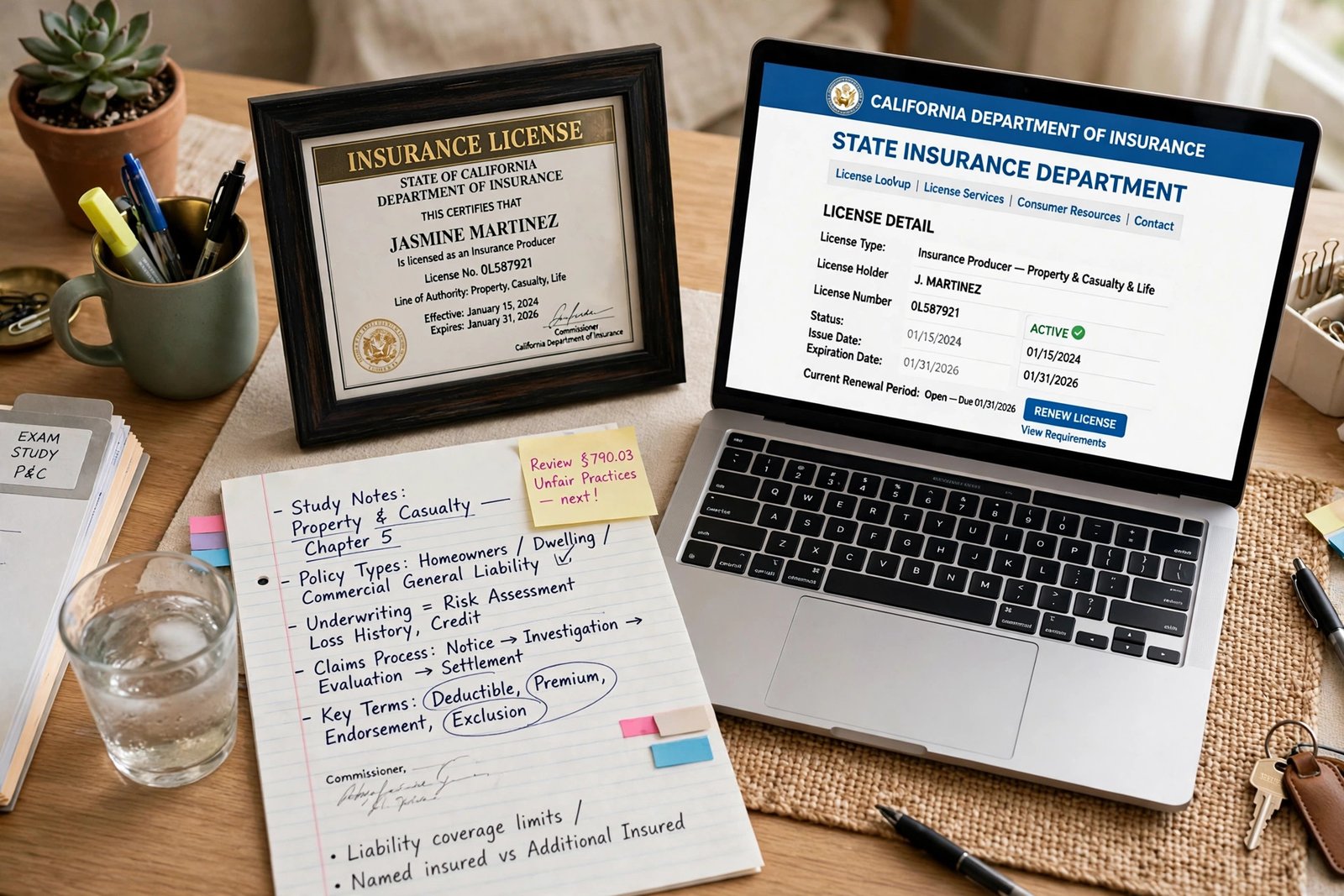
A licence is a permit from a state insurance department that says you may sell insurance or handle certain claims in that state. In the United States, insurance is regulated state by state, so there is no single national licence. The rules differ by state, and you must hold the licence for each state where you work with customers.
Sales agents and many claims adjusters need a licence. Underwriters, customer service staff, and claims processors usually do not, because they do not sell policies or settle claims on their own. Check the listing: it will say "licence required" or "licence preferred" if one is needed, and it will name the type, such as a property and casualty licence or a life and health licence.
To find your own state regulator, use the directory run by the National Association of Insurance Commissioners. The NAIC insurance departments directory gives contact details for every state insurance department, with agent search and complaint routes.
Licence checks work the same way in practice across states. For example, the Massachusetts Division of Insurance explains that state insurance departments run online licence verification for producers, agencies, adjusters, and brokers, so an employer can check your licence online before it hires you. See the Massachusetts Division of Insurance page on finding licensees for how that check looks. Legal roles follow a similar licence model. Our guide on how to find remote legal jobs shows how that check works in another licensed field.
The usual route to a licence has four steps. First, complete a pre licensing course, which many states require. Second, pass the state exam, a multiple choice test on insurance law and the type of cover you will sell. Third, apply to the state insurance department and pass a background check. Fourth, renew the licence on schedule and complete continuing education, which most states require every two years. The fees differ by state, so check your state insurance department for the current figures before you pay anything.
Step 1: Choose your role and work pattern
Before you search, choose one role and one work pattern. A focused search always beats a scattered one.
Pick your role from the table above, based on whether you hold a licence, whether you like talking to customers, and whether you prefer numbers or people. If you have no licence and no experience, start with customer service or claims processing. If you have sales experience and you are willing to study for a licence, sales agent roles often include training.
Then choose your work pattern. Full time roles give the steadiest income and the most training. Part time roles suit people who study or care for family, but they are fewer in number. Entry level roles with training provided are the best fit for beginners: the employer teaches you the systems and often pays for your licence exam. Search for the phrase "training provided" alongside the job title to find them.
Write your choice down in one sentence, such as "I am looking for a full time remote customer service role in insurance, with training provided." Use that sentence as the test for every listing you read. If the listing does not match it, skip it.
Step 2: Build your employer list
Large insurers hire remote staff in bulk, and they list the roles on their own career pages. Build a list of 15 to 20 employers, then watch those pages every week.
Start with the big names that are known for remote insurance work. FlexJobs lists fifteen companies hiring for remote insurance jobs, with two recent remote roles named for each employer, and its list is a useful starting point for your own list. Include insurers, brokers, and claims firms that hire in your state. For each employer, note the careers page link, the roles it hires remotely, and the states it hires from.
Also include smaller employers. Regional insurers, managing general agents, and insurance technology firms often hire remotely and receive fewer applications than the big names. Search for "remote insurance" plus your state name to find them.
Do not apply to a company you have not checked. A real insurer has a real website, a careers page, a physical head office address, and a listing on its state insurance department register. If you cannot find those, move on.
Step 3: How to find remote insurance jobs on the right boards
Job boards work well for insurance roles, but only if you search with the exact job title. The title employers use is often narrower than the word "insurance".
Try these searches: "remote claims adjuster", "remote underwriter", "remote insurance sales agent", "remote insurance customer service", "work from home insurance", and "remote insurance broker". Add your state to the search when the role needs a licence, because many insurers only hire licensed staff in certain states.
Use the filters on every board. Set the job type to full time or part time, set the date to the last seven days, and set the location to "remote". Then read the first line of each listing for the licence note and the states it covers. If the listing does not state the states, treat that as a small warning sign and check the employer before you apply.
Save your best searches on each board so you can repeat them in one click each week.
Step 4: Apply direct on company career pages and set up alerts
The best remote insurance jobs often appear on a company careers page before they reach a job board. That is why your employer list from Step 2 matters. Visit each careers page once a week, and set up a job alert on each one that offers alerts.
Set up alerts with the exact job title you chose in Step 1, not with the word "insurance" on its own. An alert for "remote claims adjuster" sends useful roles, while an alert for "insurance" sends every insurance job the company posts.
When you find a role on a company page, apply there, not through a third party site. Direct applications reach the hiring team faster. Save the job description, because listings close and change, and you will want the original wording when you prepare for interview.
Step 5: Prepare your CV and interview answers for insurance roles
Insurance employers hire for trust, accuracy, and clear communication, so your CV and interview answers should show all three.
On your CV, put your licence at the top if you hold one, with the state and the type. Then list the skills that matter for the role: clear phone manner, accurate data entry, knowledge of policy types, and any software you have used, such as a claims system or a customer database. If you have no insurance experience, list transferable experience instead: retail, call centre work, admin, or any job where you handled money, solved problems, or followed strict rules. Use honest numbers where you can, such as the number of customers you helped each day.
For interviews, prepare short answers to the questions insurers ask most. How would you explain a policy exclusion to an upset customer? How would you handle a claim where the documents do not match? Answer with a clear structure: what you would check first, what you would say to the customer, and what you would record. Employers want to hear that you stay calm, follow the rules, and write everything down.
Read our guide on how to write a CV for remote jobs for the full CV structure, and our guide on how to pass a remote job interview for interview preparation.
How to check a listing and an employer before you apply
Check every listing against this list before you apply. It takes two minutes, and it saves you from wasted applications and scams.
- The listing names a real insurer or broker, with a real website and a careers page.
- The listing states the licence needed, or says clearly that no licence is needed.
- The listing states the states or countries it hires from.
- The job description names the duties, the systems, and the shift pattern in detail.
- The pay is stated as a salary range or an hourly rate, or the listing says pay is discussed at interview. A listing that hides pay and promises high income is a warning sign.
- The application goes through the company careers page or a known board, not through a personal email address or a messaging app.
- No fee is charged at any stage. No real insurer charges you to apply, to train, or to receive equipment.
If a listing fails two or more of these checks, skip it and move on.
Worked example: a six week plan from beginner to first applications
Example only: these numbers are not typical results. They show the shape of a plan, not what you should expect to earn or how fast you will be hired.
Imagine you have no insurance experience and no licence, and you want a remote customer service role. Your six week plan could look like this.
Week 1 and 2: Learn the basics: the main policy types, such as car, home, life, and health cover, and the words insurers use, such as premium, excess, claim, and exclusion. Build your employer list of 15 companies.
Week 3 and 4: Rewrite your CV for customer service work, set up job alerts, and apply for 10 customer service roles. Track each one in a spreadsheet with the date, the role, and the link.
Week 5: Apply for 10 more roles, and ask two employers that offer training whether they sponsor a licence. If a sales role interests you, start the pre licensing course for your state.
Week 6: Follow up on the Week 3 applications, keep applying, and review your tracker. If you have had no replies, rewrite the top of your CV, or widen your search to claims processing roles.
That is 20 applications in a month, plus study, with a review at the end. The number matters less than the routine. A steady weekly plan beats a single weekend of rushed applications.
What it costs and what to expect
Finding remote insurance work costs little in cash, but it costs real time. Budget for both.
Most of the cost is your time. Expect to spend two to three hours a day on the search: reading listings, tailoring applications, and following up. A focused search of four to eight weeks is normal, and longer is normal for a first role. No one can promise you a job in a set number of weeks.
Cash costs are small but real. A licence exam and a pre licensing course cost money, and the amounts differ by state, so check your state insurance department for the current figures before you pay. Some employers pay for your licence once they hire you, so ask about this at interview. Do not pay a recruiter or a training company that promises you a job, because no training can promise that.
Pay varies widely by role, state, and experience. Sales roles often pay a base salary plus commission, so income varies with results. Claims and underwriting roles usually pay a fixed salary, and customer service roles usually pay an hourly rate. Compare the whole package, and check the live listing for the pay range before you apply.
Common mistakes
- Applying for sales roles that need a licence before you have one, instead of starting with roles that accept beginners.
- Ignoring the states listed in the job description, then finding out too late that you cannot work from your state.
- Sending the same generic CV to every employer, with no mention of insurance knowledge or customer service skills.
- Trusting a listing because it says "remote" in the title, without checking whether the role is truly remote.
- Paying for a course or a recruiter that promises a guaranteed remote insurance job.
- Stopping your search after one week of no replies, instead of keeping a steady weekly routine.
Risks and scams to watch for
Remote insurance jobs attract scams because the work sounds stable and the pay sounds good. The most common scam is a fake recruiter who offers you a role quickly, then asks for a fee for training, equipment, or a background check. Real insurers never ask you to pay to start work.
Another scam asks for your bank details, passport scan, or full address before any interview. Give personal documents only after a real interview, and only to a verified employer. A third trick is a "job" that asks you to move money or buy gift cards for a client. That is not insurance work, and it can be part of a fraud scheme.
Read our guide on how to spot online job scams before you apply for any remote role. If a listing feels wrong, trust that feeling and move on.
Frequently asked questions
Do I need a licence for remote insurance jobs?
It depends on the role. Sales agents and many claims adjusters need a state licence, usually a producer licence. Underwriters, customer service staff, and claims processors usually do not. The listing should say which licence it needs, so read it before you apply.
What insurance companies work fully remote?
Large insurers, brokers, and claims firms hire remote staff, and many list remote roles on their own career pages. Build a list of 15 to 20 employers and check their career pages each week, because the list changes as companies open and close remote teams. Do not trust a list that names no employer at all.
Is it hard to get a remote insurance job?
It is competitive, but entry level roles with training provided are the easiest way in. Customer service and claims processing accept beginners, while sales and adjuster roles usually need a licence first.
How much do remote insurance jobs pay?
Pay varies by role, state, and experience, so there is no single figure. Sales roles often pay a base salary plus commission, claims and underwriting roles usually pay a fixed salary, and customer service roles usually pay an hourly rate. Check the live listing before you apply.
What is the least stressful job in insurance?
No insurance job is free of stress, because every role involves rules, deadlines, and customers. Claims processing and customer service are often calmer than sales, because they have no sales targets. Choose the role that fits your strengths, not only the one that sounds easiest.
Can I get a remote insurance job with no experience?
Yes, in customer service and claims processing roles, which often include training. Show transferable skills from retail, call centre, or admin work, such as clear communication and accurate data entry. A licence is not needed for these roles, so you can start now and study for one later.
Conclusion
You now know how to find remote insurance jobs in 2026: choose one role that fits your licence and experience, build a list of employers that hire remotely, search with exact job titles, and apply direct on company career pages. Check the licence rules for your state before you apply, and check every listing against the real or fake test.
Next, read how to find remote finance jobs, how to get a remote customer service job, and how to get a remote job with no experience. Then browse all online jobs guides to plan your next step.
A note for readers outside the United States: insurance is regulated state by state in the United States, and the rules, licences, and tax treatment differ by country, so check your local regulator and tax authority before you apply. Earning results vary; nothing on this site is financial advice.