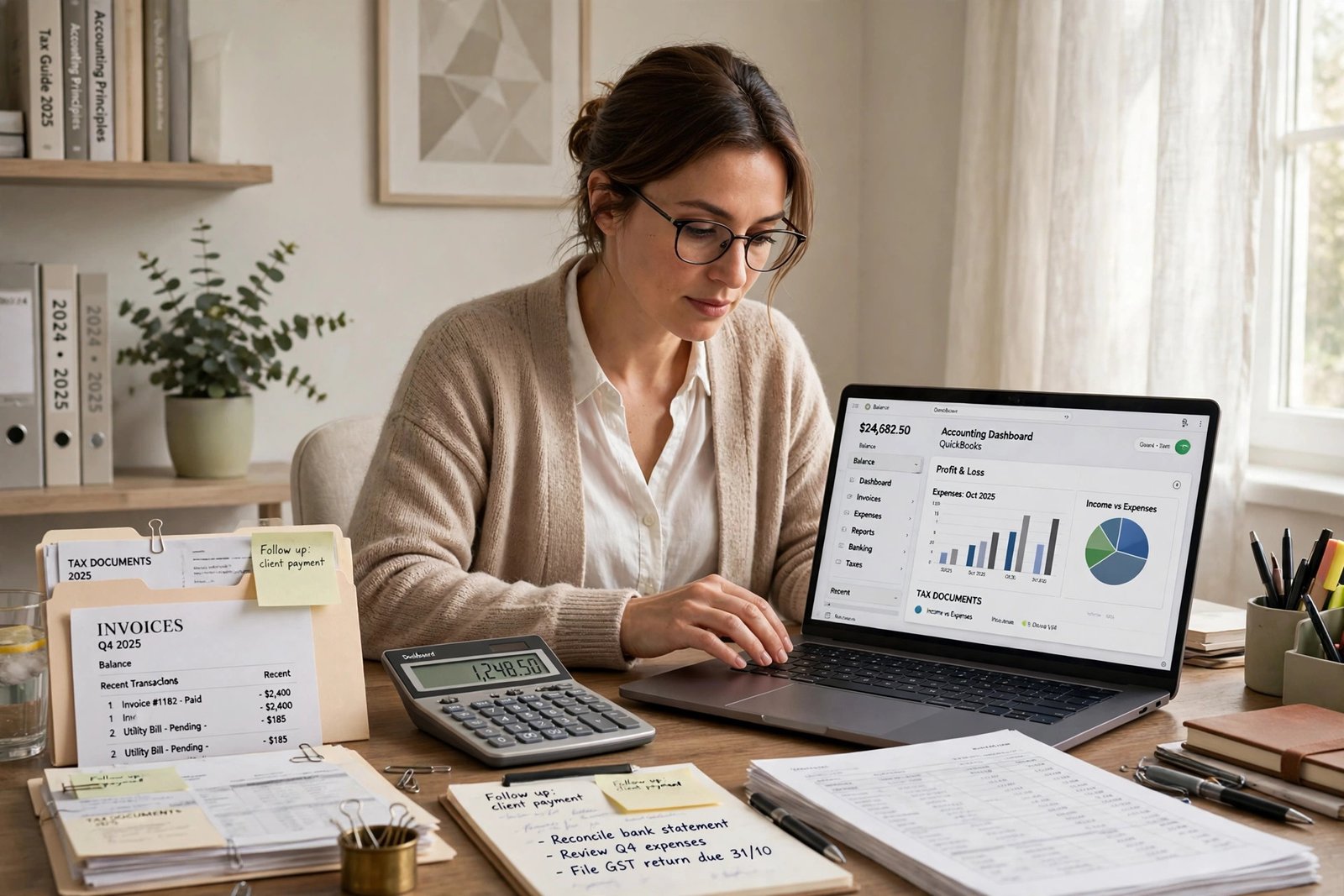
If you want to learn how to work as a remote accountant, start with two facts. First, an accountant is not a bookkeeper, and the two roles need different qualifications. Second, you can work as a remote accountant in two ways: as an employee of a firm or a company, or as a freelancer with your own clients. This guide covers both routes, the qualifications you need, the tools you will use, and a step by step plan to find real roles. It is written for accountants, accounting students, and bookkeepers who want to move up.
In this guide
- What a remote accountant does
- Accountant versus bookkeeper: which role fits you
- Qualifications and skills you need
- Route A: Find an employed remote accountant job
- Route B: Build a freelance remote accounting practice
- How to work as a remote accountant: your first 90 days
- Tools every remote accountant uses
- Handling tax season remotely
- Data security and client confidentiality
- What it costs and what to expect
- Common mistakes
- Risks and scams to watch for
- Frequently asked questions
What a remote accountant does
A remote accountant does the same work as an office accountant, but from home, using cloud software and video calls instead of paper files and face to face meetings. The work is wider than data entry. It covers reporting, tax, and advice.
| Role | Main duties | Who hires |
|---|---|---|
| Staff accountant | Month end close, reconciliations, journals, financial reports | Firms and company finance teams |
| Tax accountant | Tax returns, tax planning, filing deadlines, client advice | Accounting firms and tax practices |
| Management accountant | Budgets, forecasts, cost reports, advice to managers | Companies of all sizes |
| Audit support accountant | Preparing audit files, answering auditor questions, testing controls | Firms and company finance teams |
| Payroll accountant | Running payroll, tax withholding, pension and benefits admin | Companies and payroll providers |
| Virtual CFO or controller | Oversight of a small company finance function, reporting to owners | Small businesses and startups |
Most remote accountant jobs are employed roles in firms or company finance teams. Freelance accountants usually serve several small business clients at once. Both routes need the same core skills: accuracy, clear communication, and comfort with cloud tools.
Accountant versus bookkeeper: which role fits you
Readers often confuse these two roles, so here is the plain difference. A bookkeeper records what happened: invoices, receipts, bank transactions, and reconciliations. An accountant uses those records to prepare financial reports, file tax returns, give advice, and help a business plan ahead. Bookkeeping is transaction recording and reconciliation, usually without a degree. Accounting is a degree level role covering financial reporting, tax, audit support, and advisory work.
| Point | Bookkeeper | Accountant |
|---|---|---|
| Main work | Recording transactions and reconciling accounts | Reporting, tax, audit support, and advice |
| Qualification | Often no degree; short courses and software certificates | Degree, plus ACCA, CPA, or CIMA for senior roles |
| Clients | Small businesses that need clean records | Businesses that need reports, tax, and advice |
| Pay | Lower, because the work is more routine | Higher, because the work needs judgement |
| Remote work | Very common, often freelance | Common, employed and freelance |
If you already work as a bookkeeper and you want to move up, read our guide on how to work as a remote bookkeeper to see how that role works, then study for an accounting qualification. If you already hold a degree or a professional qualification, aim straight for accountant roles.
Qualifications and skills you need
You do not need every qualification to start, but you do need to know which one fits the role you want.
A degree in accounting or finance is the usual starting point for employed accountant roles. After the degree, the professional qualifications that employers ask for are ACCA (Association of Chartered Certified Accountants), CPA (Certified Public Accountant, mainly in the United States), and CIMA (Chartered Institute of Management Accountants, mainly for management accounting). AAT (Association of Accounting Technicians) is a respected technician level qualification, and it suits people who want to work in accounting without a full degree. The right choice depends on your country and the role you want, so check the job listings in your country before you enrol.
Beyond qualifications, employers test practical skills: cloud accounting software, spreadsheets, clear written communication, and the habit of checking your own work. They also test how you work remotely: can you manage your own deadlines, report progress without being asked, and keep client data safe? Give one example of each in your application.
For QuickBooks users, the ProAdvisor programme is worth knowing. The Intuit ProAdvisor Program offers training and certifications through the ProAdvisor Academy, badges for directories and profiles, and free QuickBooks Online Advanced and Workforce Elite for members. A secondary guide confirms the ProAdvisor exam is free through a free QuickBooks Online Accountant account, with annual recertification and a Find-a-ProAdvisor directory listing. See the Akadian ProAdvisor guide for the detail, and prefer the Intuit page for the facts. A ProAdvisor badge does not guarantee clients, but it shows you know the software.
Route A: Find an employed remote accountant job
Employed roles are the best fit for most people, because they give a steady salary, paid leave, training, and a team to learn from. Here is how to find them.
Search with exact job titles: "remote staff accountant", "remote tax accountant", "remote management accountant", "remote payroll accountant", and "remote senior accountant". Add the word "remote" to the location field, and set the date filter to the last seven days. Use general boards, accounting job boards, and the career pages of accounting firms.
Build a target list of 20 employers: accounting firms with remote teams, companies with remote finance teams, and payroll and bookkeeping providers that hire accountants. Visit each careers page once a week, and set up job alerts with the exact job title.
Apply direct on the company careers page, not through a third party site. Tailor your CV for each role: put your qualification at the top, list the software you know, and give one honest number, such as the number of client files you handled or the size of the month end close you worked on. Read our guide on how to write a CV for remote jobs for the full CV structure, and our guide on how to pass a remote job interview for interview preparation.
Expect a technical test. Many firms ask you to prepare a short set of accounts, find errors in a trial balance, or answer tax questions in a timed test. Practise with past exam questions or a sample set of accounts before you apply, so the test does not surprise you.
Route B: Build a freelance remote accounting practice
Freelance accounting suits experienced accountants who want to choose their clients and set their own hours. It also means running a small business, with admin, tax, and marketing on top of the accounting work.
Start with a niche: one type of client, such as small online shops, freelancers, or restaurants, and one service, such as monthly bookkeeping plus tax returns. A clear niche makes your profile, your prices, and your marketing far easier to write.
Find clients through marketplaces, LinkedIn, and referrals. List your services on freelance platforms, keep your LinkedIn profile clear about the niche and the software you use, and ask every happy client for a referral. Price by the month for regular work, such as a fixed monthly fee for bookkeeping and reports, and by the project for one off work, such as a tax return. Check what other accountants in your country charge for the same work, and do not price below the market to win work, because it is hard to raise prices later.
Set up the business properly. Register the business, open a separate bank account, use accounting software for your own books, and get professional liability insurance if your country requires it or your clients ask for it. Read our guide on how to start freelancing for the general steps. Tax rules differ by country, so check your local tax authority or a qualified accountant before you set your prices.
How to work as a remote accountant: your first 90 days
Whether you choose the employed route or the freelance route, your first 90 days follow the same shape.
Days 1 to 30: Learn and prepare. List your qualifications, learn the cloud tools on your target list, rewrite your CV, and build your target employer list of 20 companies. If you are going freelance, set up the business, the bank account, and a simple website or profile page.
Days 31 to 60: Apply and reach out. Apply for 10 employed roles, or contact 10 potential freelance clients, and track each one in a spreadsheet. Join one accounting community online, and ask one question a week, so people start to know your name.
Days 61 to 90: Follow up and review. Follow up on every application and every client contact, keep applying, and review your tracker. If you have had no replies, change one thing: rewrite the top of your CV, widen your target list, or narrow your freelance niche.
Tools every remote accountant uses
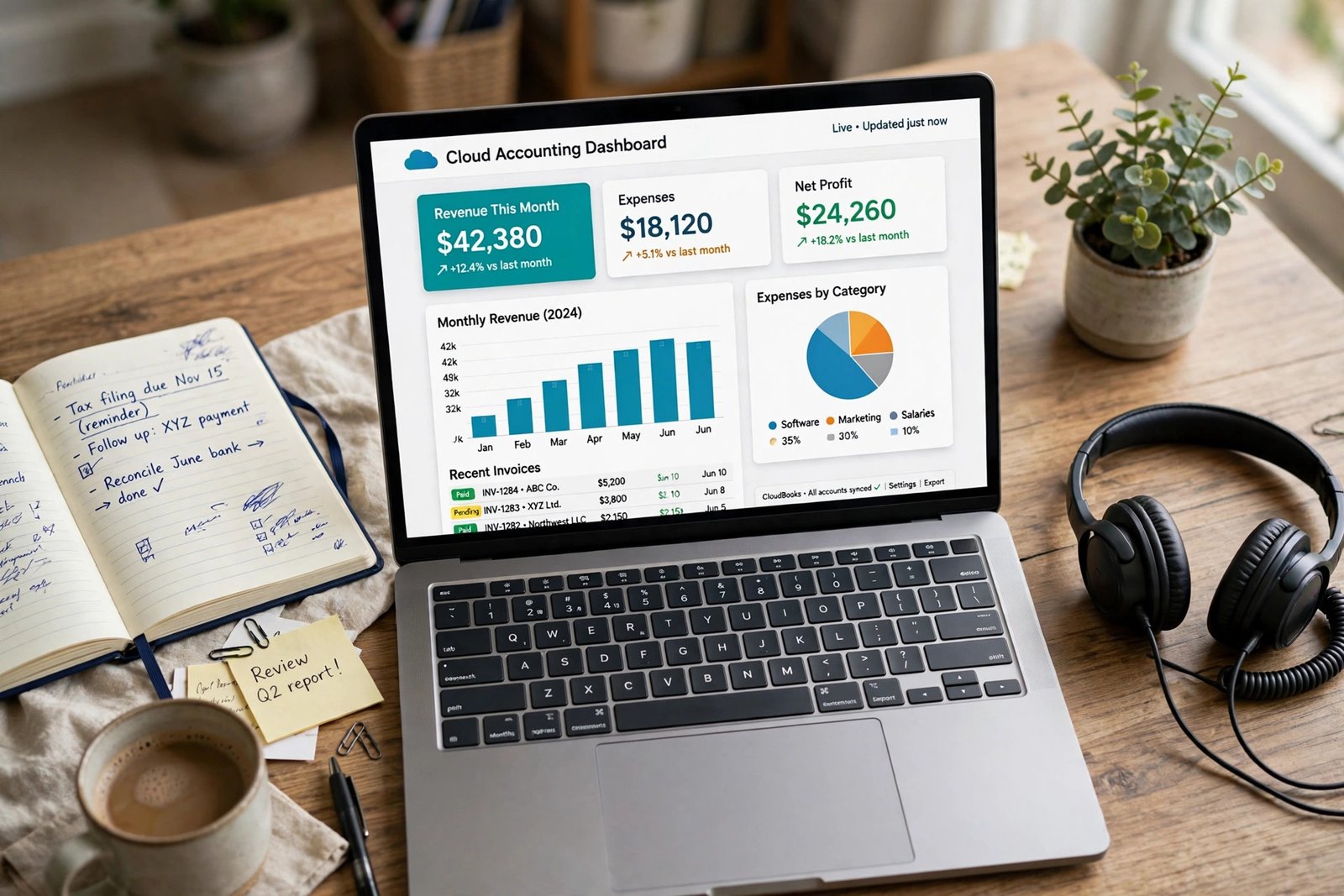
Remote accountants work in the cloud, so the tools matter. Learn the ones your target employers use, and say so on your CV.
| Purpose | Common tools |
|---|---|
| Cloud accounting | QuickBooks Online, Xero, Sage, FreshBooks |
| Spreadsheets | Microsoft Excel, Google Sheets |
| Tax preparation | Country specific tax software, such as TurboTax or TaxCalc |
| Document sharing | Google Drive, SharePoint, Dropbox |
| Video meetings | Zoom, Microsoft Teams, Google Meet |
| Practice management | Karbon, Pixie, Canopy, or a simple task tracker |
| Communication | Slack, email, and client portals |
| Security | Password manager, two factor authentication, VPN |
You do not need to know them all. Know one cloud accounting system well, one spreadsheet tool well, and the security habits below. Employers will train you on their own stack.
Handling tax season remotely
Tax season is the busiest time for most accountants, and it works differently when you are remote. Plan for it before it starts.
Agree deadlines with every client in writing, and collect documents early, because clients are slower to send files when no one chases them in person. Use a shared checklist for each client, so you can see at a glance which documents are missing. Block your calendar for deep work, and tell clients your response times, so a quick question does not break your focus all day.
If you are employed, ask your manager how the team handles overtime and time off in lieu during tax season, before you accept the role. If you are freelance, tell clients your tax season capacity in advance, and do not take on more returns than you can finish well. A late or rushed tax return costs far more than a declined client.
Data security and client confidentiality
Remote accountants handle bank details, tax numbers, and payroll data, so security is part of the job, not an extra.
- Use a password manager, and never reuse a password across client systems.
- Turn on two factor authentication on every account that offers it.
- Work on a private network, and use a VPN on public wifi.
- Lock your screen whenever you leave your desk, even at home.
- Store client files only in the approved system, never on a personal drive or a USB stick.
- Delete files securely when the work is done, following the firm's retention policy.
- Report a suspected breach at once, to your manager or the client, even if you are not sure.
If a client asks you to send sensitive files by plain email or a messaging app, say no politely and offer the secure portal instead. A client who insists on insecure methods is a client to avoid.
What it costs and what to expect
Working as a remote accountant costs little in cash, but it costs real time and study. Budget for both.
Most of the cost is study. A degree takes years, and a professional qualification such as ACCA or CPA takes months to years of study and exams. Exam fees, study materials, and annual membership fees differ by country and by body, so check the official site for the current figures before you enrol. Shorter steps, such as a ProAdvisor certificate or an AAT level, cost less and take less time, and they suit people who want to start earning sooner.
Cash costs for the job search itself are small: a home office setup, a reliable internet connection, and the software you need. Most employers provide the accounting software and the licences you need. If you go freelance, budget for business registration, insurance, and your own software subscriptions, and check the current prices before you commit.
Pay varies widely by role, country, and experience. Employed staff accountants usually earn less than tax accountants and controllers, and freelance income varies month to month, because it depends on how many clients you hold. Compare the whole package, including paid leave, training, and pension, and check the live listing for the pay range before you apply. No one can promise you a salary figure, and anyone who does is not being honest.
Common mistakes
- Confusing bookkeeping with accounting, then applying for roles you are not qualified for.
- Listing qualifications you have not finished, instead of stating clearly what you hold and what you are studying for.
- Sending a CV with no mention of cloud tools, then failing the practical test.
- Applying only on big job boards and never checking accounting firm career pages directly.
- Taking on too many freelance clients at once, then missing deadlines in tax season.
- Storing client files on a personal drive or sending them by plain email.
- Pricing freelance work below the market to win clients, then struggling to raise prices later.
- Stopping your search after one week of no replies, instead of keeping a steady weekly routine.
Risks and scams to watch for
Remote accounting jobs attract scams because the work sounds professional and the pay sounds good. The most common scam is a fake recruiter who offers you a role quickly, then asks for a fee for training, equipment, or a background check. Real employers never ask you to pay to start work.
Another scam asks for your bank details, passport scan, or full address before any interview. Give personal documents only after a real interview, and only to a verified employer. A third trick is a "job" that asks you to move money, receive payments, or process transactions for a client outside any accounting system. That is not accounting work, and it can be part of a fraud scheme. Never move money for a client except through the proper accounting and banking systems, with written instructions.
If a listing feels wrong, trust that feeling and move on. The scams guide linked in the conclusion below lists the warning signs and shows where to report a scam in your country.
Frequently asked questions
Do you need to be a CPA to work as a remote accountant?
No, not for every role. A CPA is mainly needed in the United States for senior and regulated roles. Many remote accountant jobs accept a degree plus experience, or a qualification such as ACCA, CIMA, or AAT. Check the listing for the qualification it asks for, and apply for the roles that match what you hold.
Is it possible to work remotely as an accountant?
Yes. Cloud accounting software, video meetings, and secure document sharing mean most accounting work can be done from home. Firms and companies hire remote staff accountants, tax accountants, and management accountants, and freelance accountants serve clients from anywhere. Tax season is busier, but the work itself is remote friendly.
Will AI replace accountants who work remotely?
AI is changing the work, not ending it. Software now handles routine data entry and reconciliations, so accountants spend more time on judgement, advice, and talking to clients. The accountants most at risk are those who only do routine entry. Learn the advisory side, such as tax planning and management reporting, and your skills stay in demand.
How do remote accountants handle tax season?
They plan early, agree deadlines in writing, collect documents before the rush, and use shared checklists for each client. Employed accountants should ask about overtime and time off in lieu before accepting a role. Freelance accountants should tell clients their capacity in advance, and not take on more returns than they can finish well.
What qualifications do I need to be a remote accountant?
A degree in accounting or finance is the usual starting point, plus a professional qualification such as ACCA, CPA, or CIMA for senior roles. AAT suits people who want a technician level qualification without a full degree. Check the job listings in your country, because the qualification employers ask for differs by country and by role.
Can I work as a remote accountant with no experience?
It is harder, but it is possible in junior roles, such as accounts assistant or junior staff accountant, especially if you hold a degree or you are studying for a qualification. Start with those roles, learn the cloud tools, and move into senior remote work over time. A bookkeeping role can also be a first step, if you keep studying alongside it.
Conclusion
To learn how to work as a remote accountant in 2026, know the difference between accounting and bookkeeping, hold or study for the qualification your target roles ask for, learn one cloud accounting system well, and choose your route: an employed role with a firm or a company, or a freelance practice with your own clients. Build a target list of 20 employers, apply direct, and keep a steady weekly routine.
Next, read how to find remote finance jobs, how to work as a remote bookkeeper, and how to spot online job scams. Then browse all online jobs guides to plan your next step.
A note for readers outside the United States and the United Kingdom: qualifications, tax rules, and licensing differ by country, so check your local professional body and tax authority before you apply. Earning results vary; nothing on this site is financial advice.