A CV for a remote job has one extra job beyond a normal CV: it must convince a hiring manager, who may never meet you in person, that you can work well without direct supervision. That means the document must show remote skills clearly, not just list past job titles. It must show that you communicate in writing, manage your own time, use common remote tools, and deliver work on schedule. This guide covers the CV document only. It does not cover finding roles, building proof of work in depth, or interview technique, and those guides are linked where they matter. Use this guide to build one strong CV, then tailor it lightly for each role, rather than writing a new CV from scratch every time.
First, be clear about the arrangement you are applying for, because it changes what the CV should emphasise. An employee CV should emphasise reliability, teamwork, and results inside one organisation, with clear dates and responsibilities. A contractor CV should emphasise defined projects, deliverables, and outcomes, with contract lengths stated honestly. A freelancer CV, which is closer to a portfolio and client list, should emphasise services, clients, and results, and it is not the same document as an employment CV. Most remote job postings in this guide are for employment or contract work. If you are applying for freelance work instead, How to Create a Freelance Portfolio That Gets You Hired covers the portfolio side, while this guide covers the employment CV. Do not mix the two without thinking: a hiring manager for an employee role wants to see stability and teamwork, while a freelance client wants to see services and outcomes.
Start with a clear structure
A remote CV works best in this order: contact details and location, a short summary, remote skills and tools, work history with results, education and training, and a short additional section if needed. Keep the whole document to one page if you have under ten years of experience, and to two pages at most if you have more. Hiring managers often scan a CV in under a minute at first, so the top third matters most. That top third should answer three questions at once: who are you, what role are you seeking, and why are you credible for remote work? If those answers are buried on page two, many managers will not reach them.
Contact details should be simple: full name, city and country, time zone, email address, and a link to a portfolio or professional profile if you have one. Do not include a full home address, date of birth, marital status, or a photo unless the employer or country specifically asks for those details, because they are not needed for screening and can create bias. State location honestly. If a role is limited to one country or time zone, a manager needs to know at once whether you meet that requirement. If you are willing to work hours that overlap with another time zone, say so plainly, for example: based in Karachi, available for overlap with London working hours. Do not claim authorisation to work in a country unless it is true, and do not use a misleading location to pass a filter. If authorisation is a requirement, state it briefly and factually, and check the employer's official wording before you apply.
Write a summary that names remote strengths
The summary is three or four lines at the top, not a life story. It should name the role you seek, your strongest relevant skills, and one or two remote strengths with evidence. A weak summary says: hardworking team player seeking a remote opportunity. That could describe anyone, and it gives no evidence. A stronger summary says: customer support assistant with two years of inbox and chat experience, used to handling forty cases a day with written follow ups, comfortable working async across time zones. That version names the role, the channel, the volume, and the remote skill. If you are a beginner, the summary can name transferable skills and proof instead: recent graduate with strong written communication and spreadsheet skills, three practice support samples completed, seeking an entry level remote support role. That is honest, specific, and useful. For help choosing beginner roles that fit such a summary, see How to Get a Remote Job With No Experience in 2026.
Follow the summary with a short remote skills section. List skills in groups, not as a long string of buzzwords. For example: communication, clear written replies, async updates, and handover notes; tools, help desk software, spreadsheets, chat and video tools, and shared documents; work habits, time management, meeting deadlines, and working without direct supervision. Name only tools you can actually use. If a posting lists a specific tool, and you have used it, put it in this section and in a work bullet, so both a human reader and screening software can find it. If you have not used a tool, do not list it. Learn it first, or apply to roles that do not require it. A short skills section that is true beats a long one that falls apart in an interview.
Rewrite bullets with action, task, and result
Work history is where most CVs fail, because bullets describe duties instead of results. A duty bullet says: responsible for customer emails. A result bullet says: answered customer emails within one working day, resolved most cases without escalation, and kept clear notes for the next shift. The second version is stronger because it follows a simple pattern: action, task, and result. Start with a strong verb, name the task, and add a result or a scale where you can do so honestly. Scale can be a number of cases, a time saved, an error rate reduced, or a process improved. Do not invent numbers. If you do not know the exact number, use a general but honest scale, such as daily, weekly, or for a small team, or describe the outcome in words, such as fewer repeat questions after a clearer reply template.

Here are before and after rewrites for three common beginner roles. For customer support, before: handled customer queries. After: answered chat and email queries for a small support queue, used a standard reply structure, and recorded clear case notes so the next agent could continue without asking the customer to repeat details. For data entry, before: entered data into spreadsheets. After: entered and checked order data in shared spreadsheets, flagged duplicate entries for review, and kept a daily accuracy check that reduced rework. For virtual assistance, before: helped with admin tasks. After: managed a shared calendar and inbox for a small team, prepared a weekly task list, and sent a short Friday update covering completed work and open items. Notice that none of these rewrites invents a job, a client, or a metric. Each one turns a vague duty into a clear picture of how the person works, which is exactly what a remote hiring manager needs.
For beginners with no paid work history, use the same pattern for real unpaid work, study projects, or clearly labelled practice work. For example: completed three practice support samples covering delivery delays, billing questions, and angry customers, each with a clear next step and a follow up question. That bullet is honest, it shows skill, and it links to proof. Do not present practice work as client work. Label it as practice or sample work in the CV, and keep the sample itself tidy and easy to open. One strong proof link is better than a list of claimed experience that cannot be checked.
A complete annotated sample
The sample below shows how the sections fit together on one page. Read the notes in brackets as guidance, not as text to copy into your CV. Replace every line with your own true details, and remove any section that does not apply to you.
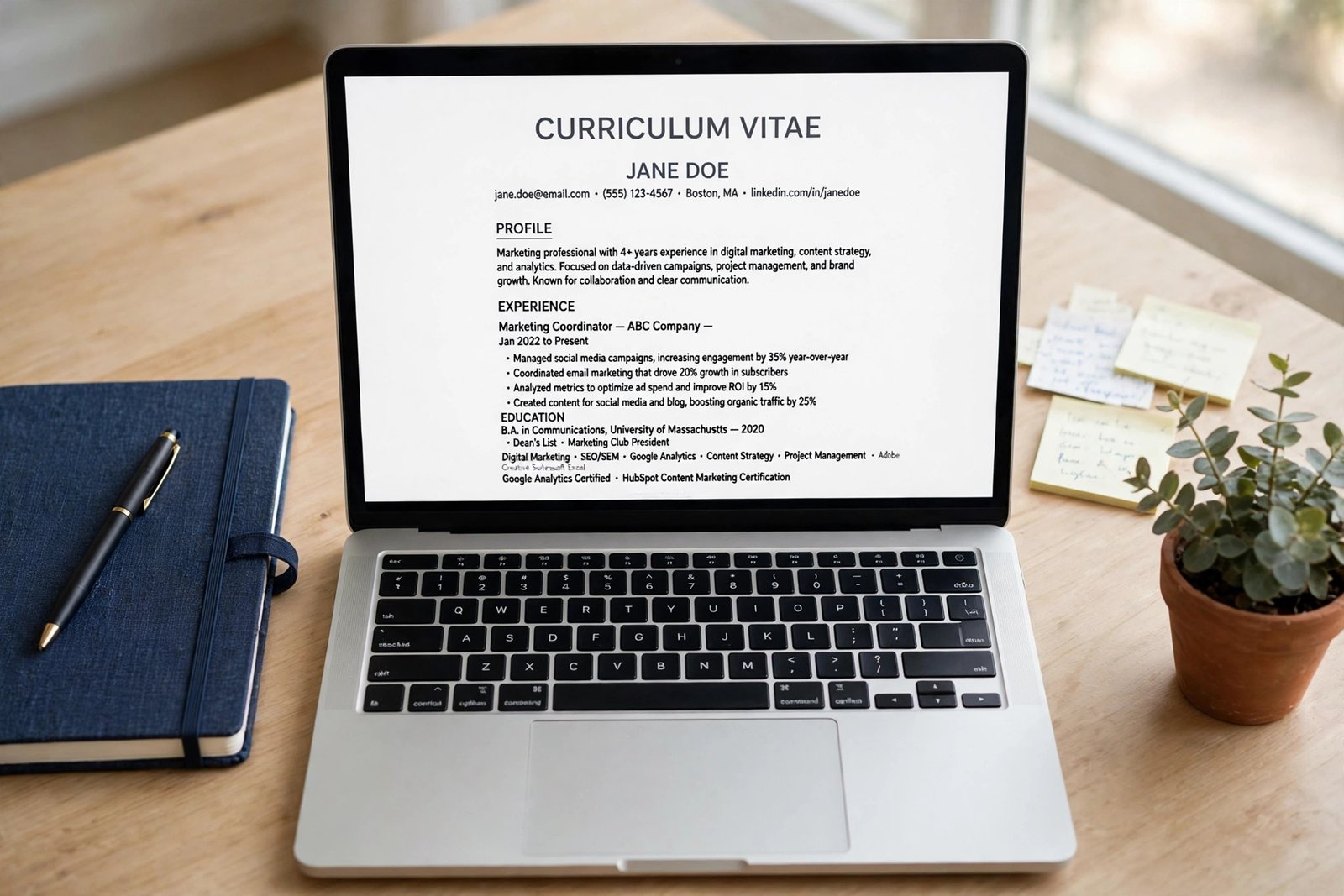
Name, city and country, time zone, email, portfolio link if any. Summary: three lines naming the role sought, key skills, and remote strengths with evidence. Remote skills: grouped skills and tools you can actually use. Work history: most recent first, with dates, employer or project type, and three or four bullets per role using action, task, and result. Education and training: most recent qualification first, plus short relevant courses with completion dates. Additional: languages, availability for time zone overlap, and work authorisation only where relevant and true.
Make the CV pass screening and format checks
Many employers use screening software to search CVs for keywords, job titles, and skills before a human reads them. Use the job title and key skills from the posting naturally, in the summary, the skills section, and a work bullet, where they are true. Use standard section headings such as Work History, Education, and Skills, because unusual headings can be missed. Save the file as a PDF unless the employer asks for another format, and use a clear file name such as Firstname-Lastname-CV.pdf. Before you send it, run a simple paste test: copy the text from the PDF and paste it into a plain text document. If the text comes out in a readable order, screening software is more likely to read it correctly. If it comes out jumbled, simplify the formatting and test again.
Common mistakes to avoid
| Mistake | Why it hurts | Fix | | A generic summary for every role | Gives no reason to choose you | Tailor three lines to the role and remote skills | | Duty bullets with no result | Hides how well you work | Use action, task, and result for each bullet | | A long list of tools you cannot use | Fails at interview or test | List only tools you can actually use | | Fancy formatting with tables and graphics | Breaks screening and phone reading | Use simple headings and plain text | | Missing location or time zone | Manager cannot check eligibility | State city, country, time zone, and overlap | | Invented experience or numbers | Destroys trust if checked | Label practice work clearly and use honest scale |
Risks and limitations
A good CV improves your chances, it does not guarantee an interview, and it cannot fix a mismatch in role, location, language, or availability. Results vary with experience, location, demand, time, competition, and the number of applicants for each role. Some employers receive hundreds of applications for one remote role, so even a strong CV may not be shortlisted. That is not a reason to inflate the CV. It is a reason to apply to roles that fit well, keep the CV honest and focused, and improve samples and targeting from any feedback you receive. Also check the current application instructions for each employer, because some ask for a specific format, a cover note, or answers to screening questions, and following those instructions matters as much as the CV itself.
Frequently asked questions
How long should a remote CV be?
One page is best if you have under ten years of experience, and two pages at most if you have more. A remote hiring manager often scans quickly, so the top third must carry the summary, remote skills, and the most relevant role. Cut older or unrelated roles to one line each, or remove them, rather than letting the CV run long.
How do I show remote experience with no remote job?
Show remote skills, not just a remote job title. Use bullets that show written communication, async updates, time management, and work without direct supervision, from in person work, study, unpaid work, or clearly labelled practice samples. Link to samples where possible, and state honestly that they are practice work.
Should a CV mention location and time zone?
Yes, briefly and honestly. State city and country, time zone, and availability for overlap with the employer's hours, if you can offer it. That helps a manager check eligibility at once. Do not claim a location or work authorisation that is not true, and do not hide location when a role is limited by country or time zone.
Conclusion
A strong remote CV is short, specific, and honest. It opens with location and a summary that names remote strengths, it shows skills in groups, it rewrites duties as actions with tasks and results, and it passes simple screening and phone checks. Your next step is to draft one page using the sample structure above, rewrite three bullets with the action, task, and result pattern, and run the paste test before you send it. Then, when replies come, use How to Pass a Remote Job Interview in 2026 to prepare for the next stage, and browse the Online Jobs category page for the finding and no experience guides that support this CV.