
If you want to learn how to find remote marketing jobs, start by choosing one specialism, because marketing is not one job. A search for "marketing" returns thousands of roles, from SEO to paid ads to social media, and most of them need different skills. This guide shows you how to pick a specialism, find the boards that list it, build a short portfolio that proves results, and apply fast. It is written for beginners and for marketers who want to move into remote work.
In this guide
- Which remote marketing roles exist
- What employers actually test
- Step 1: Pick your specialism and build a target employer list
- Step 2: Choose the right boards for your specialism
- Step 3: How to find remote marketing jobs by exact title
- Step 4: Build a short results portfolio
- Step 5: Write a CV and cover note that lead with numbers
- How to read a listing: location, time zone, contract type and pay
- Worked example: a four week portfolio project
- What it costs and what to expect
- Common mistakes
- Risks and scams to watch for
- Frequently asked questions
Which remote marketing roles exist
Marketing roles split by channel. Each specialism needs different skills, and each one hires remotely. The table below shows the main roles, what each one involves, and the skills employers ask for.
| Specialism | What it involves | Skills employers ask for | Suits whom |
|---|---|---|---|
| SEO specialist | Helping pages rank on Google, keyword research, fixing technical issues | Keyword research, Google Search Console, basic HTML | Analytical people who like research |
| Content marketer | Planning and writing articles, guides, and emails that bring in readers | Writing, editing, basic SEO, content planning | Strong writers who like research |
| Social media marketer | Running accounts, planning posts, replying to followers, tracking growth | Copywriting, scheduling tools, basic design | Creative people who like fast feedback |
| Paid media specialist | Running ads on Google and social media, managing budgets, testing | Google Ads, Meta Ads, spreadsheets, testing | People who like numbers and testing |
| Email marketer | Building lists, writing campaigns, testing subject lines, tracking opens | Email tools, copywriting, basic analytics | Organised writers who like testing |
| Product marketer | Explaining a product, writing landing pages, working with sales teams | Positioning, writing, research, presentations | People who like strategy and writing |
| Marketing manager | Planning campaigns, managing a small team, reporting on results | Planning, analytics, leadership, budgeting | Experienced marketers ready to lead |
| Growth marketer | Testing new channels, improving conversion, working across teams | Analytics, experiments, basic coding, copywriting | Curious generalists who like data |
SEO, content, and social media roles are the most open to beginners, because employers judge you on samples and small projects, not only on years of experience. Paid media and product marketing usually need more experience, because they involve budgets and strategy. Pick one specialism to start with, and add a second one later once you have proof of results.
What employers actually test
Marketing employers rarely hire on a CV alone. They test three things: can you write clearly, can you show results, and can you work without close supervision.
They test writing with a short task, such as a social post, an email, or a page outline. They test results with your portfolio, a small set of work samples with numbers attached. They test remote working with questions about how you plan your week and report progress.
You do not need a degree for most remote marketing roles. You need proof: a writing sample, a small project, or a short case study that shows what you did and what changed. Step 4 below shows how to build that proof in four weeks, even with no clients yet.
Step 1: Pick your specialism and build a target employer list
Choose one specialism from the table above, based on what you enjoy and what you can already show. If you like writing, choose content or social media. If you like numbers, choose SEO or paid media. If you are unsure, try a small project in two specialisms for one week each, then choose the one you enjoyed more.
Then build a target employer list of 20 companies: remote first companies, marketing agencies with remote teams, and software companies that sell marketing tools. For each employer, note the careers page link, the specialisms it hires, and the countries it hires from.
Follow the companies on LinkedIn and set up job alerts on their career pages. Many remote marketing jobs appear on a company page before they reach a job board.
Step 2: Choose the right boards for your specialism
Not every board lists every specialism well. Use the board that fits your role, not the biggest board you know.
| Board | Best for | Free to search | Remote only |
|---|---|---|---|
| Remote Marketing Jobs | All marketing specialisms, remote only | Yes | Yes |
| FlexJobs | All marketing roles, vetted listings | Paid subscription | Mostly |
| Marketing manager and senior roles | Yes | Filter by remote | |
| Indeed | Entry level and local remote roles | Yes | Filter by remote |
| We Work Remotely | SEO, content, and growth roles | Yes | Yes |
| AngelList (Wellfound) | Startup marketing roles | Yes | Filter by remote |
Remote Marketing Jobs is a board that lists only remote marketing roles. On the day it was checked, it showed 1,708 live jobs, with filters for job type, category, location, and salary, and a free account to see all jobs. See the Remote Marketing Jobs board to search it yourself. It is a good first stop, because every listing there is already remote.
Check the current price before you pay for any board. Free boards are enough for most searches. Never pay for a board that promises you a job, because no board can promise that.
Step 3: How to find remote marketing jobs by exact title
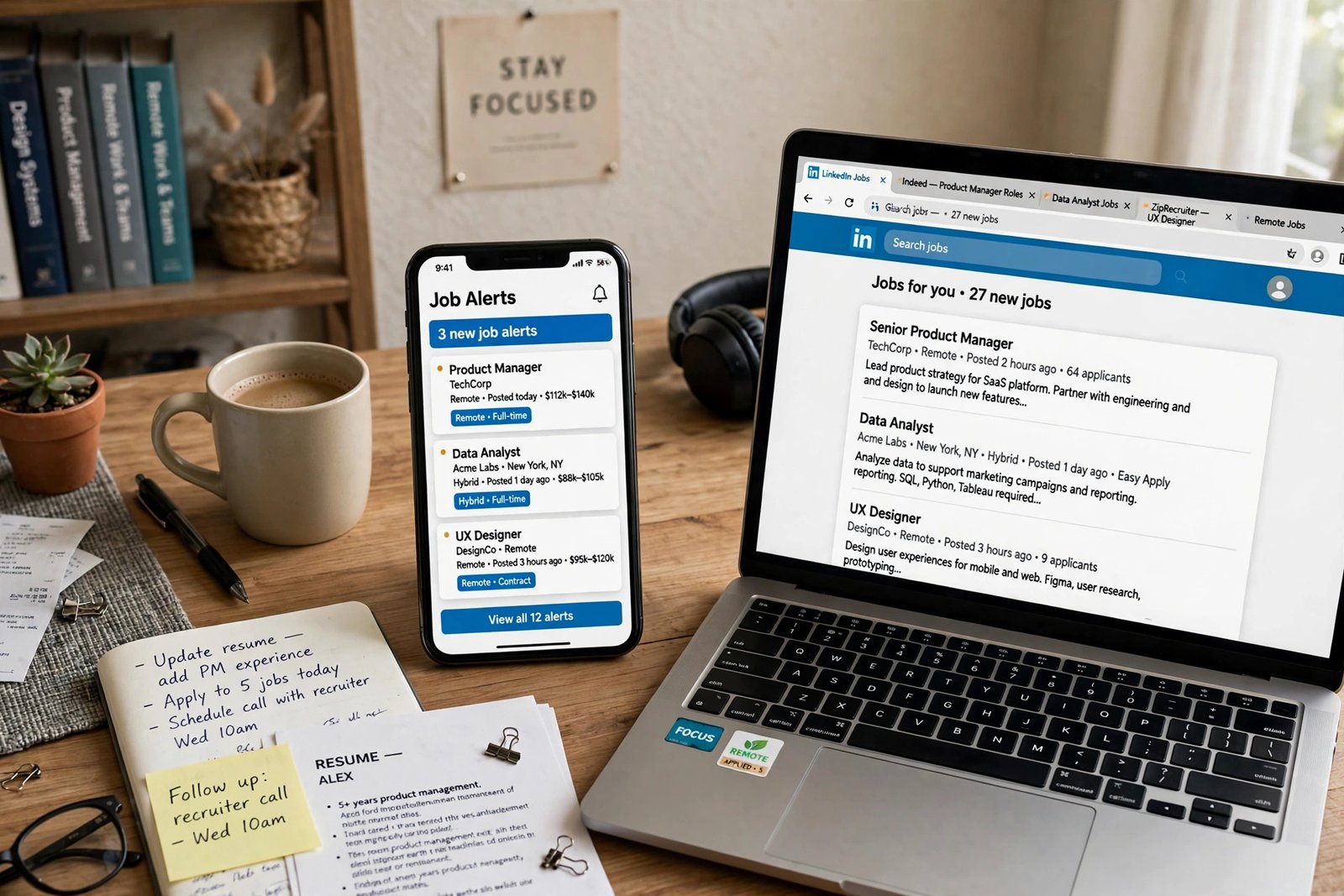
Search with the exact job title, not with the word "marketing" on its own. Try "remote SEO specialist", "remote content marketing manager", "remote social media manager", "remote PPC specialist", "remote email marketing specialist", and "remote product marketing manager". Add the word "remote" to the location field, and set the date filter to the last seven days.
Set up an alert for each exact title on two or three boards. An alert for "remote SEO specialist" sends useful roles, while an alert for "marketing" sends every marketing job on the board.
Apply within 48 hours of a role going live. Marketing roles often receive hundreds of applications, and many hiring teams read the first batch first. Keep your CV and a short cover note ready, so you can apply the same day a good role appears.
Step 4: Build a short results portfolio
A portfolio is a short set of work samples that proves you can do the job. For marketing, it is more important than a certificate, because it shows real work, not only study.
Build three pieces. First, one writing sample: an article, a landing page, or a set of social posts on a topic you know. Second, one small project: a real campaign for a local shop, a charity, or your own site, with the results recorded. Third, one case study: a one page summary with the goal, what you did, and one number that changed.
Present each piece the same way: the goal, your part, and one number. For example: "Goal: bring more visitors to a local bakery website. My part: I rewrote the home page and published four blog posts. Result: visits from Google rose over eight weeks." Keep every number honest and checkable.
If you have no clients yet, do the project for yourself or for a small business you know, with their permission. A real project with small numbers beats a fake project with big numbers.

Step 5: Write a CV and cover note that lead with numbers
Marketing CVs that list duties get ignored. Marketing CVs that lead with results get read. Put one number in the first three lines of your CV, such as the traffic you grew, the emails you sent, or the ads you managed.
Structure your CV like this. Start with a two line summary that names your specialism and one result. Then list three to five pieces of work, each with the goal, your part, and one number. Then list the tools you know, such as Google Analytics, HubSpot, or Meta Ads Manager. Keep the CV to two pages.
Write a short cover note for each application. Three short paragraphs are enough: why this role, one result that fits it, and one line about how you work remotely. Mention the company by name and one thing you noticed about its marketing.
Read our guide on how to write a CV for remote jobs for the full CV structure. When you reach interview stage, read our guide on how to pass a remote job interview. To build the skills behind the CV, read our guide on how to learn SEO for beginners or our guide on how to learn copywriting.
How to read a listing: location, time zone, contract type and pay
Read four lines in every listing before you apply. They decide whether the role fits you at all.
Location: "remote" can mean worldwide, one country only, or one state only. If the listing says "US only" and you live elsewhere, do not apply. Check the eligibility line first, because it saves you from wasted applications.
Time zone: many remote marketing teams work across time zones, but they still expect overlap. If the listing asks for four hours of overlap with US Eastern Time, check that you can work those hours.
Contract type: employed roles give a salary and benefits. Contract roles pay a daily or hourly rate and usually give no benefits. Freelance matching services, such as MarketerHire and Superpath, place freelancers, not employees, so do not confuse them with employed job boards.
Pay: many remote marketing listings now state a salary range. If the listing hides the pay, treat that as a small warning sign, not a deal breaker, and ask about the range early in the process. Never accept a role that pays only in "exposure".
Worked example: a four week portfolio project
Example only: these numbers are not typical results. They show the shape of a plan, not what you should expect to earn or how fast you will be hired.
Imagine you want a remote content marketing role and you have no portfolio yet. Your four week project could look like this.
Week 1: Pick a topic you know, such as home baking, and publish two short articles on a free blog. Learn the basics of keyword research and write each article around one clear question a reader would ask.
Week 2: Share the articles on two social channels, and write four short posts that link to them. Record the starting numbers: visits and clicks.
Week 3: Publish two more articles, reply to every comment, and update the first two articles with better titles and one internal link each.
Week 4: Write the case study. Record the goal, what you did, and the change in visits over the four weeks. Add the two best articles and the case study to your portfolio, and link to it from your CV.
That is four articles, a small social test, and one case study, all done in a month. The numbers will be small, and that is fine.
What it costs and what to expect
Finding remote marketing work costs little in cash, but it costs real time. Budget for both.
Most of the cost is your time. Expect to spend two to three hours a day on the search: reading listings, tailoring applications, and building your portfolio. A focused search of four to eight weeks is normal, and longer is normal for a first role. No one can promise you a job in a set number of weeks.
Cash costs are small. A portfolio site can be free, and most marketing tools have free plans. Certificates are optional, not required. The Google Digital Marketing and E-commerce Professional Certificate is one option beginners ask about. A review of the certificate reports seven courses and about 150 hours of study, with a cost of 49 US dollars a month on Coursera after a seven day free trial, and no prior experience needed. See the ITCareerFinder review of the Google Digital Marketing certificate for the detail. Note that this is a review site, not Google or Coursera, so check the current price on the official page before you pay. A certificate teaches skills, but it does not guarantee a job, and a portfolio with real results matters more.
Pay varies widely by specialism, country, and experience. Paid media and product marketing roles usually pay more than entry level content and social roles, because they involve budgets and strategy. Compare the whole package, and check the live listing for the pay range before you apply.
Common mistakes
- Searching for "marketing" instead of an exact job title, then drowning in irrelevant roles.
- Applying for every marketing role you see, instead of choosing one specialism.
- Sending a CV with no portfolio, no samples, and no numbers.
- Listing tools you have never used, then failing the practical test.
- Paying for a course or a board that promises a guaranteed marketing job.
- Applying a week after a role goes live, when the hiring team has already read the first batch.
- Ignoring the location and time zone lines in the listing, then finding out too late that you cannot work those hours.
- Copying a portfolio example from the internet instead of doing a real project.
Risks and scams to watch for
Remote marketing jobs attract scams because the work sounds flexible and creative. The most common scam is a "job" that asks you to buy a starter kit, pay for training, or pay a fee to join a platform. Real employers never ask you to pay to start work.
Another common scam is a listing that asks you to like and post content for pay, with no real employer behind it. These schemes pay in promises, not in money, and they can get your accounts banned. A third trick is a fake recruiter who asks for your bank details or a passport scan before any interview. Give personal documents only after a real interview, and only to a verified employer.
If a listing feels wrong, trust that feeling and move on. The scams guide linked in the conclusion below lists the warning signs and shows where to report a scam in your country.
Frequently asked questions
Can I get a remote marketing job with no experience?
Yes, in content, social media, and entry level SEO roles, which judge you on samples and small projects. Build a short portfolio with three pieces of real work, even if the numbers are small, and apply for junior roles. A certificate helps, but a portfolio matters more.
Which job boards are best for remote marketing jobs?
A marketing only board, such as Remote Marketing Jobs, is a good first stop, because every listing there is already remote. LinkedIn works well for manager and senior roles, and We Work Remotely lists SEO, content, and growth roles. Use two or three boards, and set up alerts with exact job titles.
Do remote marketing jobs state pay?
Many do now, and the number is rising. Listings that state a salary range save you time, because you can see at once whether the role fits. If a listing hides the pay, ask about the range early in the process, before you spend hours on tests and interviews.
Are remote marketing jobs full time or contract?
Both exist. Employed roles give a salary and benefits, while contract roles pay a daily or hourly rate and usually give no benefits. Freelance matching services place freelancers, not employees. Read the contract type line in the listing before you apply, so you know which one you are applying for.
Can I get a remote marketing job from outside the United States?
Yes, but not every role is open worldwide. Many listings state the countries or time zones they hire from, so read the eligibility line first. Remote first companies are more open to worldwide hires than companies that hire from one country only.
Do I need a degree for remote marketing jobs?
Usually no. Most remote marketing roles ask for skills and proof, not a degree. A portfolio with real work, a writing sample, and one honest result matters more than a qualification. Some manager roles ask for a degree, but junior and specialist roles rarely do.
Conclusion
You now know how to find remote marketing jobs in 2026: pick one specialism, build a target list of employers that hire remotely, search with exact job titles, and apply within 48 hours. Build a short portfolio with three pieces of real work, lead your CV with numbers, and read the location, time zone, and contract lines in every listing before you apply.
Marketing analytics roles overlap with data analysis work, so if numbers are your strength, also read our guide on how to find remote data analyst jobs. Next, read how to find legitimate online jobs and how to spot online job scams. Then browse all online jobs guides to plan your next step.
A note for readers outside the United States: pay, benefits, and tax treatment differ by country, so check the live listing and your local tax authority before you apply. Earning results vary; nothing on this site is financial advice.