Getting a remote job with no experience is possible, but it helps to be honest about what employers actually mean by that phrase. Very few remote jobs require literally no skills. Most beginner remote jobs require skills you can already show, even if you have never held a remote job before: clear written communication, reliable follow through, basic computer use, patience with customers, and the ability to learn a new system quickly. The task is not to invent experience. It is to choose roles that fit the skills you have, prove those skills with small visible work, and apply in a focused way until a hiring manager can see you doing the job. This guide covers entry and proof only. It does not cover CV formatting in detail, interview technique, or how to find and vet postings, and those guides are linked where they matter.
First, be clear about the arrangement you are applying for, because it changes pay, taxes, and security. An employee works for one employer with set hours and a manager, and usually receives employment protections and benefits that depend on the country and contract. A contractor is hired for a defined period or piece of work, often invoices for that work, and usually handles their own taxes and benefits. A freelancer finds their own clients and is not an employee of any client. Most beginner remote job postings are for employment or contract work, not freelance work. If a posting is vague about which one it is, check before you apply, using How to Find Legitimate Online Jobs in 2026. If you later decide freelance work suits you better, How to Find Freelance Clients in 2026 is a separate path, not a shortcut to the same roles.
Choose beginner roles that fit skills you already have
Start from skills, not from job titles alone. List the things people already ask you to do well: explain a problem clearly, stay calm with a difficult person, organise information, spot errors, write short messages, follow a process exactly, or learn a new app quickly. Then match those skills to roles. Customer support suits people who write clearly and stay patient under pressure. Data entry and operations support suit people who are accurate, consistent, and comfortable with spreadsheets and forms. Virtual assistance suits people who organise calendars, inboxes, and simple tasks well. Content moderation suits people who can follow rules consistently and handle difficult material calmly. Sales support and appointment setting suit people who are comfortable talking to strangers politely and recording details accurately. None of these roles is easy, and none is a good fit for everyone, but each one hires beginners more often than roles that require a degree, a licence, or years of specialist experience.
| Beginner role family | Core skills employers check | Proof you can build in a week | | Remote customer support | Clear writing, patience, problem solving | Three sample replies to common problems | | Data entry and operations | Accuracy, speed with care, spreadsheet basics | A cleaned sample sheet with notes | | Virtual assistance | Organisation, inbox and calendar handling | A sample weekly plan and inbox triage | | Content moderation | Rule following, consistency, calm judgement | A short moderation decision log | | Sales support | Polite outreach, accurate records | Two sample follow up messages |
Use the table to narrow your search to two role families at most. Applying to every beginner role at once looks unfocused, and it makes proof building harder, because each family needs different samples. Pick the two families where your existing skills are strongest, and where you would accept the daily work, including shift patterns and repetitive tasks. If a role family requires a skill you do not have, such as fluent written English for customer support or fast typing for data work, treat that as a training goal for two to four weeks, not as a reason to apply and hope. Honest targeting saves you from rejections that teach you nothing.
Build proof of work without a job
Proof of work is the strongest answer to the no experience problem, because it shows a hiring manager what you can do instead of asking them to trust a claim. Proof does not need to be paid work, and it must not be invented client work. Label sample work clearly as a sample, and build it from public information or invented scenarios that you state are practice examples. A customer support sample can be three short replies: one to a delivery delay, one to a billing question, and one to an angry customer, each showing empathy, a clear next step, and a question that moves the case forward. A data sample can be a small spreadsheet you clean and sort, with a short note explaining what you fixed and why. A virtual assistance sample can be a one week plan that shows how you would organise meetings, travel, and inbox priorities for a fictional manager, with the fictional nature stated clearly.
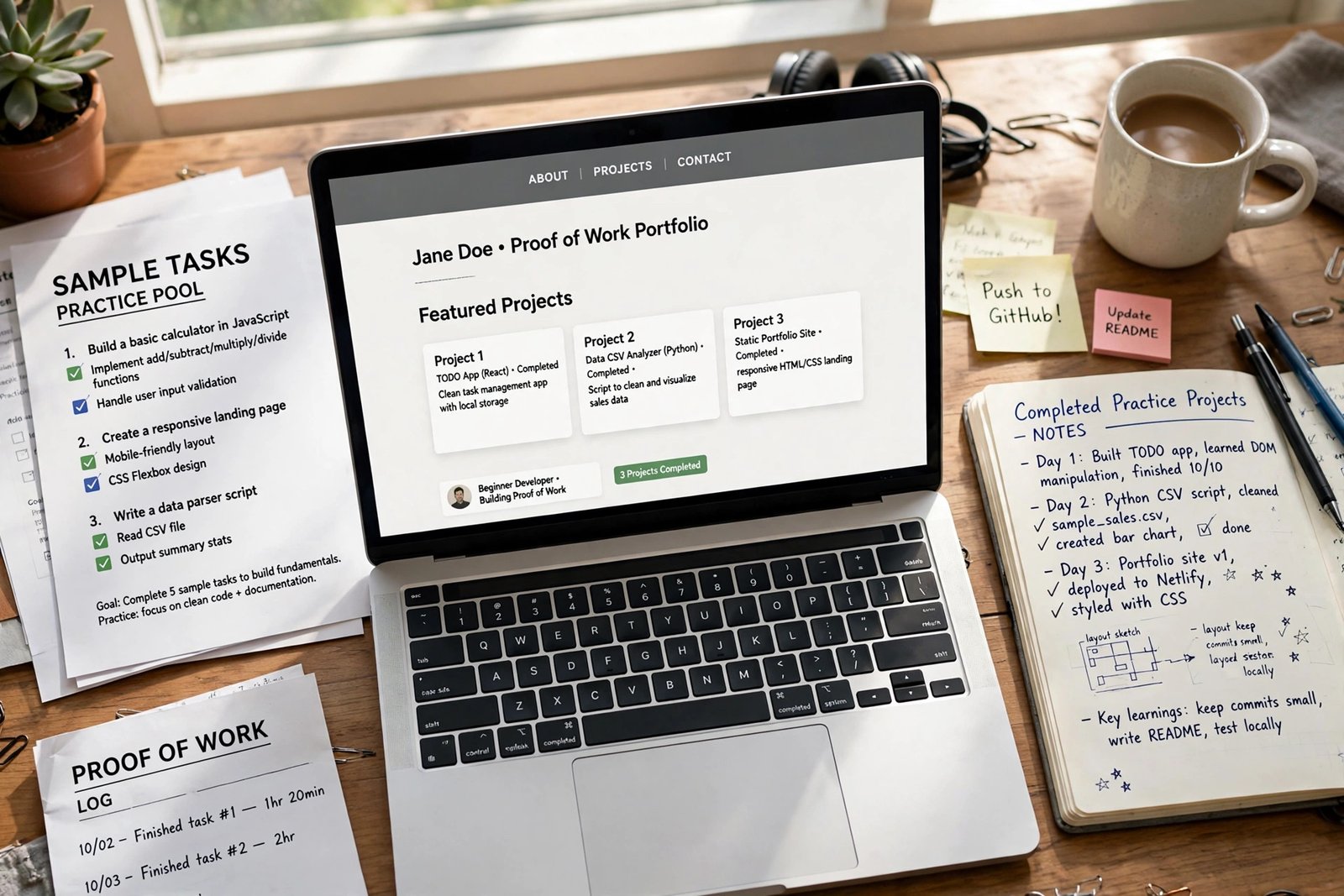
Keep proof short and tidy. Three strong samples beat ten rushed ones. Put them in one simple document or page that a hiring manager can open in under a minute, with a title, a one line description of the task, and the sample itself. Do not include personal data, real customer details, or work copied from a previous employer. If you have done unpaid work that is real, such as helping a community group, a school, or a small local business with admin, messages, or records, you can describe that honestly, with permission where needed, and explain what you did and what changed. That is real experience, even if it was not a remote job. If you have no such work yet, samples plus a short course or practice project are enough to start. Employers for beginner roles often care more about accuracy, tone, and reliability in a sample than about a long history.
Get short, role specific training
Training helps when it is short, specific, and tied to a role, and it hurts when it becomes a reason to delay applying for months. Before you enrol in anything, check the postings in your two role families and list the tools and skills they actually ask for. Common examples include help desk software, spreadsheet basics, customer relationship tools, chat and video tools, and typing accuracy. Choose one short course or tutorial series per skill gap, and finish it with a practice output you can show, such as a certificate of completion plus a sample task using that tool. A certificate alone, with no sample, is weak proof. A sample alone, with no understanding of the tool, is also weak. Together, they are credible.
Run an application system, not a spray
A good application system balances quality and volume. Pure volume, sending the same application to a hundred roles, usually produces silence, because hiring managers can tell when an application was not written for their role. Pure tailoring, spending a whole day on one application, usually produces too few chances. A workable middle is three to five tailored applications a week for six to eight weeks, with a weekly review. For each role, write a short opening that names the role and why it fits, highlight two or three skills from the posting with a brief example or sample link, and answer screening questions directly. Use How to Write a CV for Remote Jobs in 2026 for the document itself, and keep the CV to the same two role families, so every application tells a consistent story.
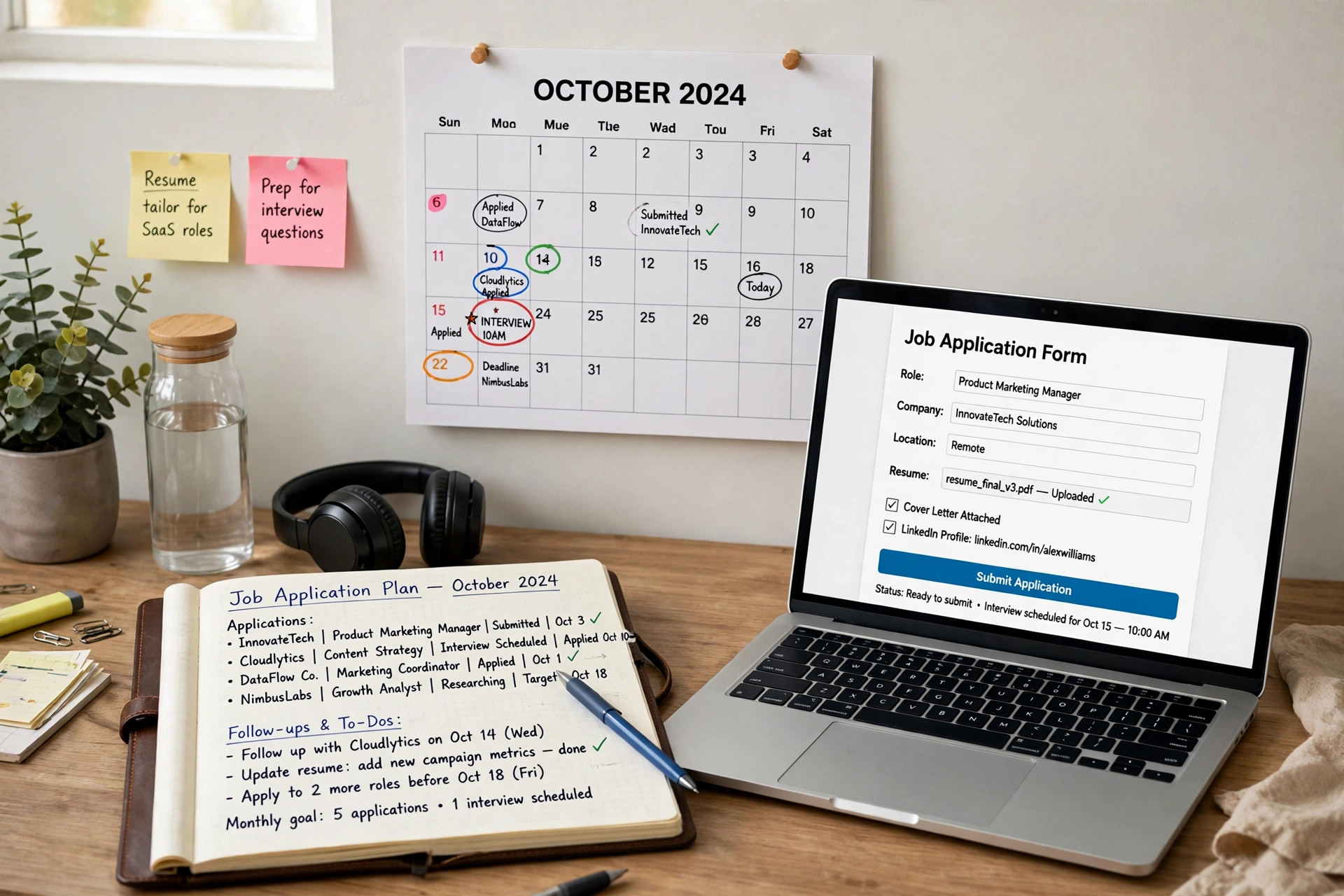
Track every application in a simple list: role, employer, date, role family, and status. After each week, look for patterns. If one role family produces replies and the other produces silence, shift more applications to the family that responds. If you get screening calls but no interviews, the issue may be availability, location, or how you describe your experience on the call, and How to Pass a Remote Job Interview in 2026 covers that next stage. If you get no replies at all after twenty strong applications, ask a trusted person to review one application and one sample, and check whether your role families, location filters, or shift availability are too narrow. Do not change everything at once. Change one thing, test it for two weeks, and keep what works. That discipline is what turns a long search into a learning process instead of a lottery.
A realistic timeline
A first remote job search usually takes weeks, not days, and sometimes takes a few months. A realistic plan is: weeks one and two, choose role families and build three samples; weeks three to six, apply to three to five roles a week and improve samples from any feedback; weeks six to ten, review patterns, adjust role families or availability, and keep applying. Some people are hired faster, especially if a role family is hiring urgently or if they already have transferable experience from in person work. Some people take longer, especially if they are limited by time zone, language requirements, or shift availability. Neither outcome means the method failed. It means the market, the role family, and your constraints differ. Keep a weekly routine you can sustain alongside other commitments, rather than a burst of applications followed by weeks of silence. If you need income sooner, consider short term local or freelance work separately, without confusing it with the remote employment search, and keep the two plans distinct.
Risks and limitations
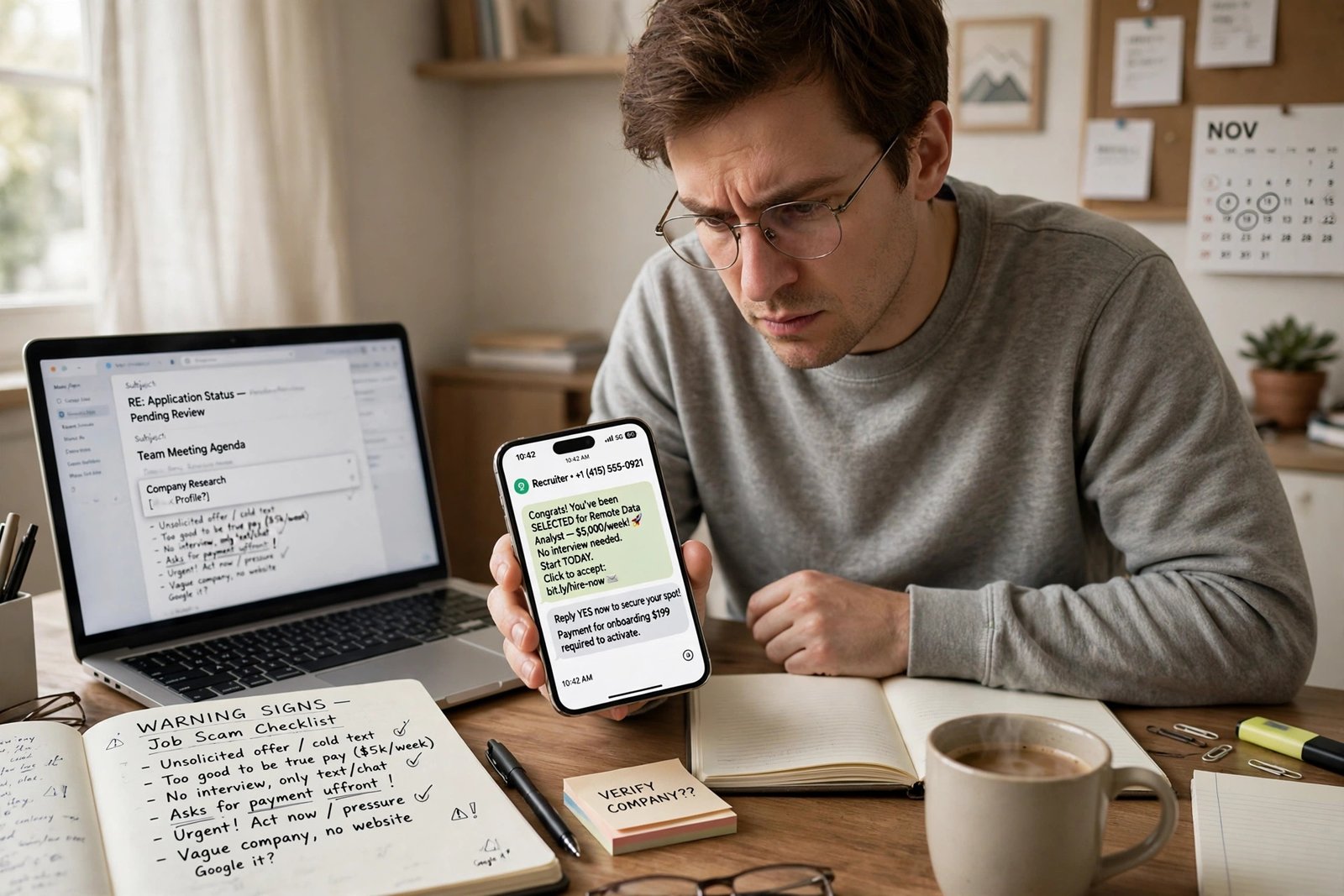
Results vary with experience, location, demand, time, competition, expenses, and platform fees. A beginner role that hires widely in one country may have few openings in another, and a role that accepts worldwide applicants will have more competition. Pay also varies widely, and you should check the pay range, hours, and employment type in each posting rather than relying on general claims about remote work. Some roles require a quiet workspace, a stable internet connection, and a suitable computer, and those costs are yours unless the employer states otherwise. Do not pay for a job, training, or equipment as a condition of hiring without checking the employer carefully, and do not share bank details or identity documents before a written offer exists. If a process asks for those things early, pause and check the scam guidance linked from the Online Jobs category page. Finally, do not present sample work as paid client work, and do not invent qualifications, because a hiring manager who discovers that will reject the application and may remember the name.
Frequently asked questions
Can I get a remote job with no experience?
Yes, for beginner roles, if you can show transferable skills and proof of work. Employers usually mean no previous remote job, not no skills at all. Choose roles that match skills you already have, build three short samples, and apply to roles in those families. You are more likely to be hired for a role you can demonstrate than for a role you only claim to want.
Should I take a course before applying?
Take short, role specific training only where postings ask for a skill you lack, and finish it with a practice output you can show. Do not delay applying for months to collect unrelated certificates. If a role requires a specific qualification or licence, meet that requirement first. Otherwise, apply while you train, and update your samples as you learn.
How long does it take to get a first remote job?
Often weeks to a few months, depending on role family, location, language, shift availability, and competition. A plan of three to five tailored applications a week for six to eight weeks, with weekly reviews, is realistic for many beginners. If there are no replies after twenty strong applications, review role fit, CV, samples, and availability, and change one thing at a time.
Conclusion
You do not need a remote job to prove you can do remote work. You need two role families that fit your skills, three short samples that show those skills clearly, short training only where a gap is real, and an application system you can sustain for weeks. Start this week by listing your transferable skills, choosing two role families, and building your first sample. Then use How to Write a CV for Remote Jobs in 2026 to present that proof well, and How to Pass a Remote Job Interview in 2026 when replies start coming. Your next step is one sample, finished and tidy, before your next five applications.