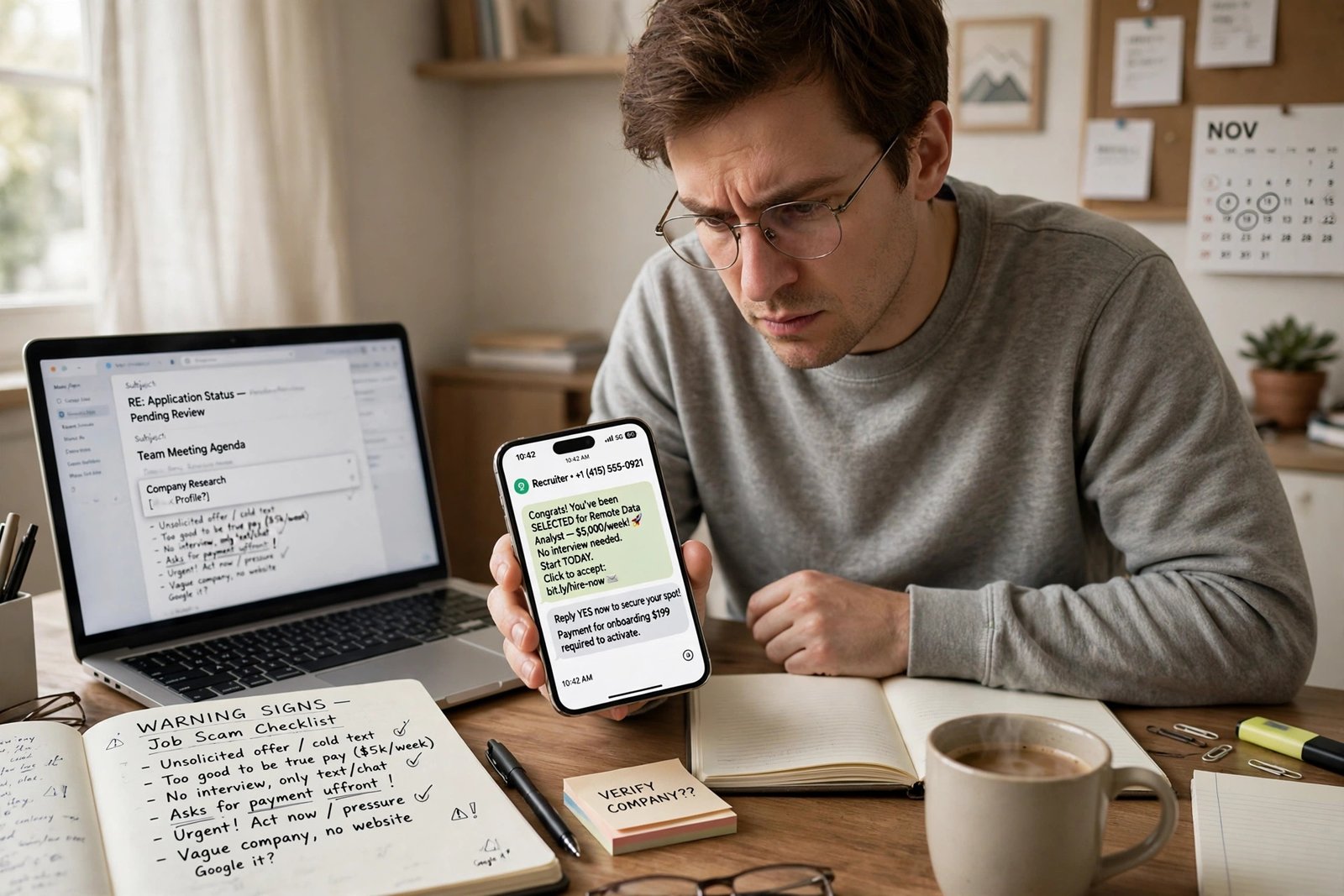
A fake job offer can look professional, arrive quickly, and promise exactly what a job seeker hopes for: easy remote work, fast hiring, and good pay. They rely on urgency, flattery, and a process that moves faster than a real hiring process, so you share money or personal data before you have time to check. This guide is the scam guide for the Online Jobs batch. It owns scam types, how scams unfold over time, and recovery. The finding guide covers vetting at search stage, and the other guides cover applications, CVs, and interviews. If you are unsure about a specific offer right now, skip to the verification checklist below, do not pay, and do not share sensitive data until you have checked.
First, be clear about the arrangement a scammer is imitating, because the warning signs differ slightly by type. An employee scam imitates a real employer offering a job with a manager, hours, and benefits. A contractor scam imitates a short contract with payment for tasks or projects. A freelance scam imitates a client offering paid work, often with a task dashboard or a test project that turns into unpaid work or a fee. In all three cases, the core test is the same: a legitimate employer or client pays you for work, after a written agreement, and does not require you to pay to be hired, to move company money through your own account, or to share full identity documents before an offer exists. If an offer reverses that flow, with you paying, moving money, or sharing sensitive data first, treat it as a scam risk until proven otherwise, no matter how professional the message looks.
The 2026 scam picture: types to recognise
Task scams are now one of the most common patterns. They usually start with a message on a messaging app or social platform, offering simple paid tasks such as liking products, rating items, or completing small online jobs. Early tasks pay small amounts, often shown in a fake dashboard, to build trust. Then the tasks grow, and you are asked to deposit money to unlock higher paying tasks, pay a fee, or complete a set of tasks to withdraw earnings. The dashboard balance is not real money, and the deposits are the real goal.
Messaging recruitment is another common pattern. A recruiter contacts you out of the blue on a messaging app, often with a job that matches your profile closely, and moves the conversation off a job board or professional site quickly. The recruiter may use a real company name, a stolen profile photo, and a plausible job description. The test is not whether the company exists, but whether the recruiter is actually connected to it. Contact the company through its public website or official phone number, and ask whether that person and role are real. Do not trust a screenshot, a company logo in a chat, or a domain that looks similar to the real company domain but differs by one letter or word.
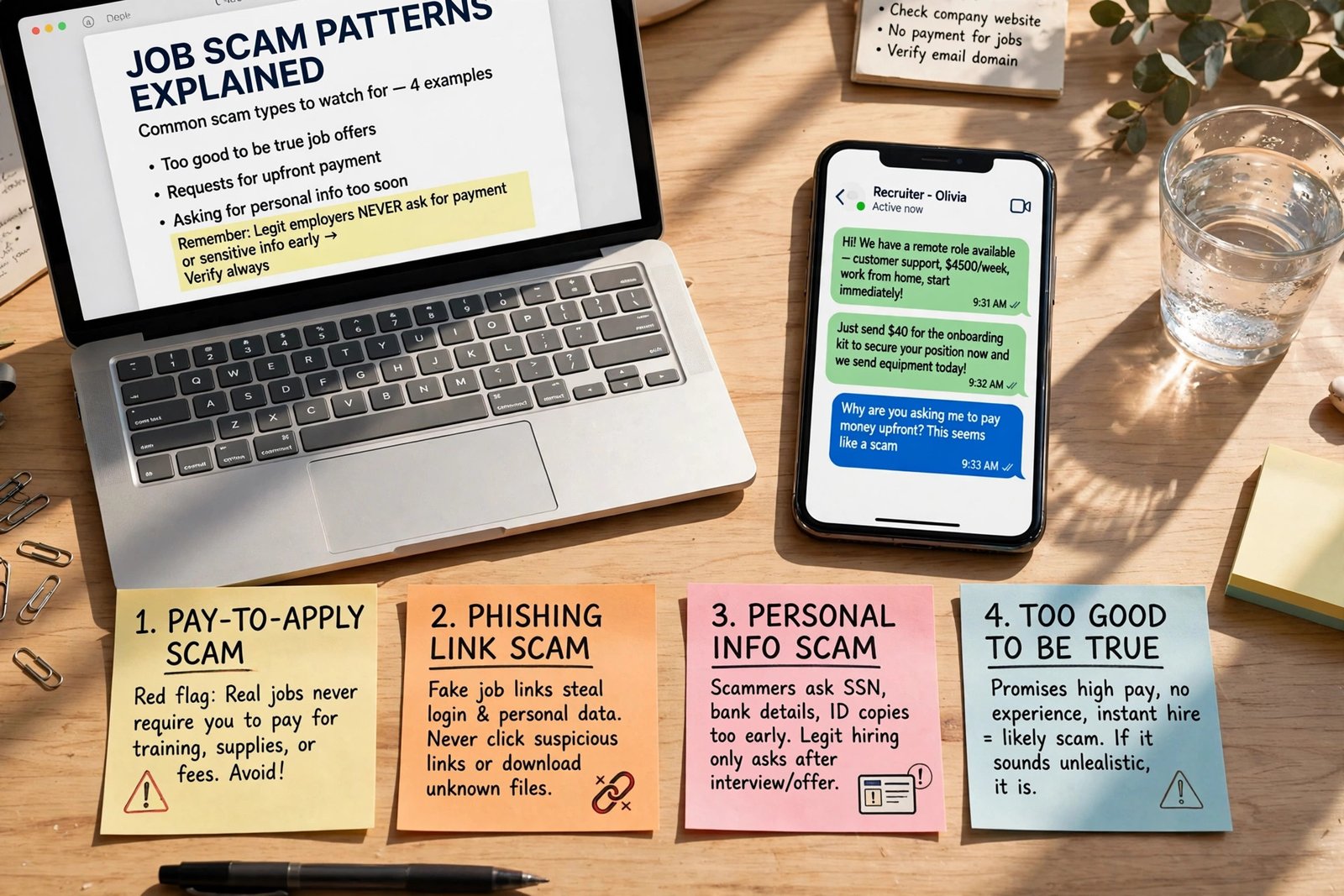
Other patterns to know include fake check scams, where you receive a check, deposit it, and are asked to send money back or buy equipment before the check clears, after which the check bounces and you owe the bank. Money mule scams ask you to receive money into your personal account and forward it elsewhere, often described as payment processing, mystery shopping, or crypto work. That is not a job, it is moving money for criminals, and it can create legal and banking problems for you even if you did not know the source. Equipment and training fee scams ask you to pay for a laptop, software, training, or a background check before you start, often through gift cards, crypto, or wire transfer. Legitimate employers may require checks, but they do not usually ask you to pay for them through untraceable methods before an offer. Finally, recovery scams target people who have already been scammed, offering to recover lost money for a fee. Anyone who contacts you after a scam and asks for payment to recover funds is very likely running a second scam.
How a scam usually unfolds over time
Scams follow a timeline designed to build trust quickly and then create urgency. Day one is often contact and flattery: a message praising your profile, a job that fits perfectly, and a fast move to a private chat. Days one to three bring a short, easy process: a brief chat instead of a real interview, a quick offer, and a request for basic details to start onboarding. Days three to seven bring the hook: a small payment that seems to work, a dashboard balance that grows, or a check that appears to clear. Then comes the pressure point: a fee to unlock earnings, a deposit to continue tasks, a purchase of equipment, or a request to forward money. The pressure is often time limited, with warnings that the offer, the task set, or the withdrawal window will expire. That urgency is intentional. It stops you from checking with the company, a bank, or a trusted person.
Use this verification checklist before you pay or share data
Print or copy this checklist and use it for every offer that asks for money, sensitive data, or a move off a known platform. Do not share bank details, full identity documents, passwords, or one time codes at any stage before a written offer from a verified employer. If an offer fails several checks, stop and do not reply further.
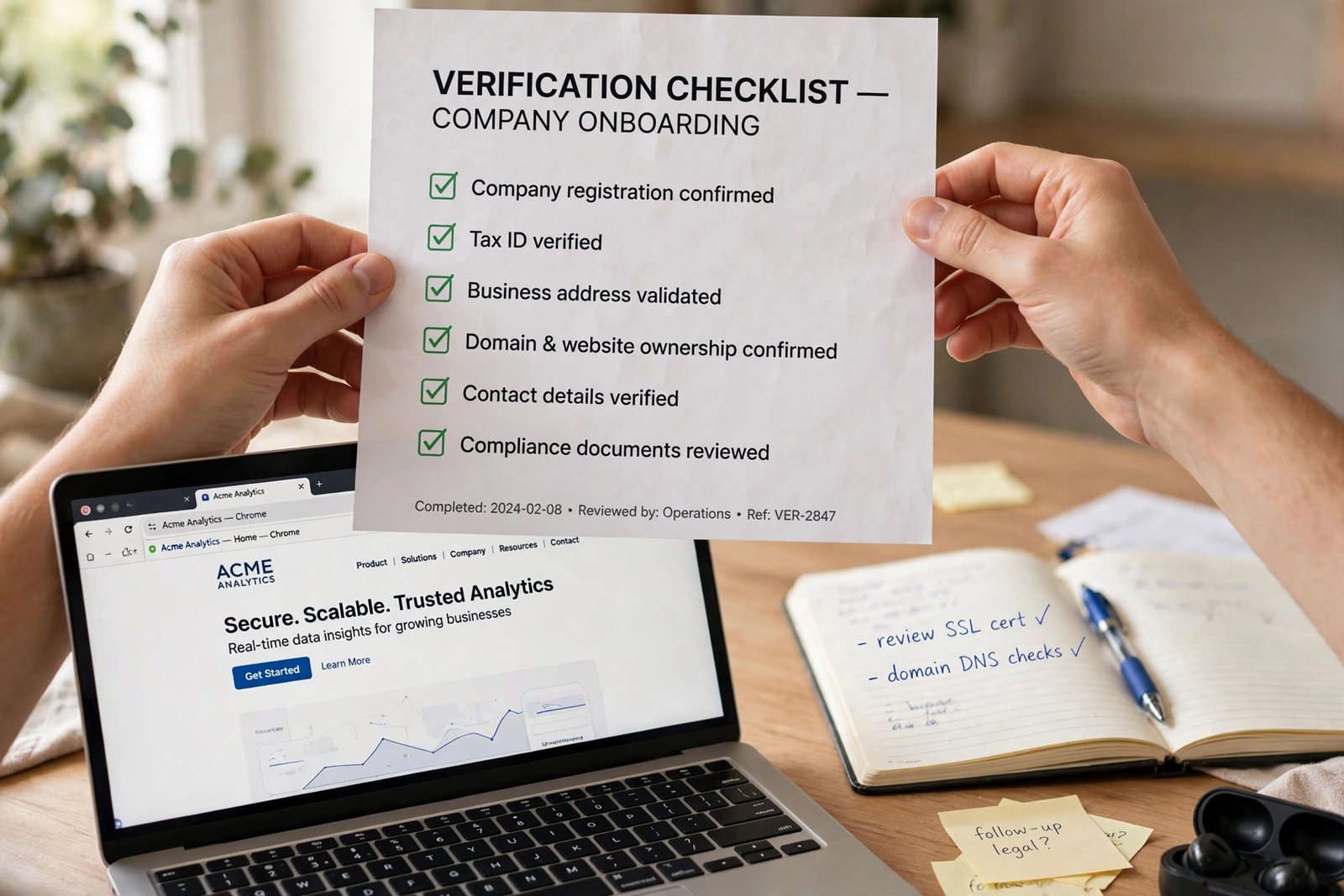
Check one: does the role appear on the company career page, or can the company confirm it through its public contact route? Check two: does the recruiter use a company domain email address or an official application system, not only a personal email or messaging app? Check three: has there been a real interview with a person who can answer role specific questions, not just a short chat and an instant offer? Check four: is there a written offer or contract stating employment type, hours, pay, and start date, before any payment or equipment purchase? Check five: are you being asked to pay by gift card, crypto, wire transfer, or a personal payment app for training, equipment, checks, or task unlocks? Check six: are you being asked to use your personal bank account, personal payment account, or personal crypto wallet to receive and forward company money? Check seven: are you being asked to install remote access software, share your screen, or share passwords or codes? Any yes to checks five, six, or seven is a strong stop signal on its own. For finding and vetting roles at search stage, see How to Find Legitimate Online Jobs in 2026, and for interview stages, see How to Pass a Remote Job Interview in 2026.
Impersonation: when the company is real but the recruiter is not
Impersonation deserves special attention, because the company name, logo, and job description may all be real, while the person contacting you is not connected to that company. Scammers copy real postings, real employee names from professional sites, and real company branding. They may create a domain that is close to the real one, such as adding a word, changing a letter, or using a different ending. They may also create a profile that looks like a real recruiter, using a stolen photo and a plausible job history. Do not verify by replying to the message itself. Verify by going independently to the company website, using the contact details published there, and asking whether the role and the recruiter are genuine. If the company has a careers page, search for the exact role title there. If the role is not listed, ask the company directly before you proceed. Keep copies of messages and payment details for banks and reporting bodies.
What to do if you are targeted, by harm type
Act fast, and act by harm type, because the steps differ. If you paid money, contact your bank or payment provider at once, explain that you believe it was a scam, and ask what recall, dispute, or freeze options exist. Keep transaction records, messages, and account details. Do not pay anyone who offers to recover the money for a fee, because that is usually a recovery scam. If you shared identity documents, such as a passport or national ID copy, contact the relevant identity or credit protection service in your country, consider a credit freeze or fraud alert where that service exists, and monitor accounts for unusual activity. Steps vary by country, so check your national consumer protection or data protection authority for the current local route, and do not rely on a single blog post for country specific instructions.
If you shared passwords or codes, change those passwords at once from a device you trust, enable two factor authentication where available, and check account activity for logins or changes you did not make. If you shared a one time code, treat that account as compromised until you have changed the password and checked settings. If you installed an app or remote access software at a scammer's request, uninstall it, run a security scan with a trusted tool, and consider asking a knowledgeable person or a device manufacturer's support service for help before you use that device for banking again. If you forwarded money through your own account, stop at once, contact your bank, and keep all records, because the bank may need to investigate and because you should not continue moving funds while unsure of their source. In all cases, stop replying to the scammer, save evidence before you block them, and tell a trusted person what happened, because scams rely on shame and secrecy to continue.
How to report, in general and by country
Report the account or listing on the platform used, and report to your bank if money was involved. Then report to your national body: in the United States, the Federal Trade Commission and the Internet Crime Complaint Center; in the United Kingdom, Action Fraud; elsewhere, your national consumer protection agency, police cybercrime route, or data protection authority. Check your country's official route, and tell a company whose name was used through its public contact route. Keep report reference numbers and dates.
Risks and limitations
No checklist catches every scam, and recovery of money is often difficult, especially for gift card, crypto, or wire payments. Be wary of anyone who guarantees recovery. Banking, identity protection, and reporting rules differ by country, so check current official guidance in your country for country specific steps. The safest rule remains simple: a legitimate job pays you after a written agreement, and it does not require you to pay, forward money, or share sensitive data to be hired.
Frequently asked questions
How do I know a job offer is a scam?
Look for a combination of signs: instant offer without a real interview, pressure to act quickly, payment for training or equipment, requests to forward money, dashboard earnings that require a fee to withdraw, and contact only through personal email or messaging apps. Verify through the company career page and public contact route. If several signs appear together, stop and do not pay or share data.
What is a task scam?
A task scam offers simple paid tasks, shows small early payments or a growing dashboard balance to build trust, then asks you to deposit money to unlock higher tasks or withdraw earnings. The balance is fake, and the deposits are the real goal. Real employers do not ask employees to deposit money to work or to withdraw wages.
What should I do if I paid a job scammer?
Contact your bank or payment provider at once, keep all transaction records and messages, and ask about recall or dispute options. Do not pay anyone who offers to recover the money for a fee. Report the account and listing on the platform used, and report to your national consumer protection or cybercrime body. Recovery is not guaranteed, especially for gift card, crypto, or wire payments.
Conclusion
Spotting a job scam is less about spotting one perfect warning sign and more about checking the whole process: is the recruiter verifiable, is there a real interview, is there a written offer, and does money flow towards you, not away from you? Use the checklist before you pay or share data, act fast by harm type if you are targeted, and report through your country's official route. Your next step is to save this checklist and use it for your next offer, before you reply with personal details. Then use How to Find Legitimate Online Jobs in 2026 to search safely, How to Get a Remote Job With No Experience in 2026 to build proof, How to Write a CV for Remote Jobs in 2026 to present it, and the Online Jobs category page to find the full batch.