How to Start a Beauty YouTube Channel and Earn Money in 2026
Learning how to start a beauty YouTube channel is a practical way for a makeup artist, skincare lover or salon owner to turn what they already know into an audience and an income. Beauty is one of the highest-earning niches on YouTube, because viewers buy the products they see in tutorials and reviews. That is also why honesty matters more here than in most niches. This guide shows you how to pick an angle, film beauty properly, plan your first videos, and earn from affiliates, brand deals and services.
In this guide
- Beauty on YouTube in 2026: what works now
- Step 1: Pick your beauty angle
- Step 2: Set up your channel
- Step 3: Film beauty properly
- Content formats that work
- Your first 10 videos
- Shorts, TikTok and Instagram cross-posting
- Titles, thumbnails and beauty SEO
- How beauty channels earn money
- Worked example: what a small beauty channel could earn
- How to start a beauty YouTube channel: what it costs and what to expect
- Disclosure and honesty rules
- Common mistakes
- Risks and scams to watch for
- Frequently asked questions
Beauty on YouTube in 2026: what works now
Beauty on YouTube has shifted towards skincare, honest reviews and short videos. Skincare routines and product reviews now draw more search interest than full makeup looks, and viewers reward creators who say when a product did not work for them. Short vertical videos are also a major discovery route, because a 30-second routine can reach people who would never watch a 20-minute tutorial.
The niche still suits beginners. You can start with a phone and a ring light, film in a bedroom or a salon chair, and use products you already own. You do not need a shelf full of expensive products. A channel that reviews budget products honestly often grows faster than one that only shows luxury items, because most viewers shop on a budget.
The main risk is trust. Beauty products touch skin and hair, so a wrong claim can harm a viewer. Never promise that a product will fix acne, remove scars or change skin colour. Say what a product did for you, show the result over time, and let viewers decide for themselves.
Step 1: Pick your beauty angle
Your beauty angle is the specific part of beauty your channel covers. A narrow angle helps viewers know what to expect and helps YouTube recommend your videos to the right people. Pick an angle you know well and can make at least 30 videos about.
| Beauty angle | Who it suits | Example video ideas |
|---|---|---|
| Skincare routines | People who love skincare science | Morning routine for oily skin, one product tested for 30 days |
| Makeup tutorials | Makeup artists and keen amateurs | Everyday look in 10 minutes, bridal makeup step by step |
| Budget beauty | Shoppers who want value | Drugstore dupes for luxury products, full look under 20 dollars |
| Haircare | Hairdressers and hair lovers | Curly hair routine, heatless styling, hair oil honest review |
| Nails | Nail artists and hobbyists | Beginner nail art, gel nails at home, nail care routine |
| Skin concerns | People with a specific concern | Acne-safe routine, sensitive skin products that worked |
| Salon business | Salon owners who want clients | Behind the scenes in the salon, client transformations |
Test your angle with three videos before you commit. If you enjoy making them and viewers watch them through, keep going. If filming feels like a chore after three videos, try a different angle. Your first angle is not fixed for life, but changing it every week will confuse the viewers you have already won.
Step 2: Set up your channel
Set up the channel before you film your first video, so every upload lands in a finished home.
- Create a Google account and a channel. Sign in to YouTube, open Settings, and create a channel. YouTube's own help page explains the steps in YouTube's guide to creating a channel.
- Choose a short, clear name. A name with your first name often works well for beauty, because viewers follow a person, not a brand. Avoid numbers, because they make a name harder to search for.
- Add a profile picture and banner. Use a clean photo of yourself or your logo, and a banner that shows the channel name and your beauty angle.
- Write your About section. Say who the channel is for, what kind of beauty you cover, and how often you upload. Add your contact email for brand enquiries.
- Set your channel defaults in YouTube Studio. Add a standard description template with links to your social profiles, and set your upload defaults.
- Turn on 2-Step Verification for your Google account. You will need it later to join the YouTube Partner Programme, so set it up now.
For the full setup walkthrough, read our guide to how to start a YouTube channel, which covers branding, Studio settings and upload defaults in detail.
Step 3: Film beauty properly
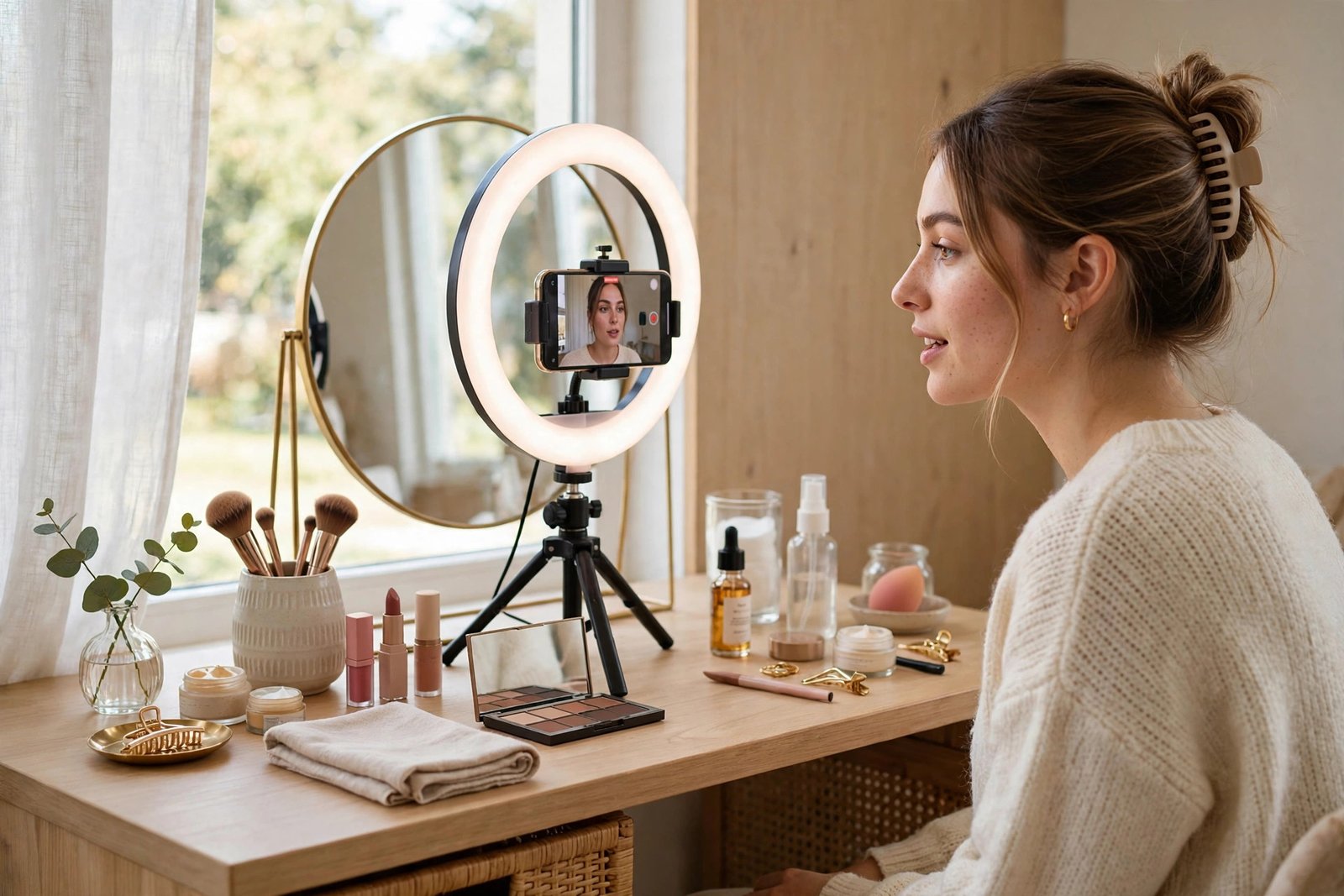
Beauty filming is about light and colour. Viewers need to see the true colour of a foundation, a lipstick or a blush, so your lighting must be even and close to daylight. Film facing a window in the daytime, or use a ring light in front of you. A ring light is a round light that sits around your camera and gives soft, even light on your face.
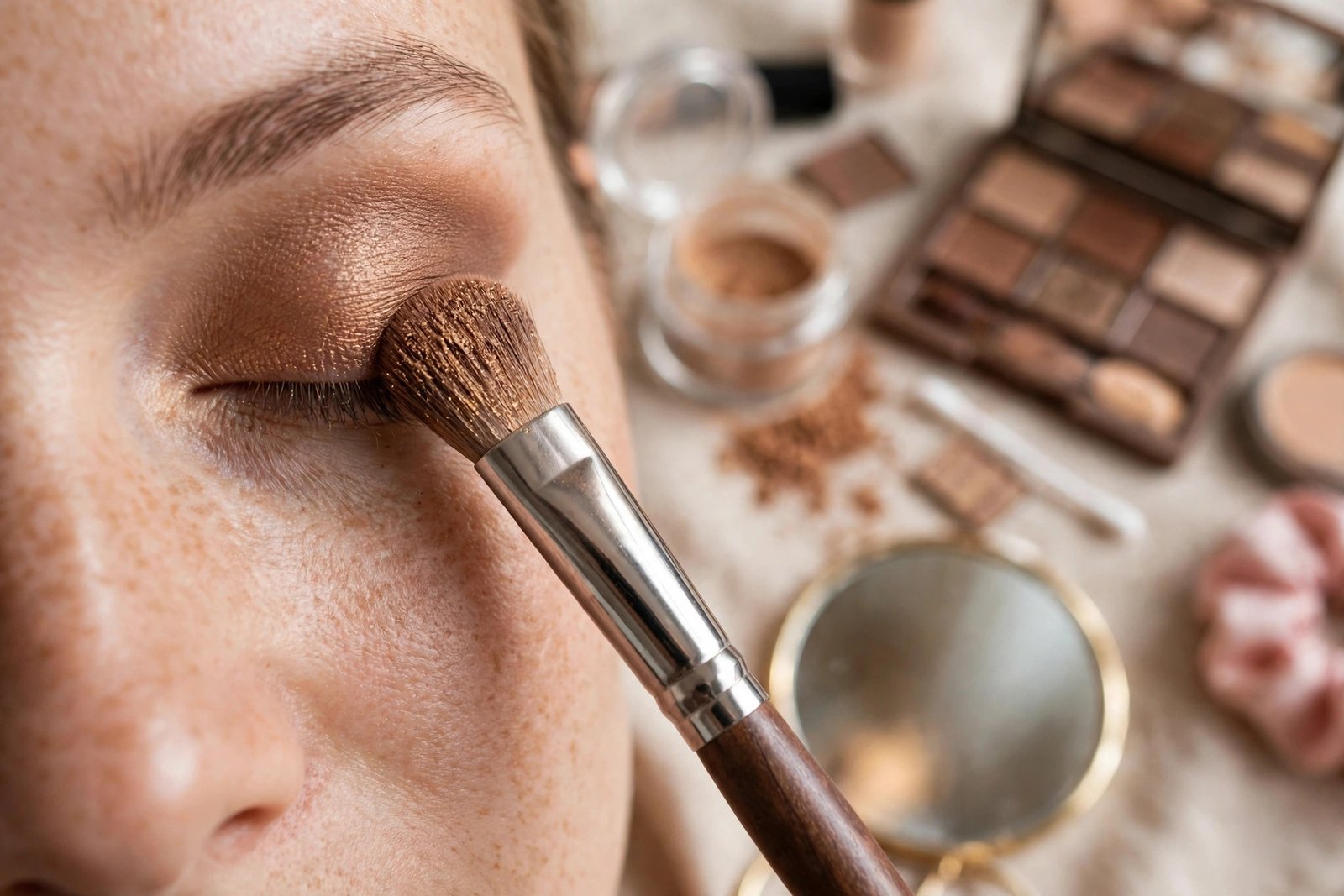
Sit close enough to the camera that viewers can see detail. A medium close-up, from the chest up, works for most tutorials, and a closer shot of one eye or one cheek works for detail steps. Keep the background tidy and neutral, so the focus stays on your face and the product. A plain wall or a clean vanity works better than a busy room.
Sound matters too. A quiet room with a clip-on microphone sounds far better than a phone microphone picking up street noise. Record a short test clip and watch it back before you film a full tutorial. Check the colours on your phone screen against the real product, and adjust the light until they match. Never use a filter that changes your skin colour.
Content formats that work
Beauty viewers come for different reasons, so mix formats that serve them all. Tutorials teach a skill, reviews help a purchase, and routines show a full process.
Tutorials. A step-by-step makeup or hair video, filmed in order, with each product named as you use it. Keep the pace steady and explain why you use each product.
GRWM videos. "Get ready with me" videos show your full routine while you talk about your day. They are casual, they build a personal connection, and they suit Shorts as well as long videos.
Hauls. A video showing products you bought, with first impressions and prices. Say clearly whether you bought them yourself or received them free.
Reviews. One product tested over days or weeks, with honest pros and cons. Reviews that say when a product failed build more trust than reviews that praise everything.
Routines. A full morning or night skincare routine, filmed in real time with short steps. Routines are evergreen, which means they keep getting views for a long time.
Before and after. A transformation video showing the result of a treatment or a makeup look. Show the real result with the same light and the same angle, and never edit the after photo to fake a change.
Your first 10 videos
Your first 10 videos teach YouTube what your channel is about, so plan them as a set. Mix searchable tutorials with a few videos that show your personality.
- Your most searched tutorial, such as an everyday makeup look or a simple skincare routine.
- A budget product review, such as a drugstore foundation tested for a full day.
- A routine video, such as a morning skincare routine for your skin type.
- A comparison, such as a drugstore dupe against a luxury product.
- A video that answers a common question, such as how to pick the right foundation shade.
- A GRWM video for a normal day.
- A product you regret buying, with honest reasons.
- A hair video, such as a simple hairstyle for beginners.
- A seasonal video, such as a summer makeup look that lasts in heat.
- A short introduction video that tells viewers what the channel is about.
Shorts, TikTok and Instagram cross-posting
Shorts are vertical videos under 3 minutes, and they are a strong discovery tool for beauty. A 30-second routine, a quick swatch test or a before-and-after clip can reach far more people than a long tutorial in its first week. Post the best moment of each long video as a Short, and link it to the full tutorial.
The same short clip can work on TikTok and Instagram Reels, which is where many beauty viewers spend their time. Film each short clip in portrait, keep it under 60 seconds, and add captions, because many people watch with the sound off. Our guide to how to grow YouTube Shorts explains how Shorts views count towards monetisation, and our guide to how to repurpose long videos into YouTube Shorts shows the cutting process.
Titles, thumbnails and beauty SEO
Beauty viewers search with plain words and specific problems. They type "foundation for oily skin" or "how to do winged eyeliner" into the search box, so your title should match the words they type. Put the product or the problem first, then a helpful detail, such as "Best Drugstore Foundation for Oily Skin (Tested All Day)".
Thumbnails need a clear close-up of the result, with few words in large text. A face with the finished look works well, especially if the expression is natural. Use bright light and true colours, and do not use a filter that changes your skin tone. Never show a result in the thumbnail that is not in the video.
Write descriptions that help search and help shoppers. Put the product names and the main keywords in the first two lines, then list every product you used, with affiliate links clearly marked. Add links to related tutorials on your channel. Our guide to YouTube SEO and how to rank videos covers keyword research, and our guide to how to design YouTube thumbnails shows what makes a thumbnail get clicked.
How beauty channels earn money
Beauty channels earn from more sources than ads alone, and brand deals and affiliates often pay more than ads for a small channel. The YouTube Partner Programme, known as YPP, is the route to ad income. The figures below come from YouTube's own Partner Programme page, checked on 2026-11-19.
| YPP tier | What you need | What it unlocks |
|---|---|---|
| Early tier | 500 subscribers, 3 public uploads in the last 90 days, plus 3,000 watch hours in the last 12 months or 3 million Shorts views in the last 90 days | Fan funding, such as channel memberships and Super Thanks, and Shopping features. No ad revenue. |
| Full tier | 1,000 subscribers, plus 4,000 watch hours in the last 12 months or 10 million Shorts views in the last 90 days | Ad revenue sharing, YouTube Premium revenue, and all fan funding features. |
Joining also needs 2-Step Verification, one active AdSense for YouTube account, and a channel that follows YouTube's monetisation policies. Review decisions typically take about one month. Note for readers in Pakistan: the early 500 subscriber tier is only open in the countries YouTube lists on its Partner Programme page, and as read on 2026-11-19 Pakistan does not appear in that list, while India does. Check the current country list on YouTube's own page.
YouTube also changes its rules from time to time. Some secondary sources report a change to the full tier thresholds from early 2027, but YouTube's own help page does not mention it as of 2026-11-19, so this guide does not print those figures as fact. Check YouTube's own Partner Programme page for the latest rules before you apply.
Beyond ads, beauty channels earn from affiliate links, brand deals, PR packages, selling services, and digital products. Affiliate programmes for beauty include Amazon Associates and LTK, which let you earn a commission when a viewer buys through your link. Brand deals usually start once a channel has a loyal audience and a clear media kit. PR packages are free products sent by brands, and they are not payment.
YouTube pays creators 55 percent of ad revenue on standard videos and 45 percent on Shorts, as of November 2026. If you run a salon, the channel can also bring clients, which may be worth more than ad income. Our guide to how to monetize a YouTube channel explains each income route, our guide to how to get YouTube sponsorships covers brand deals and rates, and our guide to how to make money with YouTube affiliate marketing covers affiliate programmes.
Worked example: what a small beauty channel could earn
Example only: these numbers are not typical results, and they are shown only to explain how the maths works.
Imagine a beauty channel that reaches the full YPP tier after 10 months. It has 2,500 subscribers and publishes one long tutorial a week plus two Shorts. It gets about 18,000 views a month. If advertisers pay an average of 5 dollars per 1,000 views after YouTube takes its share, the maths is 18 multiplied by 5, which is 90 dollars a month from ads. If affiliate links earn 40 dollars a month, and one small brand deal pays 100 dollars for a dedicated review, the total for that month is 230 dollars. Results vary with niche, audience country, upload schedule and the time of year.
How to start a beauty YouTube channel: what it costs and what to expect
You can start a beauty channel with a phone, a ring light and products you already own. A basic ring light costs roughly 20 to 50 dollars, and a clip-on mic costs roughly 15 to 30 dollars. Do not buy a shelf of new products for the channel. Use what you have, review products you already use, and buy new ones only when a video needs them.
A realistic timeline is 6 to 18 months of steady uploads to reach the full YPP tier, depending on your niche and how often you publish. Brand deals and PR usually start later, once you have a clear audience and a media kit. Plan for months with no income at all, and treat the channel as a hobby that may pay later.
Disclosure and honesty rules
Disclosure means telling viewers clearly when you were paid or given a product. It is a legal requirement in many countries, and it is also the foundation of trust in beauty. Say it at the start of the video, in your own words, and also in the description. A simple line such as "This video is sponsored by the brand, and the product was sent to me free" is enough. Do the same for affiliate links.
Never make medical claims. Do not say a product cures acne, removes scars, whitens skin or treats a condition, unless you are a qualified professional and the claim is backed by evidence. Say what the product did for you over a stated period, and tell viewers to patch test new products on a small area first. Never fake a before-and-after result with different light, a different angle or editing.
Common mistakes
- Buying products you cannot afford just to review them, which turns the channel into a loss.
- Praising every product, which makes viewers stop trusting your reviews.
- Hiding a sponsorship or a gifted product, which breaks trust and may break the law.
- Using filters that change your skin colour, so viewers buy a product based on a false colour.
- Making medical claims about a product, such as curing acne or removing scars.
- Copying a bigger creator's style instead of developing your own angle.
- Posting three videos in one week and then nothing for a month.
- Ignoring the description, where viewers look for the product list and the links.
Risks and scams to watch for
Beauty creators are a common target for scams. A common one is a "brand" that offers a sponsorship but asks you to pay for the product first, or to buy a starter pack. A real sponsor pays you or sends the product free. Another scam is a fake PR agency that asks for your login details or a fee to send you products. Never share your Google account password, and never pay to receive PR.
Be careful with your skin and your viewers' skin. Test new products on a small area first, stop using anything that causes a reaction, and say so in the video if a product irritated your skin. If you show a salon treatment, follow proper hygiene and safety practice, and say when a treatment needs a trained professional. Tax rules apply to beauty income, including gifted products in some countries.
Frequently asked questions
Do I need expensive products to start a beauty channel?
No. Start with products you already own and review them honestly. A channel that reviews budget products well often grows faster than one that only shows luxury items, because most viewers shop on a budget. Buy new products only when a video genuinely needs them.
Is skincare or makeup content better for growth?
Skincare currently draws more search interest, and routines are evergreen, which means they keep getting views for a long time. Makeup tutorials still do well, especially for specific looks and occasions. The best choice is the topic you know best and can talk about for a year without running out of ideas.
Can I do beauty content faceless?
Yes, but it is harder than in food or DIY. Hands-only videos work well for skincare routines, nail art and product swatches, where the focus is on the product, not the face. Full makeup tutorials usually need a face on camera, because viewers want to see the result on real skin.
How much do beauty YouTubers make?
It varies widely. A small channel earns mainly from ads and affiliate links, which may be tens of dollars a month at first. Brand deals can pay far more, but they are irregular and usually start once a channel has a loyal audience and a media kit. No honest guide can promise a figure, because income depends on views, audience country, niche and the number of deals you win.
How do you get PR from beauty brands?
Brands usually send PR once a channel has a clear audience, steady uploads and a contact email in its About section. You can also pitch brands yourself with a short email and a media kit. Small brands are more likely to say yes first. Always say clearly when a product was gifted, and review it honestly even if it was free.
How many subscribers do I need to monetise a beauty channel?
You need 500 subscribers for the early YPP tier, which unlocks fan funding and Shopping features but no ad revenue. You need 1,000 subscribers plus 4,000 watch hours, or 10 million Shorts views, for the full tier with ad revenue. Check YouTube's own Partner Programme page for the latest rules and the country list, because the early tier is not open everywhere.
Conclusion
Learning how to start a beauty YouTube channel in 2026 comes down to a clear angle, honest reviews, good light for true colour, and steady uploads. Pick one part of beauty, film it well with a phone and a ring light, and give viewers product lists they can trust. Reach the Partner Programme thresholds, then add affiliate links and brand deals so ads are not your only income, and always say clearly when a product was paid for or gifted.
To keep building, read our guide to how to start a YouTube channel for the full setup, our guide to YouTube SEO and how to rank videos for getting found in search, and our guide to how to get YouTube sponsorships for brand deals and rates. Browse the rest of the YouTube Earning category for more channel guides.
Earning results vary, and nothing on this site is financial advice. Check YouTube's own Partner Programme page for the latest rules before you apply, and check your local tax rules when income starts.