How to Start a Real Estate YouTube Channel and Earn Money in 2026
A real estate YouTube channel can turn what you know about homes, streets and buyers into an audience that brings you clients. Many agents post a few tours, get little response, and stop. The channels that earn keep a clear focus, publish on a steady rhythm, and help a buyer or seller take the next step. This guide shows how to start one in 2026, plan videos people search for, film honest tours, and earn from ads, sponsors, affiliates and new clients.
In this guide
- Why it works
- Step 1: Pick your angle and audience
- Step 2: Set up your channel
- Step 3: Plan videos people search for
- Step 4: Film property tours that build trust
- Step 5: Titles and thumbnails
- Step 6: Grow with Shorts
- How it earns money
- What it costs and what to expect
- Mistakes, risks and scams
- Rules and disclosure
- Frequently asked questions
Why a real estate YouTube channel works
Property is visual, and video shows a home in a way photos cannot. A buyer who watches a full tour arrives at a viewing already warm, and a seller who watches your updates already trusts your knowledge.
YouTube also rewards local knowledge. A video about one street can rank for searches that no national site can match. Your real estate YouTube channel does not need a huge audience. A few thousand local viewers can bring more real work than a hundred thousand viewers worldwide, because only local viewers can buy or sell with you.
There are two main kinds of channel. An agent channel serves buyers and sellers in one area, and its main income is new clients. An investor channel serves people who want to buy rental property, and its main income is ads, affiliates, courses and sponsors.
Step 1: Pick your angle and your audience
A real estate YouTube channel that tries to cover every kind of property in every area will struggle. Pick one area and one audience, then serve them well. Your area can be a city or a group of suburbs. Your audience can be first time buyers, investors, or sellers.
Angles that work include first time buyer guides in one city, luxury home tours if you already work in that market, rental analysis, and neighbourhood guides. Do not pick luxury tours just because they look good. If you cannot film them every week, the channel will stall.
If you are not an agent, say so clearly in your channel description, and never present yourself as a licensed agent when you are not one.
Step 2: Set up your channel
Set up your real estate YouTube channel as a business asset, not a personal account. Create a Google account for the business, then create the channel from it. Use a Brand Account so more than one person can manage it. Our guide to how to start a YouTube channel covers the full setup.
Choose a name that says what you do and where you do it, such as "Homes in Leeds with Sarah". Keep it short and easy to spell. Fill in the whole channel page before your first video, and add your business email and website.
Turn on two step verification for the Google account. A channel that starts to earn is a target for hijack attempts, and YouTube requires it before you can join the Partner Programme.
Step 3: Plan videos people actually search for
Good real estate YouTube channels are planned, not improvised. The best ideas sit where what people search for meets what you can show. A title such as "What 300,000 buys in Manchester in 2026" works because it names a price, a place and a year. A title such as "Beautiful house tour" does not. Use the table below to plan your mix.
| Video format | Who it helps | How often |
|---|---|---|
| Full property tour | Buyers | Weekly |
| Neighbourhood guide | New arrivals | Monthly |
| Market update | Sellers and buyers | Monthly |
| Buying or selling guide | Buyers and sellers | Monthly |
| Deal or rental analysis | Investors | Monthly |
| Shorts and quick tips | New viewers | 2 to 3 a week |
On a real estate YouTube channel, start with the videos that bring clients, not views. A tour of a home you are selling can bring a buyer this week. Write a simple script for each video, with the order of rooms, the three main points, and the call to action. Keep long videos between 8 and 15 minutes. Our guide to YouTube SEO and how to rank videos explains keyword research.
Step 4: Film property tours that build trust
A property tour is the core video on a real estate YouTube channel. Viewers judge your honesty from the tour itself. If you hide the small rooms or skip the street, trust will fall. Film the home as it really is.
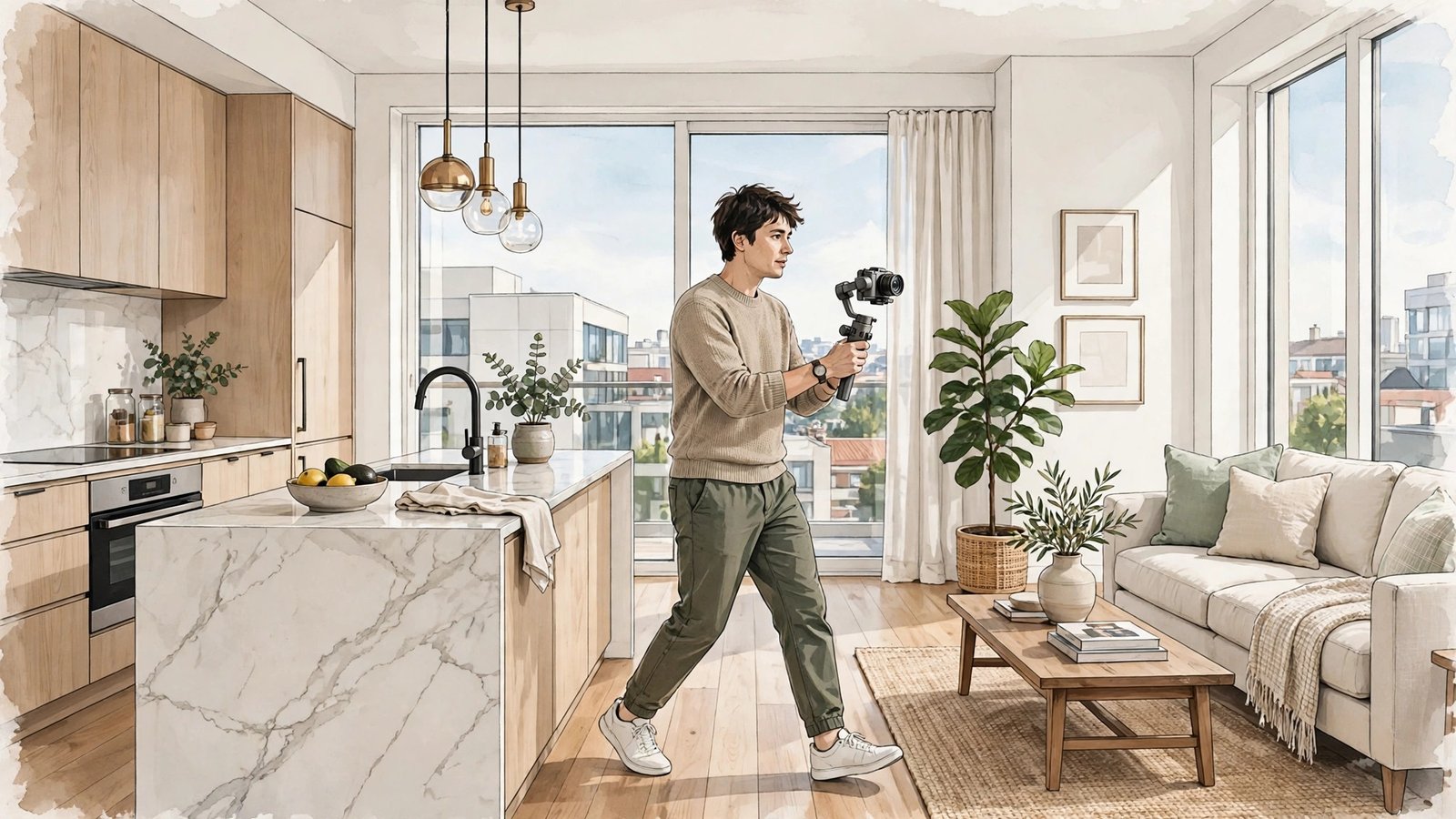
Start with the outside. Show the street, the front of the home and the entrance. Then walk through in the order a buyer would, from the living areas to the kitchen, then the bedrooms and bathrooms. End at the best view, with a short summary of price and size.
Film in daylight, and open curtains and blinds before you start. Clean, steady shots matter more than costly gear. A modern phone, a small gimbal and a clip-on microphone are enough. Hold each shot for a few seconds and move slowly. Record the sound in the room itself.
Get written permission before you film inside a home that is not yours. The seller must agree, and tenants must agree too. Remove personal items, and never film children. Never show house keys or documents. Check the price and availability on the day you publish.
Add useful detail on screen, such as floor size and distance to schools and transport. Put the price, the area and a contact link in the description. Edit with a light hand and cut pauses. Avoid heavy music, because it hides the real sound of the home and can cause copyright problems. Our guide to how to work as a freelance video editor explains what an editor does.
Step 5: Titles and thumbnails that get clicked
A good video on a real estate YouTube channel with a weak title will not be watched. The title and thumbnail are the advert for the video. The title should name the home, the place and, where it helps, the price. The thumbnail should show the best view of the home and one short line of text. A clear title is "3 Bedroom Family Home Tour in Leeds for 325,000".
Avoid titles that promise what the video cannot prove, such as "Cheapest house ever". Viewers who feel tricked will not subscribe. Be specific instead.
Design thumbnails that look clean on a phone. Use one strong photo of the home, large text, and the same style every time. Our guide to how to design YouTube thumbnails shows what makes a thumbnail get clicked. Put the price and the area in the first two lines of the description, and mark affiliate links clearly. Our guide to how to make money with YouTube affiliate marketing covers the rules.
Step 6: Grow with Shorts and a steady schedule
Long tours on a real estate YouTube channel bring trust, but Shorts bring discovery. A 30 to 60 second clip of the best room or one quick tip can reach people who have never heard of you. Film Shorts from the same visits as your long videos.
A real estate YouTube channel needs a schedule you can keep for a year. One long video a week plus two or three Shorts is a strong rhythm for most agents.
On a real estate YouTube channel, reply to comments, and treat them as leads. A comment that asks about a price or a viewing is a warm enquiry. Answer it, then invite the person to email you. Our guide to how to grow YouTube Shorts explains how Shorts views count towards monetisation.
How a real estate YouTube channel earns money
A real estate YouTube channel has more ways to earn than most niches, because the audience is close to a large purchase. Ad income is only one stream, and for agents it is often the smallest.
| Income route | When it starts | Who it suits |
|---|---|---|
| Client leads and sales | At once | Agents |
| Sponsorships and brand deals | Later | Both |
| Affiliate links | At once | Both |
| Ad revenue, Partner Programme | After the thresholds | All |
| Courses and paid guides | Later | Both |
| Memberships and fan funding | Later | Both |
Client leads come first for agents. A viewer who watches three of your tours and then books a valuation is worth far more than the ad income from a thousand views. Put a booking link in every description. Ask every caller how they found you. One sale can pay for a year of filming.
Ad revenue comes through the YouTube Partner Programme. As of November 2026, YouTube states that a channel can qualify with 1,000 subscribers and 4,000 qualified watch hours on long videos in the last 12 months, or with 1,000 subscribers and 10 million qualified Shorts views in the last 90 days. You must also follow the monetisation policies, live in a country where the programme is available, and link an AdSense for YouTube account. Meeting the numbers does not mean automatic entry, because YouTube reviews the whole channel first.
Some fan funding features open earlier, at 500 subscribers, as stated on the how to monetize on YouTube page. Ad income per thousand views varies, so do not plan on a fixed rate.
Sponsorships suit this niche well, because mortgage lenders, property platforms and home services firms want to reach buyers and investors. A brand deal can pay far more than ad income, but only once you can show a clear audience and real watch time. Our guide to how to get YouTube sponsorships covers brand deals and how to pitch. Affiliate income fits too, through mortgage tools, home insurance and moving services. Our guide to how to earn with mortgage affiliate programs explains what to check first. Only promote tools you have used, and always say when a link earns you a commission. Courses can work later, once your free videos prove you can teach.

Worked example: one listing video
Example only: these numbers are not typical results. They show the maths, not a promise.
Imagine you film a tour of a 3 bedroom home for your real estate YouTube channel, listed at 300,000 in your local currency. The video takes 3 hours to film and edit, and you spend 50 on travel and microphone hire.
In the first month the video gets 2,000 views. About 40 viewers click the booking link, and 6 of them book a viewing. One viewer makes an offer, and the sale completes. If your fee is 3,000, the video has brought in 3,000 against 50 of costs and 3 hours of your time. Ad income on 2,000 views would be small by comparison. Judge the channel after 20 videos, not after one.
What it costs and what to expect
You can start a real estate YouTube channel with a phone you already own, but a small budget makes filming faster and sound clearer. All figures are in US dollars, and prices differ by country.
| Item | Low budget | Mid budget | Higher budget |
|---|---|---|---|
| Phone or camera | 0, use your phone | 400 to 800 | 1,000 to 2,000 |
| Microphone | 30 to 60 | 80 to 150 | 150 to 300 |
| Tripod or gimbal | 30 to 80 | 100 to 200 | 200 to 400 |
| Lighting | 0, use daylight | 50 to 100 | 100 to 250 |
| Editing software | 0, free tools | 10 to 20 per month | 20 to 50 per month |
| Thumbnails | 0, free tools | 0 to 15 per month | 15 to 30 per month |
| Total to start | 60 to 140 | 640 to 1,285 | 1,485 to 3,030 |
Time is the bigger cost. Plan for 3 to 5 hours per long video. A weekly video plus Shorts is about 5 to 8 hours a week.
Set honest expectations. In the first 3 months, aim for 10 to 15 videos, a few hundred subscribers, and your first enquiries, not income. By 6 to 12 months, a steady channel can reach 1,000 subscribers, but many take longer. Ad income at that size is small. The real test is whether viewers call or book viewings. If they do not after 20 videos, change the topics and titles.
Common mistakes
- Filming only luxury homes you cannot access every week.
- Hiding the flaws of a home, which breaks trust.
- Posting tours with no price, no area and no contact link.
- Using clickbait titles that promise what the video cannot prove.
- Publishing once and then going silent for two months.
Risks and scams to watch for
Do not pay anyone who promises to grow your real estate YouTube channel fast, sell you subscribers, or guarantee views. Bought subscribers do not watch or call, and they can put your channel at risk under YouTube rules.
Be careful with sponsors who contact you early. A real brand will have a clear website, a real contact name, and a written agreement that states the fee and the deadline. A fake sponsor will rush you or ask for your password. Never share your password or verification codes.
Protect the people in your videos. Sellers and tenants may not want their home on a public channel. Get written permission, remove personal items, and take a video down quickly if a seller asks you to. Check every price before you publish, because a wrong price can mislead a buyer.
Rules, disclosure and local property law
YouTube requires creators to disclose paid promotions. If a brand pays you, gives you a free product, or gives you an affiliate link, say so clearly in the video and in the description. Use the paid promotion label in YouTube Studio as well as your own words.
Follow the property advertising rules where you work. In many countries, only a licensed agent or broker can advertise a home for sale or for rent, and the advert must show the licence number and the true price. If you are not licensed, do not present yourself as one.
Tax rules also differ by country. Income from ads, sponsors, affiliates and client fees may be taxable. Keep records of every payment and cost from the start, and check your local tax authority or a qualified accountant when income starts.
Frequently asked questions
Do I need a licence to start a real estate YouTube channel?
No, you do not need a licence to make videos about property, but you do need one in many countries to act as an agent or take a fee for a sale. If you are not licensed, say so clearly.
How much does a real estate YouTube channel earn?
It varies too much to give one figure, because income depends on your area, your audience and whether you are an agent. Ad income is usually small at first. For agents, one client can be worth more than months of ad income.
How many subscribers do I need to monetise a real estate YouTube channel?
As of November 2026, YouTube states that full ad revenue needs 1,000 subscribers and either 4,000 qualified watch hours on long videos in the last 12 months or 10 million qualified Shorts views in the last 90 days. Some fan funding opens earlier at 500 subscribers. Check the current thresholds on the official YouTube Partner Programme page before you apply.
What videos should a real estate agent post on YouTube?
On a real estate YouTube channel, post the videos that bring clients first: full property tours, neighbourhood guides and local market updates. Then add buying and selling guides. Shorts help new viewers find you, but they should point back to your longer tours.
Can a real estate YouTube channel bring clients?
Yes, a real estate YouTube channel can bring clients, but only if you make it easy to contact you and you track the results. Put a booking link in every description, and ask every new caller how they found you.
Conclusion
A real estate YouTube channel works when you pick one area, publish useful videos on a steady rhythm, film homes honestly, and make it easy for viewers to contact you. Start with your phone, plan your first ten videos, and judge it by the enquiries it brings.
To keep building, read our guide to how to monetize a YouTube channel for each income route, our guide to how to get YouTube sponsorships for brand deals, and our guide to how to sell courses on YouTube for turning knowledge into a paid product. Browse the YouTube Earning category for more channel guides.
Earning results vary, and nothing on this site is financial advice. The Partner Programme facts here were checked on the official YouTube Help pages in November 2026. Check the current rules before you apply.