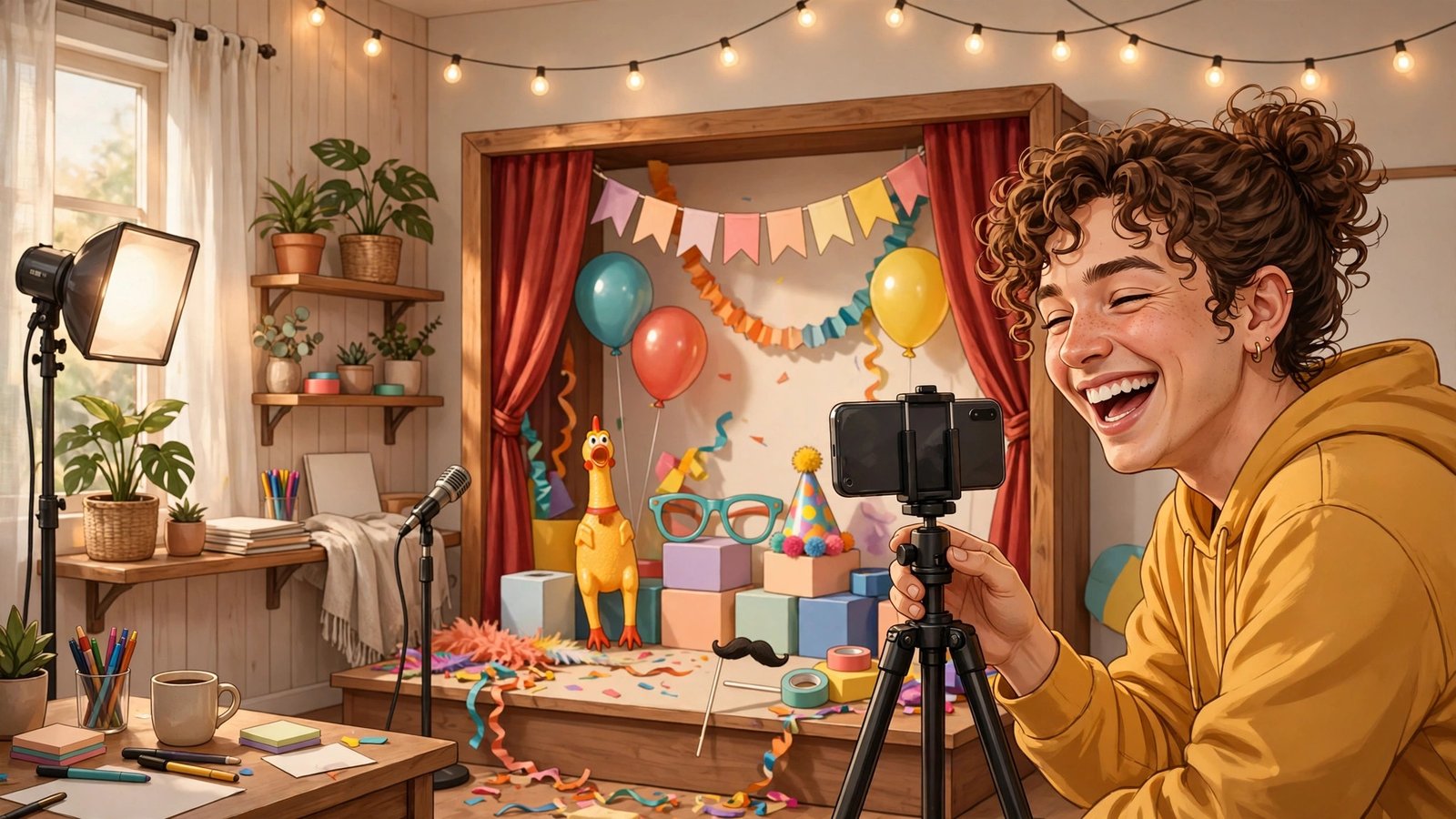
How to Start a Comedy YouTube Channel and Earn Money in 2026
A comedy YouTube channel can turn a sense of humour into an audience and, in time, an income. Many people want to make funny videos, but they do not know where to start, what kind of comedy works on YouTube, or how the money side works. This guide answers all three questions. It shows you how to pick a comedy style, set up the channel, film on a small budget, grow an audience, and earn money through ads, sponsors, memberships and more.
In this guide
- Is a comedy channel worth starting in 2026?
- Step 1: Pick your comedy style and audience
- Step 2: Set up your comedy YouTube channel
- Step 3: Plan your first 10 videos
- Step 4: Film sketches and stand-up on a small budget
- Step 5: Write jokes that land
- Step 6: Titles, thumbnails and search
- Shorts or long videos for comedy?
- How to grow your audience without buying views
- How a comedy YouTube channel earns money
- Worked example: what a small comedy channel could earn
- What it costs and what to expect
- Common mistakes
- Risks and scams to watch for
- Frequently asked questions
Is a comedy channel worth starting in 2026?
Yes, if you enjoy making people laugh and you accept a slow start. Comedy is one of the most watched kinds of content on YouTube, and a funny video can be shared far beyond your own subscribers. A single sketch that people share in group chats can bring in thousands of new viewers in a day. That sharing power is the main strength of comedy. There is also a hard truth to face early. Comedy usually earns less from ads per view than finance, tech or business content. Advertisers pay more to reach people who are about to buy something, and people watching a sketch are usually there to laugh, not to shop. That does not mean a comedy YouTube channel cannot earn money. It means ads alone will rarely pay the bills, and you need other income routes from the start. Comedy also takes more work per video than many other formats, so it is a poor choice if you only want fast income.
Step 1: Pick your comedy style and audience
Your comedy style is the kind of funny your channel is known for. It is also called a niche. A clear style helps YouTube understand who your videos are for, and it helps viewers know what to expect when they subscribe. Pick a style you enjoy making and can repeat at least 30 times without running out of ideas. Think about who you want to laugh. A channel for parents jokes about school runs and bedtime. A channel for gamers jokes about online matches and bad team mates. When the audience sees their own life in your jokes, they share the video with people like them. That is how a small comedy YouTube channel grows.
| Comedy style | What it looks like | Who it suits |
|---|---|---|
| Sketch comedy | Short scripted scenes with characters | Creators who like writing and acting with friends |
| Stand-up clips | Short sets filmed on stage or at home | Performers who already do live comedy |
| Parody | Funny versions of songs, films or adverts | Creators who follow pop culture closely |
Test your style with three videos for your comedy YouTube channel before you commit to it. Also decide what your channel will not do. Comedy that punches down at a group of people, uses slurs, or relies on shock for its own sake can limit your ads and can get videos removed.
Step 2: Set up your comedy YouTube channel
Set up your comedy YouTube channel before you film your first video, so every upload lands in a finished home. Create a Google account and a channel. YouTube's own help page explains the steps in YouTube's guide to creating a channel. Choose a clear name that says what kind of comedy you make, or use your own name if you are the act. Search the name on YouTube first to check that no bigger channel already uses it. Add a profile picture and banner that show the channel name and the kind of comedy you make, and make sure they read well on a phone. Write your About section in plain words, such as "short comedy sketches about office life, posted every week". Set your channel defaults in YouTube Studio, and turn on 2-Step Verification for your Google account. You will need it later to join the YouTube Partner Programme.
Step 3: Plan your first 10 videos
A comedy YouTube channel grows faster when the first videos show what the channel is about. Plan your first 10 videos before you publish the first one, so a new viewer who likes one video on your comedy YouTube channel can watch nine more in the same style. Here are 10 ideas that work for most comedy styles.
- A sketch about a situation your audience knows well, such as a bad job interview.
- A parody of a popular advert, song or TV show in your own style.
- A "types of" video, such as types of people at the gym.
- A short stand-up set of your three best jokes, filmed in one take.
- A reaction video to a funny trend, with your own jokes added.
- A character video where one character deals with a normal day.
- A behind the scenes video showing how you write and film a sketch.
- A sketch that answers a question your audience asks a lot.
- A collaboration sketch with another small comedy creator.
- A best-of video that cuts together the funniest moments from your first nine videos.
Step 4: Film sketches and stand-up on a small budget
You can film good videos for a comedy YouTube channel in a normal room. Comedy needs clear sound and good timing more than it needs expensive cameras. A phone made in the last few years is enough to start. Clean the room, move clutter out of shot, and use the brightest part of the room. Natural light from a window is free and looks better than a dim ceiling light. Sound matters more than most beginners expect. A joke that is hard to hear is a joke that fails. A small clip-on microphone, called a lavalier mic, sounds far better than a phone microphone picking up room noise. Record a short test clip and listen to it with headphones before you film a full sketch.

For sketches, film each scene more than once and keep the best take. For stand-up, film the whole set in one take, then cut out the dead air between jokes. Keep your videos tight. A sketch that runs long loses laughs, and a stand-up clip with slow gaps loses viewers. Keep your equipment list short at the start: a phone, a tripod or phone mount, a small light for dark evenings, and a clip-on mic are enough.
Step 5: Write jokes that land
Writing good comedy for a comedy YouTube channel starts on paper, not on camera. Write your jokes before you film, even for short videos. A script keeps the video tight and stops you from rambling. Use a simple joke structure. Set up a normal situation, then twist it in a way the viewer did not expect. The twist is the laugh. For example, a sketch about a job interview is normal until the interviewer starts asking about the applicant's favourite snacks instead of their skills. Test your jokes out loud before you film. Read the script to a friend and watch their face. If they do not laugh, the joke needs a rewrite, not a louder delivery. Cut any joke that needs a long explanation. On YouTube, a joke that needs explaining has already failed.
Step 6: Titles, thumbnails and search
People decide whether to watch a video on a comedy YouTube channel in about two seconds, based on the title and the thumbnail. Both need to promise a laugh, not just describe the video. Write titles that name the situation and the twist. "When your boss joins the video call from the beach" is better than "Funny sketch number 4". Use the words people search for, such as sketch, parody or stand-up, in a natural way. Keep titles under 70 characters so they show up in full on a phone. Make thumbnails that show a clear face and a clear emotion. A surprised face or a laughing face tells the viewer what kind of joke is coming. Use two or three words of large text at most.
Shorts or long videos for comedy?
Shorts and long videos do different jobs for a comedy YouTube channel. Shorts are vertical videos under 60 seconds, and they are a strong way to get discovered. Long videos are where most ad income comes from, because they can carry more ads. Use both, but know what each one is for.
| Format | Best for | Main weakness |
|---|---|---|
| Shorts | Fast discovery, new subscribers, testing jokes | Very low ad income per view |
| Long videos | Ad income, memberships, sponsors, loyal fans | Slower to grow, more work per video |
A good pattern for a comedy YouTube channel is to post one long video a week and two or three Shorts that cut the best joke from that video, or test a new joke in 30 seconds. If a Short does well, turn it into a full sketch.
How to grow your audience without buying views
Growth for a comedy YouTube channel comes from people sharing your videos, not from tricks. Focus on three habits. First, post on a schedule you can keep. One video a week, every week, beats three videos in one week and then nothing for a month. Pick a day and a time, and stick to it for at least three months. Second, reply to comments, especially in the first hour after you publish. Pin a comment that asks viewers a question, such as which character they want to see next. Third, share clips where your audience already spends time. Post your best 30 second joke on TikTok, Instagram Reels or X, with a link back to the full video.

Never buy views, subscribers or watch time. Bought views do not watch your videos, do not laugh, and do not buy anything, so they hurt your channel's numbers. They can also break YouTube's rules and put your channel at risk.
How a comedy YouTube channel earns money
A comedy YouTube channel can earn money in several ways, and the smart move is to build more than one.The YouTube Partner Programme is the route to ad income. As of November 2026, the official requirements are 1,000 subscribers plus either 4,000 qualified watch hours in the last 12 months or 10 million qualified Shorts views in the last 90 days. You also need to follow YouTube's monetisation policies, have no active Community Guidelines strikes, turn on 2-Step Verification, and link an AdSense for YouTube account. YouTube then reviews your channel, which typically takes about one month. Check the current rules on the YouTube Partner Programme overview and eligibility page before you apply, because YouTube has announced higher thresholds for new applicants from 1 February 2027. Our guide to how to monetise your YouTube channel walks through the application step by step.
| Income route | How it works | When it starts |
|---|---|---|
| Ads through the Partner Programme | YouTube shows ads on your videos and shares the income with you | After you meet the thresholds and pass review |
| Sponsorships and brand deals | A brand pays you to feature its product in a video | Once you have a clear audience, even a small one |
| Channel memberships | Fans pay a monthly fee for extra videos, badges or live chats | After you join the Partner Programme |
| Affiliate links | You earn a commission when viewers buy through your links | Any time, once you have products your audience would use |
| Merch, live shows and digital products | You sell merch, tickets or a joke writing guide | Once fans ask for it or you have a local fan base |
Sponsorships suit comedy well, because brands want to reach people who are in a good mood. App makers, food delivery firms and streaming services often sponsor comedy creators. Read how to get YouTube sponsorships and how to get brand deals as a small creator before you pitch your first brand. A simple media kit with your audience size, average views and audience age range is enough to start. Memberships work well for comedy because fans feel close to a comedian they watch every week. Offer members early access to sketches or a monthly live chat, and keep the perks simple. Our guide to how to make money with YouTube channel memberships explains pricing and perks in detail. Affiliate links fit comedy when the product matches the joke. Read how to make money with YouTube affiliate marketing for honest ways to use links without annoying your audience.
Worked example: what a small comedy channel could earn
Example only: these numbers are not typical results, and they are not a promise of income. They show how the maths works for a small channel. Imagine a comedy YouTube channel that has been posting one long video a week for a year. This comedy YouTube channel has 12,000 subscribers. Each long video gets about 8,000 views in its first month, and the channel gets about 40,000 views a month across all its videos. About half of those views are on videos that can show ads. Ad income: 20,000 ad eligible views a month is a small base. At a low illustrative rate, that base might bring in tens of US dollars a month, not hundreds. Sponsorships: suppose the channel lands one small brand deal every two months, at 300 US dollars per video. That averages 150 US dollars a month. Memberships: suppose 60 fans pay 5 US dollars a month, which gives 300 US dollars a month before YouTube takes its share and before tax. Add those three together, and the illustrative total is roughly 500 US dollars a month before YouTube's share, tax and costs. That is a useful side income, not a full salary, and it took a year of weekly videos to reach. The point of the example is simple: for comedy, sponsors and members usually matter more than ads.
What it costs and what to expect
Starting a comedy YouTube channel is cheap, but it is not free. The main cost is your time. Writing, filming and editing one sketch a week can take 4 to 8 hours, and that time is worth counting. The gear is simple: a phone you already own, a tripod or phone mount at 15 to 40 US dollars, a clip-on microphone at 15 to 50 US dollars, a small light at 20 to 60 US dollars if you film in the evening, and free editing apps such as CapCut or DaVinci Resolve. A realistic timeline looks like this. In the first month, you set up your comedy YouTube channel and publish your first four videos. Expect tens of views per video, mostly from friends. In three months, with weekly uploads, you may have 20 to 50 subscribers if your videos are good and you share clips. In six months, a steady channel can reach a few hundred subscribers. Reaching 1,000 subscribers and the watch hours for the Partner Programme usually takes 9 to 18 months of weekly posting, and some channels take longer.
Common mistakes
- Posting random comedy with no clear style, so viewers never know what to expect from your channel.
- Filming with bad sound, because a joke that is hard to hear is a joke that fails.
- Making videos too long, so the best joke arrives after most viewers have already left.
- Copying another creator's jokes or characters, which can lead to copyright claims and a loss of trust.
- Chasing a trend that does not fit your style, which brings viewers who never come back.
- Uploading in bursts and then going silent for a month, which breaks the habit your audience was building.
Risks and scams to watch for
A comedy YouTube channel has two risks that other niches worry about less: advertiser-friendly limits and copyright. Both can cut your income, so understand them before you publish. YouTube's advertiser-friendly rules decide which videos can earn full ad income, limited ad income, or no ad income. Strong swearing in a title or thumbnail can mean no ad income at all. Heavy swearing through most of a video, or swearing in a stand-up clip, can mean limited ad income. Jokes about sensitive topics, such as hateful content aimed at a group of people, can mean no ad income and can also break YouTube's Community Guidelines. The safest approach is to keep swearing out of titles and thumbnails, keep it light in the video, and avoid jokes that target people for who they are. Read the full advertiser-friendly content guidelines on YouTube's own help site before you build a style around edgy material. Copyright is the second risk. You cannot use other people's clips, songs or film scenes just because you are making a joke about them. Short clips used for comment or criticism may be allowed in some countries under rules such as fair use, but those rules are narrow, they differ by country, and YouTube's system can still flag your video. The safe path is to use your own footage, your own music, or music from YouTube's free audio library, and to get written permission before you use anyone else's work. If you use a song, a film clip or a TV clip without permission, the owner can claim the video, take the ad income, or have the video removed. Three copyright strikes can close your channel. Watch out for scams aimed at small creators. Common ones include a fake brand that offers a big sponsorship but asks you to pay a fee first, a fake manager who asks for your channel password, and a service that sells subscribers or watch hours to help you reach the Partner Programme. Real brands never ask you to pay to work with them. No one who works for YouTube will ask for your password. Bought subscribers and watch hours can get your channel removed from the Partner Programme. If an offer feels rushed or too good, check the sender's real website and email address before you reply, and never share your password or verification codes. Income from YouTube, even small amounts, may be taxable in your country, so keep a simple record of what you earn and what you spend.
Frequently asked questions
Is a comedy YouTube channel worth starting in 2026?
Yes, if you enjoy making people laugh and you accept that income takes time. Comedy has strong sharing power, and a funny video can reach far beyond your subscribers. It is a poor choice if you want fast income, because reaching the Partner Programme usually takes many months of weekly posting.
How do comedy YouTubers make money?
Most comedy YouTubers earn from a mix of ads through the YouTube Partner Programme, sponsorships, channel memberships, Super Chat and Super Thanks, affiliate links, merchandise, live shows and digital products. For comedy, sponsorships and memberships often matter more than ads, because comedy ad rates are usually lower than in finance or tech.
How many subscribers do you need to monetise a comedy YouTube channel?
As of November 2026, ad income through the YouTube Partner Programme needs 1,000 subscribers plus either 4,000 qualified watch hours in the last 12 months or 10 million qualified Shorts views in the last 90 days. An earlier access tier at 500 subscribers unlocks fan funding features, such as memberships and Super Thanks, with lower thresholds. Check the official Partner Programme page for the current rules before you apply.
Can you use other people's clips in comedy videos?
It is risky to use other people's clips, music or film scenes without permission, even in a comedy video. Short clips used for comment or criticism may be allowed in some countries, but the rules are narrow and differ by country, and YouTube can still flag the video. The safe path is to use your own footage and music, use YouTube's free audio library, or get written permission first.
How much do comedy YouTubers earn?
There is no single figure, because earnings depend on views, audience country, ad rates, sponsors and memberships. Comedy usually earns less from ads per view than finance or tech, so most comedy creators rely on sponsors, memberships and merch as well as ads. Any site that gives you an exact income figure for comedy channels is guessing, unless it names a real source.
Conclusion
To start a comedy YouTube channel, pick one comedy style and one audience, set up a clean channel, plan your first 10 videos, film with clear sound and tight editing, and post every week. Then build income in layers: ads through the Partner Programme, sponsors, memberships, affiliate links and, later, merch, live shows or digital products. Keep your titles and thumbnails free of strong swearing, use only clips and music you have the right to use, and never buy views or subscribers. Comedy rewards patience, and a comedy YouTube channel that posts good jokes every week for a year is in a far stronger place than one that posts ten videos and stops. Next, read how to monetise your YouTube channel to plan your route to the Partner Programme, how to make money with YouTube affiliate marketing to add your first income route before ads, and how to grow your YouTube channel to turn new viewers into subscribers. Then browse the full YouTube Earning category for more guides. The facts in this guide were checked against YouTube's own help pages in November 2026.
Earning results vary; nothing on this site is financial advice.