How to Start a Pressure Washing Side Hustle in 2026
Learning how to start a pressure washing side hustle is a good fit if you like outdoor work, you want a low cost start, and you are happy to spend weekends on your feet. A pressure washing side hustle means cleaning driveways, patios, decks, siding and other outside surfaces with high pressure water, and with low pressure cleaning solutions where the surface is delicate. You can start with one machine and a few local jobs, and grow only when the work is there.
This guide is for complete beginners. You will learn the difference between pressure washing and soft washing, what kit to buy, how to price by the square foot, how to handle insurance and water rules, and how to win your first ten jobs.
In this guide
- What pressure washing really is
- Step 1: Learn on your own surfaces first
- Step 2: Pick your services and set your prices
- Step 3: Buy the starter kit, not the dream rig
- Step 4: Register, insure and check the local rules
- Step 5: Build a fast quoting system
- Step 6: Win your first ten jobs
- Worked example: one weekend of pressure washing
- What it costs and what to expect
- Common mistakes
- Risks and scams to watch for
- Frequently asked questions
What pressure washing really is
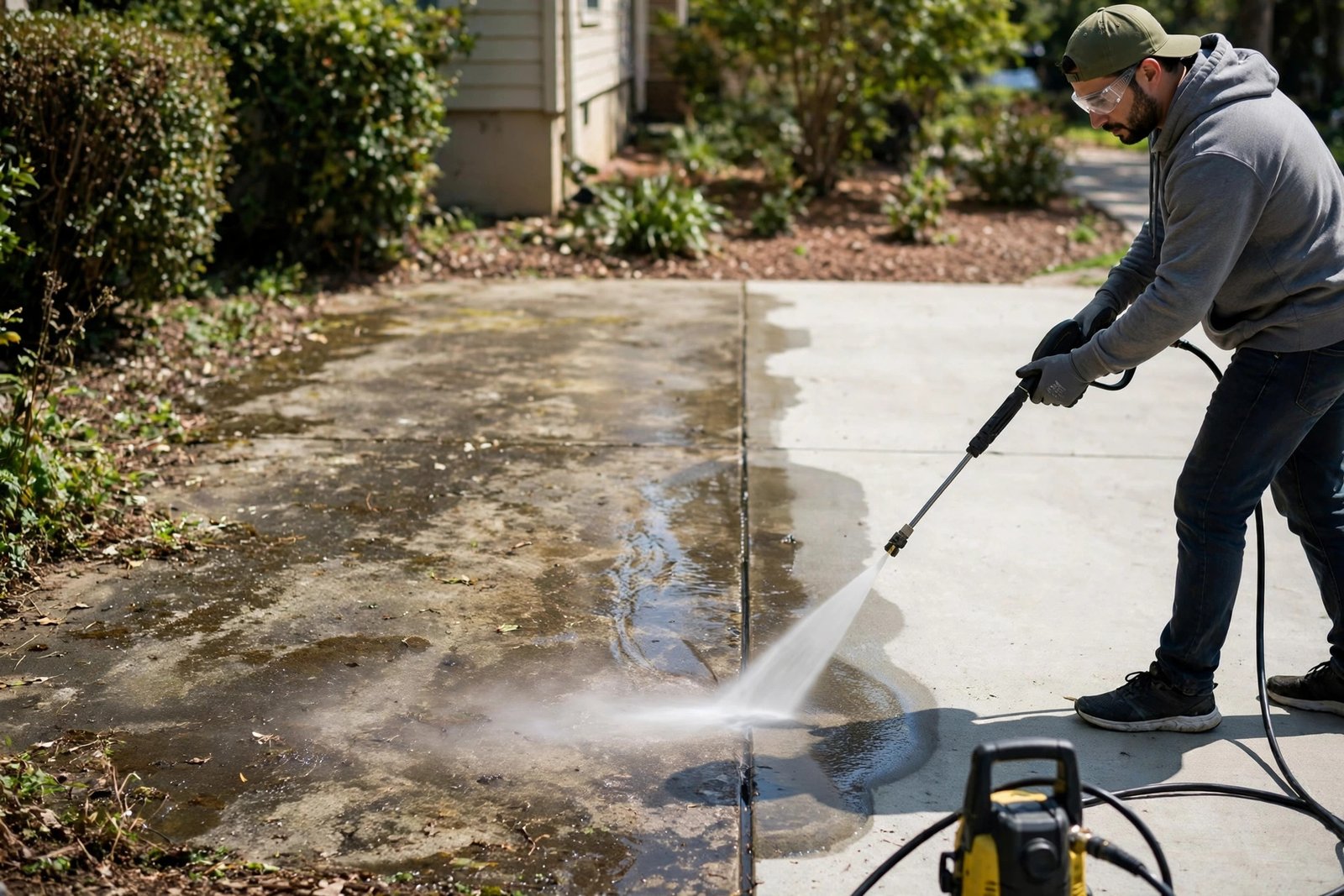
Pressure washing uses high pressure water to clean hard surfaces such as concrete driveways, patios and sidewalks. Soft washing uses low pressure plus cleaning solutions, and it is the correct method for siding, roofs, painted wood and other surfaces that high pressure can damage. Knowing which method to use on each surface is what separates a professional from someone who causes expensive damage.
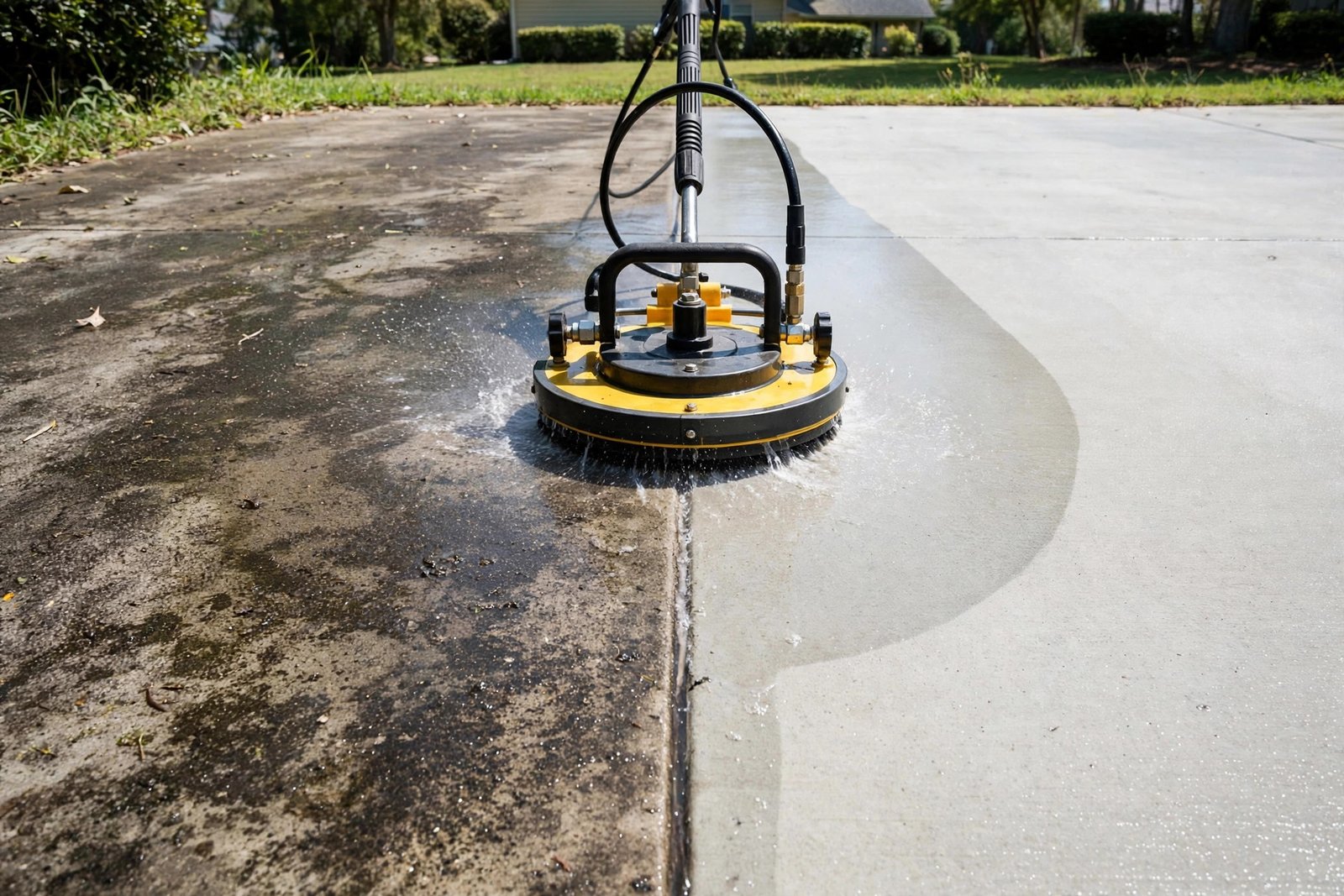
Most beginners should start with flatwork, which means driveways, patios, sidewalks and pool decks. Flatwork is the easiest to learn, the easiest to price, and the hardest to damage. House washing, deck cleaning and fence cleaning come next, once you understand soft washing. Roofs, two storey houses and painted wood are jobs to refuse until you have the training and the right equipment. A declined job costs nothing. A claim costs a season of profit.
The work itself is physical. A typical day means loading equipment, driving to one to three job sites, setting up hoses and a surface cleaner, and washing for one to three hours per job. You will be on your feet, often in heat or cold, handling a heavy hose and managing water runoff. Around the cleaning, expect 30 to 60 minutes most days on quoting, scheduling, messaging customers and collecting payment. Weekend and early morning work is common, because that is when homeowners are at home and want the work done. For the wider picture of starting small, read how to start a side hustle.
| Surface | Method | Time | Typical price range |
|---|---|---|---|
| Driveway, 2 car | Pressure wash with surface cleaner | 1 to 2 hours | 120 to 250 US dollars |
| House soft wash, 1 storey | Soft wash with cleaning solution | 2 to 4 hours | 250 to 450 US dollars |
| Deck or patio | Soft wash for wood, pressure for concrete | 1 to 3 hours | 150 to 400 US dollars |
| Fence | Soft wash for wood, pressure for vinyl | Varies by length | 1 to 2 US dollars per linear foot |
| Commercial flatwork | Pressure wash, per square foot | Varies by size | 0.08 to 0.20 US dollars per sq ft |
Prices vary by region and surface condition. These ranges come from competitor guides published in 2026 and are a starting point for your own local research, not a promise of what you will earn.
Step 1: Learn on your own surfaces first
Do not practise on a paying customer's house. Start with your own driveway, patio and sidewalk, then offer free or discounted washes to friends and family. Photograph every surface before and after, from the same angle, because those photos are your portfolio and your best marketing.
Learn the two numbers that matter on a pressure washer: PSI and GPM. PSI is the pressure, and GPM is the water volume. GPM decides how fast you clean, more than PSI does. A good starter machine for residential flatwork is a belt-drive gas unit at about 4 GPM and about 4,000 PSI, with a surface cleaner attachment. The surface cleaner is a spinning bar inside a round cover, and it cuts driveway time dramatically while leaving an even finish. Without it, you will leave stripes on the concrete.
Learn the nozzle colours too. A red 0 degree nozzle cuts a narrow, powerful jet and can damage wood, siding and concrete if you hold it too close. A yellow 15 degree nozzle is for tough concrete stains. A green 25 degree nozzle is the general workhorse. A white 40 degree nozzle is gentle, for rinsing. A black soap nozzle applies cleaning solution at low pressure. The wrong nozzle on the wrong surface is how beginners etch concrete, strip paint and crack windows.
Practise your pattern until your passes are even. Move at a steady speed, overlap each pass by a third, and keep the wand at a constant distance. Uneven passes show up as stripes, and the customer will see them. Learn soft washing before you touch a house: apply the cleaning solution at low pressure, let it sit, then rinse gently. Never use high pressure on vinyl siding, roofs or painted wood.
Step 2: Pick your services and set your prices
Start with three or four services you can do well: driveways, patios, sidewalks and house soft washing. Add deck and fence cleaning, and sealing as an upsell, once you have the experience. Sealing a clean driveway or deck adds margin and gives the customer a reason to book you again.
You need three numbers written down before your first quote: a per square foot rate for each surface you serve, a job minimum that makes small jobs worth the drive, and an hourly floor to check every quote against. Concrete flatwork commonly runs 0.08 to 0.20 US dollars per square foot in most markets, with pavers and decks higher. Most operators set a job minimum between 125 and 175 US dollars, and an hourly floor between 100 and 175 US dollars. Improvising a price on a customer's driveway is how new operators end up working weekends for less than minimum wage.
Choose one pricing method and stick to it. Per square foot is simple and transparent, and it works well for flatwork. Flat per job is easiest for clients, because they know the number up front, and it works well for houses and standard services. Per hour is common for commercial work and complex jobs. Many operators use a hybrid: a base price for typical jobs, plus fees for heavy staining or special chemicals, with a minimum charge that covers drive time and setup. For a full method on setting rates, read how to set freelance rates.
Do the maths for every service. For example, a driveway that takes 1.5 hours on site plus 0.5 hours of travel and setup is 2 hours of your time. If your operating cost is 20 US dollars an hour and your labour target is 50 US dollars an hour, the cost is 140 US dollars. Add a 30 to 50 percent profit margin, and the price lands at about 180 to 210 US dollars. Round it to 200 US dollars. This kind of maths forces you to know your numbers, and it stops you from underpricing.
Step 3: Buy the starter kit, not the dream rig
You can start for about 500 US dollars at the very low end, with a consumer machine and the basics, but a comfortable starting budget is closer to 2,500 to 5,000 US dollars. The single most expensive mistake new operators make is buying for the business they imagine instead of the jobs they have. An 8 GPM machine and a wrapped trailer do not generate leads. They generate payments.
| Item | Typical cost |
|---|---|
| Gas pressure washer, 4 GPM at about 4,000 PSI | 1,200 to 2,200 US dollars |
| Surface cleaner, 19 to 20 inch | 300 to 700 US dollars |
| Pressure hose, 100 to 200 feet | 150 to 350 US dollars |
| Nozzle set, wand, ball valve | 80 to 180 US dollars |
| Sodium hypochlorite and surfactant | 60 to 120 US dollars |
| Water supply hose, filters, protective gear | 100 to 200 US dollars |
| Working setup total | About 1,900 to 3,750 US dollars |
You can start cheaper with a consumer grade gas machine at 300 to 800 US dollars, and it works for residential driveways and decks. Be honest about its limits: it struggles with large commercial jobs and heavy concrete, and it wears out faster under daily use. Plan to upgrade to a professional unit within your first year if the business grows. Buying used from a contractor who is upgrading can cut the cost by a third, but always inspect and test the machine before you pay.
Skip for now: the trailer, the soft wash system, the vehicle wrap and the hot water unit. Every one of those is a great purchase after demand exists, and a payment book before it does. Rent or borrow a water tank and trailer for jobs without water access. Buy decent hoses, because cheap ones kink and burst. Keep a first aid kit in the vehicle, and keep safety data sheets for your chemicals. For more on keeping startup costs low, read side hustles with low startup costs.
Step 4: Register, insure and check the local rules
Treat the side hustle as a real business from day one. In the United States, most solo operators start as a sole proprietor or form a limited liability company, known as an LLC. An LLC separates your personal assets from the business, which matters in a trade where you point pressurised water at other people's property. Filing usually costs 50 to 500 US dollars depending on the state, and takes under an hour online. The US Small Business Administration explains the business structures on its register your business page. Get a free EIN from the IRS, which takes about ten minutes and is needed to open a business bank account. The IRS page for applying for an EIN is the only place you need, and you should never pay a third party for one.
Call your city clerk about a local business license, because many cities require one, and some areas have waste water runoff rules for washing. In most areas no specific licence is required for pressure washing itself, but you will need a general business registration and general liability insurance. Some municipalities regulate water runoff, especially for commercial jobs and surfaces that release contaminants, so check your local rules before taking on commercial work.
Insurance is not optional. Pressure washing is a low startup cost trade with real damage potential: water forced under siding, stripped paint, etched wood, cracked windows and chemical burns on plants. General liability insurance typically runs 50 to 150 US dollars a month for a new solo operator, or 500 to 2,000 US dollars a year. Two things new operators get wrong: relying on a homeowner's policy, which excludes business activity, and buying a generic policy that misclassifies the work. Make sure the policy explicitly covers pressure washing, and understand what it does not cover. Most policies exclude damage to the exact surface you are working on, so read the wording before you buy. Commercial auto cover, equipment cover and workers' compensation come later, once you hire.
Keep your business money separate from your personal money, open a business bank account, and track every job, every expense and every mile. A simple spreadsheet is enough at first. For the tax side in plain language, read freelance taxes for beginners.
Step 5: Build a fast quoting system
The contractor who quotes first wins a disproportionate share of jobs, almost regardless of price. Your quoting system matters more than any piece of equipment you own. Set it up before the leads arrive.
When a lead texts you an address, measure the driveway from satellite imagery, multiply by your rate, and send a written quote with the square footage on it, within the hour, without driving anywhere. For example, 1,150 square feet at 0.15 US dollars per square foot is 172.50 US dollars. A same-hour quote with a real number beats a vague promise to swing by on Saturday. Track every quote you send, whether it closed or was lost, and why. That record teaches you more about pricing than any guide can.
Follow up every open estimate. Most estimates do not close on the first message, and most new operators never send a second one. A two-line follow-up text three days later, and again at day ten, is the cheapest revenue you will ever recover. Take a deposit of 25 to 50 percent up front for jobs over 500 US dollars, and always collect payment before you leave the site. Accept cards as well as cash, because getting paid on time is not a luxury. Late or messy invoicing is one of the fastest ways a small service business runs into cash trouble.
Step 6: Win your first ten jobs
Forget paid ads for now. The first ten jobs come from three free channels, in this order: a Google Business Profile, your own network and street, and before and after photos posted everywhere. Set up your free Google Business Profile first. It is the listing that appears in map results when someone searches for pressure washing near them, and it is the single biggest driver of local leads. Add real photos, your services and your service area. You can set one up on Google Business Profile.
Post in local Facebook groups and Nextdoor, offering a small launch discount on your first ten driveway and siding washes. Leave door hangers in the neighbourhood where you just worked, because neighbours who see a clean driveway are the warmest leads you will ever get. Ask every single happy customer for a Google review on the day you finish, while they are standing on clean concrete. Ten five star reviews with photos will outperform any amount of early ad spend.
Work within 30 to 60 minutes of home. Beyond that, fuel costs and travel time eat your margins. Drive target neighbourhoods and look for visibly dirty driveways and houses, because those are future clients. Older neighbourhoods with middle-class homes are strong markets. Once you have a few reviews, approach small commercial clients such as restaurants, storefronts and property managers for recurring contracts. Commercial work is steadier and less seasonal, but it is harder to win and the insurance costs are higher.
Worked example: one weekend of pressure washing
Example only: these numbers are not typical results. They show how the maths works for one weekend, in US dollars.
A weekend operator does 4 driveway jobs on a Saturday and Sunday, at 200 US dollars each.
| Line | Amount |
|---|---|
| 4 driveway jobs at 200 US dollars | 800 US dollars |
| Fuel and vehicle | minus 60 US dollars |
| Chemicals | minus 30 US dollars |
| Insurance share for the weekend | minus 25 US dollars |
| Net before tax | 685 US dollars |
The work takes about 8 hours on site, plus about 2 hours of driving, setup and quoting, so 10 hours in total. That is about 68 US dollars per hour before tax, on a good weekend with four jobs booked close together. Your result can be lower or higher. If the jobs are scattered across town, the driving eats the profit. If you only book two jobs, the gross is 400 US dollars and the hourly rate falls sharply. That is why route density matters more than equipment: jobs close together are what make the money.
What it costs and what to expect
Starting a pressure washing side hustle costs about 500 US dollars at the very low end, 1,900 to 3,750 US dollars for a solid starter kit, or 2,500 to 7,500 US dollars for a fuller launch with insurance and legal setup. Monthly running costs run about 440 to 1,310 US dollars, mostly fuel, chemicals, insurance, software and marketing.
Expect first income in one to two weeks, and a realistic ramp after that. Most operators land their first jobs within one to two weeks of marketing, and build a semi-reliable client base over three to six months. A genuinely steady, referral-fed pipeline usually takes one to two seasons. Part-time operators in their first year commonly earn 1,500 to 4,000 US dollars a month, working weekends. Full-time solo operators who book consistently can reach 5,000 to 8,000 US dollars a month, but that takes a full year of steady work and is not a starting point.
The work is seasonal in most climates. Spring through autumn is busiest, with demand spiking before holidays and home sales. In cold regions winter slows dramatically, and some operators add gutter cleaning, holiday lighting or commercial work to fill the gap. In warm climates it can run nearly year round. The work is also hard on the body. Six to ten hours on your feet, a heavy hose, a trigger pulled hundreds of times a day, and work in heat, rain and cold. It is not passive income, and it burns people out fast if they try to do it on top of a full-time job without rest days.
Common mistakes
- Buying the cheapest machine, which breaks mid-job and costs more in downtime and replacement than a decent unit would have.
- Underpricing to win jobs, then discovering the work takes longer than expected and the hourly rate is poor.
- Skipping general liability insurance. A single etched surface or damaged window can end the business.
- Using too much pressure on siding, roofs and wood, instead of soft washing where appropriate.
- Buying the big rig first. A wrapped trailer does not generate leads, it generates payments.
- Taking every job, including roofs and two storey houses you are not trained for.
- Sending slow, vague quotes, and never following up on open estimates.
- Relying only on word of mouth and building no online presence or review base.
- Not tracking real time per job, so you never learn whether you are actually making money.
Risks and scams to watch for
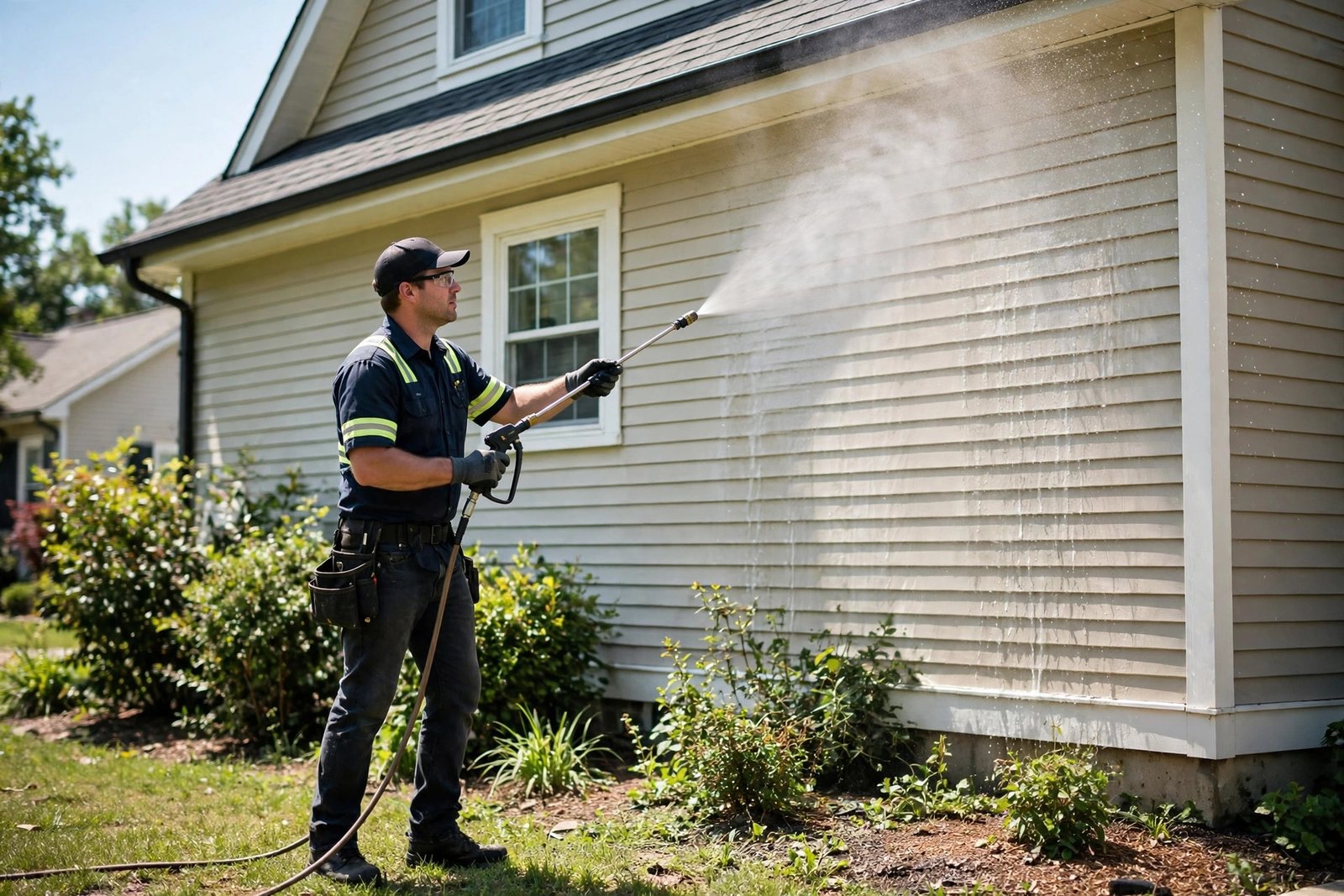
The biggest risk is damage. High pressure water can force water under siding, strip paint, etch wood, crack windows and kill plants. Chemicals add another risk: sodium hypochlorite, the main cleaning chemical, is bleach-based. It can burn skin and eyes, damage plants and harm pets if it is not handled and rinsed properly. Wear goggles, gloves and a respirator where needed, protect plants with water before and after the job, keep pets and children away from the work area, and never mix cleaning chemicals. Read the safety data sheets for every product you use.
Waste water is a legal risk as well. Dirty water that runs into a storm drain can carry chemicals and contaminants into waterways, and many towns and cities control it. Check your local rules before you take on commercial work, and use a water recovery mat where the rules require it.
Watch out for customers who want the cheapest price and the most work, and for jobs where the surface is already damaged and the customer expects you to fix it. Inspect the surface with the customer before you start, note existing damage, and agree the scope in writing. Be careful with franchise offers and courses that promise a fast path to a six figure income. No course can guarantee customers. Start lean, spend little, and let paying work decide what you buy next. For the wider method of choosing a side hustle that fits your life, read how to choose the right side hustle.
Frequently asked questions
Do I need a licence to start a pressure washing business?
In most areas no specific licence is required for pressure washing itself, but you will need a general business registration and general liability insurance. Some cities require a business licence, and some municipalities regulate water runoff, so check your local rules before you take on commercial work.
Can I start with a 300 US dollar pressure washer from a hardware store?
You can start with a consumer grade machine, but be honest about its limits. It struggles with large commercial jobs and heavy concrete, and it wears out faster under daily use. For residential driveways, decks and soft washing it is workable. Plan to upgrade to a professional unit within your first year if the business grows.
How much should I charge for pressure washing?
Pricing varies by region and surface, but many operators charge per square foot for flatwork, commonly 0.15 to 0.40 US dollars, or flat rates per job. The key is to measure and time your real work so your effective hourly rate stays profitable.
Is pressure washing seasonal?
In most climates spring through autumn is busiest, with demand spiking before holidays and home sales. In cold regions winter slows dramatically, and some operators add gutter cleaning, holiday lighting or commercial work to fill the gap. In warm climates it can run nearly year round.
What is the difference between pressure washing and soft washing?
Pressure washing uses high pressure water and is right for hard surfaces like concrete. Soft washing uses low pressure plus cleaning solutions and is the correct method for siding, roofs and painted or wood surfaces, which high pressure can damage. Knowing which to use on each surface is what separates professionals from people who cause expensive damage.
How quickly can I realistically make money?
Many operators complete their first paid jobs within one to two weeks of buying equipment and marketing locally. Reaching a consistent, reliable income usually takes three to six months of steady work, reviews and referrals.
Conclusion
Learning how to start a pressure washing side hustle comes down to a simple order: learn on your own surfaces first, start with flatwork, set your rates and a job minimum before your first quote, buy a solid starter kit instead of a dream rig, get insured, build a fast quoting system, and win your first ten jobs through a Google Business Profile, your own street and before and after photos. Refuse the jobs you are not trained for, track your real time per job, and let paying work decide what you buy next.
For your next steps, read how to start a side hustle, side hustles with low startup costs, and how to manage a side hustle with a full-time job. You can browse all the guides in the category at Side Hustles.
Notes for the reader: rules on registration, insurance, licences and waste water differ by country, state and city, and prices differ by area. Check your local authority before your first paid job, and set aside money for tax on every job. Earning results vary; nothing on this site is financial advice.