How to Make Money with a Cleaning Side Hustle in 2026
Learning how to make money with a cleaning side hustle is a good fit if you are reliable, you like visible results, and you want a low cost start. A cleaning side hustle means cleaning homes for paying customers, usually on a weekly or fortnightly visit, with your own supplies. You can start with a basic kit and a few local homes, and grow only when the work is there.
This guide is for complete beginners. You will learn which services to offer, what kit to buy, how to price by the job, how to handle insurance and trust, and how to build a round of repeat customers.
In this guide
- What a cleaning side hustle really is
- Step 1: Pick your service and your area
- Step 2: Buy the starter kit
- Step 3: Set your prices by the job
- Step 4: Register, insure and check the local rules
- Step 5: Win your first customers and build a recurring round
- Step 6: Run each booking like a pro
- Worked example: one week of cleaning
- What it costs and what to expect
- Common mistakes
- Risks and scams to watch for
- Frequently asked questions
What a cleaning side hustle really is
House cleaning is exactly what it sounds like. You arrive at a client's home with your supplies and clean it to their satisfaction. The work includes vacuuming, mopping, dusting, scrubbing bathrooms and kitchens, and handling rubbish. Deep cleans and move-out cleans also include appliance interiors, baseboards and inside cabinets.
The business model is simple: build a set of recurring weekly or fortnightly clients and fill your week with a consistent schedule. A single client who books weekly becomes a predictable income stream, and a handful of steady clients is worth far more than a long list of one-off jobs. Cleaning has one of the lowest barriers to entry of any service trade. You do not need a degree, a licence to mop a floor or expensive machinery. You need supplies, a way to get to the job, and the discipline to do consistent work. For the wider picture of starting small, read how to start a side hustle.
| Service | What it includes | Typical price range |
|---|---|---|
| Standard recurring clean | Dust, vacuum, mop, kitchen and bathroom wipe down | 100 to 200 US dollars per visit |
| Deep clean | Standard clean plus appliance interiors, baseboards, inside cabinets | 200 to 400 US dollars |
| Move-in or move-out clean | Full deep clean of an empty home | 200 to 400 US dollars |
| Vacation rental turnover | Clean and reset between guests | 80 to 150 US dollars per clean |
| Office cleaning, small business | Trash, vacuum, desks, restrooms, break room | Priced per visit or monthly |
A standard recurring clean of a two or three bedroom house takes roughly 1.5 to 3 hours. Prices vary by area and home size. These ranges come from competitor guides published in 2026 and are a starting point for your own local research, not a promise of what you will earn.
Step 1: Pick your service and your area
Before anything else, decide what kind of cleaning you want to offer, because this single choice shapes your pricing, your equipment and how big you can grow. Residential house cleaning is the easiest place to start. You can work alone, the spaces are smaller, and clients usually pay right after each visit. You will typically build up to a dozen or more homes that you clean weekly or every other week. This is the right fit if you want to start solo and keep things simple.
Commercial cleaning means offices, retail spaces and other businesses. It usually requires a small team, a vehicle to move people and supplies, and the ability to clean after hours. A few regular commercial contracts can keep you profitable, because the jobs are larger and recurring, but you are managing a schedule, a team and a facility manager rather than working alone. Many owners start residential and add commercial later. If you are not sure, start with house cleaning, because it costs less to launch and teaches you the fundamentals fast.
Pick a niche you can own. A focused position, for example eco-friendly home cleaning or office cleaning for small clinics, lets you charge more and market with a sharper message than a generic "we clean everything" company. Look for a gap. If nobody local offers move-out cleaning, eco-friendly cleaning or vacation rental turnovers, that gap is your opening.
Choose a small service area and one clear offer, such as regular domestic cleaning with a two hour minimum. A small area keeps travel costs low, and a clear offer makes it easy for customers to say yes. Start with a few manageable bookings around your existing responsibilities, rather than filling every spare hour immediately. For the wider method of picking a side hustle that fits, read how to choose the right side hustle.
Step 2: Buy the starter kit
You can start a cleaning side hustle for as little as 50 to 300 US dollars if you go solo and residential, or about 300 to 2,000 US dollars for a more complete setup with insurance and registration. A basic supply kit gets you started for under 100 US dollars. Buy only what your first jobs need, and reinvest your early profits.
| Item | Typical cost | Notes |
|---|---|---|
| Cleaning supplies kit | 50 to 100 US dollars | All-purpose cleaner, glass cleaner, bathroom cleaner, microfibre cloths, scrub brushes, mop |
| Vacuum cleaner | 0 to 150 US dollars | Use the client's vacuum to start, or buy your own for a more professional look |
| Caddy or supply bag | 15 to 30 US dollars | Keeps supplies organised and speeds up your work |
| Gloves and protective gear | 10 to 30 US dollars | Chemical resistant gloves, masks for heavy duty jobs |
| General liability insurance | 25 to 50 US dollars a month | Required by most platforms and many homeowners |
| Total to start | 50 to 300 US dollars | Your first 2 to 3 paid jobs cover the supplies |
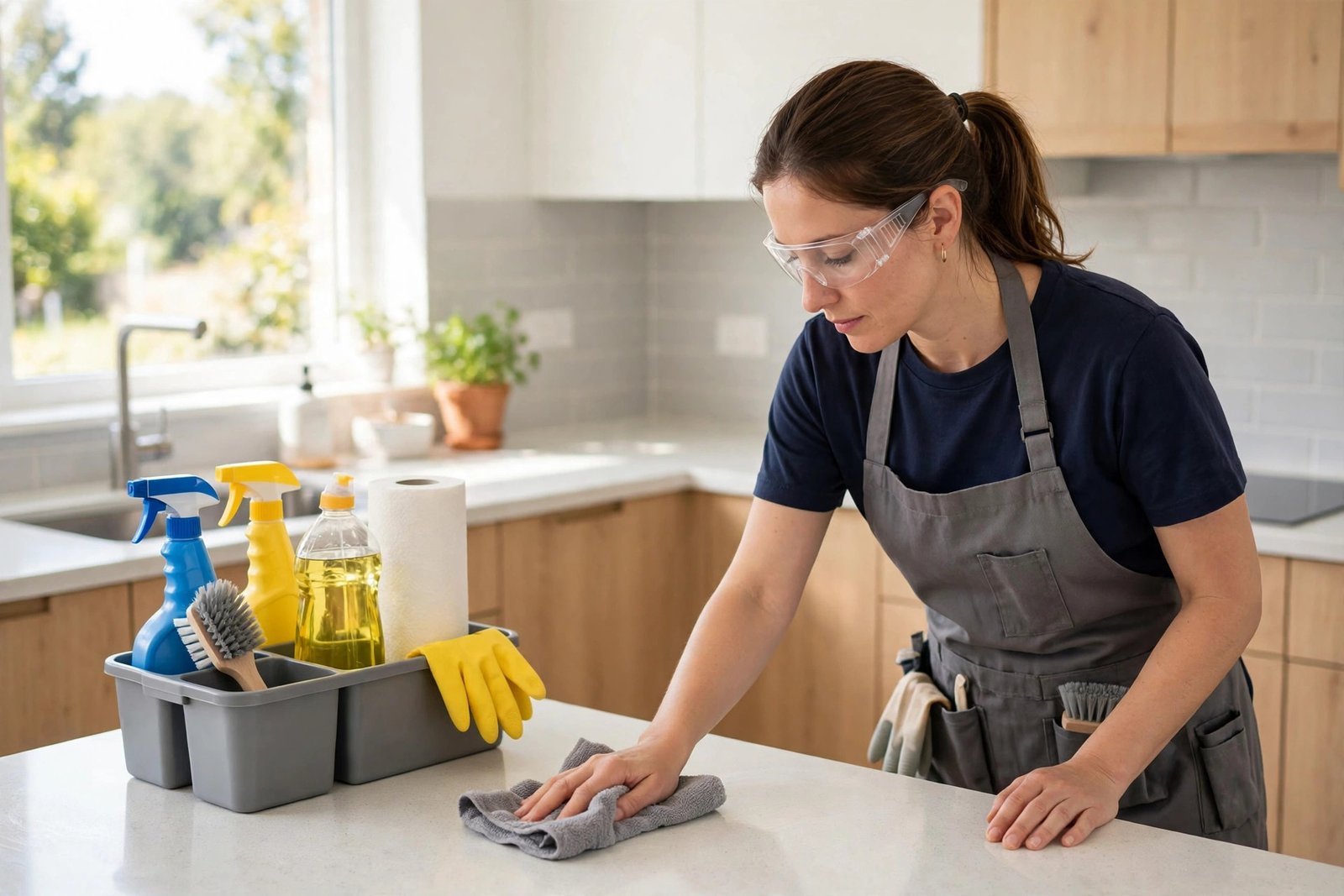
Begin with microfibre cloths separated by task, suitable gloves, non-scratch sponges, a caddy, brushes, a mop and bucket, and labelled products suitable for the surfaces you clean. Use separate cloths for toilets and kitchens, and never mix them up. Agree in advance whether you use your own equipment or the customer's. Always bring your own supplies. It looks more professional, it ensures you use products that work well, and it removes awkward conversations about what a client may or may not have. Factor supply costs, roughly 5 to 10 US dollars per job, into your pricing.
Keep ovens, carpets, mould removal, hazardous waste and work at height outside your starter service, unless you have the right training, equipment and cover. Those jobs need different skills and different insurance, and they are where beginners get hurt or cause damage. You can add them later, once you understand the access, equipment and insurance needs. Consider stocking eco-friendly products if your market wants them, because they support premium pricing. For more on keeping startup costs low, read side hustles with low startup costs.

Step 3: Set your prices by the job
Price by the job, not by the hour, because it rewards your efficiency. A two bedroom apartment runs 100 to 150 US dollars. A three bedroom house is 150 to 200 US dollars. A deep clean or move-out clean is 200 to 400 US dollars. Charge more for first-time cleans, because they take longer. Offer a 10 to 15 percent discount for weekly recurring clients, to secure stable income.
Hourly rates help you check your prices. Beginner cleaners charge about 25 to 30 US dollars an hour, intermediate cleaners 30 to 42 US dollars, and experienced cleaners 42 to 50 US dollars or more. In the United Kingdom, an indicative starting benchmark for regular domestic cleaning is 15 to 25 pounds per booked cleaning hour. These are business revenue, not wages or take-home profit, because travel, products, insurance and tax all come out of them. Research your local market and your own costs before choosing a price.
To set your rates, walk the space and factor in its size, its condition, how often you will clean it, and your supply and travel costs. Research what local competitors charge, so you are in the right range, then add your target profit margin. Quote deep cleans separately, after assessing the work, because you cannot price a deep clean without seeing the home. Consider a minimum booking, such as two hours, so travel does not consume the margin. Many new owners underprice to win clients, then struggle to raise rates later, so charge what the work is worth from the start. For a full method on setting rates, read how to set freelance rates.
Step 4: Register, insure and check the local rules
Register your business before you clean for paying customers. In the United States, many owners start as a sole proprietor for simplicity, then form a limited liability company, known as an LLC, for liability protection as they grow. An LLC helps separate your personal assets from the business. The US Small Business Administration explains the business structures on its register your business page. Get an EIN from the IRS, which is free and takes a few minutes online. You can apply on the IRS EIN page. Never pay a third party for an EIN. Open a separate business bank account so your business and personal finances never mix.
Most cities and counties require a general business licence to operate legally, but there is usually no special cleaning licence for basic residential or commercial work. The details vary by state and even by city, so check your city or county clerk before you take on clients. Specialty work such as mould remediation or lead and asbestos abatement is separately regulated in most places, and it is illegal without the right contractor licence. Industry certifications build credibility but never replace a government licence.
In the United Kingdom, most cleaners start as a sole trader. You register with HMRC soon after you start trading and complete a Self Assessment tax return each year. The GOV.UK page on setting up as a sole trader explains the steps, including keeping records and paying Income Tax and National Insurance on your profits.
General liability insurance is essential, because you work inside clients' homes and offices. If you break a vase or cause water damage, this cover protects you from a claim that could otherwise sink the business. Most cleaning companies carry 500,000 to 2 million US dollars in cover, with premiums starting at around 400 to 1,200 US dollars a year for a small operation, or 25 to 50 US dollars a month. Many commercial contracts and vendor platforms will not let you bid without proof of insurance. A janitorial or surety bond, sometimes called being bonded, reassures clients that they are protected against theft or damage, and it is frequently required to win commercial contracts. It costs about 100 to 300 US dollars a year. Once you hire employees, most places require workers' compensation.
Keep records from the start. Record income, receipts and work expenses, and track mileage to every job, because mileage driven to client homes is a deductible business expense in the United States. The IRS sets a standard mileage rate each year, so check the current rate on the IRS site rather than relying on a figure from a guide. In the United States, self-employed cleaners also pay self-employment tax on top of regular income tax, so set aside 25 to 30 percent of your income for tax and pay quarterly estimates. For the tax side in plain language, read freelance taxes for beginners.
Step 5: Win your first customers and build a recurring round
Your first customers will come from people you know. Tell friends, family, neighbours and former coworkers that you are open for business, and ask them to spread the word. Clean 2 to 3 homes for free or at a discount to get reviews. Post on Nextdoor or your neighbourhood Facebook group, offering a discounted first clean in exchange for an honest review. Take before and after photos, with permission. Your goal is 3 to 5 reviews before charging full market rates, because these early reviews are the foundation of your word-of-mouth business.
Set up a free Google Business Profile as soon as you have a business name. It is where most local clients will find and vet you. Add photos of your work and respond to reviews. You can set one up on Google Business Profile. Create profiles on platforms such as Thumbtack and Handy, which connect you with homeowners actively searching for cleaners. Both take a fee or a percentage, so use them as a bridge to build reviews, then move clients onto your own direct booking system where you keep the full fee.
After a client's first clean, offer a 10 to 15 percent discount for a weekly or fortnightly recurring booking. Most clients who liked the first clean will convert. A weekly or fortnightly contract is worth far more than a one-off clean, so make recurring service your default offer. Introduce yourself to local real estate agents, because move-out cleans are in constant demand near apartment complexes, and agents are a great referral source. A simple referral programme, such as a discount on the next clean for every friend referred, turns happy clients into a sales force.
Aim for recurring work from the start, and group jobs by area so you spend less time driving. A well-run solo operation with 10 recurring clients can earn 4,000 to 6,000 US dollars a month, according to one 2026 guide, but that is a full client roster built over time, not a starting point. Your first goal is simpler: get one paying customer, complete the agreed checklist well, record the real time and costs, and secure a repeat booking if the customer is happy. Then improve your process before chasing more work.
Step 6: Run each booking like a pro
A good booking starts before you arrive. Ask about the property size, its current condition, priority rooms, pets, parking and access. Agree a written checklist, a price, a booking length, equipment arrangements and payment terms. Explain what is excluded, and agree how extra work will be authorised before you start it. Check surface care instructions, and test suitable products in an inconspicuous area where appropriate.
Work systematically, room by room, with separate cloths for toilets and kitchens. Follow product labels, dilution instructions and safety data sheets. Never mix cleaning products, especially bleach with other cleaners. Use suitable protection and ventilation, keep products labelled, and prevent slips on wet floors. Keep customer addresses and access details secure, because you are working in someone's private space every week, and trust is the real product you sell.
Walk through the completed checklist with the customer, record payment, and offer a repeat slot. Ask for a Google review after every job, while the customer is happy. If something is broken or damaged, tell the customer at once and report it to your insurer. Hiding a breakage destroys trust far faster than the breakage itself. Keep a history for every client, with notes on what was done, what products were used and any special requests. For the wider method of fitting a side hustle around a job, read how to manage a side hustle with a full-time job.
Worked example: one week of cleaning
Example only: these numbers are not typical results. They show how the maths works for one week of part-time cleaning, in US dollars.
A cleaner does 6 recurring cleans in a week, at 150 US dollars each, with each clean taking 3 hours.
| Line | Amount |
|---|---|
| 6 cleans at 150 US dollars | 900 US dollars |
| Products, about 8 US dollars per job | minus 48 US dollars |
| Travel, fuel and parking | minus 60 US dollars |
| Insurance share for the week | minus 12 US dollars |
| Net before tax | 780 US dollars |
The work takes 18 hours of cleaning, plus about 6 hours of travel and admin, so 24 hours in total. That is about 32 US dollars per total working hour before tax, and about 43 US dollars per cleaning hour. Your result can be lower or higher. The example counts travel and admin, which many guides leave out, and that is why the hourly rate is lower than the headline rate. A cleaner who only counts cleaning hours will think they earn more than they do. Count every hour, and price accordingly.
What it costs and what to expect
Starting a cleaning side hustle costs about 50 to 300 US dollars for a basic kit, or 300 to 2,000 US dollars for a more complete setup with insurance and registration. Monthly running costs are low: products, fuel, insurance and a phone. Most of your money goes to your time, not to supplies.
Expect first income in one to two weeks, because the work is easy to start and demand is steady year round. A part-time solo cleaner with a few clients can earn 800 to 1,500 US dollars a month at beginner rates, growing to 2,500 to 4,500 US dollars a month as reviews and recurring clients build. A full-time solo cleaner with a full roster can earn 5,000 to 8,000 US dollars a month before expenses, but that takes months of steady work and is not a starting point. Cash tips are common, and all income is taxable, including cash tips, so keep a record of them.
The work is physical and repetitive. You will spend several hours a day on your feet, moving between rooms, lifting heavy items and performing repetitive motions such as scrubbing, mopping and vacuuming. It takes a toll on joints and back over time, and you will be exposed to cleaning chemicals, so use gloves, ventilation and ergonomic tools. Client homes vary widely in condition, and some will be far dirtier than you expected. Quote first-time cleans higher, and agree the scope in writing before you start. The work is not passive income, and it is not a quick route to a full-time income, but it is steady, honest work with real demand in every town.
Common mistakes
- Underpricing, then being unable to raise prices without losing customers.
- Driving too far between small bookings, so travel eats the margin.
- Buying expensive machines before customers need them.
- Promising more work than the booked time allows.
- Treating customer payments as pure profit, and forgetting tax, travel and products.
- Using the client's supplies instead of your own, which looks unprofessional.
- Taking on specialised work, such as mould removal or carpet cleaning, without the training and cover.
- Not asking for reviews, so the business stays invisible online.
- Forgetting to record cash tips and mileage, which causes trouble at tax time.
Risks and scams to watch for
The biggest risk is trust. You work alone in a client's private home, often with a key or a lockbox code, and customers are buying trust as well as a clean room. Never claim to be insured, vetted or experienced unless it is true. Keep customer addresses and access details secure. If you lose a key or damage something, tell the customer at once. A background check can reassure clients, and some platforms require one, so consider it if you plan to work through a platform.
Chemical safety is a second risk. Never mix cleaning products, especially bleach with other cleaners, because the fumes can be dangerous. Read product labels and safety data sheets, wear gloves, ventilate the rooms you clean, and keep products away from children and pets. Some surfaces are damaged by the wrong product, so test in an inconspicuous area first.
Watch out for jobs that ask you to clean hazardous waste, mould, or homes with unsafe conditions. Refuse those jobs and refer them to a specialist. Be careful with platforms that charge high fees or take a large percentage of every booking. Use them to build reviews, then move clients to direct booking where you keep the full fee. Be careful with franchise offers and courses that promise guaranteed income. No course can guarantee customers. Start small, spend little, and let paying work decide what you buy next. For the wider method of choosing a side hustle that fits your life, read how to choose the right side hustle.
Frequently asked questions
How much can you make cleaning houses?
A standard three bedroom house clean takes 3 to 4 hours and pays 120 to 200 US dollars, which works out to 30 to 50 US dollars an hour. With 5 recurring weekly clients, you can earn 600 to 1,000 US dollars a week part time. Full-time cleaners with 10 or more weekly clients earn 3,000 to 6,000 US dollars a month before expenses, but that is a full roster built over time.
Do I need a business licence to clean houses?
Requirements vary by state and city. Most solo house cleaners operate with a general business registration, and some cities require one, typically for a small fee. Check your local city clerk website. Platforms such as Handy handle their own contractor requirements separately from city licensing.
Should I use clients' cleaning supplies or bring my own?
Always bring your own supplies. It looks more professional, it ensures you use products that work well, and it removes awkward conversations about what a client may or may not have. Factor supply costs, roughly 5 to 10 US dollars per job, into your pricing.
How do I price a house cleaning job?
Price by the job, not the hour. A two bedroom apartment runs 100 to 150 US dollars. A three bedroom house is 150 to 200 US dollars. A deep clean or move-out clean is 200 to 400 US dollars. Charge more for first-time cleans, because they take longer. Offer a 10 to 15 percent discount for weekly recurring clients to secure stable income.
Is house cleaning a good side hustle?
Yes, it is one of the best local service side hustles. Demand is consistent year round, cash tips are common, startup cost is low, and recurring clients provide predictable income. The main downsides are physical toll over time and exposure to cleaning chemicals. Using ergonomic tools and chemical resistant gloves helps a lot.
Do I need insurance to clean houses?
Yes. A general liability policy costs about 25 to 50 US dollars a month and covers accidental damage. It is required by most platforms and many homeowners. A bond, which costs about 100 to 300 US dollars a year, reassures clients that they are protected against theft or damage, and it is often required for commercial contracts.
Conclusion
Learning how to make money with a cleaning side hustle comes down to a simple order: pick residential cleaning as your starting service, buy a small starter kit, price by the job with a minimum booking, register and insure the business, win your first customers through people you know and a free Google Business Profile, and turn every first clean into a recurring booking. Bring your own supplies, work to a written checklist, count travel and admin in your real hourly rate, and ask for a review after every job. Start with one paying customer and a repeat booking, then improve your process before chasing more work.
For your next steps, read how to start a side hustle, how to choose the right side hustle, and how to manage a side hustle with a full-time job. You can browse all the guides in the category at Side Hustles.
Notes for the reader: rules on registration, insurance, licences and tax differ by country, state and city, and prices differ by area. Check your local authority and tax office before your first paid job, and set aside money for tax on every job. Earning results vary; nothing on this site is financial advice.