You finish your main job tired, and your side hustle still needs hours. Some weeks you do too much and feel worn out. Other weeks you do nothing and feel guilty. Both patterns are normal, and both are fixable. The problem is rarely effort. It is the lack of a weekly system: fixed slots, clear boundaries, and a plan for busy weeks. This guide gives you that system. It assumes your full time job stays, and your hustle stays part time. It does not teach you how to choose an idea or how to quit. For choosing, read How to Choose the Right Side Hustle in 2026. For launching, read How to Start a Side Hustle in 2026. For leaving your job in phases, read How to Turn a Side Hustle Into Full-Time Income in 2026 only when you are ready for that decision, not as a reason to overload yourself now.
In this guide
- Rule 1: Your main job comes first
- Rule 2: Fix your weekly hours before you fill them
- Rule 3: Block time by energy type, not just by clock
- Rule 4: Handle your employer honestly and safely
- Rule 5: Run a weekly review in 15 minutes
- Rule 6: Use a busy period protocol
- Rule 7: Guard rest and watch for burnout
- What it costs and what to expect
- Common mistakes
- Risks to watch for
- Frequently asked questions
Rule 1: Your main job comes first
Your full time job pays your bills, funds your safety net, and gives you the freedom to test a hustle without panic. Protect it. Never work on your hustle during paid work time, never use employer equipment, software, or contacts for hustle work, and never let hustle messages distract you from job tasks. This rule is practical, not just polite. Working on a hustle during job hours can break your contract, damage trust, and cost you the job that funds the hustle. It also blurs the line in a way that can create ownership disputes over work you create. Keep the two worlds separate in tools too: a separate calendar, a separate email address, separate folders, and separate payment accounts. Physical separation helps as well.
Rule 2: Fix your weekly hours before you fill them
Pick a weekly hour budget and treat it as a limit, not a target to beat. Most people with a full time job sustain 5 to 12 hours a week for a hustle, depending on family, health, and commute. Start at the low end. A 5 hour week done every week beats a 20 hour week that collapses after two weeks. The table below shows three sample weeks. Each one protects one full day off, keeps hustle work out of job hours, and leaves room for admin.
| Version | Weekly hours | Typical pattern | Best for |
|---|---|---|---|
| 5 hour week | 5 hours | Two weekday evenings of 1.5 hours, plus 2 hours on Saturday | Beginners, parents, or anyone with a long commute |
| 8 hour week | 8 hours | Three weekday evenings of 2 hours, plus 2 hours on Saturday | Steady growth with one full day off |
| 12 hour week | 12 hours | Four weekday evenings of 2 hours, plus 4 hours across the weekend | Experienced hustlers in a short push, not forever |
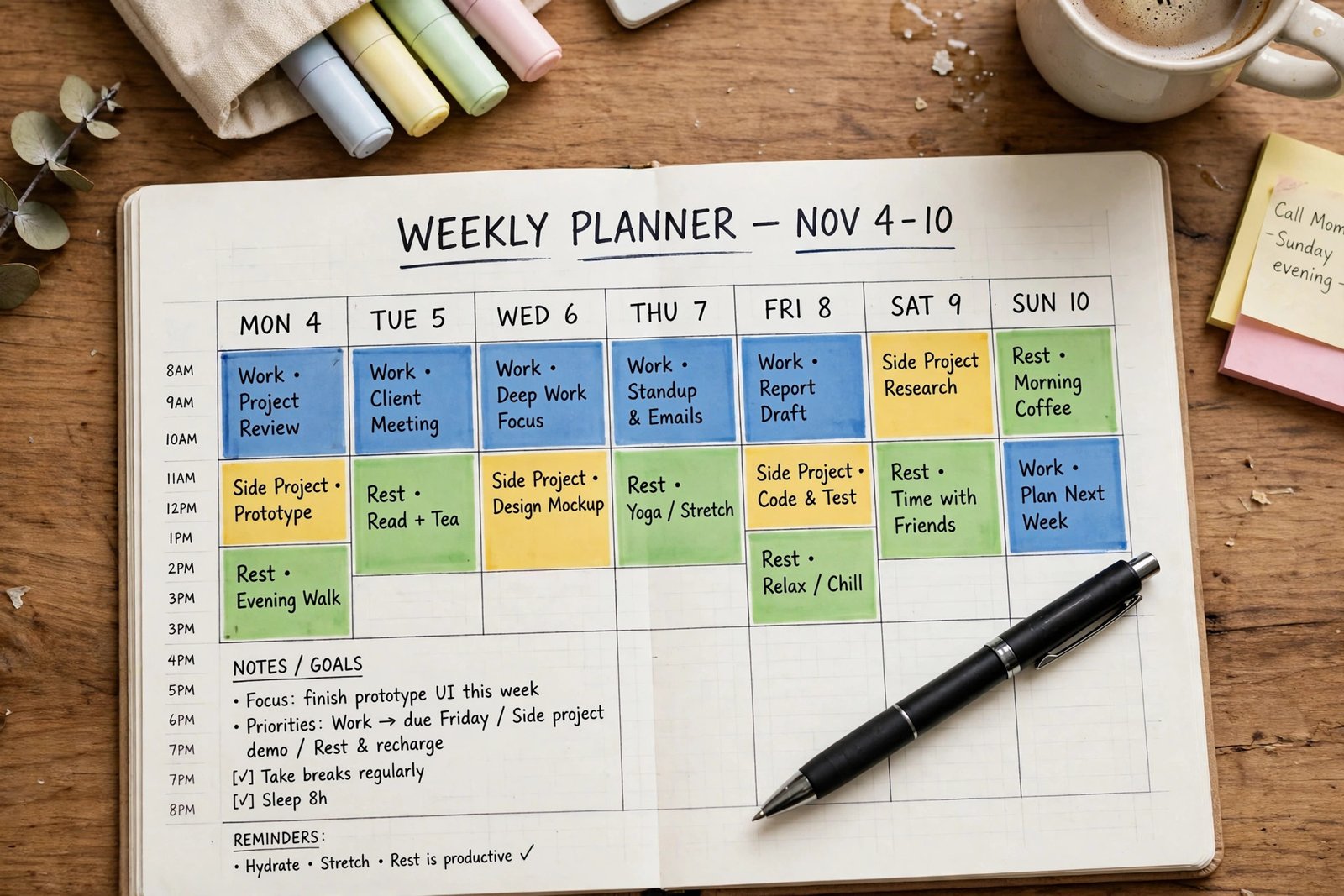
For shift workers, the same totals apply, but the slots move to rested off-shift days, and carers should use short, protected slots agreed with the household.
Rule 3: Block time by energy type, not just by clock
Time blocking means giving each task a fixed slot. Energy batching means grouping similar tasks so you do not switch modes all evening. Both help, but energy batching is what makes a small number of hours productive. Sort hustle tasks into three energy types. Creative work, such as writing, designing, or planning, needs fresh focus. Client work, such as calls, messages, and delivery, needs social energy and patience. Admin work, such as invoices, records, and listings, needs little creativity but steady attention. Put creative work in your best slot, usually the first hustle slot of the week or the slot after rest. Put client work in a slot where you can be friendly and patient. Put admin in a low energy slot, such as a short Sunday session, and batch it: answer all messages at once, send all invoices at once, update all listings at once. Do not scatter admin through every slot, because each switch costs focus. A simple weekly shape looks like this: one creative slot, one client slot, one delivery slot, and one short admin slot. If a task does not fit any slot, it may not belong in this week's plan.
| Energy type | Best hustle tasks | Best slot |
|---|---|---|
| Creative and fresh | Writing, designing, planning | First hustle slot of the week |
| Social and patient | Calls, messages, delivery | A slot where you can be friendly |
| Steady and low creativity | Invoices, records, listings | One short batched admin slot |
Example only: an 8 hour week that holds
Example only: this schedule is invented to show the method. Suppose a reader works 9 to 5 and blocks Tuesday and Thursday evenings for client work, Wednesday evening for creative work, and Saturday morning for admin. Sunday is fully off. In a busy week she keeps only booked client work and skips admin, so the average stays near 7 hours and the plan survives.
Rule 4: Handle your employer honestly and safely
Employer rules come before hustle ambition. Start by reading your employment contract and any staff handbook rules about outside work, conflicts of interest, confidentiality, non compete clauses, and use of company property. General information about employment terms is published by GOV.UK at its employment contracts pages, but your own contract is the document that binds you. If the contract bans outside work, or bans work in a related market, do not ignore it. Choose a hustle outside that market, or seek advice before you start. Next, decide whether to tell your employer. Telling can help when your hustle builds a skill your employer values, when your contract requires disclosure, or when a manager is likely to find out anyway. In that case, keep the conversation short and professional: what the hustle is, that it happens outside work hours, that it uses no employer time or property, and that it does not serve your employer's clients or competitors.
Rule 5: Run a weekly review in 15 minutes
A weekly review turns busy work into a system. Pick one fixed time, such as Sunday evening, and answer five questions in writing. What did I finish this week? What earned money or moved a sale forward? What took longer than expected, and why? What will I do in each hustle slot next week? What will I stop doing, pause, or delegate? Keep the review to 15 minutes. Its purpose is to choose next week's work, not to judge yourself. If a task keeps rolling forward week after week, it is either too big, too vague, or not worth doing. Break it smaller, define its done state, or drop it. If income is flat but hours are rising, check your price, your scope, or your client mix, rather than adding more hours. If you feel tired every review, cut hours before you cut quality. The review is also where you spot overwork early, which brings us to the next two rules. A hustle without a review grows by accident.
Rule 6: Use a busy period protocol
Busy periods at your main job will happen: deadlines, overtime, travel, illness in the family, or exam seasons. Decide your protocol before one hits, so you do not decide while exhausted. The protocol has three levels. Level 1, for a busy week, means pause new clients, keep only paid work already booked, and cut hustle hours in half. Level 2, for a busy fortnight, means pause new work entirely, tell existing clients about a short delay, and keep only a 30 minute admin slot per week. Level 3, for a crisis or a long overtime stretch, means pause the hustle fully, tell clients honestly, and set a restart date. Pausing is not quitting. It is how a part time hustle survives a full time job. Tell clients early, in plain words: "My main job has a busy period for the next two weeks, so deliveries will move by one week. I will confirm your new date by Friday." Most clients accept an honest delay.
Rule 7: Guard rest and watch for burnout
Rest is part of the system, not a reward for finishing everything. Keep at least one full day each week with no hustle work, and keep some evenings free. Protect sleep first, because tired work is slow work with more mistakes. Watch for burnout warning signs: dreading every hustle slot, falling asleep at your main job, snapping at family over small things, missing deadlines you used to meet, and feeling ill or exhausted most days. If several signs appear for more than two weeks, cut hustle hours at once, even if income dips. A short cut now saves a long break later. Also watch the hidden cost of always being on. Turn off hustle notifications outside your slots, and do not check client messages in bed or at family meals. If a client demands instant replies at all hours, that client is a poor fit for a part time hustle, however well they pay. For the overlap between overwork and common beginner errors, read Common Freelancing Mistakes.

What it costs and what to expect
Managing a hustle beside a job costs time and attention, not just money. Budget 30 minutes a week for planning and review, on top of your hustle hours. Expect uneven weeks, because your main job or family will sometimes need you. Tax rules differ by country, so keep records from day one and check the tax authority's small business pages for United States guidance.
Common mistakes
- Working on the hustle during paid job hours, or on employer equipment.
- Setting no weekly hour limit, then working until exhaustion and quitting.
- Doubling the next slot to catch up after a missed slot.
- Scattering admin through every slot instead of batching it once a week.
- Skipping the weekly review, so the same unfinished tasks roll forward for months.
Risks to watch for
The main risks here are contractual, health, and relationship risks, not just money risks. A contract breach can cost you your main job, so read the contract before you start and keep the boundary strict. Overwork can harm sleep, health, and family life, so treat the rest rule as a rule, not a suggestion. Client pressure can creep upward: a client who starts with one job and grows to expect daily availability needs a clear hours conversation, or a polite ending. Platform and payment risks also apply: keep records, confirm scope and price in writing, and take deposits for larger jobs where that is normal. If a client asks you to do work that breaks your employer's rules, or asks you to use confidential information, decline it. No single job is worth your main income or your reputation.
Frequently asked questions
How many hours a week should a side hustle take with a full-time job?
Most people sustain 5 to 12 hours a week. Start at 5, review after a month, and raise hours only if rest, main job performance, and relationships stay healthy.
Should I tell my employer about my side hustle?
Tell your employer if your contract requires disclosure, if the hustle is related to your job, or if a manager is likely to find out. Otherwise, telling is optional when the hustle is unrelated and uses no employer time or property.
How do I avoid burnout with a side hustle?
Fix a weekly hour limit, keep one full day off, block work by energy type, and run a short weekly review. Cut hours at the first sustained warning signs, such as dread, exhaustion, or falling main job performance.
What do I do when my main job gets busy?
Use a busy period protocol decided in advance. For a busy week, halve hustle hours and pause new clients. For a busy fortnight, pause new work and keep only a short admin slot. For a crisis, pause fully, tell clients honestly, and set a restart date.
Conclusion
Managing a side hustle beside a full time job comes down to seven rules: main job first, fixed weekly hours, time blocked by energy type, honest employer boundaries, a 15 minute weekly review, a busy period protocol, and guarded rest. Pick your hour budget this week, write it into your calendar, and protect one full day off. Your next step is to choose the 5, 8, or 12 hour pattern that fits your life and block next week's slots today. When you are ready to think about going full time, read How to Turn a Side Hustle Into Full-Time Income in 2026. Browse the full Side Hustles category page for the rest of the series.