
Freelance Taxes for Beginners Explained in 2026
When you start freelancing, tax feels different from a salaried job, because no employer takes tax from your pay before you receive it. You are responsible for tracking your income, keeping records, setting money aside, and paying what you owe by the local deadline. This guide explains freelance taxes for beginners in general, country neutral terms, so it stays useful wherever you live. Tax rules differ by country, and they change over time, so check your local tax authority or a qualified accountant for the rules that apply to you. This article is general information only, not tax advice, and it quotes no specific tax rate as universal, because no single rate applies everywhere.
Why freelance tax feels different
In a salaried job, the employer usually withholds tax from each pay packet and sends it to the tax authority. As a freelancer, clients usually pay you the full agreed fee, and no tax is taken out first. That means the money in your account is not all yours to spend, because part of it will later go to tax. This is the single biggest surprise for new freelancers, and it causes the most stress at filing time. The fix is a habit, not a single action: set money aside as income arrives, track every payment, and keep records through the year.
The three ideas that matter
Taxable profit is the first idea, and it means your income minus your genuine business expenses. A business expense is a cost you incurred to earn your freelance income, such as software, equipment, or work travel. Personal spending is not a business expense, even when it happens during a working day. Setting money aside is the second idea. As each payment arrives, move a share into a separate account for tax, so the money is there when payment falls due. The right share differs by country, income level, and personal situation, so choose it with local guidance, not from a figure quoted for another country. Records are the third idea. Records are the lists, receipts, and invoices that prove your income and expenses, and they are what make deductions stand if a tax authority asks questions. These three ideas support everything else in this guide.
A simple system: separate money, track everything
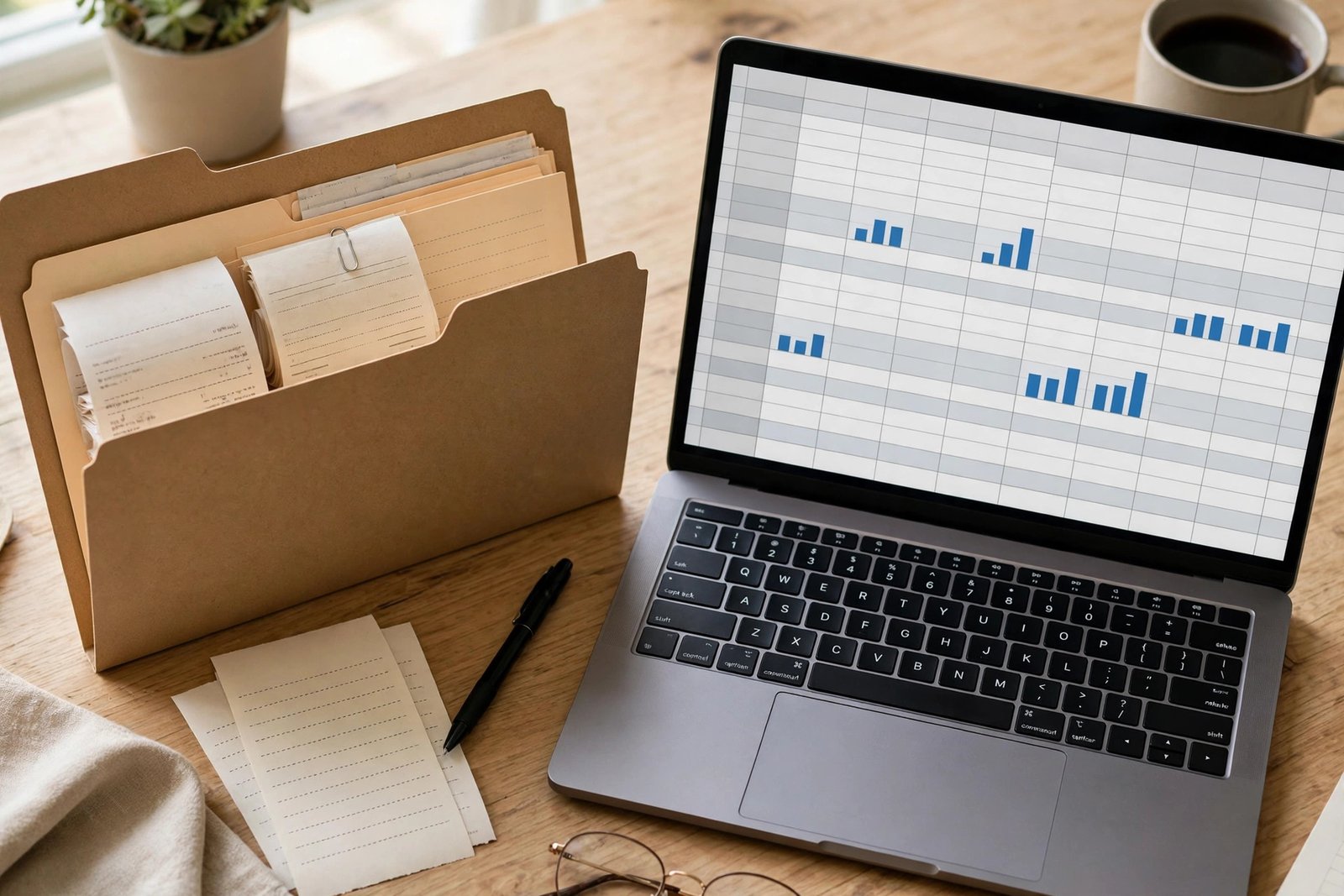
A simple system beats a complex one you abandon. Open a separate bank account for freelance money where you can, or at least keep a separate record of freelance income and spending. Record every payment you receive, with the client name, the date, the amount, and the invoice number. Record every business expense, with the date, the supplier, the amount, and the purpose. Keep the receipt or invoice for each expense, photographed or scanned, in one folder per year. Move a set aside share into your tax account each time a client pays you, and do not borrow from that account for personal spending. Review your records once a month, so gaps are small and easy to fix. Our guide on how to invoice freelance clients explains the invoice side of this record habit, and keeping invoices with contracts gives you a clean trail from agreement to payment to tax record.
What counts as a business expense
Business expenses fall into categories, and each category needs the same three tests: was the cost for the business, is it recorded, and is personal spending kept separate. Workspace costs cover a home office share or a rented workspace, where local rules allow it. Tools and software cover the programmes and subscriptions you use for client work. Equipment covers computers, phones, and other gear used for the business, though larger items may follow special local rules. Phone and internet cover the business share of those bills, not the whole bill when the phone is also personal. Travel for work covers trips made for a client or a job, with dates and purposes noted. Learning covers courses and books that keep your freelance skills current. Professional fees cover accounting, legal, and business advice. Transaction fees cover payment processing costs on client payments. Insurance covers business cover where you hold it.
| Expense category | Examples | Record to keep |
|---|---|---|
| Workspace | Home office share, rented desk | Bills, floor area note, local rule check |
| Tools and software | Design, writing, accounting tools | Subscription receipts, renewal dates |
| Equipment | Computer, phone, camera | Purchase invoice, business use note |
| Phone and internet | Business share of bills | Bills, business share calculation |
| Travel for work | Client visits, work trips | Dates, purpose, tickets, mileage log |
| Learning | Courses, books, events | Receipts, course details |
| Professional fees | Accountant, legal advice | Invoices, advice notes |
| Transaction fees | Payment processing charges | Payment statements |
Payments through the year in general terms
Some countries ask freelancers to pay tax in advance, in instalments through the year, rather than in one payment after year end. Other countries collect the full amount after you file. Check which system your country uses, and find the local payment schedule from your tax authority. Mark the schedule in your calendar, and treat those dates as fixed, because missed payments can bring penalties or interest under local rules. If your income rises or falls sharply during the year, check whether your instalments need adjusting, and ask a qualified accountant if you are unsure. Do not copy a payment schedule from another country's guide, because dates, thresholds, and methods differ. The guides that rank for this topic are largely written for the United States, with its own forms and deadlines, so their schedules should not be treated as global rules. Your local tax authority website is the right source for your dates, and a qualified accountant can confirm them for your situation. For readers in the United States only, the Internal Revenue Service publishes general guidance for self employed people on its tax help for small businesses and self employed page, and its self employment tax questions page, but readers elsewhere should use their own authority instead.
Filing: gather, check, file, keep
Filing means sending your tax return, which is the official statement of your income and expenses, to your tax authority by the local deadline. Gather your records before you start: your income list, your expense list, your invoices, and any tax forms or statements your clients or platforms sent you. Fill in the return from your records, not from memory, and check each figure once before you send it. File by the local deadline, even if you cannot pay the full amount at once, because filing late and paying late are often treated as separate problems, and your tax authority may offer a payment plan. Keep your records after filing, for the retention period your country requires, because that period differs by country and no single period applies everywhere.
Platform and cross border income
Platform income needs the same care as direct client income. Track every payout yourself, because a platform statement may show payouts, fees, and refunds differently from your own records. Cross border income adds currency questions. Record the amount in your own currency as well as the payment currency where you can, and note the exchange rate or the converted amount shown by your bank. Check local rules for foreign clients, because some countries have extra reporting or withholding rules for cross border payments. If cross border work grows into a large share of your income, get advice early, because the rules are easier to follow from the start than to fix later.
Business structure in general terms only
Most freelancers start as sole traders, which means they trade as individuals and report freelance income on their personal tax return. Some later form a company, which is a separate legal entity with its own tax and reporting rules. The choice affects liability, which means who is responsible if something goes wrong, and it affects how tax is calculated and paid. The right choice differs by country, income level, and risk, so do not copy a structure decision from another country's guide. Changing structure has tax and legal effects, so get professional advice before you change.
A monthly and yearly routine
A routine turns tax from a yearly panic into a small monthly task. Each month, record all income, record all expenses, move your set aside share to your tax account, review outstanding invoices, and file new receipts in the year folder. At year end, gather your records, check forms received, confirm your income list against your bank account, and prepare your return in good time before the deadline. After filing, store the return with the year folder, and start a fresh folder for the new year.
Mistakes beginners make
The most common beginner mistakes are easy to avoid once you name them. Spending all income and facing a bill later is the first, and the set aside habit fixes it. Mixing personal and business money is the second, and a separate account fixes it. Losing receipts is the third, and photographing each receipt on the day fixes it. Waiting for a form before reporting income is the fourth, because income counts whether or not a form arrives. Claiming personal spending as business spending is the fifth, and it creates risk if a tax authority checks your return. Missing a local payment schedule is the sixth, and a calendar note fixes it. Guessing figures instead of checking records is the seventh, and a monthly review fixes it. Copying another country's rates, forms, or deadlines is the eighth, and it misleads you even when the source looks authoritative.
When to get professional help
Get help in your first year if you can, because a short meeting with a qualified accountant can confirm your system, your set aside share, and your local deadlines. Get help when your income grows quickly, when you add new income streams, when you take cross border clients, when you change business structure, when you miss a payment, or when you receive a notice from a tax authority. A notice from a tax authority is a formal letter asking for information or payment, and it deserves a prompt, careful reply, not panic and not silence. Choose an accountant who works with freelancers or small businesses, and ask for a fixed fee for the work you need. Bring your income list, expense list, and year folder to the meeting, because clean records make advice faster and cheaper. For the invoicing habit that feeds your tax records, read how to invoice freelance clients, and browse all our guides on the freelancing category page.
What it costs and what to expect
Tax itself costs a share of your profit, and that share differs by country, income, and personal situation, so no figure in this guide states it. Record keeping costs time, about an hour a month for most beginners, plus the cost of any software you choose. Accounting software ranges from free tools to monthly subscriptions, and a simple spreadsheet works fine at the start. Professional help costs a fee that varies by country and by the work involved, so ask for a fixed quote first.
Risks and limitations
Tax rules are complex, and this general guide cannot cover every country's system. A rule that applies in one country may not apply in another, and a form, threshold, or deadline from one country should never be treated as global. Competitor guides for this topic disagree with each other on several figures, which is why this article quotes no specific rate, threshold, or deadline as universal. Penalties for late filing or late payment differ by country, and interest on unpaid tax differs too, so check your local rules rather than guessing. This article is general information, not advice for your situation. When your case is complex, a qualified accountant is the right next step.
Frequently asked questions
Do I owe tax if no client sent me a tax form
Yes, in general, income counts whether or not a form arrives. Your own records, invoices, and bank statements show what you earned, and you should report income from those records. Check your local rules for which forms apply in your country, and do not wait for a missing form to start your return.
What counts as a business expense
A business expense is a cost you incurred to earn your freelance income, recorded with a receipt and a clear purpose. Common categories include workspace, tools, equipment, the business share of phone and internet, work travel, learning, professional fees, and transaction fees. Personal spending does not count, even when it happens during a working day, and local rules decide the details.
How long should I keep tax records
Keep records for the retention period your country requires, because that period differs by country and no single period applies everywhere. Check your local tax authority for the period that applies to you, and keep a simple year folder with income, expenses, invoices, and your filed return until that period ends.
Does accounting software replace a professional adviser
No, software organises your records, but it does not give advice for your situation. Good software makes filing easier and your records cleaner, but a qualified accountant is still the right choice for complex cases, structure changes, missed payments, or notices from a tax authority.
Should I set money aside from every payment
Yes, move a share into a separate tax account each time a client pays you. The right share differs by country, income, and personal situation, so choose it with local guidance or a qualified accountant. A separate account keeps tax money visible and prevents the shock of a bill you cannot pay.
Conclusion: build the habit, then check local rules
Freelance tax becomes manageable when you track income and expenses, keep receipts, set money aside as income arrives, and file by the local deadline. Start with a separate account, a monthly review, and a year folder, and let the routine grow with your income. Your next step is to open your tax account today, record this month's income and expenses, and check your local tax authority for your payment schedule and filing deadline. For the records habit in detail, read how to invoice freelance clients, and browse all our guides on the freelancing category page.