How to Start a Gutter Cleaning Side Hustle in 2026
A gutter cleaning side hustle is one of the lowest-barrier home services you can start. Most homeowners hate cleaning gutters, very few companies specialise in it, and the work pays well for how straightforward it is. A ladder, a scoop, and a bucket are enough to take your first paid job.
This guide shows you how to start a gutter cleaning side hustle from zero. You will learn what it costs, what kit to buy, how to price by the storey, what insurance and rules apply, how to stay safe on a ladder, and how to win customers in the autumn rush.
In this guide
- What a gutter cleaning side hustle is, and who it suits
- Step 1: Learn what the job really involves
- Step 2: Pick your setup level
- Step 3: Sort the legal setup and insurance
- Step 4: Set prices that work
- Step 5: Win your first customers
- Step 6: Turn one-off jobs into a maintenance list
- Step 7: Add services that raise each ticket
- What it costs and what to expect
- Common mistakes
- Risks and scams to watch for
- Frequently asked questions
What a gutter cleaning side hustle is, and who it suits
Gutter cleaning means removing leaves, moss, silt, and other debris from rainwater gutters, then checking that the downpipes run clear so water drains away from the home. A standard job also includes bagging the mess, flushing the downspouts with a hose, and checking for loose brackets or small leaks.
The work suits you if you are comfortable on a ladder, you do not mind dirty hands, and you can work to a seasonal rhythm. It does not suit you if you are afraid of heights or you need steady income every month, because demand peaks twice a year, in spring and autumn, and January and February are dead. The operators who make it work treat it as a seasonal business with a year-round system, not as a job that pays the same every week.
Gutters need cleaning at least twice a year, in spring and autumn, which gives you two guaranteed touchpoints with every customer each year. Clogged gutters cause real damage. Water overflows, ruins landscaping, and can seep into walls, and that damage costs thousands to repair. Homeowners know this, and they happily pay the same day for a clean job done well.
Step 1: Learn what the job really involves
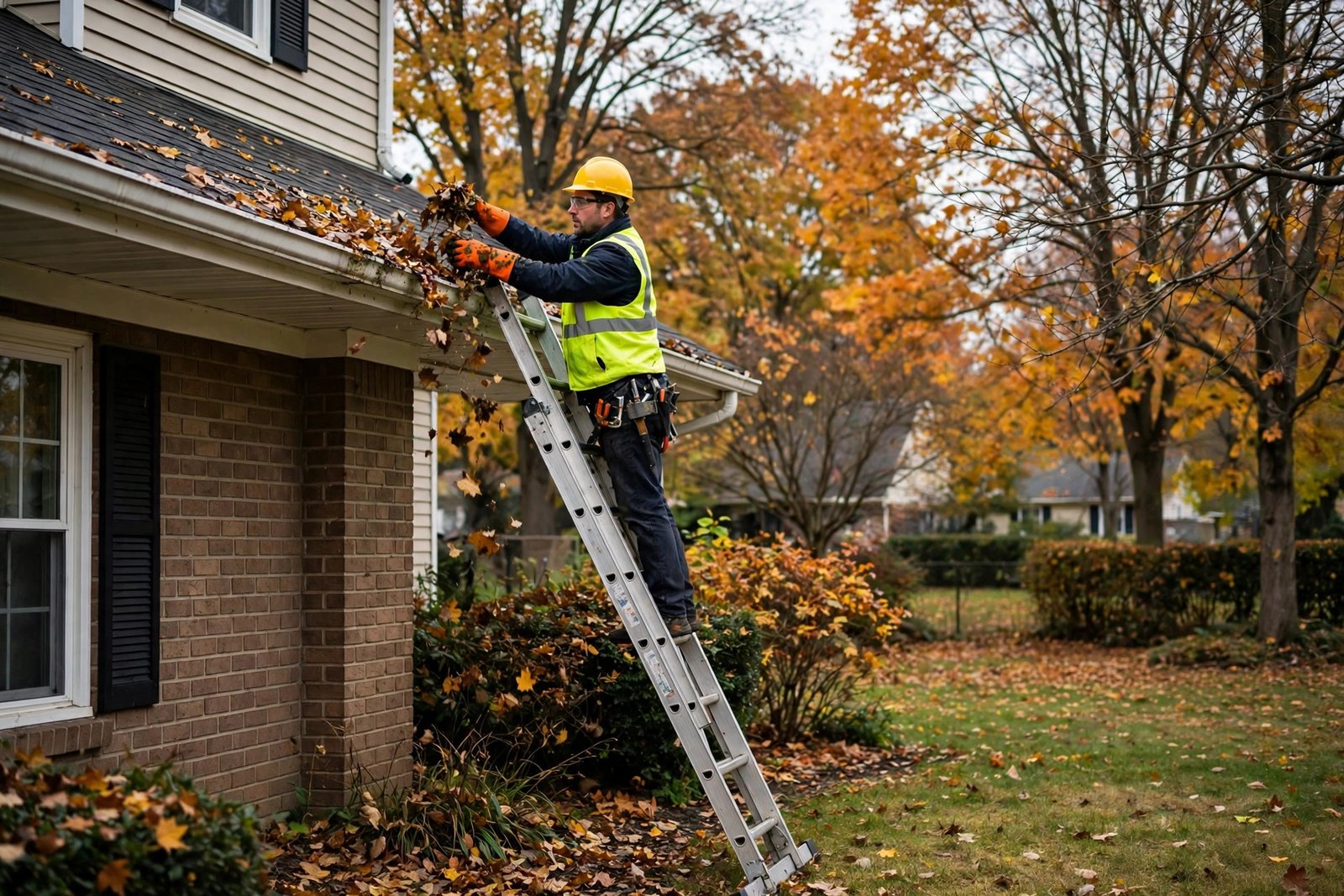
A typical job follows the same steps. Walk the perimeter of the house with the homeowner if they are home, and point at what you see: a corner that overflows, a downspout that is clogged, a bracket that has pulled loose. Quote a flat price in writing before you climb. Set the ladder with a stabiliser, scoop the debris into a bucket, clear the downspouts, flush with a hose, and bag everything for disposal. Take before-and-after photos, show them to the customer, and get paid the same day.
Practise on your own home and a friend's home first. Time yourself. A standard single-storey home takes 30 to 45 minutes solo once you are efficient. A two-storey home takes longer, and heavy debris, gutter guards, and steep roofs add time. Knowing your real speed matters, because your prices must cover the hours you actually spend.
Learn to spot the jobs you should not take. Three-storey homes, slate roofs, visibly rotted fascia boards, and gutters pulling away from the house are walk-away or refer-out situations until you have the gear and experience. No single job is worth a fall. If you find damaged gutters or a rotted fascia, photograph it, show the homeowner, and be honest about what is inside your scope. Minor resealing of a leaky seam is a fair add-on if you know how. Rotted fascia, detached gutters, and roof damage belong to a proper contractor.
Step 2: Pick your setup level
There are three realistic entry levels, and you should pick yours deliberately rather than drifting into one by accident.
| Setup | Kit | Typical cost | Homes per day |
|---|---|---|---|
| Lean ladder start | Ladder, scoop, buckets, hose, blower, safety gear | $1,500 to $2,500 | 4 to 6 |
| Gutter-vacuum pro | Lean kit plus wet-and-dry gutter vacuum with poles | $4,000 to $8,000 | 6 to 9 |
| Crew operation | Two vans, vacuum per van, second worker, software | $10,000 to $20,000 | 12 to 20 |
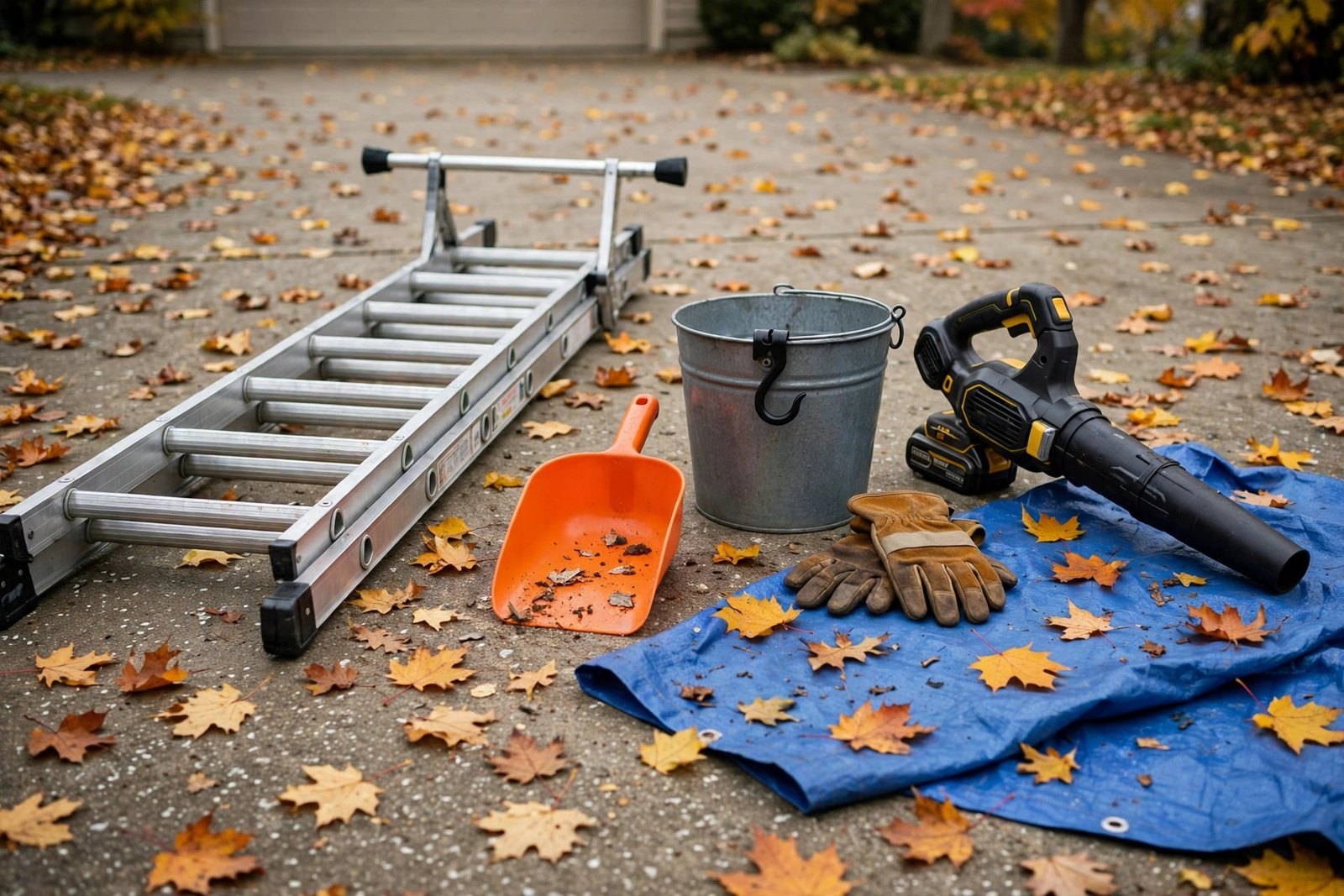
The lean ladder start is the most sensible way in for a beginner. A solid extension ladder, 28 feet, Type IA or IAA, rated for 300 pounds, a gutter scoop, heavy gloves, 5-gallon buckets with a hook, a stiff brush, a garden hose with a spray nozzle, drop tarps, a leaf blower, a ladder stabiliser, and basic safety gear. All in, bought sensibly rather than premium, that lands around $1,500 to $2,500. You can fit everything in the back of a car with the seats down, or strap the ladder to a basic roof rack.
The gutter-vacuum setup is the professional step up. A wet-and-dry gutter vacuum system with carbon fibre poles lets you clean most single-storey gutters from the ground, with no ladder on most homes, and it is faster on two-storey homes. A decent vacuum rig costs $2,000 to $5,000 on top of your basics. It genuinely increases your daily capacity and it impresses homeowners, but it does not magically find you customers.
Step 3: Sort the legal setup and insurance
Most US states do not require a specific licence for gutter cleaning. It usually falls under general handyman work. Check your state and county rules anyway, because a few places draw the line at certain job values, commonly around $500 to $1,000 per job, or require registration for home improvement work. A quick call to your county business office settles it. Most cities and counties also require a general business licence, usually $50 to $200 a year.
Register a simple LLC if you plan to run this beyond a casual side hustle. It costs roughly $50 to $300 depending on the state and keeps your personal assets separate from the business. Get a free EIN from the IRS to open a business bank account and keep business money apart from personal money. The SBA guide to choosing a business structure explains each option in plain language.
Insurance is where beginners get this badly wrong, and in this trade it is not optional. You are on ladders, near rooflines, and handling water around foundations. A standard general liability policy for a small gutter cleaning operation typically runs $500 to $1,200 a year for $1 million in cover. Budget $1,500 to $4,000 for your first year of insurance if you add commercial auto cover. Make sure your general liability policy explicitly covers work at height and ladder use. If you ever hire help, even casually, you will also need workers' compensation cover in most states.
Taxes apply from your first paid job. In the United States, the IRS self-employment tax page explains that you generally owe self-employment tax once your net earnings reach $400 in a year. The rate is 15.3 percent, which covers Social Security and Medicare. Keep every receipt, and set money aside for tax with every payment. Rules differ by country, so check your local tax authority if you are outside the United States.
Step 4: Set prices that work
The industry standard is flat-rate pricing by storey, and you should adopt it from day one. Homeowners hate hourly billing for this work because they cannot verify the hours, and you hate it because it punishes you for getting fast. Quote a flat number, do excellent work, and get paid the same day.
A starting framework for 2026, based on published guides, is:
| Home | Typical price |
|---|---|
| Single-storey home | $125 to $175 |
| Two-storey home | $175 to $250 |
| Three-storey or large home | $250 to $350 |
| Small ranch, under 1,500 square feet | $100 to $150 |
| Commercial or multi-family, per linear foot | $1.50 to $3.00 |
The average for a basic gutter cleaning in 2026 is $119 to $234 per job, according to the Angi cost guide quoted by trade publishers. Set a minimum charge now. A $75 to $125 minimum keeps you from driving 40 minutes to clean one garage gutter for pocket money. Your time has a floor, so set it.
Add-ons are where the margin lives. Downspout flushing and clog clearing costs $25 to $50. Minor resealing of leaky seams costs $40 to $75. Gutter guard removal and reinstall costs $50 to $150. A steep roof pitch, heavy debris, or a three-storey surcharge can add $25 to $150. Quote on the spot, in writing, before you climb. Walk the perimeter with the homeowner, point at what you see, and text the quote with two or three before photos. That creates a written record and makes the before-and-after comparison dramatic later. Take a deposit on jobs over $300.
One pricing trap to avoid is the "while you are up there" freebie. Every homeowner will ask you to look at the roof, tighten a shutter, or clear a chimney cap. A quick favour builds goodwill. A pattern of unpaid extras quietly halves your hourly rate. Be warm, do the tiny thing, and quote the bigger thing on the spot.
Step 5: Win your first customers
Here is the uncomfortable truth about gutter cleaning: the work is easy to learn and the customers are not. You do not have a marketing problem in October. You have a marketing problem in July. Start building your pipeline before you need it.
Your Google Business Profile is your shopfront. Set it up on day one, complete with photos of actual work, your service area, and honest reviews from your first customers. When someone searches for gutter cleaning near them in October, this profile is what they see, and a profile with 15 real reviews and before-and-after photos beats a fancy website every time. Ask every happy customer for a review before you drive away. Hand them your phone with the review page open and make it frictionless.
Door hangers in October are almost unfairly effective. Target streets with mature trees and visibly overflowing gutters. You can literally see your prospects from the pavement. A simple hanger with a before-and-after photo, your flat rate, and a phone number outperforms most digital ads for this trade, because the need is visible and immediate. After every job, leave door hangers on the 5 to 10 closest houses. The pitch is simple: "We just cleaned your neighbour's gutters. Your gutters likely have the same debris buildup. Here is a quote."
Real estate agents and property managers are your repeat pipeline. Agents need gutters cleaned before listings go live and before inspections. Property managers need it done on schedules across dozens of homes. Introduce yourself with a simple one-pager and a reliable phone number, then be the person who actually shows up when promised. One property manager with 30 rentals is worth more than 300 door hangers. Nextdoor is the digital version of the same idea: neighbours recommending a local gutter cleaner is how this trade has always worked.
Step 6: Turn one-off jobs into a maintenance list
Gutter cleaning demand peaks twice: late spring, when seed pods, blossoms, and storm debris fill the gutters, and autumn, when the leaves fall. October and November can keep you booked solid for weeks. January is dead. February is deader. Summer is sporadic, with storm cleanups and real-estate turnover, but no steady flow. About 60 to 70 percent of annual revenue happens in the autumn push, so plan your finances around that from the start. The autumn money has to carry you, or you need a complementary winter service. Holiday light installation pairs well, because it uses the same ladders and the same customers in the opposite season.
The smartest operators flatten the curve with maintenance plans. Offer a twice-a-year plan, spring and autumn cleans at a 10 to 15 percent discount, paid upfront or on a simple subscription, and pitch it to every customer at the end of the first job, when the gutters look perfect and the trust is highest. Even 40 households on a plan transforms your cash flow. Instead of starting every October from zero, you start with a booked calendar.
Keep a simple list from job one, with names, addresses, and dates, and text last season's customers when the new season starts. The second year of this business should be far easier than the first, but only if you built the list.
Step 7: Add services that raise each ticket
Gutter cleaning gets you on the property and builds trust. The real money is in the add-on services your customer already needs. Gutter guard installation is the natural fit. After you have cleaned a gutter twice, suggesting guards is a service, not a sales pitch. Guards cost $6 to $12 per linear foot installed, and a standard home has 150 to 200 linear feet of gutter, so a guard job runs $900 to $2,400. Downspout repair or replacement costs $75 to $200 per spout. Gutter reattachment or re-sloping costs $100 to $300 per section. Roof cleaning or moss treatment costs $250 to $600 per roof.
Only upsell what you can do well, and never invent problems. One customer who realises you exaggerated a damaged gutter will cost you more in reputation than the upsell ever earned. If you want a bigger ticket that fits the same customer, pressure washing pairs naturally with gutter work, and our guide to starting a pressure washing side hustle covers the equipment and pricing. Our handyman side hustle guide covers the small repair work that gutter customers often ask about.
What it costs and what to expect
Here is a realistic startup budget for a lean start, assuming you already own a vehicle:
| Item | Cost |
|---|---|
| Ladder, scoop, buckets, hose, blower, safety gear | $1,500 to $2,500 |
| Business registration (LLC) and licences | $100 to $400 |
| General liability insurance, first year | $500 to $1,200 |
| Flyers, door hangers, Google Business Profile | $200 to $600 |
| Total to start | $2,300 to $4,700 |
A professional vacuum setup adds $2,000 to $5,000. A crew operation costs $10,000 to $20,000 to set up properly, and most people should not start there. Run lean for a season first, learn which jobs are profitable in your area, and then scale with money the business already earned.
Example only: these numbers are not typical results. Imagine you clean 6 homes a day at $150 each on a busy autumn Saturday. That is $900 in gross income for the day. Fuel, bags, and wear on gear cost about $50. That leaves $850 before tax for roughly 6 hours of work. A full autumn month with 15 working days at that pace would gross $13,500, but that pace only holds in peak weeks, and most operators earn the bulk of their annual income in spring and autumn, with quiet winters. Results vary with experience, location, demand, time, competition, expenses, and the season.
Common mistakes
- Underpricing to get started, which trains the neighbourhood to expect a low price.
- Skipping insurance because you are careful. Careful people still meet rotted fascia boards, wasp nests, and gutters that tear loose.
- No photos, no proof. Gutters look identical before and after to a homeowner who never goes up there, so your value is invisible unless you document it.
- Working steep or damaged roofs alone, or taking jobs you should refer out.
- Marketing only in October, when the established operators are already booked.
- No system for repeat business, so every autumn starts from zero.
- Saying yes to everything, including jobs outside your skill, such as roof repairs and chimney work.
- Blasting gutters with a pressure washer, which can dent aluminium and push water under shingles.
Risks and scams to watch for
Ladders are the real risk in this business. Falls from ladders send large numbers of people to emergency departments every year, and gutter cleaners are heavily represented because they work on the very edge of rooflines, often on soft ground, and often in the wet. Treat ladder safety as a professional discipline, not common sense. Keep three points of contact at all times, extend the ladder 3 feet past the gutter line, keep your belt buckle between the rails and never overreach, set the base 1 foot out for every 4 feet of height, never work on wet or icy days, and never lean a ladder directly on the gutter you are cleaning. That is what the stabiliser is for. Tell someone where you are working, and on your first jobs, bring a friend to foot the ladder. The US Occupational Safety and Health Administration (OSHA) publishes a portable ladder safety QuickCard with the same rules. Read it before your first job.
Watch for wasp nests, which are common in gutters in late summer and autumn. If you disturb one, come down calmly and call a pest control service. Do not try to clear it yourself. Be wary of any supplier or trainer who asks for a large upfront payment for a gutter cleaning course or a ready-made customer list with a promise of guaranteed income. No one can guarantee your income. Buy gear from established suppliers, check reviews, and keep receipts.
Frequently asked questions
How much does it cost to start a gutter cleaning side hustle?
A lean ladder start costs about $1,500 to $2,500. A professional vacuum setup costs $4,000 to $8,000 in total. Add $500 to $1,200 a year for general liability insurance, plus registration and marketing.
Do I need a licence to clean gutters?
In most US states, no specific licence is required, because gutter cleaning usually falls under general handyman work. Some states and counties require registration or a contractor licence above certain job values, so check with your county business office before you start. A city business licence is required in most places.
How much can I charge for gutter cleaning?
A starting framework for 2026 is $125 to $175 for a single-storey home, $175 to $250 for a two-storey home, and $250 to $350 for a three-storey or large home. The average for a basic clean is $119 to $234 per job. Set a minimum charge of $75 to $125.
Is gutter cleaning too seasonal to be a real business?
It is seasonal if you let it be. Demand peaks in spring and autumn, and winter is quiet. Operators who make it work year-round sell twice-a-year maintenance plans, add a winter service such as holiday light installation, and bank their autumn earnings instead of spending them.
Do I need a pressure washer for gutters?
No, and for beginners it is often a liability. High pressure can dent aluminium gutters, force water under shingles, and damage soffits. A garden hose with a good nozzle handles downspout flushing well. If you later add pressure washing as a separate service, price it and insure it separately.
How long does a typical gutter cleaning take?
Most jobs take 30 to 45 minutes for a single-storey home, and 1 to 2 hours for larger homes or heavy buildup. Larger homes, gutter guards, and steep roofs add time.
Conclusion
This guide showed you how to start a gutter cleaning side hustle step by step, from a lean ladder kit to a maintenance list. Start lean, insure yourself, photograph everything, price fairly by the storey, and build the maintenance list from job one. Market in August and September so that when the leaves fall, you are the name people already know.
To round out your plan, read our guide to starting a pressure washing side hustle, which is the most natural add-on for gutter cleaners, and our guide to making money with a cleaning side hustle, which covers year-round indoor work for the quiet winter months. If you want a trade with a similar route model, our lawn care side hustle guide covers the summer season. You can browse all of them in the side hustles category.
Earning results vary, and nothing on this site is financial advice. Check your local rules before you start, and never climb a ladder on a wet or windy day.