How to Start a Snow Removal Side Hustle in 2026
A snow removal side hustle is one of the fastest ways to earn in winter. The work is simple, the same customers call back after every storm, and a single snowblower can clear a street of driveways before most people have had breakfast. If you live somewhere with regular snow, this is a practical seasonal income.
This guide shows you how to start a snow removal side hustle from zero. You will learn what gear to buy, how to price per storm and per season, what contracts and insurance you need, how to sign clients before the first snow, and how to stay safe on cold, early mornings.
In this guide
- What a snow removal side hustle is, and who it suits
- Step 1: Check your area gets enough snow
- Step 2: Pick your gear level
- Step 3: Sort the legal setup and insurance
- Step 4: Set your prices and write the deal down
- Step 5: Sign your route before the first snow
- Step 6: Run a storm morning like a plan
- Step 7: Stay busy all year
- What it costs and what to expect
- Common mistakes
- Risks and scams to watch for
- Frequently asked questions
What a snow removal side hustle is, and who it suits
Snow removal means clearing driveways, walkways, and steps after snow falls, so people can leave their homes safely. You charge per storm or per season. The work comes in bursts. You might clear eight driveways in one morning and then nothing for two weeks.
The work suits you if you are an early riser, you do not mind hard physical work in cold and dark conditions, and you can be ready at short notice. It does not suit you if you need a fixed schedule, because the storm picks your working days. It also does not suit you if you live somewhere with little or no snow. This hustle is seasonal and region-dependent, so say it plainly: it is not year-round income everywhere, and it is not an option at all in warm climates.
Snow is different from every other hustle in one key way. The selling happens before the snow. Once a storm hits, people who have not lined someone up either shovel it themselves or call whoever they already know. Knocking on doors in the middle of a storm is the hardest, lowest-paying way to do this. Signing people up in November is the easiest and best-paying way.
Step 1: Check your area gets enough snow
Before you buy anything, check how much snow your area really gets. Look up the average number of snow days and the average snowfall for your town over the last few winters. A place that gets 10 to 15 snowfalls a year can support a small route. A place that gets two light snowfalls a year cannot.
Walk your own street and count the driveways, the older residents, and the homes with long commutes. Older neighbours, families who leave early for work, and people who travel in winter are your best customers, because they genuinely struggle to shovel themselves or they are not home to do it. Corner lots get extra snow pushed onto them by plows and have more sidewalk to clear, so they are good targets too.
Step 2: Pick your gear level
You do not need a truck, a plow, or thousands of dollars in equipment to start. Pick the level your budget allows, and reinvest your first-season income into better gear.
| Level | Gear | Typical cost |
|---|---|---|
| Shovel only | Quality metal shovel, ice melt, cold weather gear | Under $200 |
| Snowblower | Single-stage blower for light snow, or two-stage for heavy snow | $300 to $1,500 |
| Truck and plow | Used pickup with a plow attachment | $5,000 to $20,000 |
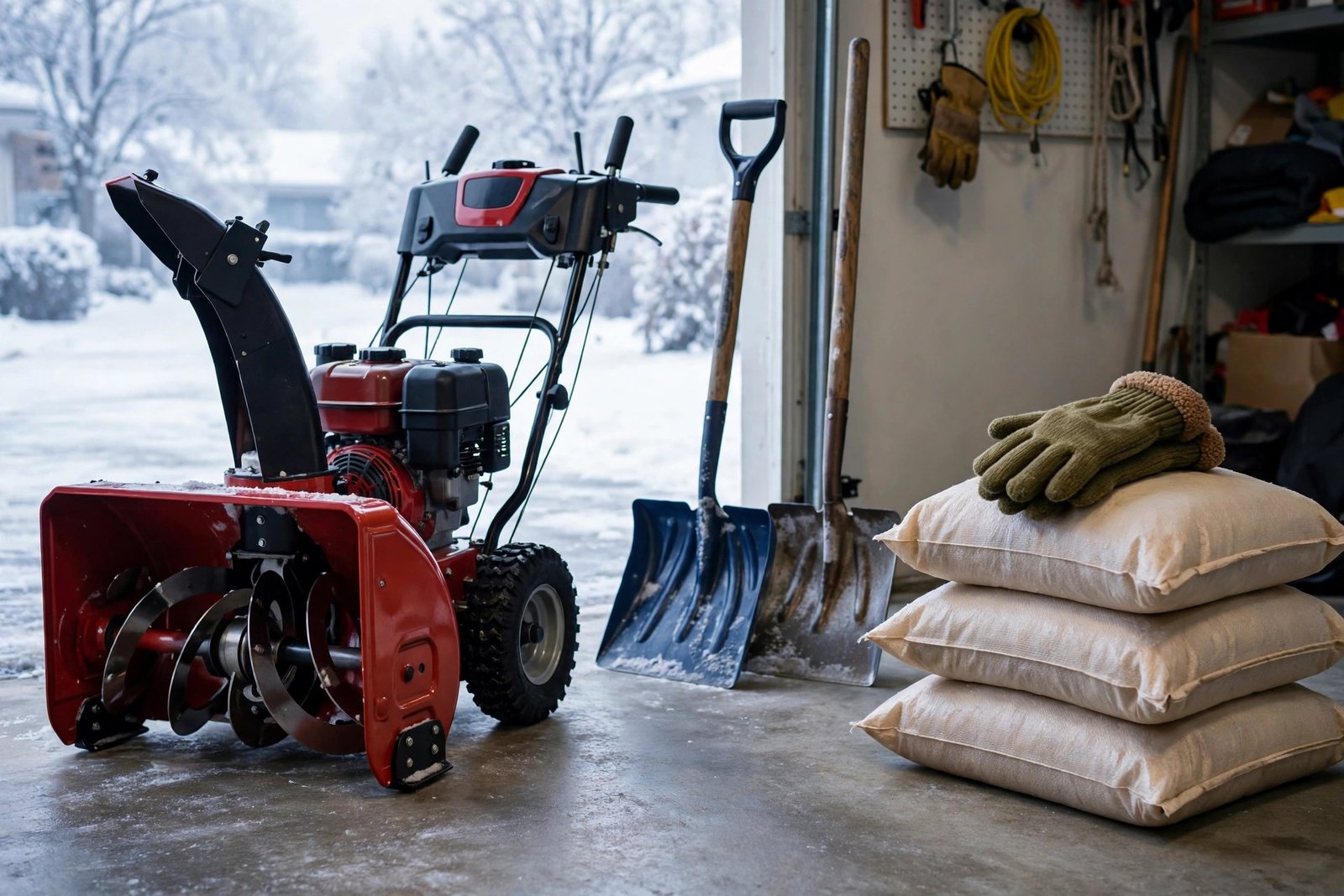
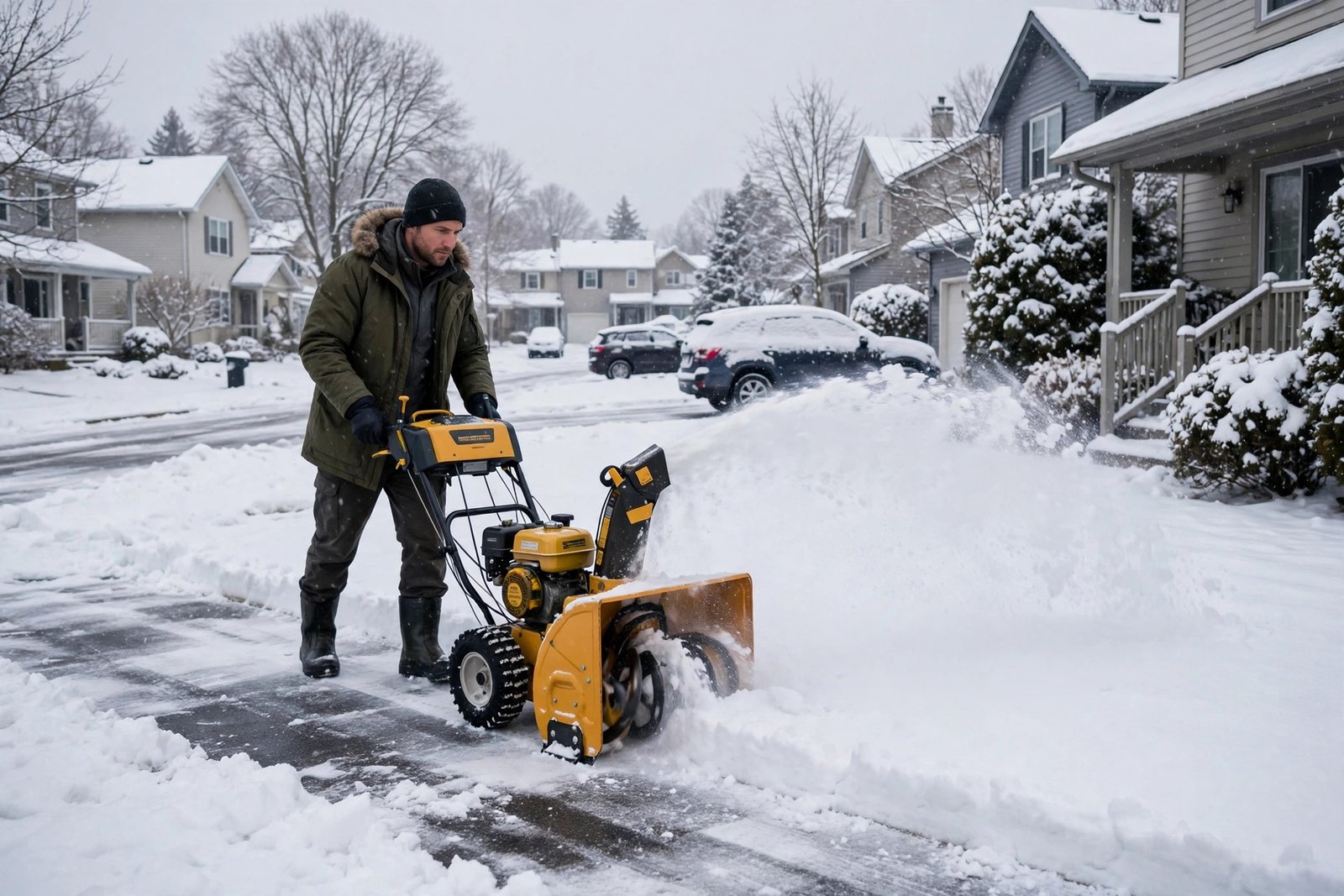
A single-stage snowblower handles lighter snowfalls under 8 inches and costs $300 to $700 new. A two-stage machine handles heavier snow and costs $700 to $1,500. A two-stage blower clears 15 or more long driveways per storm, while a single-stage is fine for about eight. A truck and plow is a different business, aimed at commercial car parks and property management contracts, so do not buy one until you have the clients to pay for it.
Your starter kit should also include a pusher shovel with a wide blade, an ergonomic shovel with a bent handle for the snow you have to lift, an ice chipper for packed ridges and icy steps, waterproof boots with grip, two pairs of gloves so you can swap halfway when the first pair gets wet, and a headlamp, because it is dark at 5:30 in the morning in winter. Let customers supply their own ice melt where possible. Rock salt is cheap but can damage newer concrete and is hard on plants, and some ice melts bother pets' paws, so asking what they prefer keeps you out of the middle of that.
Buy ice melt in bulk in autumn, and service your blower before winter so it starts on the first cold morning.
Step 3: Sort the legal setup and insurance
Most states do not require a specific licence to shovel driveways or plow car parks, but a few things are not optional if you want to take this seriously.
Form a limited liability company (LLC) before you start taking money if you plan to run this beyond a casual few jobs. Snow removal carries real liability. If someone slips on ice you were hired to clear, you can be named in a lawsuit. An LLC separates your personal assets from the business, and formation costs $50 to $150 in most states. The SBA guide to choosing a business structure explains each option in plain language.
Get general liability insurance. A $1 million policy typically costs $500 to $1,200 a year for a solo operator. Most property managers require proof of insurance before they sign a commercial contract, so you cannot win that work without it. For a side hustle clearing residential driveways, you can start without it, but a basic policy is cheap peace of mind once you have regular customers. Check whether your policy covers slip-and-fall claims, because that is the biggest risk in this business.
Use a written service agreement for every client. Include the services you will do, the trigger depth that starts a visit, usually 2 inches of snow, the price, the payment terms, and a liability note. A simple template from a free forms site costs nothing and protects you from disputes. Keep a record of every visit, with the date, the snowfall, and whether the client paid.
Taxes apply from your first season. In the United States, the IRS self-employment tax page explains that you generally owe self-employment tax once your net earnings reach $400 in a year. The rate is 15.3 percent, which covers Social Security and Medicare. Keep every receipt for fuel, gear, and ice melt. Rules differ by country, so check your local tax authority if you are outside the United States.
Step 4: Set your prices and write the deal down
Snow removal uses two main pricing models. Per-push pricing means you charge a flat fee each time it snows above a trigger depth, usually 2 inches. Seasonal pricing means you charge one flat fee for the whole season, no matter how many times it snows. Offer both, and let each customer choose.
Typical per-push prices reported in 2026 guides are:
| Job | Per-push price |
|---|---|
| Small driveway, 1 to 2 cars | $25 to $50 |
| Medium driveway, 3 to 4 cars | $50 to $80 |
| Large or circular driveway | $80 to $150 |
| Sidewalk and walkway add-on | $10 to $20 |
| Ice melt application | $10 to $25 |
Starting rates for a new business in the northern United States are often quoted as $35 for a single driveway, $55 for a double driveway, and $90 for a long driveway. Seasonal contracts are typically 8 to 12 times the per-push rate, based on your area's average number of snow events. For a driveway priced at $40 per push in a market that averages 10 snowfalls a year, a seasonal contract would run $320 to $480.
The two models split the weather risk differently. With per-storm pricing, a heavy winter pays you more and a light winter pays you almost nothing. With a seasonal price, you get the same amount either way: you win in a light winter, and your customers win in a heavy one. Many new operators start per storm, because it is simple to explain and customers are not paying upfront for snow that might never fall. Add a heavy storm surcharge of 50 percent or more for snow well past your normal depth, such as 8 inches or more, or wet, heavy snow, and say it upfront, not on the morning of the storm. Put a storm limit in a seasonal deal, such as up to 12 storms, then a set price per storm after that, so a record winter does not turn into free labour.
Write the deal down and text it to every customer in November. Agree on when you come, what is included, what is not included, the price, and what happens if you cannot come. Include the plow ridge, which is the packed wall of snow the city plow leaves across the bottom of every driveway, often after the driveway was already cleared. Promising to deal with it, and coming back after the plow if you need to, is what separates you from the person who shoveled once and left. Say plainly that you cannot promise the ground stays ice-free after you leave, because meltwater refreezes. Name a backup person who covers for you if you are sick or away, and text the customer before 6 in the morning if that happens.
Step 5: Sign your route before the first snow
Most operators get their first five to ten clients before the season starts, without spending a dollar on advertising. Start in September or October, and aim to be fully booked by the time the first snow falls.
Walk your target neighbourhood in October or early November before the first snow. Leave a door hanger or printed flyer at 100 to 200 homes, with your name, phone number, services, pricing, and a simple call to action such as "Text me to get on the route this season." Conversion rates of 3 to 5 percent are normal, which means 3 to 10 clients from 100 flyers in a decent area.
Post in your neighbourhood Nextdoor page and local Facebook groups in early autumn. Be specific: your name, your neighbourhood, your price range, and how to book. Post before-and-after photos the night a storm is forecast. Ask satisfied clients to recommend you, because word of mouth travels fast in close neighbourhoods, especially for reliable service.
Set up a free Google Business Profile. When someone searches for snow removal near them before a storm, a verified local profile with reviews gets the clicks. Call or email property management companies in September. They manage homeowners associations, apartment blocks, and commercial properties, and they need reliable contractors before winter. A single property management contract can be worth $5,000 to $20,000 for a full season.
Keep the route tight. Six driveways on your own street and the next one over are worth more than ten spread across town, because walking between jobs in deep snow eats the time you do not have before work or school.
Step 6: Run a storm morning like a plan
A storm morning has a rhythm, and it starts the night before. Check the forecast and text your route: "Snow coming tonight, I will have you done by 7:15." Lay out your clothes and gear by the door, and charge your phone.
Start with the people who leave earliest, then work outward in a loop so you are never walking back past houses you have already done. If you are running behind, clear a path to every door before you finish anyone's full driveway. A safe walk is the thing people need first.
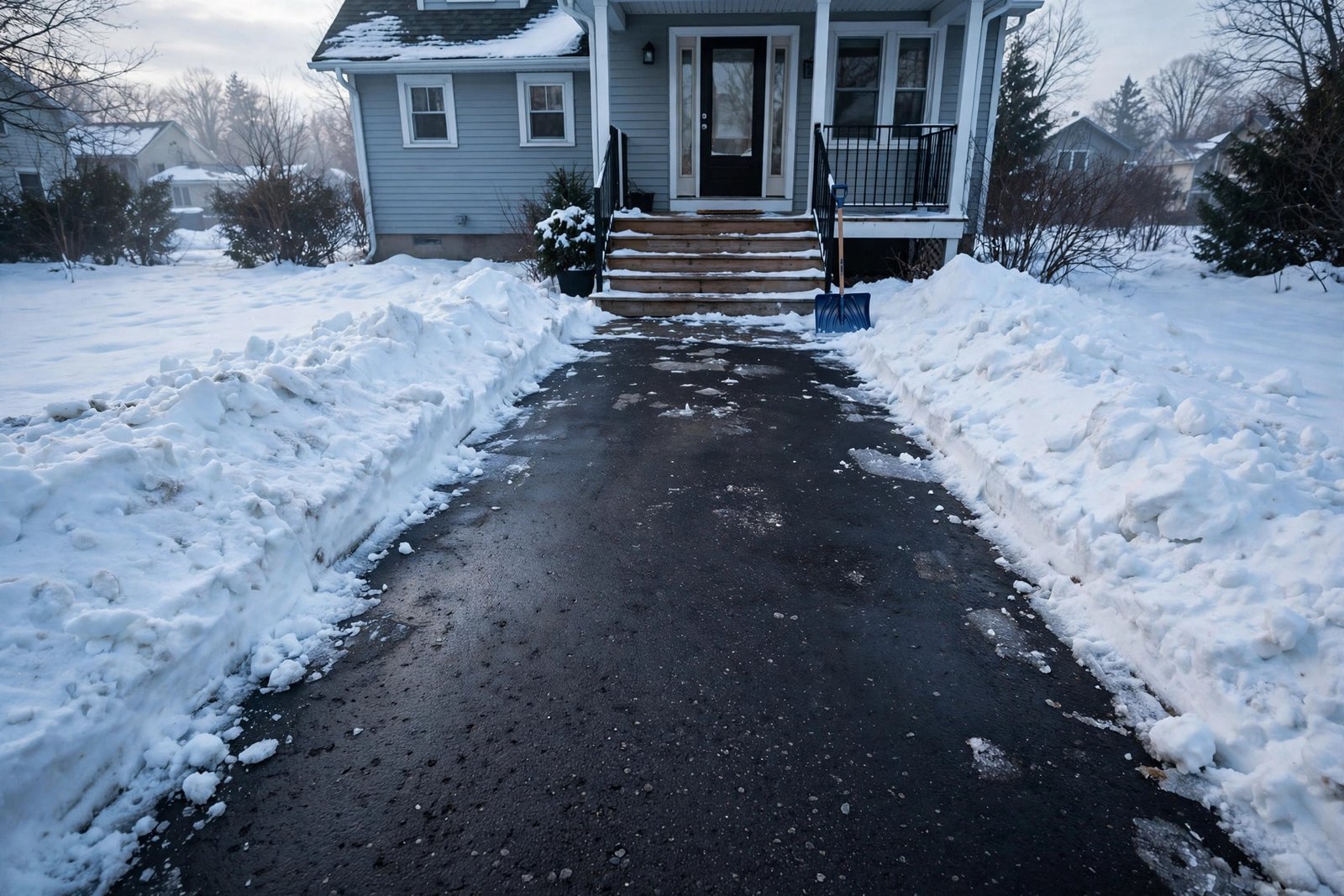
Send a quick "all done" text to each customer when you finish. That text is what gets you paid without having to ask twice. After the storm, go back and clear the plow ridge at the end of each driveway if the plow came through after you. That is the part customers remember.
Time yourself on the first storm, then size your route to fit the window you actually have. Taking on more than you can finish is the fastest way to lose customers.
Step 7: Stay busy all year
Snow removal is seasonal, which is the main limitation. The season usually runs from November to March, and your income stops when the snow stops. Plan for that from the start.
Many operators pair snow with a summer service such as lawn care, landscaping, or pressure washing, using the same customers and the same route. Add gutter cleaning in the autumn and a lawn route in summer, so the same households pay you all year. Our guide to starting a lawn care side hustle covers the summer half of that pair, and our guide to starting a pressure washing side hustle covers another service the same customers need. Bank your winter earnings instead of spending them, because the money has to carry you through the quiet months, or be saved for next season's gear.
What it costs and what to expect
Here is a realistic startup budget for a lean start:
| Item | Cost |
|---|---|
| Shovel, ice melt, and cold weather gear | $100 to $200 |
| Single-stage snowblower | $300 to $700 |
| Business registration (LLC) | $50 to $150 |
| General liability insurance, first year | $500 to $1,200 |
| Flyers and door hangers | $50 to $100 |
| Total to start | $1,000 to $2,350 |
A two-stage blower instead of a single-stage adds $400 to $800. A used truck with a plow is $5,000 to $20,000 and is a step for later, not for starting.
Example only: these numbers are not typical results. Imagine you clear 12 driveways at $40 per storm, and your area gets 8 storms in a winter. That is $3,840 in gross income for the season. Fuel and ice melt cost about $300, insurance about $700, so about $2,840 remains before tax for roughly 60 to 80 hours of early morning work. A heavy winter with 15 storms at the same rate would gross $7,200, while a light winter with 3 storms would gross only $1,440. That is the weather gamble, and it is why many operators mix per-storm and seasonal contracts. Results vary with experience, location, demand, time, competition, expenses, and snowfall.
Common mistakes
- Starting to sell after the first snow, when customers have already lined someone up.
- Taking on a route too big to finish before people leave for work.
- Pricing per storm without a heavy storm surcharge, then working twice as long for the same money.
- Offering a seasonal price with no storm limit, then working for free in a record winter.
- Skipping the written agreement, then arguing about what was included.
- Forgetting the plow ridge, which is the part customers hate most.
- Pushing snow into the street or onto a neighbour's property, which many towns do not allow.
- Waiting until the end of winter to collect payment, then chasing money in March.
- Buying a truck and plow before you have the clients to pay for it.
Risks and scams to watch for
Snow removal is hard physical work in miserable conditions, often starting before dawn. Shoveling is heavy, and backs get hurt when people twist with a loaded shovel. Push snow to the side whenever you can. When you have to lift, take small loads, bend your knees, keep the shovel close to your body, and turn your whole body instead of twisting. Watch for frostbite. Cover your ears, fingers, and face, and if skin goes numb, turns white or grey, or feels hard or waxy, stop and get inside to warm up slowly.
Never reach into a snowblower chute or auger to clear a jam with your hand. Shut the engine off, wait until everything has stopped moving, and use the clearing tool or a stick. That single rule prevents the worst snowblower injuries. Never go up on a roof or a ladder to clear snow, no matter what someone offers to pay. Stay out of the street, wear something bright or reflective, and never push snow into the road, because plows and cars have a hard time stopping on snow.
Be wary of anyone selling a ready-made snow route or a franchise with a promise of guaranteed winter income. No one can guarantee how much it snows. Check local rules on where snow piles can go, because many towns fine you for pushing snow into the street. If a commercial client asks you to sign a 24-hour service agreement, read it carefully and make sure your route and your gear can meet the deadline before you agree.
Frequently asked questions
How much does it cost to start a snow removal side hustle?
You can start for under $200 with a shovel and ice melt, or $450 to $900 with a snowblower and basic gear. A two-stage blower costs $700 to $1,500, and a used truck with a plow costs $5,000 to $20,000. Add $500 to $1,200 a year for liability insurance.
How much should I charge for snow removal?
Typical per-push prices are $25 to $50 for a small driveway, $50 to $80 for a medium driveway, and $80 to $150 for a large driveway. Starting rates for a new business are often $35 for a single driveway, $55 for a double, and $90 for a long driveway. Seasonal contracts usually run 8 to 12 times the per-push rate.
Do I need insurance for snow removal?
For a side hustle clearing residential driveways, you can start without it, but a basic general liability policy is cheap peace of mind once you have regular customers. A $1 million policy typically costs $500 to $1,200 a year. Commercial clients usually require proof of insurance before they sign.
When should I start selling snow removal?
Start in September or October, and aim to be fully booked before the first snow. The selling happens before the snow falls. Once a storm hits, people who have not lined someone up either shovel it themselves or call whoever they already know.
Is snow removal a year-round income?
No. It is seasonal and region-dependent. The season usually runs from November to March in areas with regular snow, and there is little or no work outside it. Many operators pair it with lawn care or pressure washing in summer so the same customers pay them all year.
Can a teenager start a snow removal business?
Yes. Clearing driveways with a shovel or a blower is one of the most common first businesses. Run the blower only when you can see the whole area, never clear a jam with your hand, and keep the route close enough to walk between houses. Payment apps usually need an adult to set up an account for anyone under 18.
Conclusion
This guide showed you how to start a snow removal side hustle step by step, from your first shovel to a route of signed-up clients. Start with a shovel or a blower, get the legal setup and insurance sorted, write the deal down with every customer, and keep your route tight enough to finish before people leave for work.
To plan the rest of your year, read our guide to starting a lawn care side hustle, which is the natural summer partner for a snow route, and our guide to starting a pressure washing side hustle, which the same customers need in spring. If you want a winter-proof option as well, our guide to making money with a cleaning side hustle covers indoor work that runs all year. You can browse all of them in the side hustles category.
Earning results vary, and nothing on this site is financial advice. Check your local rules before you start, and never work on a roof or a ladder to clear snow.