How to Start a Car Detailing Side Hustle in 2026
Learning how to start a car detailing side hustle is a good idea if you like cars, you enjoy careful hands-on work, and you want weekend income without a big loan. A car detailing side hustle means cleaning cars to a high standard for paying customers, usually at their home or workplace. You can start small, with a basic kit and a few weekend jobs, and grow only when the work is there.
This guide is for complete beginners. You will learn the difference between valeting and detailing, what to charge, what kit to buy first, how to handle insurance and water rules, and how to find your first ten customers.
In this guide
- What car detailing really is
- Step 1: Learn the craft before you charge
- Step 2: Pick your service menu and prices
- Step 3: Buy the starter kit only
- Step 4: Sort the legal basics and insurance
- Step 5: Solve water, power and weather
- Step 6: Find your first ten customers
- Worked example: one weekend of detailing
- What it costs and what to expect
- Common mistakes
- Risks and scams to watch for
- Frequently asked questions
What car detailing really is
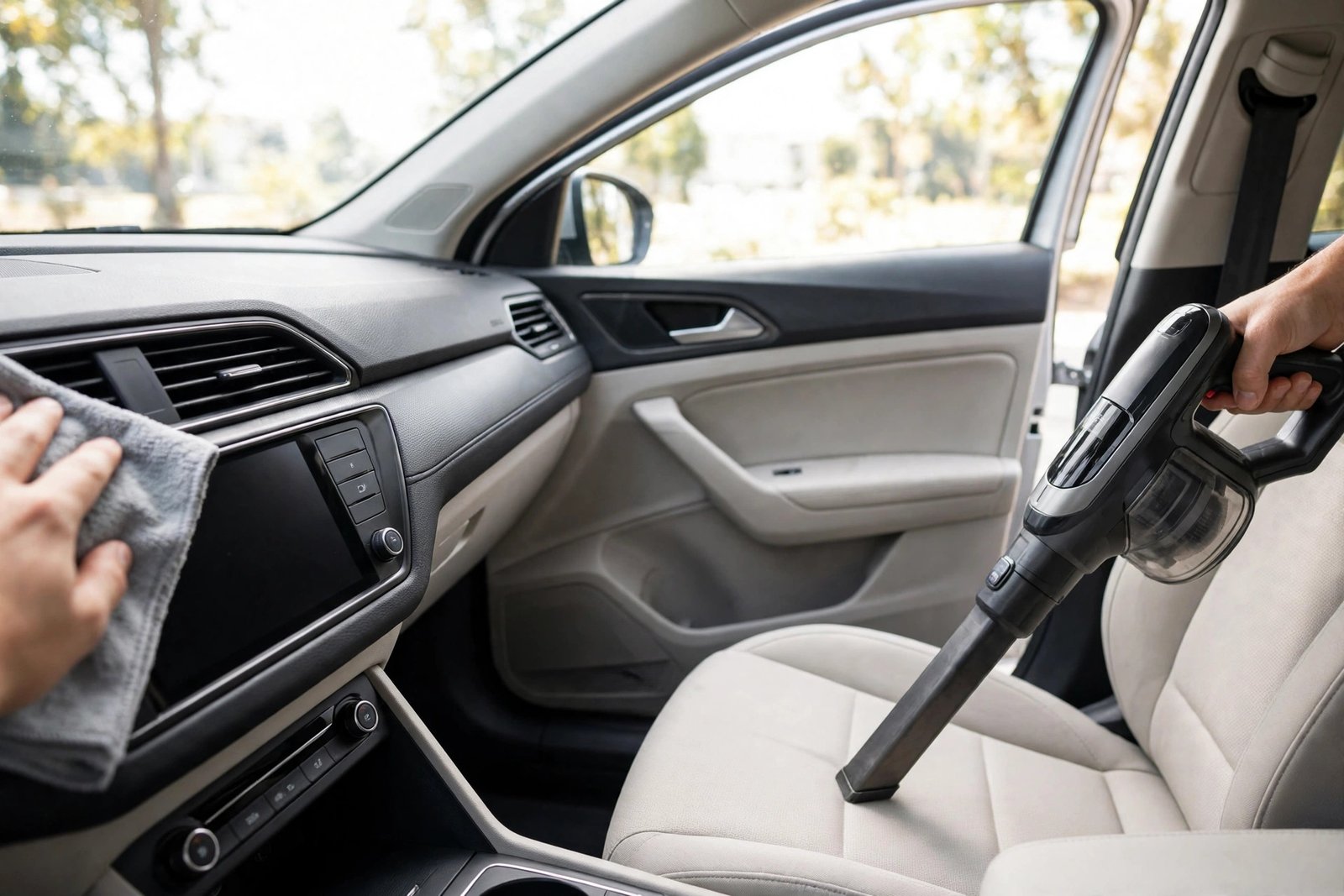
Car detailing has two levels, and mixing them up is the first mistake most beginners make. Valeting is cleaning. You wash the outside, clean the wheels, vacuum the inside, wipe the dashboard and clean the glass. A full valet takes one to three hours. Detailing is correction. You remove dirt bonded to the paint, use a clay bar, machine polish the paint to remove swirl marks and light scratches, then protect it with a sealant or a coating. A proper detail takes six to ten hours.
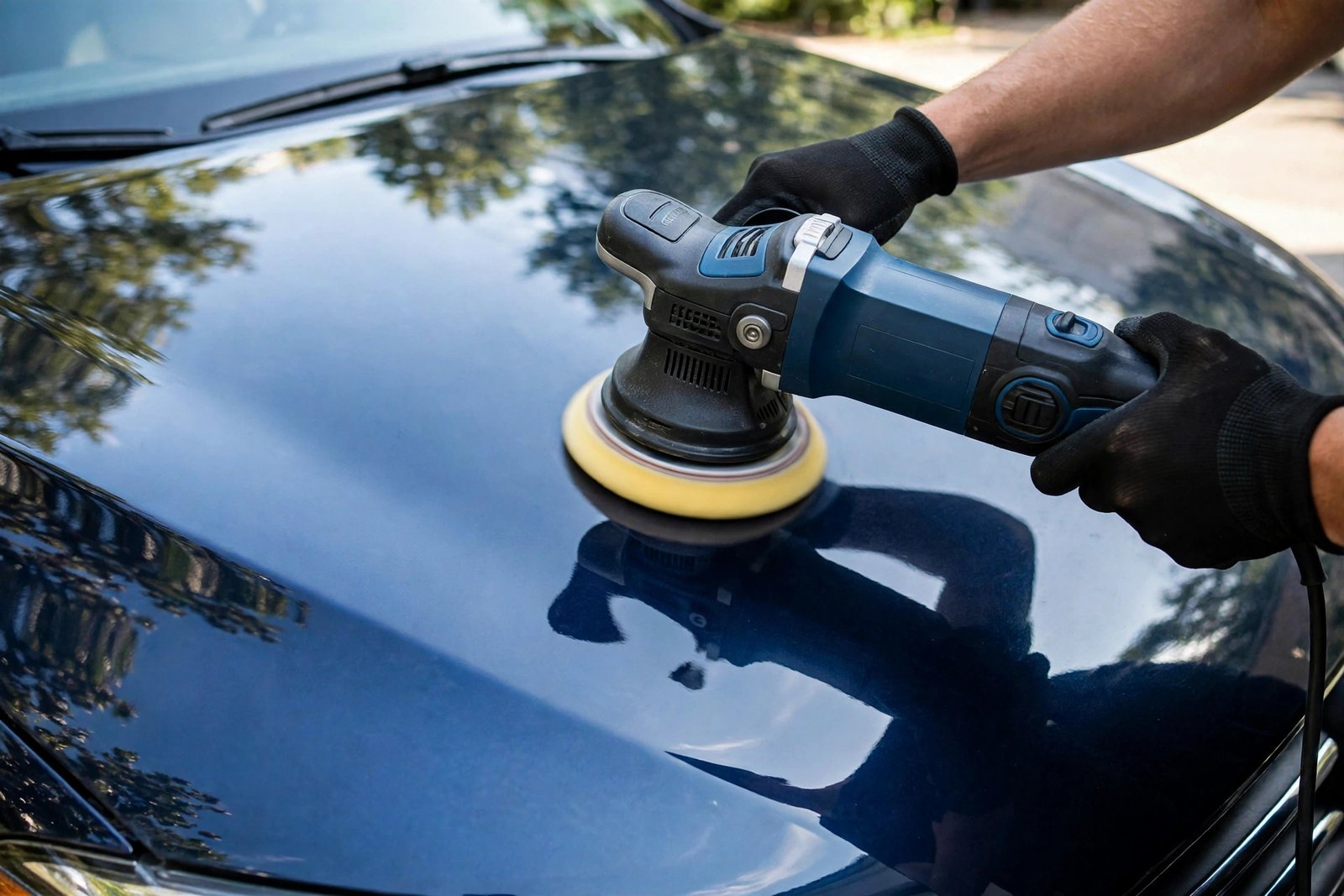
The two levels have different customers and different prices. The valeting customer wants a clean car, fast, at a fair price. The detailing customer wants the paint to look better than it did, and will pay several times more for it. The sensible path is to start with valeting, build a round of repeat customers, and add machine polishing only after you have practised on your own car and on friends' cars. Machine polishing done badly burns through the clear coat, and that is a respray, not a refund.
You also need to choose between mobile work and a fixed base. Mobile detailing means you go to the customer, which keeps costs low because you pay no rent. A fixed base, such as a garage or a rented bay, gives you shelter from rain and a controlled space for paint work, but it adds rent and bills. Most side hustlers start mobile and add a covered space later, when the work pays for it. For the wider picture of starting small, read how to start a side hustle.
| Service level | What it includes | Time | Typical price range |
|---|---|---|---|
| Exterior wash | Hand wash, dry, wheels, tyres, glass | 45 minutes to 1 hour | 20 to 30 US dollars |
| Full valet | Wash plus interior vacuum, wipe down and glass | 2 to 3 hours | 45 to 80 US dollars |
| Interior deep clean | Shampoo seats and carpets, extraction, odour treatment | 3 to 4 hours | 80 to 150 US dollars |
| Machine polish and sealant | Decontamination, one stage polish, sealant | 6 to 8 hours | 180 to 300 US dollars |
| Full correction and coating | Multi stage polish, ceramic coating | 1 to 2 days | 450 to 900 US dollars |
Prices vary a lot by area. Big cities charge more, rural areas charge less. These ranges come from competitor guides published in 2026 and are a starting point for your own local research, not a promise of what you will earn.
Step 1: Learn the craft before you charge
Do not charge for a service you cannot do well. Start by detailing your own car, then the cars of family and friends, for free or at the cost of the products. Take before and after photos of every job, from the same angle and in the same light. These photos become your portfolio, and they sell the work better than any advert.
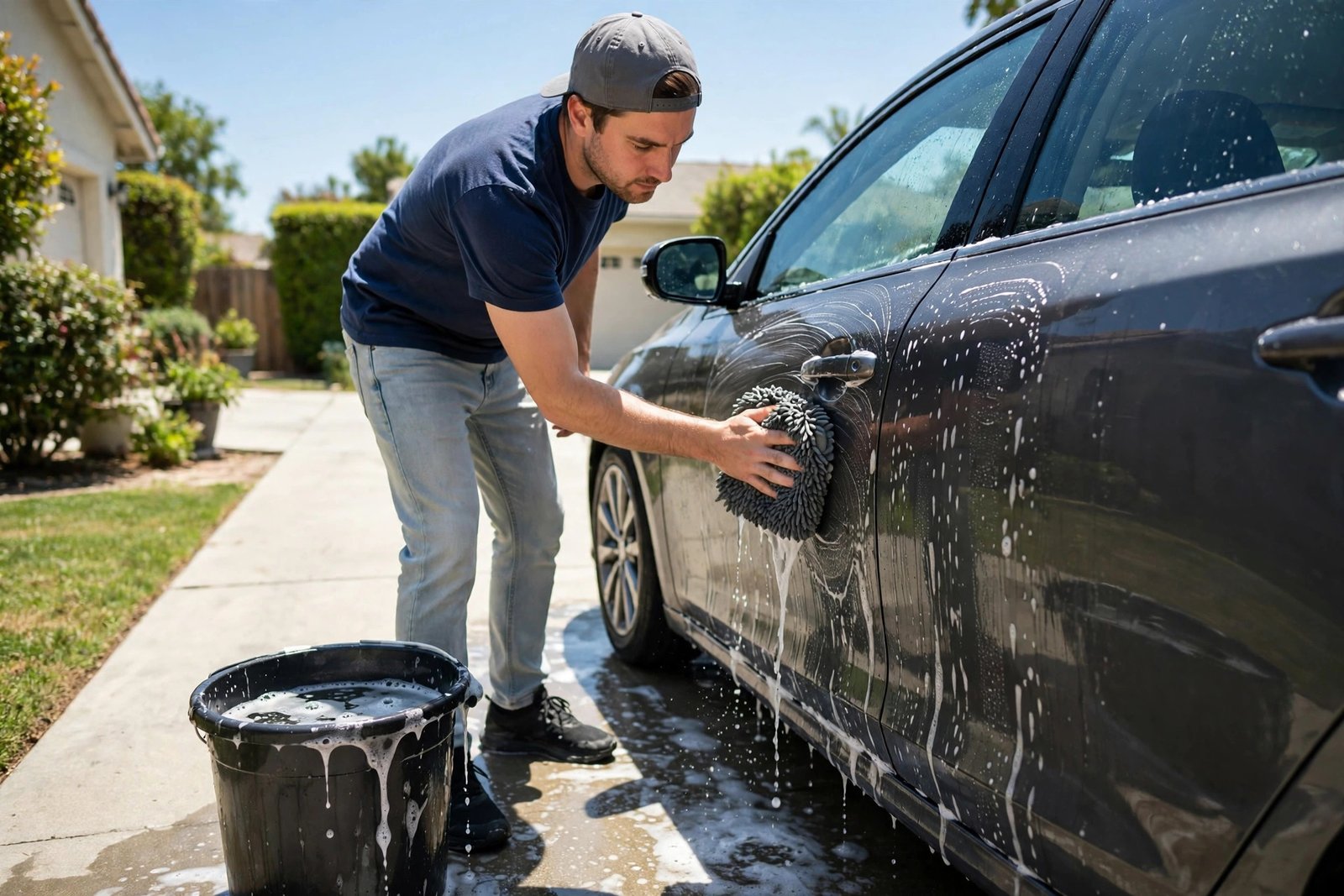
Learn the two bucket wash method early. One bucket holds clean soapy water, the other holds rinse water, and both have grit guards at the bottom. You wash with a mitt from the clean bucket, rinse the mitt in the second bucket, and never put dirty water back on the paint. This one habit prevents most of the scratches beginners cause.
Watch how professionals work, and practise the skills in order. Washing and drying first, then interiors, then paint decontamination with a clay bar, then machine polishing last. A dual action polisher is far more forgiving than a rotary polisher, and it is the one to learn on. Practise on a scrap panel from a breaker yard before you touch a customer's paint. A paint depth gauge, which costs about 60 US dollars, is worth buying once you charge for correction work, because it tells you how much clear coat is left to work with.
You do not need a formal qualification to start. The International Detailing Association offers certification, and it can reassure customers, but it is not a legal requirement. Your photos and your reviews matter more in the first year.
Step 2: Pick your service menu and prices
Keep your menu short. Three or four packages are enough to start, and customers choose faster when the choice is simple. A good starter menu is an exterior wash, a full valet, an interior deep clean, and one premium option such as a machine polish. Add pet hair removal and headlight restoration as add-ons, because they take little time and customers value them highly. Headlight restoration takes about 40 minutes and sells well.
Set your prices from your costs, not from what feels cheap. Work out how long each service takes, what the products cost per job, what your fuel and insurance cost, and what you need to earn per hour. Then check what the top-rated mobile detailers in your area charge, and stay near their range. Charging far less than everyone else attracts customers who complain the most and never rebook. Price in the middle, be reliable, and photograph everything.
Always quote a starting price, and say that the final price depends on the size and condition of the car. A large SUV covered in pet hair is not the same job as a small hatchback that was cleaned last month. Put the price in writing before you start, and agree any extra work with the customer first. For a full method on setting rates, read how to set freelance rates.
Step 3: Buy the starter kit only
You can start with about 250 US dollars of kit if you already own a vacuum, or about 500 to 2,000 US dollars for a fuller setup. Buy in stages, and only buy the next stage when paying jobs demand it. Do not buy a ceramic coating kit, a rotary polisher, a branded uniform or a van wrap in month one. Those are things people buy instead of finding customers.
| Stage | What to buy | Typical cost |
|---|---|---|
| Stage 1, enough to take money | Two buckets with grit guards, wash mitt, pH neutral shampoo, wheel cleaner, glass cleaner, interior cleaner, tyre dressing, microfibre cloths, drying towels, wet and dry vacuum, entry level pressure washer | About 250 to 500 US dollars |
| Stage 2, once you are booked out | Snow foam lance, water tank with a 12V pump, heated carpet extractor | About 300 to 800 US dollars |
| Stage 3, only after practice | Dual action polisher, pad set, compounds, paint depth gauge | About 200 to 400 US dollars |
Buy more microfibre cloths than you think you need, because they get filthy fast. A dirty cloth is the fastest way to scratch a customer's car. Keep clean cloths separate from used ones, and wash them without fabric softener, which ruins their absorbency. For chemicals, you need only a few products to start: an all-purpose cleaner, a wheel cleaner, a glass cleaner and a spray wax or sealant. That covers about 90 percent of the work.
Keep your kit organised in bins or a tool bag, so you can load the car and go. A tidy setup shows the customer you are professional, even if you work from the back of a small car. For more on keeping startup costs low, read side hustles with low startup costs.
Step 4: Sort the legal basics and insurance
Treat the side hustle as a real business from day one, even if you only work four Saturdays a month. The exact steps depend on where you live, so check your local rules before your first paid job. In the United States, many detailers register as a sole proprietor or form a limited liability company, known as an LLC. An LLC separates your personal assets from the business, which matters when you work on cars worth thousands of dollars. The US Small Business Administration explains the business structures on its register your business page. If you form an LLC or hire anyone, you will need an employer identification number, known as an EIN, from the IRS. It is free, and you can apply on the IRS EIN page. Never pay a third party for an EIN.
In the United Kingdom, most detailers start as a sole trader. You register with HMRC once your income passes the 1,000 pound trading allowance in a tax year. The GOV.UK page on setting up as a sole trader explains the steps, including keeping records and paying Income Tax and National Insurance on your profits.
Insurance is the one thing you must not skip. Public liability insurance, called general liability insurance in the United States, covers you if you damage a customer's car or property. Typical cover starts at 1 million pounds or 1 million US dollars, and costs about 150 to 300 pounds a year in the UK or about 100 to 300 US dollars a month in the US for a fuller policy. If you ever move a customer's car, even a few feet on a driveway, you also need motor trade or garage keepers cover, because standard liability does not cover a car in your care. Get quotes from more than one insurer, and read what the policy actually covers before you buy.
Keep your business money separate from your personal money from the start. Open a business bank account, keep every receipt, and set aside money for tax on every job. A simple spreadsheet is enough at first. For the tax side in plain language, read freelance taxes for beginners.
Step 5: Solve water, power and weather
Water and weather are the two problems that quietly kill mobile detailing businesses, and most guides barely mention them. Many customers will not want you using their outside tap, and plenty of flats and terraces do not have one. A 100 to 200 litre water tank in the back of a van or car, with a 12V pump, removes that objection entirely and lets you say yes to jobs your competitors turn down. It is the single best equipment purchase after the basics.
Power is the same problem. Running an extension lead through a customer's window is awkward and sometimes unsafe. A leisure battery with an inverter, or a petrol pressure washer, makes you independent. Check the rules where you work before you wash on a public road, because some councils and cities control where wash water may run. Detergent run-off going into a surface water drain is an offence in many places. Wash on a permeable surface or a drive that drains to foul water, never near a roadside gully, and never let soapy water run into a storm drain.
Weather decides your income in a way no other part of the business does. In winter you will lose working days to rain and cold, and products behave differently below about 10 degrees. Plan for it. Push interior work in winter, because it is weather independent and pays well. Build a rain policy into your booking messages, so cancellations are not awkward. If you can access a garage, a unit or even a carport, your winter income roughly doubles. Spring and summer are the busy seasons, when people want their cars to look good for road trips and events. Autumn brings winter preparation work, such as sealants and underbody protection.
Step 6: Find your first ten customers
Your first customers will come from people, not from adverts. Tell everyone you know what you now do, and offer your first few jobs at a fair price in exchange for honest reviews and permission to use before and after photos. Detail your own car first, photograph it well, and post the photos on a business page on Facebook and Instagram. Join local community groups and offer your services there, without spamming.
Set up a free Google Business Profile as soon as you have a business name. It is the listing that appears in map results when someone searches for mobile detailing near them. Add your services, your service area and your working hours, and ask every happy customer for a review on the day you finish the job. Five honest reviews beat a fancy website in the first months. You can set one up on Google Business Profile.
Other good sources of work are small used car dealers, who need steady repeat work preparing stock, and private sellers, who will happily pay for a pre-sale preparation package before they list a car. Working on a driveway in good weather also generates neighbours asking for your card, so carry business cards in your pocket. Leave a card with a friendly note if you see a neglected car in a driveway, and partner with local businesses that do not compete with you, such as a window tinting shop or a mechanic.
Once you have repeat customers, offer a monthly maintenance wash, booked in advance for a round of cars in one area. A monthly wash at a set price is the most efficient work in this trade, because you drive less and clean cars that are already in good condition. Keep your weekends for paying jobs, and keep your weekday evenings for quoting, booking and ordering products. Use a digital calendar for everything, and never rely on memory. If you only work weekends, say so clearly on your pages, so people do not call you at 10 in the morning on a Tuesday while you are at your day job.
Worked example: one weekend of detailing
Example only: these numbers are not typical results. They show how the maths works for one weekend, in US dollars.
A weekend detailer does 6 full valets and 2 interior deep cleans on a Saturday and Sunday.
| Line | Amount |
|---|---|
| 6 full valets at 65 US dollars | 390 US dollars |
| 2 interior deep cleans at 120 US dollars | 240 US dollars |
| Gross income | 630 US dollars |
| Chemicals and consumables | minus 50 US dollars |
| Fuel and travel | minus 40 US dollars |
| Insurance share for the weekend | minus 25 US dollars |
| Net before tax | 515 US dollars |
The work takes about 22 hours in total: 6 valets at 2.5 hours each is 15 hours, and 2 deep cleans at 3.5 hours each is 7 hours. That is about 23 US dollars per hour before tax, and before the time spent quoting, driving and booking is counted. Your result can be lower or higher. The point of the example is that the money comes from the mix: the two deep cleans are a quarter of the jobs and more than a third of the income. That is the argument for learning higher value services, once you can do them well.
What it costs and what to expect
Starting a car detailing side hustle costs about 250 to 500 US dollars for a basic kit, or 500 to 2,000 US dollars for a fuller setup with insurance and registration included. Monthly running costs are low: chemicals, fuel, insurance and replacing cloths and pads. Most of your money goes to your time, not to products.
Expect a slow start. A realistic first month is 3 to 8 jobs, mostly from Facebook and word of mouth, at 45 to 65 US dollars each. Anyone who promises a full diary in week one is selling a course. It takes three to six months of steady work, reviews and referrals before the weekends fill up. The work is physical and outdoors, and it is not passive income. You will be on your feet for hours, in heat and rain, and your hands and back will feel it. If you are physically fit, genuinely fussy about detail, and have somewhere to work in poor weather, 700 to 1,000 US dollars a month net from weekends is realistic within a few months. The ceiling is high if you go full time with a covered unit, but that is a later decision, not a starting requirement.
Common mistakes
- Calling yourself a detailer while charging valeting prices and doing valeting work. Decide which you are, and price it honestly.
- Buying expensive equipment before you have customers. Get the customers first, then let the work pay for the kit.
- Undercutting the local competition. Detailing at a very low price attracts customers who complain the most and never rebook.
- Skipping insurance to save money. One scratched paint job or damaged interior can cost thousands to fix.
- Using a dirty cloth or the wrong wash method. One scratch on a customer's paint can end your reputation.
- Taking on machine polishing before you have practised. Learn on your own car and a scrap panel first.
- Having no rain policy. Bad weather without a plan means awkward cancellations and lost income.
- Forgetting to ask for reviews. Reviews are your reputation, and they compound over time.
Risks and scams to watch for
The biggest risk in this trade is damage to a customer's car. A burned clear coat, a scratched panel, a stained seat or a broken trim piece can cost far more than the job paid. Insurance and careful practice are your protection. Never promise a result you cannot deliver, such as removing a deep scratch, and always inspect the car with the customer before you start, noting existing damage in writing or with photos.
Watch out for customers who ask you to work on a car they do not own, or who refuse to agree a price in writing. Agree the scope, the price and the payment terms before you start, and take payment on the day. Be careful with ceramic coating kits sold as a quick route to premium prices. Manufacturer accreditations are largely a sales channel for the coating brands, and a coating applied badly is expensive to fix. Learn to polish properly first.
Chemical safety matters too. Wheel acids and fallout removers are not harmless. Read the labels, wear gloves and eye protection, keep products away from children and pets, and store them safely. If you take on help, you have duties around the chemicals and the safety of the people working with you.
There is also the risk of buying into a franchise or a course that promises guaranteed income. No course can guarantee customers. Start small, spend little, and let paying work decide what you buy next. For the wider method of choosing a side hustle that fits your life, read how to choose the right side hustle.
Frequently asked questions
Do I need a van to start a car detailing side hustle?
No. A car with a decent boot works for valeting. The van becomes worthwhile when you add a water tank and a proper extractor, because then you need the space and the carrying capacity.
How do I learn machine polishing?
Practise on a scrap panel from a breaker yard, then your own car, then friends' cars. Use a dual action polisher, not a rotary, because it is far more forgiving. A paint depth gauge is worth buying once you charge for correction work.
How much does it cost to start a car detailing side hustle?
You can start with about 250 to 500 US dollars of basic kit, or 500 to 2,000 US dollars for a fuller setup with insurance and registration. Buy in stages, and only buy the next stage when paying jobs demand it.
How much can I earn detailing cars part time?
It depends on your prices, your area and how many jobs you book. A realistic first month is a few hundred dollars. Weekend work can grow to 700 to 1,000 US dollars a month net within a few months if you build repeat customers, but results vary and nothing is guaranteed.
Do I need insurance to detail cars?
Yes. Public liability insurance is the one thing you must not skip, because damage claims on paintwork are expensive and common. If you ever move a customer's car, you also need motor trade or garage keepers cover.
Should I offer a monthly maintenance wash?
Yes, once you have repeat customers. A monthly wash at a set price, booked in advance for a round of cars in one area, is the most efficient work in this trade, because you drive less and the cars are already in good condition.
Conclusion
Learning how to start a car detailing side hustle comes down to a simple order: learn the craft on your own car first, pick a short service menu with honest prices, buy only the kit you need, get insured, solve your water and weather problems, and find your first ten customers through people you know and a free Google Business Profile. Start as a valet, build a round of repeat customers, and add machine polishing only when you can do it well. Keep your costs low, photograph every job, and let paying work decide what you buy next.
For your next steps, read how to start a side hustle, side hustles with low startup costs, and how to manage a side hustle with a full-time job. You can browse all the guides in the category at Side Hustles.
Notes for the reader: rules on registration, insurance and tax differ by country, and prices differ by area. Check your local authority and tax office before your first paid job, and set aside money for tax on every job. Earning results vary; nothing on this site is financial advice.