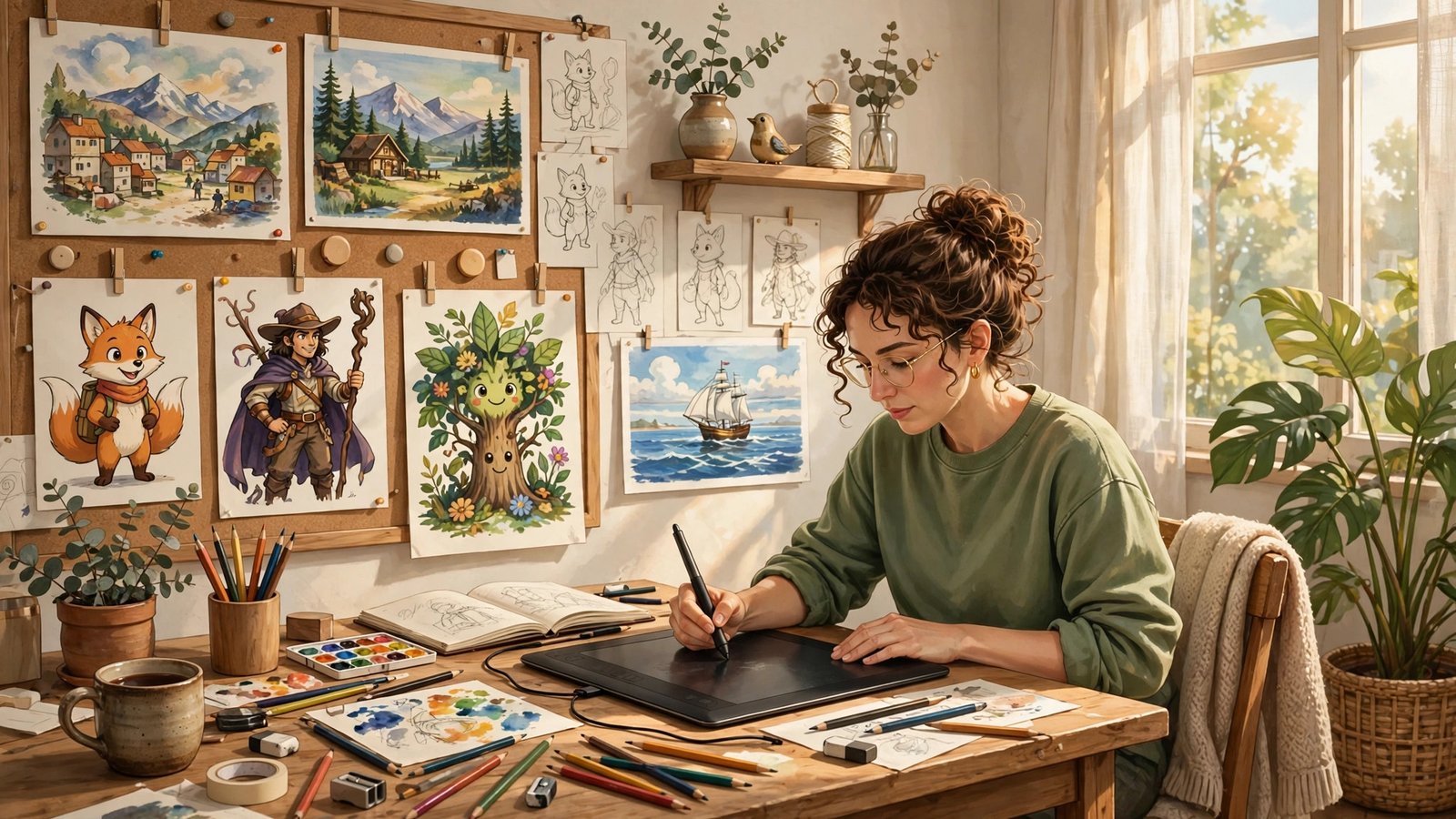
How to Work as a Freelance Illustrator in 2026
A freelance illustrator creates images for clients, one project at a time, and gets paid for that work. If you love to draw but you are not sure how drawing becomes a living, this guide is for you. It walks you through skills, tools, a portfolio, pricing, clients, contracts, and the honest timeline to your first paid job.
In this guide
- What a freelance illustrator does
- Types of illustration work and who buys them
- Step 1: Build your core drawing skills
- Step 2: Pick a niche you can serve well
- Step 3: Learn the digital tools clients expect
- Step 4: Build a portfolio that wins briefs
- Step 5: Set up the simple business basics
- Step 6: Price your work fairly
- Step 7: Find your first clients
- Step 8: Run each project like a professional
- Licensing and copyright in plain words
- A worked example: pricing one editorial illustration
- What it costs and what to expect
- Common mistakes
- Risks and scams to watch for
- Frequently asked questions
What a freelance illustrator does
A freelance illustrator is a self employed artist who makes images that help a client say something. The image might explain an idea in a magazine, bring a character to life in a children's book, or give a brand a look people remember.
You are not only an artist. You are also the person who finds the work, talks to the client, agrees the price, meets the deadline, and sends the invoice. That business half surprises many new illustrators, and it decides whether the work pays.
Clients hire you for a clear result, not for a vague talent. They want a cover by Friday, ten spot illustrations for a course, or a set of icons that match their brand.
Types of illustration work and who buys them
Illustration covers many kinds of work, and each kind has different buyers and budgets. The table below shows the most common types so you can pick one to start with.
| Type of work | Typical buyers | What you deliver |
|---|---|---|
| Editorial | Magazines, newspapers, blogs | One image that sums up an article |
| Children's books | Publishers, self published authors | Pages with consistent characters |
| Advertising and brands | Brands, agencies, small firms | Campaign and packaging art |
| Character and concept art | Game and animation studios | Character sheets and storyboards |
| Product and packaging | Food, drink, and gift brands | Labels, boxes, and patterns |
Start with one type. A portfolio that shows one clear strength beats a mixed pile of everything. You can widen your range later, once one type brings in steady work.
Step 1: Build your core drawing skills
Good illustration starts with drawing basics, and those basics matter more than any software trick. Clients notice weak drawing even when the colours are pretty, so build the foundation first.
Learn to draw what you see before you draw what you imagine. Practise simple shapes, then proportions, then light and shadow. Draw people, animals, and everyday objects from life, not only from photos.
Study composition, which is how you arrange things in a picture. A strong composition leads the eye to the most important part first. Study colour too, and keep your palette small at first, with two or three main colours and one accent colour.
Step 2: Pick a niche you can serve well
A niche is a small area you focus on, such as children's books, food packaging, or editorial illustration for health magazines. A clear niche helps clients remember you, and it helps you get better faster because you repeat similar work.
Pick a niche that fits three things: work you enjoy, work you can do well, and work people pay for. If you love drawing animals but hate deadlines, children's books may suit you better than daily editorial work.
Step 3: Learn the digital tools clients expect
Most clients expect digital files they can use at once, so learn at least one digital tool well. You do not need every program, and you do not need the most expensive plan on day one.
Adobe Illustrator is the standard tool for vector art, which is art made from clean curves that stays sharp at any size. Adobe Photoshop is the standard tool for painting, texture, and photo based illustration. Procreate on an iPad is popular for sketching and finished work.
Pick the tool that matches your niche. A children's book illustrator may live in Procreate or Photoshop, while a packaging illustrator may need Illustrator for clean vector files. Learn one tool deeply before you add a second, because clients pay for finished files, not for a long list of apps you have tried.
Step 4: Build a portfolio that wins briefs
A portfolio is a small set of your best finished work, shown in a way that helps a client picture you doing their job. It is the single most important tool for a freelance illustrator, because clients hire what they can see.
Show eight to twelve pieces, and make every one your best work. Ten strong pieces beat twenty average ones. Cut anything weak, old, or off topic, even if you liked making it.
If you have no clients yet, make practice projects that look like real briefs. Illustrate a magazine article, design a book cover for a made up story, or create packaging for a made up jam brand. Label these clearly as personal work, and never present them as paid client jobs.
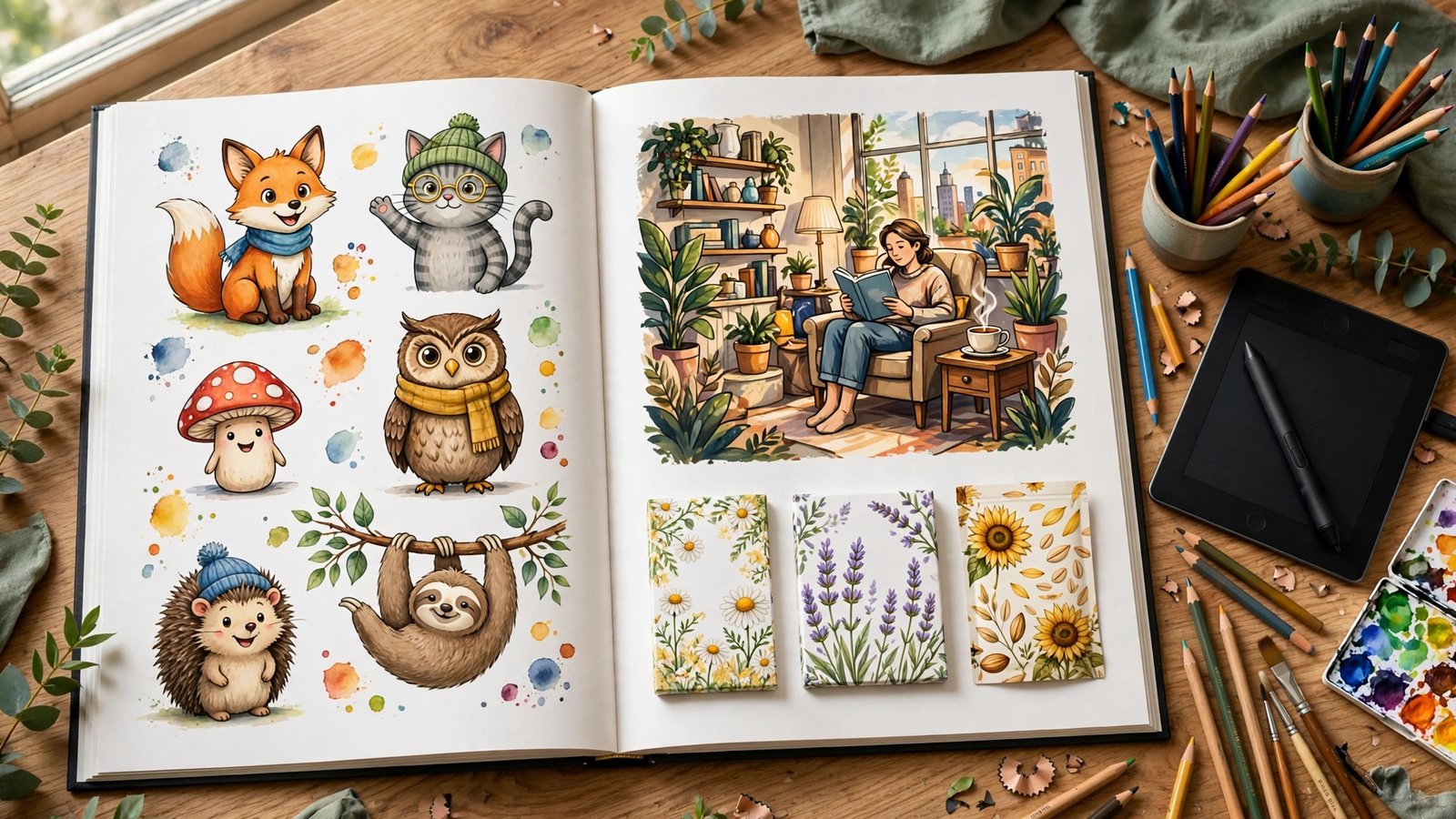
Put your portfolio on a simple website or on a platform such as Behance, keep the best three pieces at the top, and make your contact details easy to find. If you want a wider shop window for your art, read our guide on how to sell digital art online.
Step 5: Set up the simple business basics
Freelance illustration is a small business, so set up the basics before your first paid job. Keep it simple, and do not spend weeks on paperwork instead of drawing.
Learn the tax rules where you live. In most countries, freelance income is taxable, and you may need to register as self employed or file a return. The rules differ by country, so check your local tax authority or ask a qualified accountant.
Use a simple contract for every job, even a small one. A contract should state the fee, the deadline, the number of revision rounds, the file formats, the payment date, and the licence, which is the permission the client gets to use the image. The Association of Illustrators (AOI) offers contract and business support for illustrators, and its template contract is a useful starting point.
Step 6: Price your work fairly
Pricing is the part most new illustrators fear, and it decides whether the work can last. Price from your costs and your time, not from what feels polite. There are three common ways to charge, and each one suits different jobs.
| Pricing method | How it works | When it suits the job |
|---|---|---|
| Flat fee | One price for the whole job | Book covers, packaging, most briefs |
| Hourly rate | You charge for each hour | Work where the scope is unclear |
| Licence fee | The client pays for set use | Advertising and wide use work |
A flat fee is the most common choice, because clients want to know the total cost before they agree. Work out how many hours the job will take, multiply by the hourly rate you need to cover your costs, add time for revisions and admin, and add a margin for the licence if the use is wide.
Never work for free to gain exposure. Exposure does not pay rent, and clients who expect free work rarely become paying clients. Check platform fees before you quote on a marketplace. On Upwork, the Upwork freelancer service fee page states that the fee ranges from 0% to 15% per contract, and the exact rate is shown before you submit a proposal.
Step 7: Find your first clients
Clients do not appear on their own, so finding work is a daily task, not a one off event. Treat outreach as part of the job, and set aside time for it every week.
Start with warm outreach, which means contacting people you already know. Tell friends, past colleagues, and local businesses that you take illustration commissions. Many first jobs come from someone who already trusts you, even if the job is small.
Then try cold outreach, which means contacting art directors, editors, and small businesses you have never met. Find the right person by name, look at their recent work, and send a short email with three of your best images and one line about how your style fits their next project. Ten careful emails work far better than a hundred generic ones.
Use portfolio platforms and freelance marketplaces as well. Dribbble and Behance let art directors find you, and marketplaces let you bid on open jobs. Read our guide on how to earn money on Dribbble to see how that platform works, and read our guide on how to earn money on DesignCrowd before you enter a contest.

Step 8: Run each project like a professional
Professional habits win repeat work. Clients return to illustrators who communicate clearly, hit deadlines, and make the process easy.
Start every job with a written brief that states the deliverable, the size and format, the deadline, the fee, the number of revision rounds, and the licence.
Show your work in stages. Send a rough sketch first, so the client can check the idea before you spend hours on detail. Then send a colour draft, then the final art. At each stage, ask one clear question, such as whether the character pose works, so the client can answer fast.
Agree the number of revision rounds in advance, and most projects use two or three rounds. A revision round means a set of changes sent at one time, not endless small tweaks over weeks. If the client asks for major changes beyond the agreed rounds, quote an extra fee politely and in writing.
Licensing and copyright in plain words
Copyright is the legal right that belongs to the person who creates an image, and in most countries it belongs to you from the moment you draw it. A licence is the permission you give a client to use the image in a set way, for a set time, and in a set place.
Most illustration work uses a licence, not a sale of the copyright. The licence should state where the image can appear, for how long, and in which countries. A licence for one magazine issue costs less than a licence for worldwide advertising for five years, because the use is smaller.
A buyout means the client owns the image outright and can use it forever, and you may not even be able to show it in your portfolio. A buyout should cost far more than a normal licence, because you give up future income from that image. Read any buyout clause slowly, and ask for advice before you sign one.
A worked example: pricing one editorial illustration
Example only: these numbers are not typical results, and they are made up to show the maths. Your own costs, time, and market will differ.
Imagine a magazine asks you for one editorial illustration. You estimate the work will take 6 hours in total, including the sketch, the colour draft, one revision round, and the final files. You decide you need USD 25 per hour to cover your time, your tools, and your living costs.
First, work out the drawing time: 6 hours times USD 25 per hour equals USD 150. Next, add admin time for emails, invoicing, and file delivery, which you estimate at 1 hour, so add USD 25, which brings the total to USD 175. Then add a small licence margin for the magazine use, which you set at USD 25, so the quote becomes USD 200.
What it costs and what to expect
Starting as a freelance illustrator costs less than many other freelance jobs, because the main tool is your skill. The table below shows typical startup costs in general terms.
| Item | Typical cost | Notes |
|---|---|---|
| Drawing tablet or iPad | Low to moderate, one off | A basic tablet works at the start |
| Software | Low per month, or free | Free tools such as Krita cost nothing |
| Portfolio website | Low per year | A free portfolio platform is enough |
| Business basics | Low, one off | Templates and invoicing can be free |
| Learning | Free to moderate | Free tutorials and short paid courses |
| Marketing | Free to low | Outreach costs time, not money |
Expect a slow start. Your first paid job may take weeks or months of outreach, and your first months may bring little or no income. That is normal for a new freelance illustrator, and it does not mean your work is bad.
Common mistakes
- Showing every piece you have ever made instead of your ten best, which makes clients unsure what you do well.
- Copying another illustrator's style instead of building your own voice, which leaves you competing on price alone.
- Starting work without a written brief, which leads to endless revisions and disputes about what was agreed.
- Charging too little because you feel new, which attracts clients who do not value the work and leaves you unable to pay your costs.
- Ignoring the business side, such as invoices, records, and tax, which creates stress and can cost you money later.
- Giving away your copyright or your working files for free, which removes future income from work you already made.
Risks and scams to watch for
Freelance illustration attracts real clients, and it also attracts scams. Learn the warning signs before you need them.
Be careful with any client who asks you to pay a fee to start work, buy a starter kit, or pay for training before you earn. Real clients pay you, not the other way round. Be careful with jobs that promise huge pay for tiny work, or that pressure you to decide in hours.
Never send finished high resolution files before you have a written agreement and, for larger jobs, a deposit. Send low resolution previews or watermarked drafts until payment terms are agreed.
Watch for clients who ask for your bank details, passwords, or identity documents early in the conversation. A real client needs your payment details only when they pay you, and they never need your passwords. Check a new client before you start, and look for a real website, real past work, and real contact details. If something feels wrong, walk away, because a bad client costs more time than a lost job.
If you lose money to a scam, report it. In the United States, you can report fraud to the FTC through Report Fraud at the FTC.
Frequently asked questions
Do I need a degree to be a freelance illustrator?
No, you do not need a degree to work as a freelance illustrator. Clients hire you for your portfolio, your reliability, and your communication, not for a diploma.
How do freelance illustrators find clients?
Freelance illustrators find clients through warm outreach to people they know, careful cold emails to art directors, portfolio platforms, freelance marketplaces, social media, and referrals from happy clients.
How much should a freelance illustrator charge?
There is no single correct rate, because fees vary with your skill, your location, the type of work, the licence, and the client. Work out your hourly need from your costs, estimate the hours, add admin time and a licence margin, and quote one clear number in writing.
How long does it take to become a freelance illustrator?
It takes most beginners several months to a year or more to build the skills, the portfolio, and the client list for regular paid work. The drawing skill comes first, then the portfolio, then the outreach.
What tools do freelance illustrators use?
Most freelance illustrators use Adobe Illustrator for vector art, Adobe Photoshop for painting and texture, or Procreate on an iPad for sketching and finished work. Free tools such as Krita can also produce finished work.
Conclusion
Working as a freelance illustrator comes down to a clear order: build your drawing skill, pick one niche, learn one digital tool well, show ten strong pieces, price from your costs, and do outreach every week until the first client says yes.
Next, read how to work as a freelance graphic designer for a related visual route, how to work as a freelance copywriter if you want to pair words with your images, and how to work as a freelance video editor if you want to add motion to your work. Then browse all freelancing guides to find your next step.
Tax and copyright rules differ by country, so check your local rules or ask a qualified adviser before you sign a contract or file a return. Earning results vary; nothing on this site is financial advice.