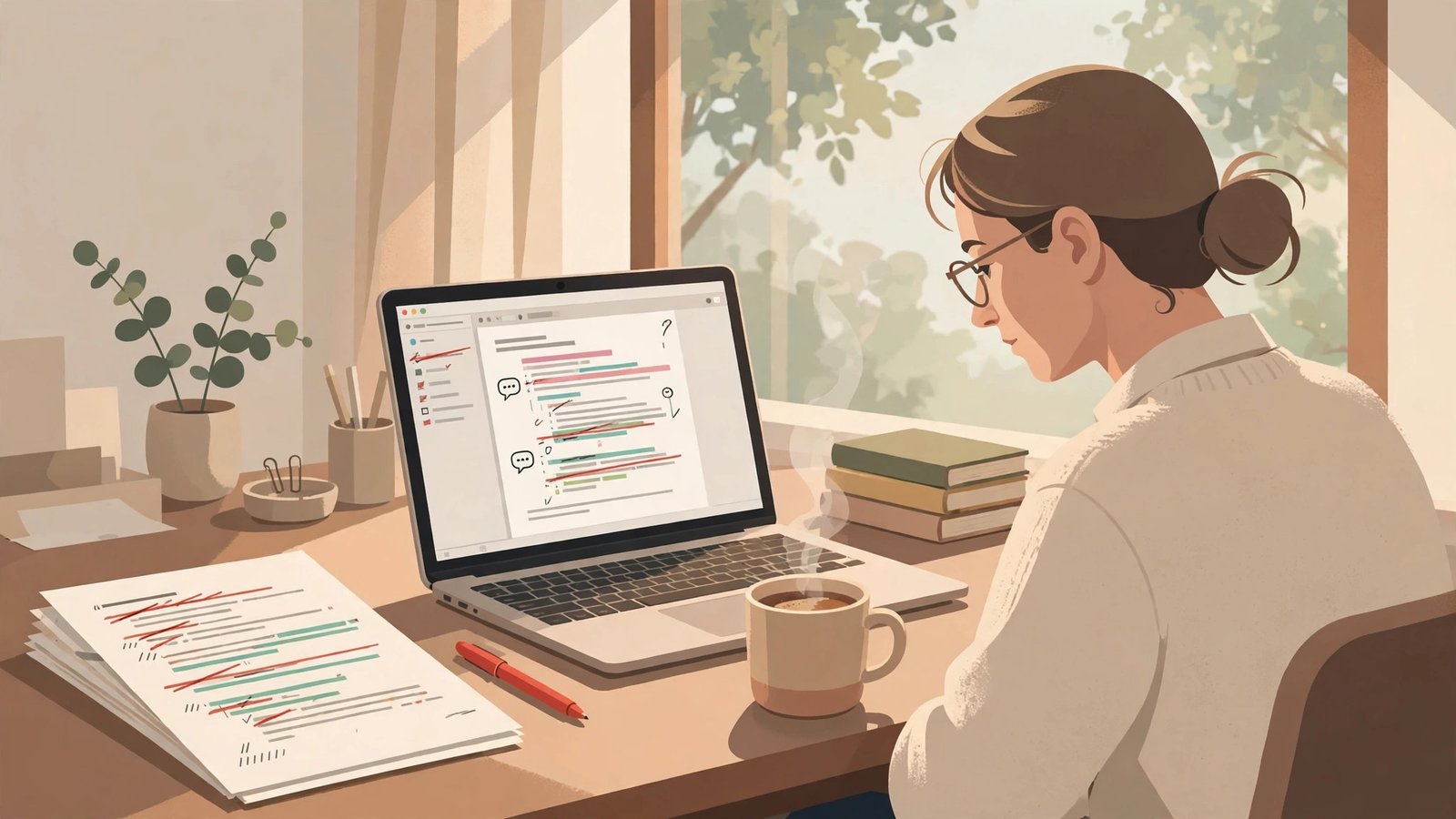
How to Work as a Freelance Editor in 2026
A freelance editor is paid to improve other people's writing before it is published. You check the words, fix the errors, and sharpen the sentences. This guide shows you how to work as a freelance editor in 2026, from choosing the type of editing you will sell to setting a rate and finding your first clients.
In this guide
- What a freelance editor actually does
- The skills you really need
- Step 1: Choose your service and niche
- Step 2: Learn the craft
- Step 3: Build a portfolio with samples
- Step 4: Set your rates
- Step 5: Set up the business basics
- Step 6: Find your first clients
- Step 7: Deliver great work and win repeat clients
- A worked example
- What it costs and what to expect
- Common mistakes
- Risks and scams to watch for
- Frequently asked questions
What a freelance editor actually does
A freelance editor works for many clients instead of one employer. A client sends you a draft, and you return it cleaner, clearer, and ready for its reader. Editing is several levels of work, and each level has a different price.
| Type of edit | What you do | When a client needs it |
|---|---|---|
| Proofreading | You fix spelling, grammar, punctuation, and small typing errors. | The draft is finished and nearly ready to publish. |
| Copy editing | You fix errors and also improve sentences, tone, and consistency. | The draft is sound but rough, and it needs a careful polish. |
| Line editing | You improve the flow, rhythm, and voice of the writing, sentence by sentence. | The writing feels flat or hard to follow, even though the ideas are good. |
| Developmental editing | You advise on structure, order, gaps, and whether the piece serves its reader. | The draft is early, and the writer needs direction before they rewrite. |
Most beginners start with proofreading and copy editing. Clients include authors, bloggers, businesses, students, and researchers. Pick one or two groups and serve them well.
The skills you really need
You do not need a degree to become a freelance editor. Most clients will ask to see your work, not your certificate. Still, you need real skills.
You need strong language skills. You must know grammar, spelling, and punctuation well enough to explain a change, not just make it. You also need attention to detail. Editing is slow, close work, and if you skim you will miss the errors you were paid to catch. You need tact too. You are telling a writer that their work needs fixing, and writers care about their words. Good editors give clear, kind feedback.
You need time management, because you will often juggle two or three jobs with different deadlines. You also need the tools. Most clients expect tracked changes in Microsoft Word or Google Docs, so the client can see every edit. Learn one style guide too, such as the Chicago Manual of Style.
Grammar tools can catch simple slips, but they are not a replacement for your judgement.
Step 1: Choose the service and the niche you will sell
A profile that says you will edit anything is hard to hire. A profile that names one service and one kind of client is easy to compare. So start narrow.
Pick one level of editing first. Proofreading is the simplest start. Copy editing is a strong start if you enjoy rewriting sentences. Pick the level that matches your current skill, not the one that pays most.
Then pick a niche. A niche is a small, clear market you serve, such as blog posts, novels, or academic papers, or a subject such as health or finance. Good niches for beginners include blog posts for small businesses, books for self-published authors, student essays, business reports, and CVs.
Specialist niches such as medical or legal editing usually need a degree or work experience in that field. Do not claim a specialism you cannot back up with a sample.
Step 2: Learn the craft and build your skills
Reading a lot is the base of this work. Read widely in the kind of text you want to edit.
Then practise on real text. You can edit public domain books, which are old books whose copyright has ended. You can also write a short piece yourself and edit it a day later. Practise with tracked changes on, so you learn to show your work the way a client expects to see it.
A course can speed this up. The Chartered Institute of Editing and Proofreading offers training for editors and proofreaders. A certificate helps, but clients hire you for the sample.
Learn one style guide well, such as the Chicago Manual of Style for books or the Associated Press Stylebook for news. Give yourself four to six weeks of steady practice to build a first set of samples, then move on to finding a client.
Step 3: Build a portfolio with honest samples
A portfolio is a small set of your best work that a client can look at before they hire you. As a beginner, you will not have client work yet, so you build samples instead. Label them as samples and never present them as paid client work.
Build three short samples. A good sample is a before and after pair. Show a short passage as it was, then show your edited version, with three or four notes that explain why you made each change.
Build three samples in a week. First, proofread a public domain passage of about 500 words. Second, copy edit a rough blog post you wrote yourself. Third, line edit a short business page you wrote yourself.
Put the samples on a one page website or a shared document with a clear link. Include a short bio, your services, your rates, and a way to contact you. Keep the site free of errors.
Step 4: Set your rates from real industry figures
Rates are where many beginners get stuck. Charge too little and you cannot live on the work. Charge too much with no proof and clients will pass you by. Start from what the industry actually charges. The Editorial Freelancers Association 2026 Rate Chart is based on a survey of more than 1,100 editorial professionals, and it gives median ranges, which means half charged more and half charged less. The table below shows the non-fiction medians from the Editorial Freelancers Association 2026 Rate Chart.
| Service | Per word (non-fiction) | Per hour (non-fiction) |
|---|---|---|
| Proofreading | 2.0 to 3.0 cents | $40 to $55 |
| Copy editing | 3.0 to 4.0 cents | $45 to $60 |
| Line editing | 3.5 to 5.0 cents | $50 to $65 |
| Developmental editing | 4.0 to 5.0 cents | $57.50 to $70 |
Fiction rates are lower: copy editing has a median of 2.0 to 2.7 cents per word, and proofreading has a median of 1.2 to 2.0 cents. Academic and medical editing sit higher.
These are medians for experienced editors in the United States, so a beginner will usually start below them. Start near the bottom of the range, and raise your rate after each few completed jobs. Never work for free beyond a tiny sample edit.
Before you quote, ask for a sample of the text. A clean 5,000 word draft may take you four hours. A messy one may take eight. Always state the word count, the level of edit, the number of rounds, and the delivery date in writing.
Platform fees matter too. If you find work on Upwork, the platform takes a fee of 0 percent to 15 percent per contract, as of November 2026, so the rate you quote is not the rate you keep. For context, the US Bureau of Labor Statistics reports that the median annual wage for employed editors was $77,920 in May 2025. That figure covers staff editors with a salary, so it is not a promise of freelance income. See the US Bureau of Labor Statistics editors page.
Step 5: Set up the business basics
You do not need a company or office to start. You need a few basics in place before your first client.
First, set up a simple way to get paid, such as a bank transfer, PayPal, Wise, or the payment system of the platform where you found the work. Check which methods work in your country first.
Second, write a short contract or terms sheet with the scope, the price, the delivery date, the number of rounds, and the payment terms. Send it before you start, and get the client's agreement in writing.
Third, agree payment terms. A deposit of 50 percent before you start is normal for a new client, with the rest on delivery. Do not start a large job with no deposit and no written agreement.
Fourth, keep simple records. Save every invoice and note every payment. Tax rules differ by country, so check your local tax authority or a qualified accountant.
Step 6: Find your first clients
Clients will not find you by themselves. You need to go where the people who need editing already are.
Freelance marketplaces are the easiest start. Upwork and Fiverr both list editing jobs, and they give a new editor a way to win a first review. Some listings pay very little, so look for small, clear jobs that match your sample, such as a blog post or a short chapter.
Job boards are another route. ProBlogger's job board, Freelance Writing, and FlexJobs list editing work. Content agencies also hire freelance editors for steady batches of articles. Reedsy connects vetted editors with authors, but it reviews profiles first.
Networking brings the clients that marketplaces miss. Tell friends, family, and former colleagues that you edit, and say exactly what kind of text you edit. Other editors are not only rivals. They pass on work they cannot take. When you apply for a job, keep your proposal short. Name the level of edit, point to the matching sample, give the price and the delivery date, and ask one clear question.
If you want a related skill that pairs well with editing, read our guide to how to work as a freelance copywriter or our guide to how to work as a freelance translator.

Step 7: Deliver great work and win repeat clients
Your first client matters more than your tenth, because a happy first client can give you a review, a referral, and repeat work. Start by reading the brief twice. Ask the client what the piece is for, who will read it, and what style they use.
Edit in two passes. On the first pass, read for structure and sense. On the second pass, read for errors. Take a short break between passes, so you read the text with fresh eyes.
Deliver on time, with a short note that explains what you changed and why. After delivery, ask for feedback and a review. If the client is happy, ask whether they have more work coming. Most freelance editing income comes from repeat clients and referrals.
A worked example with the maths shown
Example only: these numbers are not typical results. They show how a simple job is priced.
A client asks you to copy edit a 5,000 word blog post. You quote 3.5 cents per word, inside the EFA median range for non-fiction copy editing.
- Price: 5,000 words times $0.035 equals $175.
- Time: you edit about 1,000 words per hour, so the job takes about 5 hours.
- Hourly value: $175 divided by 5 hours equals $35 per hour.
- Platform fee: if the job came through a platform that takes 10 percent, the fee is $17.50.
- You keep: $175 minus $17.50 equals $157.50.
The $35 per hour is below the EFA median of $45 to $60 per hour, which is normal for a beginner. As you gain reviews and speed, you can raise your rate.
What it costs and what to expect
Starting as a freelance editor costs very little. You need a computer, an internet connection, and word processing software.
| Cost | What it is | Rough cost |
|---|---|---|
| Domain and simple website | Your portfolio page and contact details | Low, often under $100 per year |
| Word processing software | Microsoft Word or Google Docs | Free to low monthly cost |
| Style guide | A book of editing rules, such as the Chicago Manual of Style | One off purchase, low cost |
| Grammar checking tool | Software that flags simple errors | Free plan, or a low monthly fee |
| Training course | A short editing or proofreading course | Low to moderate, one off |
| Professional membership | Joining a body such as the CIEP | Annual fee, optional |
Prices change often, so treat the figures above as a rough guide. You can start with free tools and add paid ones once you have income.
Expect a slow start. Many beginners spend two to four weeks building samples, then one to three months finding a first paid job. Steady work often takes six to twelve months.
Common mistakes
- Offering every type of editing to every kind of client.
- Quoting a price before you have seen a sample of the text.
- Working without a written agreement.
- Giving a large free test edit, which is often free work in disguise.
- Editing and proofreading in a single pass.
- Keeping your rate at beginner level for years.
Risks and scams to watch for
Freelance editing is real work, but scams exist, and beginners are the usual target.
Never pay a fee to get a job. A real client pays you, not the other way round. Be wary of any listing that asks for a training fee, a registration fee, or a deposit before you can start. No course can guarantee you a job.
Be careful with large unpaid test edits. A short test of 300 to 500 words is normal. A test that asks you to edit a whole chapter for free is usually free labour.
Do not share bank details, identity documents, or passwords with a client. If someone asks for your bank login or a code from your phone, stop and report them to the platform.
Watch for scope creep, which is when a job quietly grows after you agree the price, such as a proofread that turns into a full rewrite. If the job changes, say so at once and agree a new price before you continue. Check the client before you start a large job, and be wary of new accounts with no history that offer very high pay for simple work. If a job feels wrong, trust that feeling and turn it down.
Frequently asked questions
Do you need a degree to be a freelance editor?
No, you do not need a degree to work as a freelance editor. Clients hire you for your samples and your accuracy, not for a certificate.
How much do freelance editors charge?
It depends on the service, the text, and your experience. The Editorial Freelancers Association 2026 Rate Chart gives medians of 2.0 to 3.0 cents per word for non-fiction proofreading, 3.0 to 4.0 cents for copy editing, 3.5 to 5.0 cents for line editing, and 4.0 to 5.0 cents for developmental editing. Beginners start below these medians.
Can you be a freelance editor with no experience?
Yes, you can start with no paid experience, but you cannot start with no proof of skill. Build three short before and after samples, label them as samples, and use them to apply for small jobs.
What is the difference between editing and proofreading?
Editing improves the writing itself, such as the sentences, the flow, and the structure. Proofreading is the last check for surface errors such as spelling, grammar, and punctuation. It is often the best first service for a beginner to sell.
How do freelance editors find clients?
Most freelance editors find clients through a mix of marketplaces, job boards, direct outreach, and referrals. Upwork and Fiverr are common starting points. Over time, repeat clients and referrals usually become the main source of jobs.
Is freelance editing a good job for beginners?
It can be, if you already read carefully and enjoy fixing language. The startup cost is low, and you can start with small jobs while you learn. It is not a quick income, though, and the first months are often slow.
Conclusion
Working as a freelance editor comes down to a simple method. Pick one service and one niche, build three honest samples, set your rate from real industry figures, and find your first clients through marketplaces and job boards. Then deliver on time and raise your rate as your reviews grow.
To see how a close skill compares, read our guide to how to work as a freelance copywriter. If you also work across languages, read our guide to how to work as a freelance translator. And if you want to grow beyond solo work, read our guide to how to start a content writing agency. You can browse all of them in the freelancing category.
Earning results vary, and nothing on this site is financial advice. Tax and work rules differ by country, so check your local tax authority or a qualified accountant before you set up your freelance business.