
How to Become a Freelance Writer in 2026
Learning how to become a freelance writer is possible with no degree, no published clips, and no connections, if you follow a clear method. Many beginners wait for permission: a course, a certificate, or a first client who takes a chance. That permission never arrives. Clients hire writers who can show good samples, explain a topic clearly, and deliver on time.
This guide is for complete beginners who want to earn as a freelance writer. You will learn what a freelance writer actually does, how to pick a niche, how to build a portfolio with no clients, how to set up your professional home, the craft basics, where to find your first paid jobs, how to pitch, how to set your rates, how to run the business side, and how to handle difficult clients and scams. You will also get a first-30-days plan.
In this guide
- What a freelance writer actually does
- Step 1: Pick a niche that is flexible, not final
- Step 2: Build a portfolio with no clients
- Step 3: Set up your professional home
- Step 4: Learn the craft basics
- Step 5: Find your first paid jobs
- Step 6: Pitch before you feel ready
- Step 7: Set your rates
- Step 8: Run the business side
- Step 9: Handle difficult clients and non-payment
- Scams aimed at new writers
- How to become a freelance writer: a first-30-days plan
- Common mistakes
- Frequently asked questions
What a freelance writer actually does
A freelance writer is paid to write for other people and businesses. The work falls into several types. Content writing means blog posts and guides that help a business attract readers. Copywriting means sales pages, adverts, and emails that persuade a reader to act. Technical writing means manuals and help pages. Editorial writing means articles for magazines and websites. Ghostwriting means writing in someone else's name. Most beginners start with content writing, because it has the most jobs and the lowest barrier.
Writers are hired by businesses of every size, and by agencies, publishers, and website owners. They are paid per word, per hour, per project, or on a monthly retainer, which is a fixed monthly fee for a set amount of work. Rates vary widely by niche, experience, and location, and no single figure describes what writers earn. Be wary of any guide that quotes one person's income as typical. The Federal Trade Commission explains in its Endorsement Guides FAQ that atypical results must be explained, not presented as what most people can expect.
You do not need a degree to become a freelance writer. Clients care about samples, not certificates. You do need clear writing, reliable delivery, and the habit of checking facts.
Step 1: Pick a niche that is flexible, not final
A niche is a topic area you write about. Picking one helps you find clients, because a business that needs a writer for its software blog will hire the writer who knows software. Your niche should be flexible, not final. You can change it later, and most writers do.
Pick from three sources. First, your experience: past jobs, study, hobbies, and life experience. A former nurse can write about health, and a teacher can write about education. Second, what businesses pay for: finance, technology, health, business, and education all have steady demand for writers. Third, what you enjoy reading and writing about.
Test your niche with three questions. Can you name ten topics in it without research? Can you name five businesses who pay writers in it? Would you still enjoy it after writing about it every week for three months? If the answer is yes to all three, you have a workable niche.
Step 2: Build a portfolio with no clients
A portfolio is a small set of writing samples that shows a client what you can do. You need three to five strong samples before you look for paid work. Write them yourself, as if a real client had asked for them.
Write three kinds of sample. First, a how-to guide in your niche, of about 800 to 1,000 words, with clear headings and a useful answer. Second, a rewrite: take a weak article on a topic you know, and rewrite it better. Third, a short sales page or a product description, if you want copywriting work. Publish the samples on your own site, or on a free platform.
Label every sample honestly. A sample is not a client project, and you must not present it as one. Write "Sample written for portfolio" at the top, or publish it on your own site where the context is clear. Honest samples build trust. Fake client names destroy it. For the portfolio method, read how to create a freelance portfolio.
Step 3: Set up your professional home
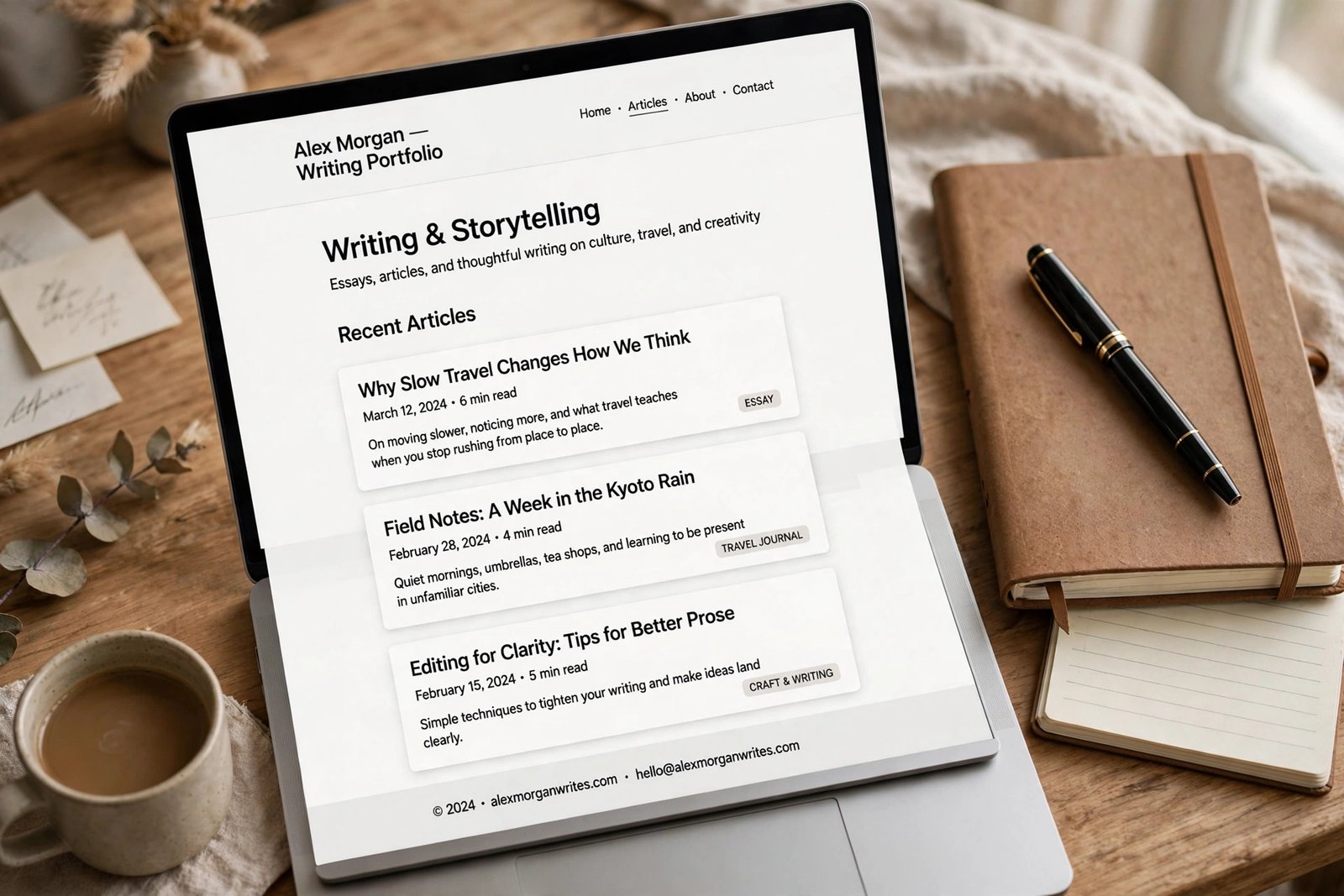
Your professional home is one place where a client can check you out. A simple website is best, because you control it. It needs four parts: a short bio, a services page, your three to five samples, and a contact route.
Set up one or two social profiles where your clients spend time. For business writing, that is often LinkedIn. Keep your bio, photo, and wording the same as your website. One profile you update weekly beats five you never touch.
Keep your tools simple: a laptop, a writing program, a task list, and a way to get paid. A grammar checker helps, but it does not replace reading your work aloud. A simple website, a clear bio, and three good samples are enough to start.
Step 4: Learn the craft basics
Writing well is a craft, and the basics are simple to learn. Research first: read the official source, and check every fact you state. Structure second: plan your headings before you draft. Write third, in plain language, with short sentences. Revise fourth: read your draft aloud, cut every weak sentence, and check the facts again.
Learn one style guide and use it. A style guide is a set of rules for spelling, capital letters, and punctuation, and it keeps your work consistent. Many clients use their own guide, so ask for it before you start. Google asks writers to show first-hand expertise and real depth in its guide on creating helpful, reliable, people-first content, and it warns against deceptive authorship information.
Practise every week. Rewrite a weak article. Summarise a long report in 300 words. Explain a hard topic to a friend in plain words.
Step 5: Find your first paid jobs
Your first paid jobs will come from four places. Job boards list writing jobs every day. Freelance platforms let you build a profile and bid for work, though competition is high and fees apply. Direct outreach means emailing a business that needs a writer, with a short pitch and a sample. Referrals come from people who know your work.
Start with job boards and platforms, because they need no reputation. Apply to jobs that match your niche and your samples, and write a short application that names the client's problem, not your life story. Then add direct outreach, because it pays better and builds real relationships. Pick ten businesses in your niche, read their blogs, find a gap, and pitch one article idea each. For the wider method, read how to find freelance clients.
Avoid content mills that pay a few dollars per thousand words. Avoid any job that asks you to pay to get work, to buy a starter kit, or to write a long free trial article. A short sample of 200 to 300 words is a normal test. A full article for free is not a test. It is free labour.
Step 6: Pitch before you feel ready
Most beginners wait to pitch until they feel ready. That feeling rarely arrives. Pitch before you feel ready, because pitching is how you learn what clients want.
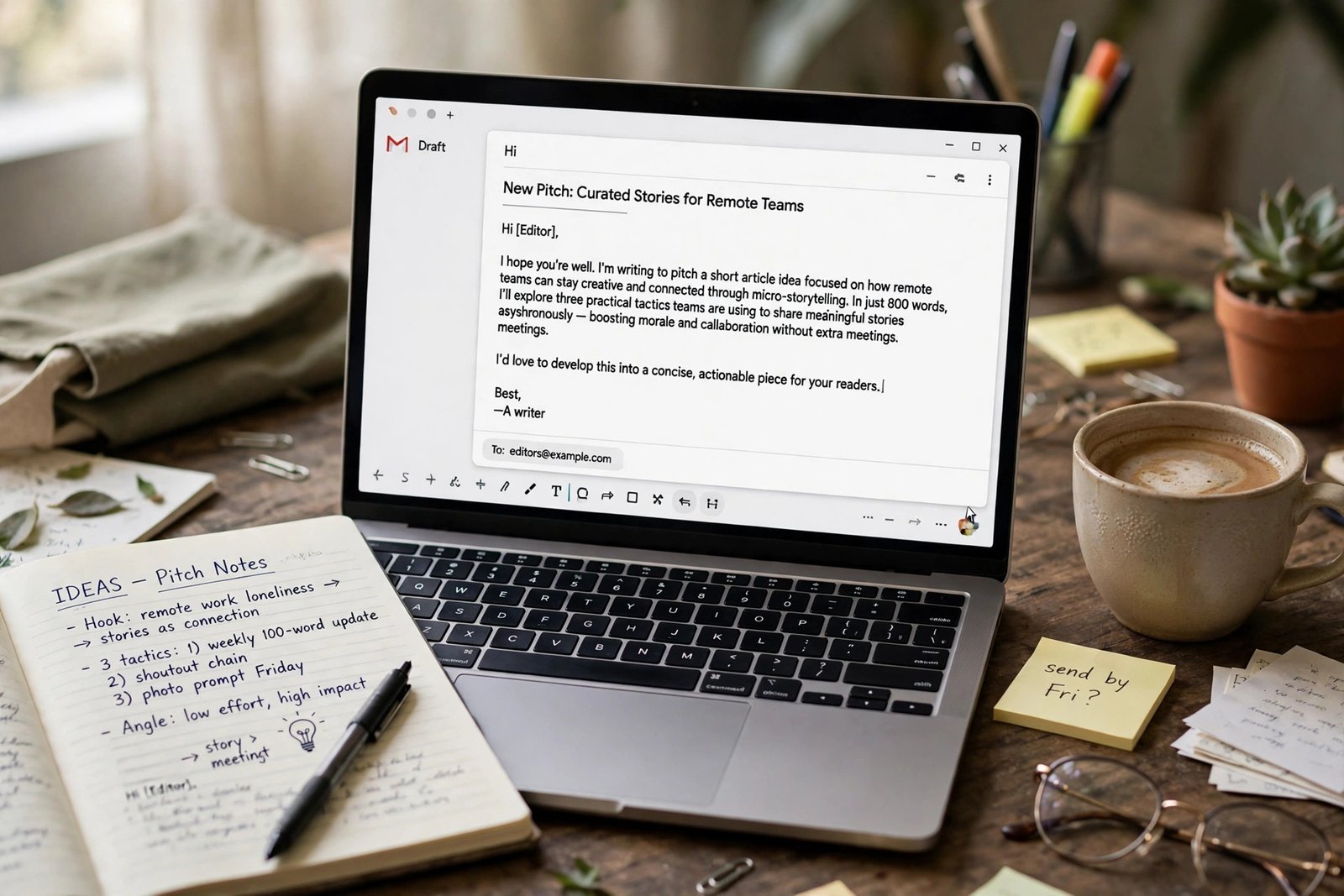
Use this template, and adapt it to your own words:
Subject: Article idea for your blog: how small cafes can fill weekday tables
Hello [name], I read your guide on [topic], and I noticed you have not covered [gap]. I write about [niche], and I would like to write a 1,000-word guide on [idea] for your readers. It would cover [point one], [point two], and [point three]. Here are two samples: [link one] and [link two]. My rate for a guide like this is [rate]. Would you like a short outline first? Thank you, [your name].
Keep the pitch short, specific, and about the client's readers, not about you. Send five pitches a week, follow up once after seven days, and keep a simple record of who you pitched, when, and what they said. Rejection is normal. Most pitches get no reply, and that is not a verdict on your writing.
Step 7: Set your rates
Writers are paid in four ways: per word, per hour, per project, or on retainer. Per-word pay is simple, but it punishes fast writers. Per-hour pay is fair for research-heavy work, but it punishes efficiency. Per-project pay rewards speed and skill, but you must estimate the work well. A retainer gives steady income, but it ties up your time.
Example only: these numbers are not typical results. Imagine the same job, a 1,000-word blog post, priced three ways. Per word at 0.10 dollars a word, it pays 100 dollars. Per hour, four hours at 40 dollars an hour pays 160 dollars. Per project, you might charge a flat fee of 150 dollars. The same job pays 100, 160, or 150 dollars, depending on the method. For most beginners, a per-project rate is the best choice, because it rewards good work.
Start with a rate you can defend, and raise it as your portfolio and demand grow. Do not work for a few dollars per thousand words, because that rate does not cover your time. For the full rate method, read how to set freelance rates.
Step 8: Run the business side
Freelance writing is a business, and the admin matters. Use a simple contract for every job, even a small one. It should state the scope, the price, the payment terms, the revision rounds, and the deadline. For the contract method, read freelance contracts explained.
Send an invoice for every job, with the invoice number, the date, the amount, and the payment terms. Track every pitch, every job, and every payment in one spreadsheet. Keep your tax records from the start, and set aside a share of each payment for tax. Tax rules differ by country, so check your local tax authority. For the tax basics, read freelance taxes for beginners, and for invoicing, read how to invoice freelance clients.
Step 9: Handle difficult clients and non-payment
Sooner or later, a client will ask for endless revisions, pay late, or rewrite your work and ask for a refund. Handle it calmly and in writing. Point to the contract, name the impact, and offer clear choices. If a client does not pay, send a polite reminder, pause new work, and send a written demand.
If a client rewrites your work heavily and then asks for a refund, check what was agreed. If the work matches the brief, you are not obliged to refund. If the work missed the brief, fix it or agree a partial refund in writing. For the full method, read how to handle difficult freelance clients, the companion guide in this batch.
Scams aimed at new writers
New writers are a target for scams, because they are keen for work. A job that asks you to pay to apply, to buy training, or to buy a starter kit is a scam. A client who asks for a long free trial article is using you for free labour. A content mill that pays a few dollars per thousand words is not a scam, but it is not a living either. A job that asks for your bank details before any work is agreed is a scam.
Check every new client before you start. Search their name and their business, read their website, and ask for a written brief and a contract. If they will not give you one, walk away. For the wider warning signs, read how to spot online job scams.
How to become a freelance writer: a first-30-days plan
You can go from no samples to your first pitches in 30 days, with one clear action each week.
| Week | Action | What to keep as evidence |
|---|---|---|
| Week 1 | Pick your niche, and write your first two samples | Two finished samples, published on your site or a free platform |
| Week 2 | Write one more sample, and set up your website and profile | Three samples, a live website, and one updated profile |
| Week 3 | Send five pitches, and apply to five jobs on boards or platforms | A record of ten applications, with dates and replies |
| Week 4 | Follow up on every pitch, send five more, and review your rates | A record of twenty applications, and one rate you can defend |
After 30 days, you will have three samples, a live website, and twenty applications sent. That is a real start. From there, keep pitching five a week.
Common mistakes
- Writing for free for too long, instead of charging from the first paid job.
- Having no niche, so no client knows if you are right for them.
- Presenting samples as client work, which destroys trust when a client checks.
- Paying to get work, or writing long free trial articles for strangers.
Frequently asked questions
How do I become a freelance writer with no experience?
Start with three to five samples you write yourself, in a niche you know. Publish them on your own site or a free platform, set up a simple website and one profile, then pitch five businesses a week. You do not need a degree or published clips.
Do I need a degree to become a freelance writer?
No. Clients hire writers for their samples, not for their certificates. A degree can help in a specialist niche, such as law or medicine, but it is not required for most freelance writing. Clear writing, good research, and meeting deadlines matter far more.
How much do freelance writers make?
Rates vary widely by niche, experience, and location, so no single figure is honest. Beginners often charge less while they build samples, and experienced writers in specialist niches charge far more. Be wary of any guide that quotes one person's income as typical.
How long does it take to become a freelance writer?
You can have samples and a website ready in about 30 days, as the plan above shows. Your first paid job may take a few weeks more, depending on how many pitches you send. Steady income usually takes months, not days.
Where do freelance writers find clients?
Job boards and freelance platforms are the easiest place to start, because they need no reputation. Direct outreach to businesses in your niche pays better. Referrals from people who know your work grow over time.
What type of freelance writing pays best?
Specialist writing usually pays best, because fewer writers can do it. Technical writing, finance, health, and business writing often pay more than general blog writing, because they need real knowledge.
Conclusion: write three samples, then pitch
Becoming a freelance writer starts with proof, not permission. Pick a niche you can explain, write three to five honest samples, and set up a simple website. Learn the craft basics: research, structure, plain language, revision, and fact checking. Then pitch before you feel ready, five pitches a week. Set your rate by the project, and run the business side with a contract and an invoice for every job.
Your next step is to write your first sample today, in your niche, of about 800 to 1,000 words. When it is done, build your portfolio with how to create a freelance portfolio, set your rate with how to set freelance rates, and handle hard clients with how to handle difficult freelance clients.
Note for the reader: tax and business rules differ by country, so check your local rules. Earning results vary; nothing on this site is financial advice.