
How to Manage Multiple Freelance Clients in 2026
Learning how to manage multiple freelance clients is what separates a freelancer who earns well from one who is always behind. Three clients can feel fine. Five can feel busy. Eight can feel like drowning. The problem is rarely the number of hours. It is the switching, the remembering, and the admin that grows with every client you add. This guide gives you a simple system for handling several clients at once, without missing deadlines or burning out.
This guide is for freelancers who already have two or more clients and want a method they can use every week. You will learn how to work out your real capacity, put everything in one system, stagger projects, block time by client, set communication boundaries, handle conflicting deadlines, and know when you have too many. You will also get a weekly capacity worksheet.
In this guide
- Why multiple clients are hard: context switching, not hours
- Step 1: Work out your real capacity
- Step 2: Put everything in one system
- Step 3: Stagger projects at different stages
- Step 4: Block time by client and batch similar work
- Step 5: Standardise your processes
- Step 6: Set communication boundaries
- Step 7: Manage expectations and conflicting deadlines
- Step 8: Track time and money per client
- How to manage multiple freelance clients when you have too many
- Confidentiality between clients
- Burnout prevention
- Frequently asked questions
Why multiple clients are hard: context switching, not hours
Most freelancers blame the hours when several clients feel hard. The real cost is switching. Each time you move from one client to another, you must remember their brief, their tone, their files, and where you stopped. That mental reset takes time and focus.
Switching also causes mistakes. You send the wrong file to the wrong client. You use one client's tone in another client's draft. You forget a small detail that mattered. The fix is not to work longer hours. It is to reduce the switching, by grouping similar work, blocking time by client, and keeping one clear record for each client. Google asks writers to give readers real value in its guide on creating helpful, reliable, people-first content.
How many clients can a freelancer handle? There is no single number. Some guides suggest three to five active clients, while others say five to eight retainer clients can work. The truth depends on the work. Judge by hours and complexity, not by a single number someone else picked.
Step 1: Work out your real capacity
Before you take on another client, work out how many hours you really have. Start with your working week, then subtract the time that is not billable. What is left is your billable capacity, and that decides how many clients you can take.
Example only: these numbers are not typical results. Imagine you work 40 hours a week: 25 hours on billable client work, 8 hours on non-billable work such as admin and marketing, and 7 hours unallocated as a buffer. If a new client needs 10 hours a week, you do not have room for them, because your buffer is only 7 hours.
Use the worksheet below to work out your own capacity. Fill it in honestly, with your real hours, not your ideal ones.
| Your week | Hours |
|---|---|
| Total working hours per week | 40 |
| Billable client work | 25 |
| Non-billable work (admin, marketing, learning) | 8 |
| Buffer for urgent work and overruns | 7 |
| Hours free for a new client | 0 |
Keep 15 to 20 percent of your week unallocated, as the buffer in the example shows. That buffer absorbs the late brief, the urgent fix, and the project that runs long. Without it, one surprise pushes every other deadline. If you are starting out, read how to start freelancing first.
Step 2: Put everything in one system
One client, one notebook, one inbox, and one chat app is a recipe for lost work. Put everything in one system, so there is one place to look for every deadline and every file.
Pick one project tool and use it for every client: a simple board tool, a task app, or a spreadsheet. Give each client one board or one page, and list every task, its deadline, and its status. Keep one calendar for all deadlines, with each client in a different colour, and one folder per client for files.
The tool matters less than the habit. A simple system you use every day beats a powerful tool you update once a week. Check your board each morning, update it each evening, and never trust your memory for a deadline.
Step 3: Stagger projects at different stages
Deadlines cluster when every project is at the same stage. If all five clients need delivery in the same week, you will work late every night, and something will slip. Stagger your projects, so they sit at different stages.
A project has four broad stages: discovery, execution, waiting on feedback, and final review. Aim for a mix. While one project is in execution, another should be waiting on feedback, and a third should be in discovery. That way, your busy weeks are spread out, and you always have something to work on while you wait for a client reply.
When you take on a new project, look at your board first. If three projects are already in execution, ask the new client for a later start date or a longer deadline. Clients usually accept a clear start date.
Step 4: Block time by client and batch similar work
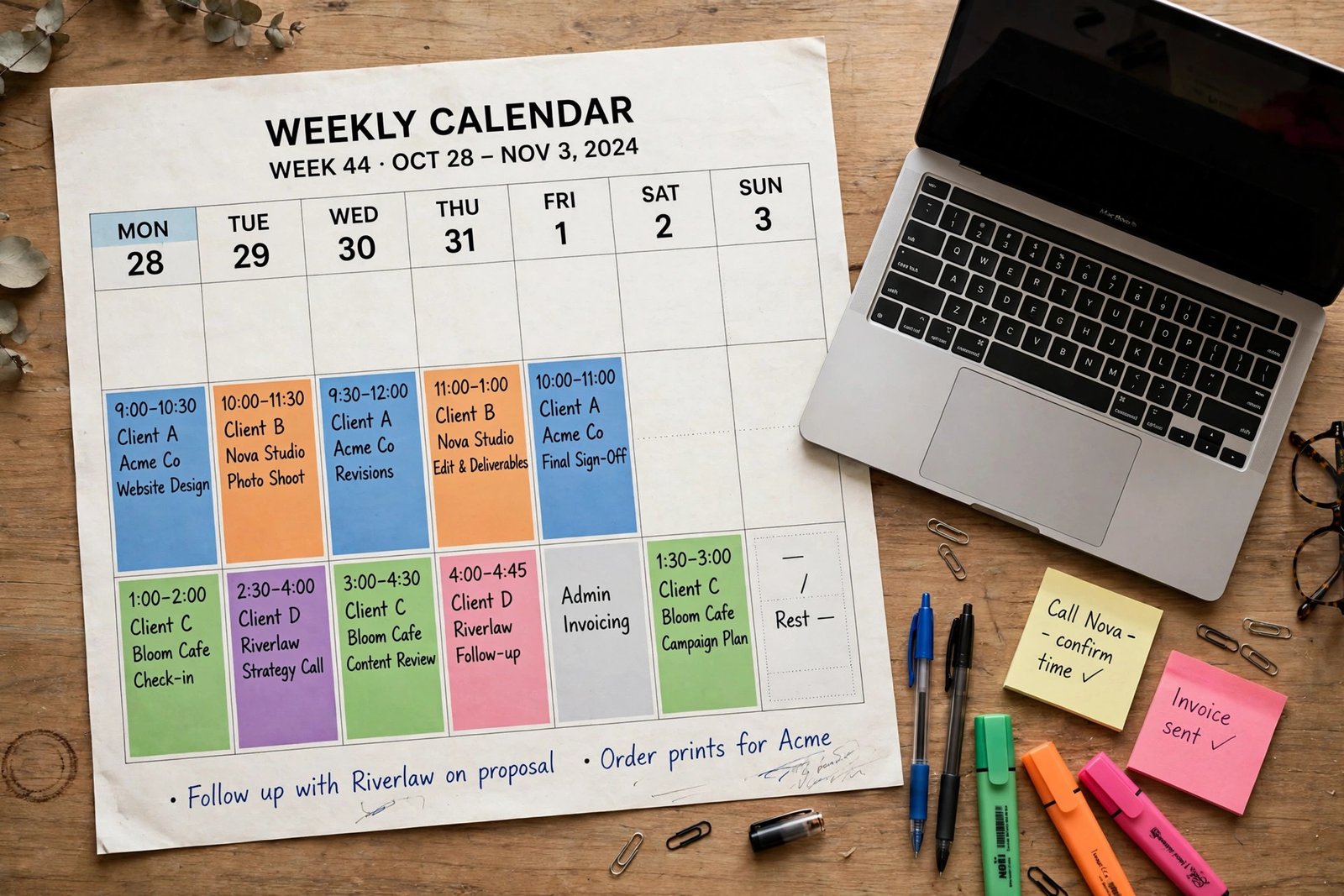
Time blocking means giving each client a fixed slot in your week, and working only on that client during that slot. For example, you might give Client A Monday morning, Client B Monday afternoon, and Client C Tuesday. Calls for all clients go on Thursday morning, and admin goes on Friday afternoon.
Batching means grouping similar work together. Write all your drafts in one block, do all your design work in another, and take all your calls in a third. That cuts the switching cost, because your brain stays in one mode for longer.
Use the calendar example below as a starting point, then adjust it to your own clients and energy.
Step 5: Standardise your processes
Every client feels unique, but most of the process is the same. Onboarding, kick-off, status updates, invoicing, and handoff all follow a pattern. Write that pattern down once, as a checklist or a template, and reuse it for every client.
Keep templates for the emails you send most often: the kick-off email, the weekly status update, the feedback request, the invoice email, and the handoff email. Keep a checklist for onboarding a new client: confirm the brief, agree the scope and price, get the files you need, set the deadline, and add the client to your system. Keep a per-client cheat sheet, with the client's preferred tone, key contacts, deadlines, and payment terms. That cheat sheet is what stops you mixing up two clients.

Standardising does not mean treating every client the same. It means the admin is the same, so you have more time for the work that is different. For the contract side of your process, read freelance contracts explained.
Step 6: Set communication boundaries
Multiple clients can mean messages all day, from every direction. Without boundaries, you will spend your day replying, and your work will wait until the evening. Set clear communication rules.
Give each client one channel, such as email or one chat app, and ask them to use it for all project messages. That keeps every conversation in one place. Set a reply time you can keep, such as "I reply within one working day", and state your office hours. Use communication windows: check messages at 9 to 10 in the morning and 3 to 4 in the afternoon, and do deep work in between. Clients accept a clear reply time. They do not accept silence with no explanation.
When a client messages outside your hours, do not reply at once unless it is a real emergency. A fast reply at midnight teaches the client that midnight is a working hour. A calm reply the next morning teaches them the boundary without an argument.
Step 7: Manage expectations and conflicting deadlines
Sooner or later, two clients will want the same week. When that happens, flag it early, before the deadline arrives. A client who learns of a delay a week ahead can plan around it.
Use a short decision method. First, check the impact: which deadline matters more, and who is affected if it slips? Second, check the contract: which client has a written deadline, and which one is flexible? Third, tell the affected client first, with a new date and a clear reason. Fourth, offer something: a partial delivery now and the rest later, or a shorter version by the original date. Most clients accept a new date when it comes early, with a plan attached.
If two clients want the same week every week, that is a capacity problem, not a scheduling problem. You have too many clients, or too little buffer.
Step 8: Track time and money per client
Not every client is worth the same. One client may pay well and need little admin. Another may pay the same rate but need five calls a week and endless revisions. Track time and money per client.
Keep a simple weekly log: hours worked per client, money earned per client, and extra time spent on calls, revisions, or admin. At the end of each month, divide the money by the hours for each client. That gives you a real hourly rate per client. A client who pays 50 dollars an hour but needs two hours of calls for every hour of work is really paying you far less.
Use that number to make decisions. Raise the rate for the client who costs the most time. Reduce the scope for the client who needs the most revisions. Let go of the client who pays the least per hour and takes the most energy. For invoicing and payment terms, read how to invoice freelance clients, and for tax, read freelance taxes for beginners.
How to manage multiple freelance clients when you have too many
You have too many clients when the warning signs appear together. Deadlines start to slip. You work evenings and weekends to catch up. You mix up briefs or files. You dread opening your inbox. If three of those are true, you have too many, whatever the number is.
You have four options. First, say no to new work, or say "not yet" and offer a later start date. Second, waitlist the client, with a clear date when you can start. Third, refer the work to a trusted colleague. Fourth, raise your rates, which reduces the volume of work while keeping your income steady. For the rate method, read how to raise freelance rates.
Do not take on more work to solve a money problem caused by too much work. More clients means more switching, more admin, and more risk of missed deadlines. Fix the rate or the capacity first.
Confidentiality between clients
With several clients, confidentiality matters. Keep separate files for each client, and never share one client's work with another. Do not show a client's draft, report, or numbers to another client, unless the first client has agreed in writing. Do not mention one client's business in a call with another. If a client asks you to sign a non-disclosure agreement, read it carefully, and keep to its terms.
This matters for trust as well as for law. A client who sees you share another client's work will assume you will share theirs too. The Federal Trade Commission makes a similar point about honesty in its Endorsement Guides FAQ: endorsements and claims must be honest and must not mislead. Show only work you have permission to show, and label samples clearly when they are not client work.
Burnout prevention
Managing several clients is a marathon, not a sprint. Protect your recovery time, or the system will break, however good it is. Take one full day off each week, with no client work and no inbox checking. Keep a financial buffer of three to six months of costs where you can. Diversify your income, so no single client is more than 40 percent of what you earn.
Watch for the early signs of burnout: tiredness that sleep does not fix, dread before work you used to enjoy, and small mistakes that keep happening. When those signs appear, cut back before you break. Drop one client, extend one deadline, or take a few days off. A short break costs less than a long recovery.
Common mistakes
- Taking on a new client without checking your capacity worksheet first.
- Letting every project sit at the same stage, so all deadlines land in one week.
- Checking messages all day, instead of using set communication windows.
- Sharing one client's work with another, or mixing up files between clients.
Frequently asked questions
How many freelance clients should I have?
There is no single number. Three to five active clients suit many freelancers, while five to eight small retainer clients can also work. It depends on the hours each client needs and the complexity of the work. Use the capacity worksheet in Step 1 to work out your own number.
How do I manage multiple freelance clients without burning out?
Use one system for every deadline, block time by client, batch similar work, and keep a buffer of 15 to 20 percent of your week unallocated. Set communication boundaries, take one full day off each week, and keep no client above 40 percent of your income.
How do I handle conflicting deadlines?
Flag the clash early, before the deadline arrives. Check which deadline matters more and what your contract says, then tell the affected client first, with a new date and a clear reason. Offer a partial delivery or a shorter version by the original date. Most clients accept a new date when it comes early with a plan.
When should a freelancer say no to new work?
Say no when your capacity worksheet shows no free hours, when your buffer is already gone, or when taking the work would push another deadline. Offer a later start date or a referral.
What tools do freelancers use to manage clients?
Most freelancers use one board or task app for all clients, one calendar for all deadlines, and one folder per client for files. The tool matters less than the habit of updating it every day. Pick a simple tool you will actually use.
How do I keep clients separate and confidential?
Keep separate folders and separate boards for each client, and never share one client's work with another without written permission. Use one channel per client for messages, and do not mention one client's business in a call with another.
Conclusion: one system, one calendar, one honest capacity
Managing multiple freelance clients is a system, not a talent. Work out your real capacity, and keep a buffer. Put everything in one system, with one board per client and one calendar for all deadlines. Stagger your projects, block time by client, and batch similar work. Standardise your processes, set communication boundaries, and flag deadline clashes early. When you have too many, say no, waitlist, refer, or raise your rate. Keep each client's work confidential, and protect one full day off each week.
Your next step is to fill in the capacity worksheet in Step 1 today, with your real hours. Then set up one board per client, and give each client a time block for next week. For the rate side, read how to raise freelance rates. For keeping the clients you want, read how to keep freelance clients. For the wider picture, read common freelancing mistakes, and browse all our guides in the freelancing category.
Note for the reader: tax and record keeping rules differ by country, so check your local rules. Earning results vary; nothing on this site is financial advice.