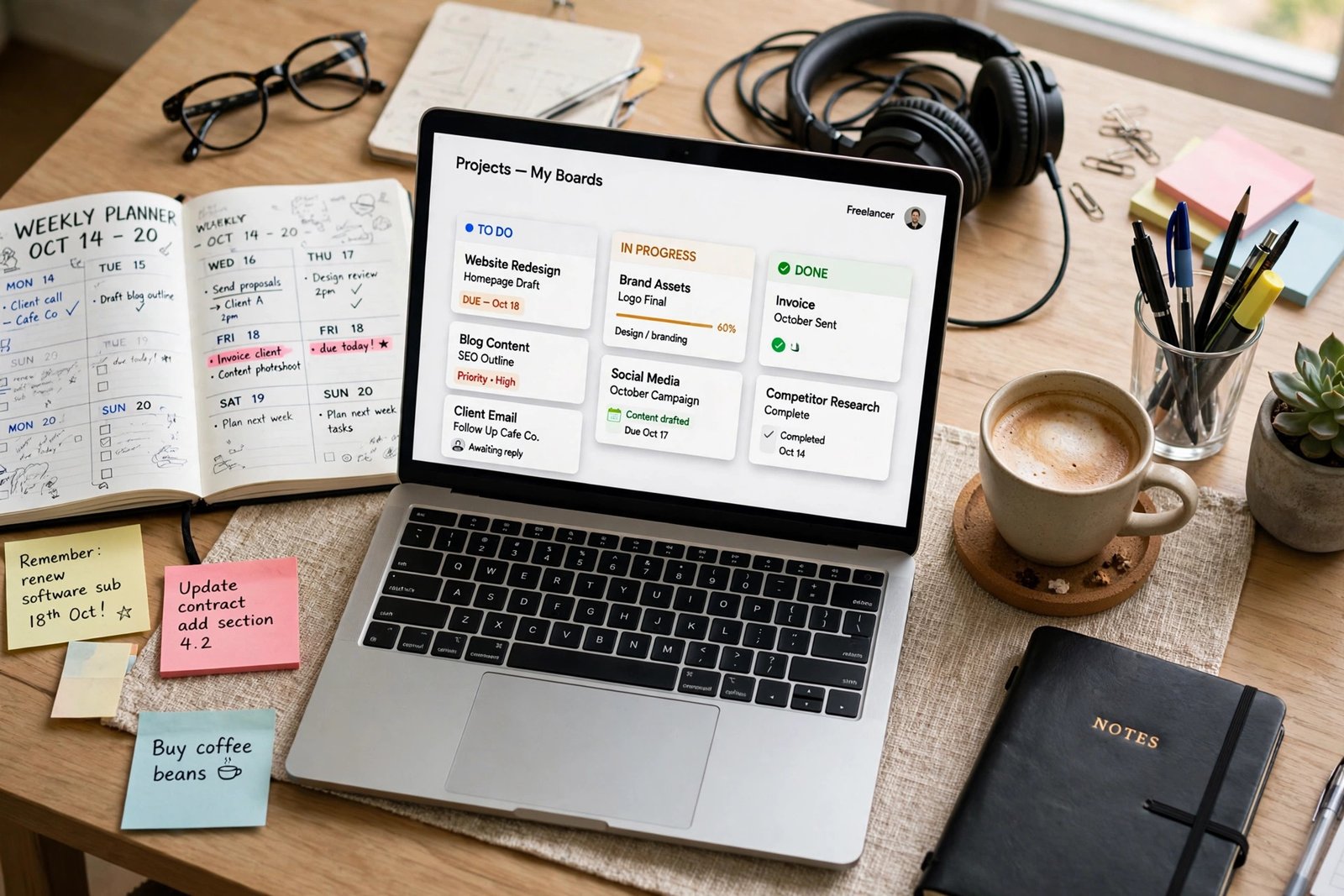
How to Raise Your Freelance Rates in 2026
Learning how to raise freelance rates is the skill that turns a busy freelance practice into a sustainable income. Many freelancers charge the same rate for years, even as their skills improve, their costs rise, and their calendar fills up. Raising your rate feels risky, because you fear losing clients. In practice, a planned raise, given with notice and explained clearly, loses far fewer clients than most freelancers expect. This guide shows you when to raise, by how much, what to say, and how to check the maths first.
This guide is about raising an existing rate with existing clients, not setting your first rate. If you are setting a rate for the first time, read how to set freelance rates first. Here, you will learn the five signals that say it is time to raise, how to work out your real floor, how to research the market, how much to raise, the churn maths, the right timing, and copy-ready scripts.
In this guide
- How to raise freelance rates: five signals that say it is time
- Step 1: Work out your real floor
- Step 2: Research the market honestly
- Step 3: Decide how much to raise
- Step 4: Do the churn maths
- Step 5: Choose the right timing
- Step 6: Tell existing clients in writing
- Copy-ready scripts for the four common situations
- What to do when your biggest client says no
- Fixed-price and retainer clients
- Show the change on the first invoice
- Common mistakes
- Frequently asked questions
How to raise freelance rates: five signals that say it is time
Raise your rates when the evidence points the same way. Look for these five signals.
First, you are booked out. If your calendar is full for the next six weeks and you turn work away, your price is too low for the demand. A higher rate will slow the flow to a level you can handle.
Second, you win every quote. If every client says yes at once, with no discussion, your rate is below the market. A healthy rate should win most quotes, but not all of them.
Third, there is no pushback at all. When clients never question your price, even after a year of working together, they are likely getting a bargain. Pushback is a sign that your price is being tested, which is where it should be.
Fourth, your skills have grown. A new skill, a new qualification, or a faster delivery time all add value. If you can do in one day what used to take three, your rate should reflect that.
Fifth, your costs have risen, or a year has passed since your last raise. Software, equipment, tax, and living costs all rise over time. A rate that never moves falls in real terms. Review your rate at least once a year.
If two or more of these signals apply, it is time to plan a raise. If none apply, focus on skills and demand first, and review again in a few months.
Step 1: Work out your real floor
Before you choose a new rate, work out your floor: the lowest rate you can charge and still cover your costs. Add your target income, your business costs, and your tax allowance, then divide by your realistic billable hours.
Example only: these numbers are not typical results. Imagine you want to earn 36,000 dollars a year after costs, your business costs are 6,000 dollars a year, and your tax allowance is 8,000 dollars a year. Add them together to get 50,000 dollars. If you work 25 billable hours a week for 48 weeks, that is 1,200 hours a year. Divide 50,000 by 1,200, and your floor is about 41.67 dollars an hour.
Be honest about billable hours. A 40-hour week does not mean 40 billable hours. Admin, marketing, learning, and gaps between projects all take time. Most freelancers bill 20 to 30 hours a week, even when they work full time. Use your real number, not an ideal one.
Step 2: Research the market honestly
Once you know your floor, check the market: freelancer profiles on platforms, published rate guides, and peer ranges in your field. Note the range, not a single number, and remember that averages are estimates.
Check three sources at least: platform profiles for your skill, a published rate guide from a reputable industry association if one exists for your field, and peers in a trusted group. Treat every figure as a guide, not a fact. Rates vary by niche, experience, location, and client type.
Do not copy the highest rate you find. A rate is only useful if clients will pay it for your work, at your level, in your market. Use the research to set a range, then pick a number inside it that sits above your floor. If the market range is below your floor, change your niche, your service, or your clients, rather than keep working below your floor.
Step 3: Decide how much to raise
How much you raise depends on the situation. A routine annual bump is small, a raise when you are booked solid can be larger, and a major skill leap justifies the biggest jump. Use the table below as a guide, not a rule.
| Situation | New clients | Existing clients |
|---|---|---|
| Routine annual bump | 10 to 15 percent | 5 to 10 percent |
| Booked solid | 25 to 50 percent | 15 to 25 percent |
| Major new skill | 30 to 50 percent | 15 to 30 percent |
| Costs rose, demand flat | 5 to 10 percent | 5 percent, or hold and review |
New clients can be quoted the new rate at once, with no announcement. Existing clients need notice, a clear date, and a calm explanation, which Step 6 covers.
Do not jump too far in one step if you can avoid it. A small raise every year is easier for clients to accept than a large jump after three silent years. If you have waited years, phase the raise in two steps, six months apart.
Step 4: Do the churn maths
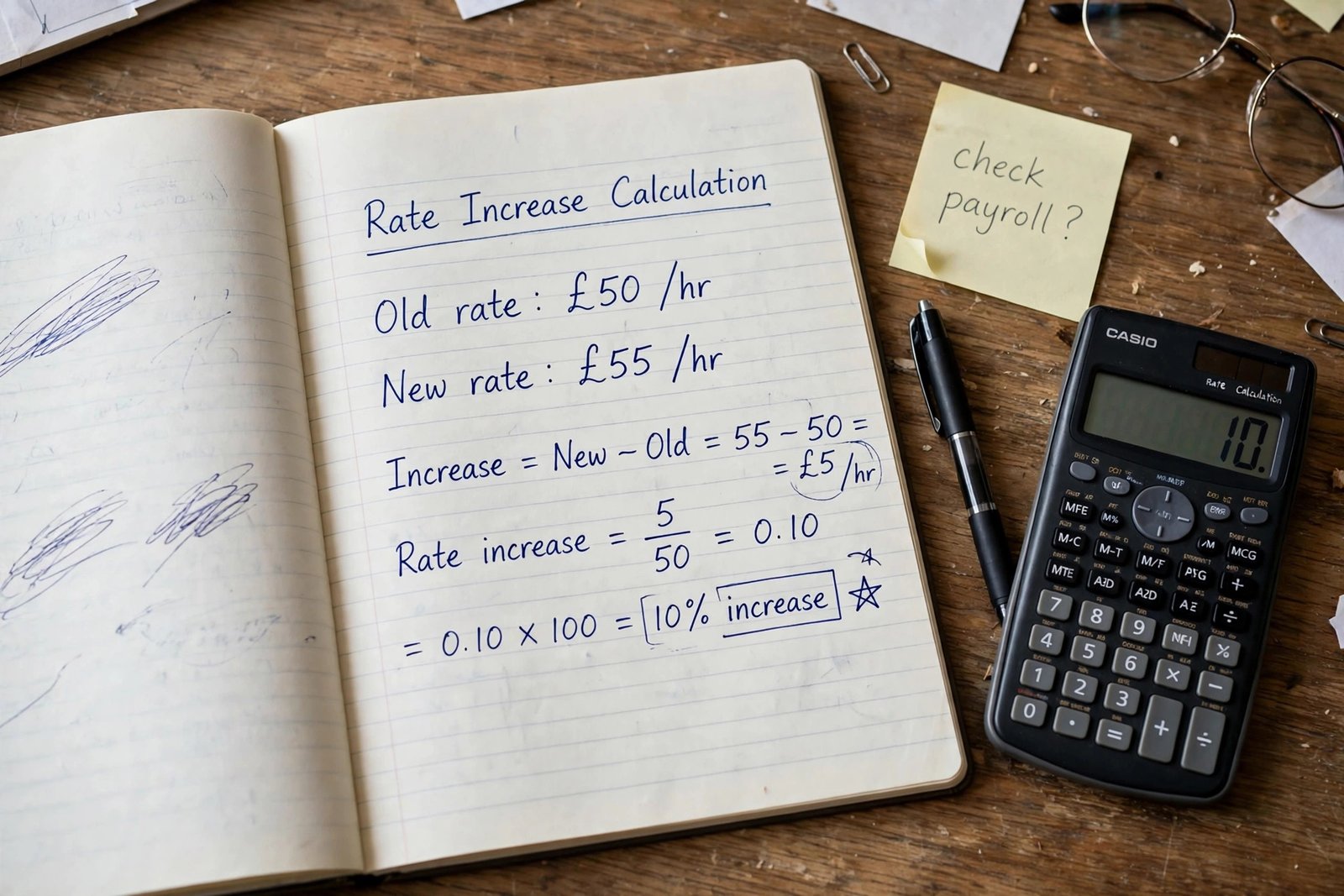
Every raise loses some clients. That is normal, and it is not always bad. The churn maths shows you how many you can afford to lose before the raise costs you money. A raise breaks even when the extra income from the clients who stay is more than the income lost from the clients who leave.
Example only: these numbers are not typical results. Imagine you have eight clients, and each pays 250 dollars a month, which is 2,000 dollars a month in total. You raise your rate by 20 percent, so each client now pays 300 dollars a month. If all eight stay, you earn 2,400 dollars a month. If one client leaves, you earn 2,100 dollars a month, which is 100 dollars more than before, for fewer hours. If two clients leave, you earn 1,800 dollars a month. So this raise breaks even if you lose one client.
Check the maths twice, with your own numbers, before you send the email. Write down your current monthly income, your new rate, and how many clients you can afford to lose. If losing one client would break you, plan that conversation separately, as the section below explains. Google asks writers to avoid easily checked factual errors in its guide on creating helpful, reliable, people-first content. Label your examples as examples, and never present a made-up number as a market fact.
Step 5: Choose the right timing
Timing matters as much as the number. The best times are at a contract renewal, at the start of a new project, at the start of a new year, or just after a clear win.
Never raise your rate in the middle of a project, or just after a delivery problem. A mid-project raise feels like a surprise, and a raise after a mistake feels like a reward for poor work. Wait until the project ends.
Give existing clients 30 to 60 days of written notice. That gives them time to plan their budget, to ask questions, and to decide. A short notice period feels like pressure, and a long one feels fair. For retainer clients whose budgets are set once a year, time the raise to their budget cycle.
Step 6: Tell existing clients in writing
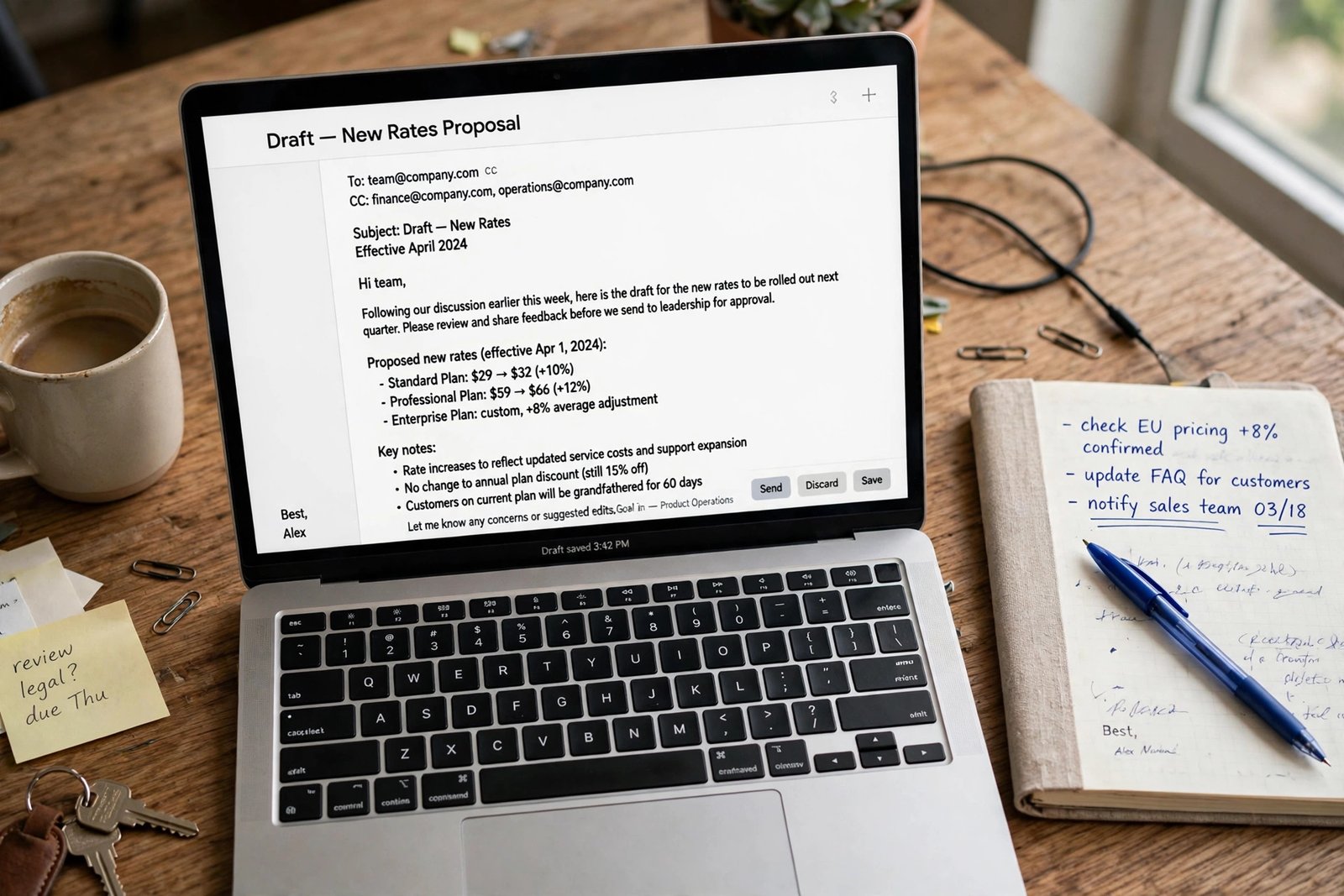
Tell existing clients in writing, by email, not by chat message. Put the date and the number first, give one sentence of reason, and do not apologise. An apology suggests the raise is wrong. It is a normal business decision.
A good email has four parts: the new rate and the date it starts, one sentence on why, what stays the same, and an invitation to talk. Keep it short.
Do not over-explain. You do not need to list your costs or your tax bill. One sentence of reason is enough. Do not offer a discount in the same email.
Copy-ready scripts for the four common situations
These scripts are templates. Adapt the names, dates, and numbers to your own work.
New inquiry quote: "Thank you for getting in touch. My rate is 60 dollars an hour, or a fixed price of 900 dollars for the full scope. That includes two revision rounds and delivery within ten working days. If that fits your budget, I can start next Monday."
Scheduled adjustment email: "Hello, I am writing to let you know that my rate will change from 50 dollars an hour to 60 dollars an hour, starting on 1 January 2026. This reflects new skills I have added this year, and the demand for my time. Your current project will finish at the old rate. I am happy to talk through any questions."
New scope price: "Thanks for the extra request. That is outside the scope we agreed, so I can add it for 200 dollars, delivered by Friday. If you would prefer, I can swap it for the FAQ section and keep the price and deadline. Let me know which you prefer."
Grandfathering with an end date: "As a thank you for our long working relationship, I will hold your current rate of 50 dollars an hour until 31 March 2026. From 1 April, the new rate of 60 dollars an hour will apply."
Grandfathering means letting an existing client keep the old rate for a set time, then moving them to the new rate. Always set a written end date. Without one, it becomes a permanent discount that is hard to remove.
What to do when your biggest client says no
Your biggest client needs a separate plan. If one client is more than a quarter of your income, losing them hurts, and a flat email is not enough. Talk to them in a call or a meeting, not just by email.
Prepare before the call. Know your floor, know your churn maths, and know what you will accept. Offer a trade: hold the old rate for three more months for a longer commitment, reduce the scope so the client pays the same total for less work, or phase the raise in two steps. If the client still says no, thank them, finish the current work well, and part on good terms. A client who leaves over price may return later, when their budget grows.
Never lower your rate to keep one client quiet. A discount given under pressure becomes the new rate. It is better to lose one client at the right price than to keep one client at a price that does not cover your costs.
Fixed-price and retainer clients
Fixed-price work and retainers need a slightly different approach. For fixed-price projects, the new rate applies to the next project, not to work already in progress. Never change the price of a project you have already agreed.
For retainer clients, the new rate applies at the next renewal or annual budget cycle. Tell the client before their budget is set. If the retainer is monthly with no fixed term, give 30 to 60 days of notice. If you grandfather a retainer, put the end date in writing.
Show the change on the first invoice
The first invoice at the new rate should be clear. Show the new rate on the line, state the hours or the scope, and add a short note that refers to the notice you sent. For example: "Rate 60 dollars an hour, as advised by email on 1 November 2026." Do not backdate the new rate to earlier work. If a project spans the change date, show the old-rate hours and the new-rate hours on separate lines.
A clear invoice prevents disputes. A vague invoice invites them. For invoicing and payment terms, read how to invoice freelance clients. For the contract wording that supports a rate change, read freelance contracts explained.
Common mistakes
- Raising your rate with no warning, so the client first learns of it from an invoice.
- Apologising for the raise, which tells the client it is wrong.
- Discounting under pressure, which turns a temporary fix into a permanent lower rate.
- Ignoring your costs, and raising the rate without checking your floor first.
Frequently asked questions
How much should I raise my freelance rates?
A routine annual bump is usually 5 to 10 percent for existing clients, and 10 to 15 percent for new clients. If you are booked solid, a larger raise of 15 to 25 percent for existing clients may be right. Check your floor first, then your churn maths.
How do I tell clients I am raising my rates?
Tell them in writing, by email, with 30 to 60 days of notice. Put the new rate and the start date first, give one sentence of reason, and do not apologise. Invite questions.
How often should freelancers raise rates?
Review your rate at least once a year. Most freelancers raise their rate once a year, or when demand, skills, or costs change. A small annual raise is easier to accept than a large jump after several silent years.
Will raising my rates lose clients?
Some clients will leave, and that is normal. The churn maths in Step 4 shows how many you can afford to lose. A 20 percent raise with eight clients breaks even if you lose one, and loses money only if you lose two.
Can I raise my rates mid-contract?
It depends on your contract. If it fixes the rate for a set term, wait until renewal. If the contract allows a rate review, follow the notice period it states. Never change the price of work already agreed.
Should existing clients pay less than new clients?
Existing clients often pay a little less, for a set time, as a thank you for loyalty. That is called grandfathering, and it works well when it has a written end date. A short grandfathering period, of three to six months, is usually enough.
Conclusion: plan the raise, then send the email
Raising your freelance rates is a business decision, not a confrontation. Check the five signals, work out your floor, research the market honestly, and pick a raise that fits the situation. Do the churn maths with your own numbers, give 30 to 60 days of written notice, and use the scripts to keep the message calm and clear. Handle your biggest client separately, and show the new rate clearly on the first invoice.
Your next step is to work out your floor today, using the formula in Step 1. Then read how to keep freelance clients for the retention side, and how to manage multiple freelance clients for using higher rates to reduce your client volume. For the wider picture, browse all our guides in the freelancing category.
Note for the reader: freelance protection laws differ by country. In the United States, some states have freelance protection laws with their own payment thresholds and rules, and those rules do not apply elsewhere. Check your local rules. Any claim about what clients typically pay must be checked against a real source, and the Federal Trade Commission explains why atypical results must not be presented as typical in its Endorsement Guides FAQ. Earning results vary; nothing on this site is financial advice.