How to Make Money with a Rideshare Side Hustle in 2026
A rideshare side hustle looks simple. You turn on an app, pick up passengers, and get paid. The part most new drivers miss is that the number on the app is gross pay, not take home pay. Fuel, wear on your car, insurance, and tax all come out of it. This guide shows you how to start, what it really costs, how much you can make after expenses, and how to stay safe.
In this guide
- What a rideshare side hustle is and how it works
- What you need before you apply
- How to start in seven steps
- What it costs and what to expect
- How much you can make
- Best times and places to drive
- Uber versus Lyft
- Multi-apping and delivery driving
- Staying safe and keeping your rating
- Insurance: the gap new drivers miss
- Taxes in plain terms
- Common mistakes
- Risks and scams to watch for
- Is a rideshare side hustle worth it for you
- Frequently asked questions
What a rideshare side hustle is and how it works
A rideshare side hustle means driving passengers in your own car through an app such as Uber or Lyft. You choose when to drive, so it fits around a job, study, or family. You are an independent contractor, not an employee. The platform does not pay you a wage, does not cover your fuel, and does not handle your tax. You take the trips you want and you pay your own costs.
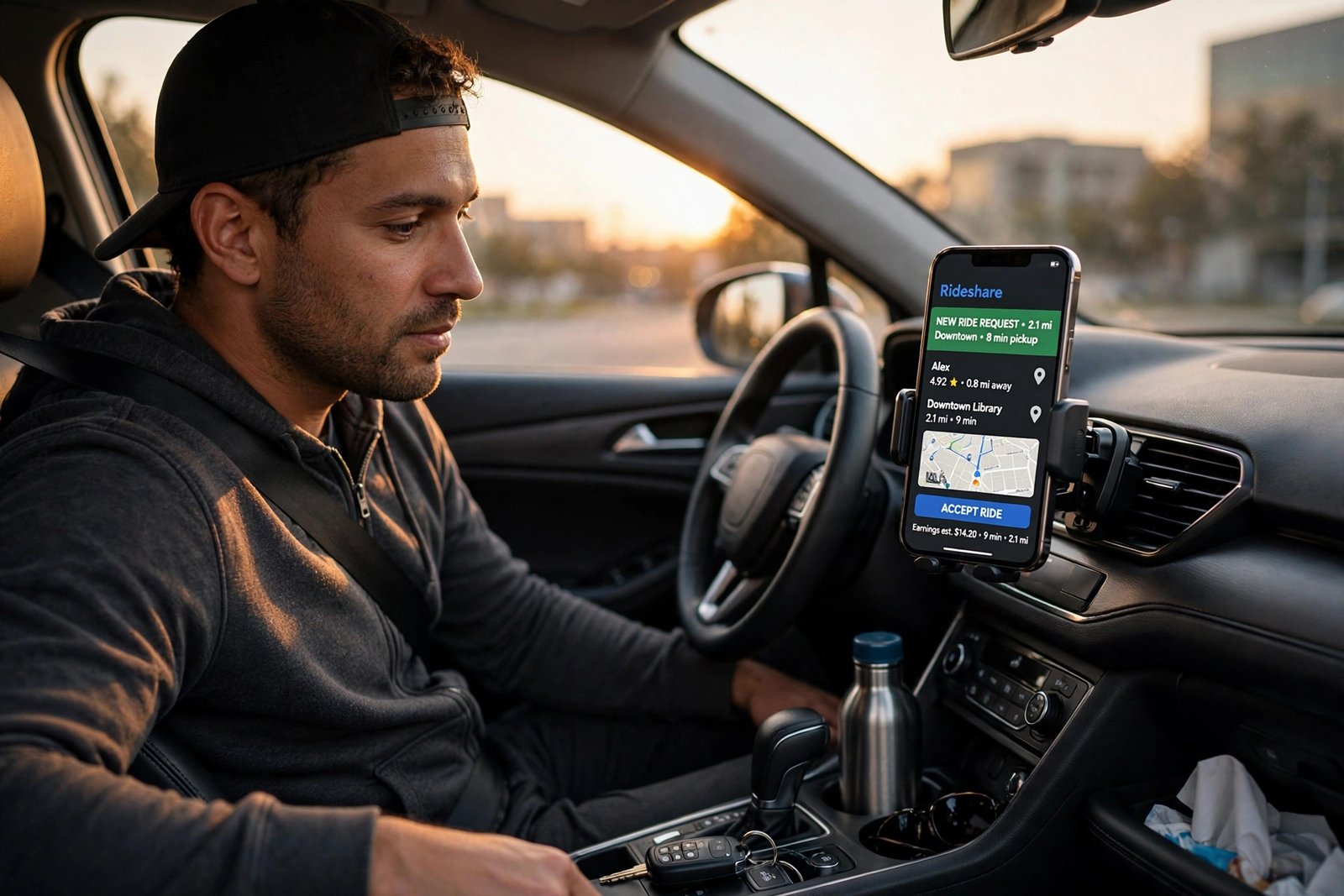
Here is how a trip works. You go online in the driver app. The app offers a ride request with the pickup point and an estimated fare. You accept it, pick up the passenger, and take them to their destination. The passenger pays through the app, the platform takes its share, and the rest goes to your balance.
Most pay comes from the fare. You can also earn tips, surge pricing when demand is high, and bonuses for completing a set number of trips. None of these are guaranteed. Pay changes by city and by hour.
What you need before you apply
Both platforms check the same basics. Check the official Uber driver requirements page and the official Lyft driver requirements page for your city before you apply.
You need a valid driving licence and at least one year of driving experience in the United States. You need a four door car with at least four passenger seats and working seat belts. Your car must meet the platform age and condition rules for your city, and pass an inspection where required. You need proof of insurance and registration in your name, and you must pass a background check and a driving history review.
Age is the rule where sources disagree, so here is what the official pages say as of November 2026. Uber sets the minimum age by state. It is 21 in most states, 23 in Arizona, Florida, Georgia, Michigan, and Minnesota, and 25 in California, New York, and several other states. Lyft sets the minimum age at 25 for drivers in the United States. If you are under 25, Uber may still accept you depending on your state, but Lyft will not. Check the official driver requirements page for your city, because these rules change. You also need a smartphone that runs the driver app and a data plan.
How to start in seven steps
Step 1: Check your market
Open both apps as a rider in your city and look at wait times and the surge map at different hours. A city with short waits and regular surge is a better market than one where drivers sit idle.
Step 2: Call your insurer before you apply
Tell your car insurer that you plan to drive for a rideshare platform. Many personal policies do not cover you while you wait for a request. Do this before your first trip, not after an accident.
Step 3: Apply to both apps
Apply to Uber and to Lyft, even if you plan to drive for one of them most of the time. Upload your licence, insurance, registration, and a photo. The background check usually takes a few days.
Step 4: Pass the vehicle inspection
If your city requires an inspection, book it early. The inspector checks tyres, brakes, lights, seat belts, and general condition.
Step 5: Set up your car
Buy a phone mount, a charging cable, and a small rubbish bag for the back seat. Keep the car clean and the boot clear for luggage.
Step 6: Start a mileage log on day one
Record every mile you drive for work, including trips to pickups and the drive home. Those empty miles are called dead miles, and they still cost you fuel and wear.
Step 7: Run two short test shifts
Drive a weekday morning shift and a Friday evening shift. Note your gross pay, miles, and fuel use.
What it costs and what to expect
Startup costs are low, but running costs eat into every trip. The table below shows the usual startup costs in US dollars.
| Startup cost | Typical range | Notes |
|---|---|---|
| Vehicle inspection | 0 to 50 dollars | Some cities require it, some do not |
| Dash cam | 40 to 120 dollars | Protects you in disputes |
| Phone mount and charger | 15 to 40 dollars | Buy once, lasts a long time |
| Car cleaning and supplies | 20 to 50 dollars | First deep clean and basic supplies |
| Rideshare insurance endorsement | 15 to 40 dollars per month | Extra premium on your car policy |
| Total to start | 90 to 300 dollars | Before fuel |
Running costs are where most new drivers underestimate the job. Fuel, tyres, oil, brakes, and depreciation all grow with every mile. The US Internal Revenue Service sets a standard mileage rate that estimates the full cost of running a car for business. For 2026 it is 72.5 cents per mile for miles driven from 1 January to 30 June, and 76 cents per mile for miles driven from 1 July to 31 December, according to the IRS standard mileage rates page. That rate is a US tax rule, but it is a useful guide to what each mile really costs you.
Here is a worked example with the maths shown. Example only: these numbers are not typical results, and your city and hours will change them.
| Three hour evening shift | Amount |
|---|---|
| Trips completed | 12 |
| Gross pay from fares and tips | 78 dollars |
| Total miles driven, including dead miles | 62 miles |
| Car cost at 76 cents per mile | 47.12 dollars |
| Net before tax | 30.88 dollars |
| Net per hour before tax | 10.29 dollars |
62 miles times 0.76 dollars equals 47.12 dollars, and 78 dollars minus 47.12 dollars equals 30.88 dollars, or 10.29 dollars per hour before tax. The gross figure of 26 dollars per hour looks good, but the net figure is the one that matters. Short trips with long pickups are the worst, because you drive unpaid miles.
Expect a slow start. Do not buy a car to drive for rideshare. The maths rarely works when you add a car payment to the running costs.
How much you can make
There is no single answer, because pay depends on your city, your hours, your car, and how many other drivers are online. Gross pay of 20 to 30 dollars per hour during busy times is common in large US cities, according to driver reports. After fuel and car costs, most part time drivers keep far less, often in the range of 10 to 20 dollars per hour before tax. These are broad ranges from driver reports, not a promise. Pay per mile matters more than pay per hour. A 12 dollar trip for 3 miles beats a 15 dollar trip for 10 miles. Surge pricing can lift your pay, but it is not reliable.
Best times and places to drive
The best hours are when demand is high and drivers are few. Weekday mornings from 7 to 9 and weekday evenings from 5 to 7 usually bring commuter trips. Friday and Saturday nights bring the highest fares, and the hardest passengers. Airport runs pay well per trip, but the wait in the airport queue can eat an hour. The worst hours are mid morning and mid afternoon on weekdays, when demand is low.

Uber versus Lyft
Both platforms do the same job, and most drivers end up with a small preference. The table below compares them on the points that matter to a new driver.
| Point | Uber | Lyft |
|---|---|---|
| Minimum driver age in the US | 21 to 25, by state | 25 |
| Driving experience needed | At least 1 year | 1 to 3 years, by location |
| Vehicle | 4 doors, 4 passenger seats | 4 doors, 5 seat belts including driver |
| Instant cash out | Yes, usually for a small fee per transfer | Yes, usually for a small fee per transfer |
| Surge and bonuses | Surge pricing and trip bonuses | Prime time pricing and ride challenges |
| Market size | Larger in most cities | Smaller, but strong in some cities |
Uber usually has more riders, so you wait less between trips. Run both for two weeks and compare your own numbers. The platform that pays you more per mile is the right one for you.
Multi-apping and delivery driving
Multi-apping means running two or more apps at once, for example Uber and Lyft together. It cuts waiting time, because you take the first good trip that appears. It has real downsides. You must accept a trip on one app and go offline on the others at once, or you risk two requests at the same time. Passengers wait while you finish another job, and your rating suffers. Our guide on how to make money with a food delivery side hustle explains that option in detail. Stop and run one app at a time if you start cancelling trips.
Staying safe and keeping your rating
Your safety comes first, and your rating is what keeps you on the platform. Check the rider name in the app before you unlock the doors, and never take a passenger who does not match the booking. If a passenger is aggressive, drunk, or threatening, end the trip in a safe public place and report it in the app at once. Keep a dash cam running on every shift. Keep the car clean and drive smoothly, because hard braking and sharp turns are the most common reasons for low ratings. Passengers rate you out of five stars after each trip. If your average falls below the platform minimum, often around 4.6 stars, you can be warned and then deactivated. If a passenger damages your car, take photos first and report it through the app the same day.
Insurance: the gap new drivers miss
A normal car policy covers personal driving. It usually does not cover rideshare driving. The gap has three phases, and each one is covered differently. In phase one, you are online and waiting for a request. Your personal policy often does not cover this phase, and the platform cover is limited. In phase two, you have accepted a trip and are driving to the passenger. In phase three, the passenger is in your car, and the platform cover is at its fullest. The gap is phase one. The fix is a rideshare endorsement on your personal policy, sometimes called a rideshare add on. It fills the gap and usually costs 15 to 40 dollars a month in the United States. Tell your insurer the truth about your driving. If you hide it, your insurer can refuse a claim after an accident.
Taxes in plain terms
No tax is taken from your pay, so you must set money aside yourself. A safe habit is to put aside 20 to 25 percent of your net pay after car costs into a separate account, and to pay it when your tax return is due. In the United States, drivers usually track their business miles and claim the standard mileage rate, which was 72.5 cents per mile for the first half of 2026 and 76 cents per mile for the second half, according to the IRS. Drivers also pay self employment tax on their net income in the United States. Keep every receipt and your mileage log up to date. Rules differ by country, so treat this section as general guidance only.
Common mistakes
- Do not judge the job by gross pay. Always subtract your miles and your costs first.
- Do not drive far to reach a pickup. A long pickup eats the profit.
- Do not skip the call to your insurer. The phase one gap is real and it is expensive.
- Do not accept every trip. Short trips with long pickups are usually a loss.
- Do not drive tired. Late night shifts after a full work day are when accidents happen.
- Do not buy a car on finance to start driving. The car payment turns a thin margin into a loss.
Risks and scams to watch for
Fake sign up offers are the most common scam aimed at new drivers. A real platform never asks you to pay to apply, and never asks for your bank login. Apply only through the official app or website. Check any sign up bonus on the official platform page first, because many of these offers are fake. Car rental schemes are another risk. Some companies rent cars to drivers at a high weekly rate and promise the driving will cover it. The maths often fails. Deactivation is a real risk too. Platforms can deactivate drivers for low ratings, cancellations, or complaints. Keep your rating up and cancel rarely. Finally, driving late at night brings real safety risks. Drunk passengers, tired driving, and quiet roads are a hard mix. At night, keep your dash cam on and stop driving when you feel tired.
Is a rideshare side hustle worth it for you
It suits you if you already own a suitable car, you can drive evenings or weekends, and you want flexible hours. It suits you if you are comfortable with strangers in your car. It is a poor choice if you need a guaranteed income, if your car is old or costly to run, or if you would need to buy or rent a car to start. Our guide on how to start a car detailing side hustle shows how to earn from cars without driving passengers, and our list of the best weekend side hustles shows other ways to use the same hours.
Frequently asked questions
How old do you have to be to drive for Uber?
It depends on your state. Uber sets the minimum age at 21 in most states, 23 in Arizona, Florida, Georgia, Michigan, and Minnesota, and 25 in California, New York, and several other states, according to the official Uber Help page checked in November 2026. Lyft sets the minimum age at 25 across the United States.
Do I need special insurance to drive for Uber or Lyft?
Yes, in most cases. A normal car policy often does not cover you while you are online and waiting for a trip. Ask your insurer for a rideshare endorsement.
How much do Uber drivers make per hour?
Gross pay of 20 to 30 dollars per hour during busy times is common in large US cities. After fuel and car costs, most part time drivers keep 10 to 20 dollars per hour before tax.
Should I drive for Uber or Lyft?
Try both for two weeks and compare your own numbers. Uber usually has more riders, so you wait less. Many drivers run both.
Do Uber and Lyft drivers pay taxes?
Yes. Drivers are independent contractors, so no tax is taken from their pay. You must set money aside and pay it yourself. In the United States, drivers track business miles and claim the IRS mileage rate.
How long does it take to start driving for Uber?
The background check usually takes a few days, and an inspection can add more time. Apply at least a week before you want to start.
Conclusion
Apply to both Uber and Lyft, sort your insurance before your first trip, track every mile from day one, and judge the job by net pay per hour, not the gross figure on the app.
To go further, read how to make money with a food delivery side hustle, how to start a moving help side hustle, and how to start a car detailing side hustle, then browse the full Side Hustles category for more guides. The facts in this guide were checked against the official Uber and Lyft driver requirements pages and the IRS mileage rates page in November 2026.
Note for the reader: pay and tax figures are in US dollars and reflect United States rules as of November 2026. Uber and Lyft do not operate everywhere, and age, vehicle, and insurance rules differ by country and city, so check the official pages for your area before you apply. Earning results vary; nothing on this site is financial advice.