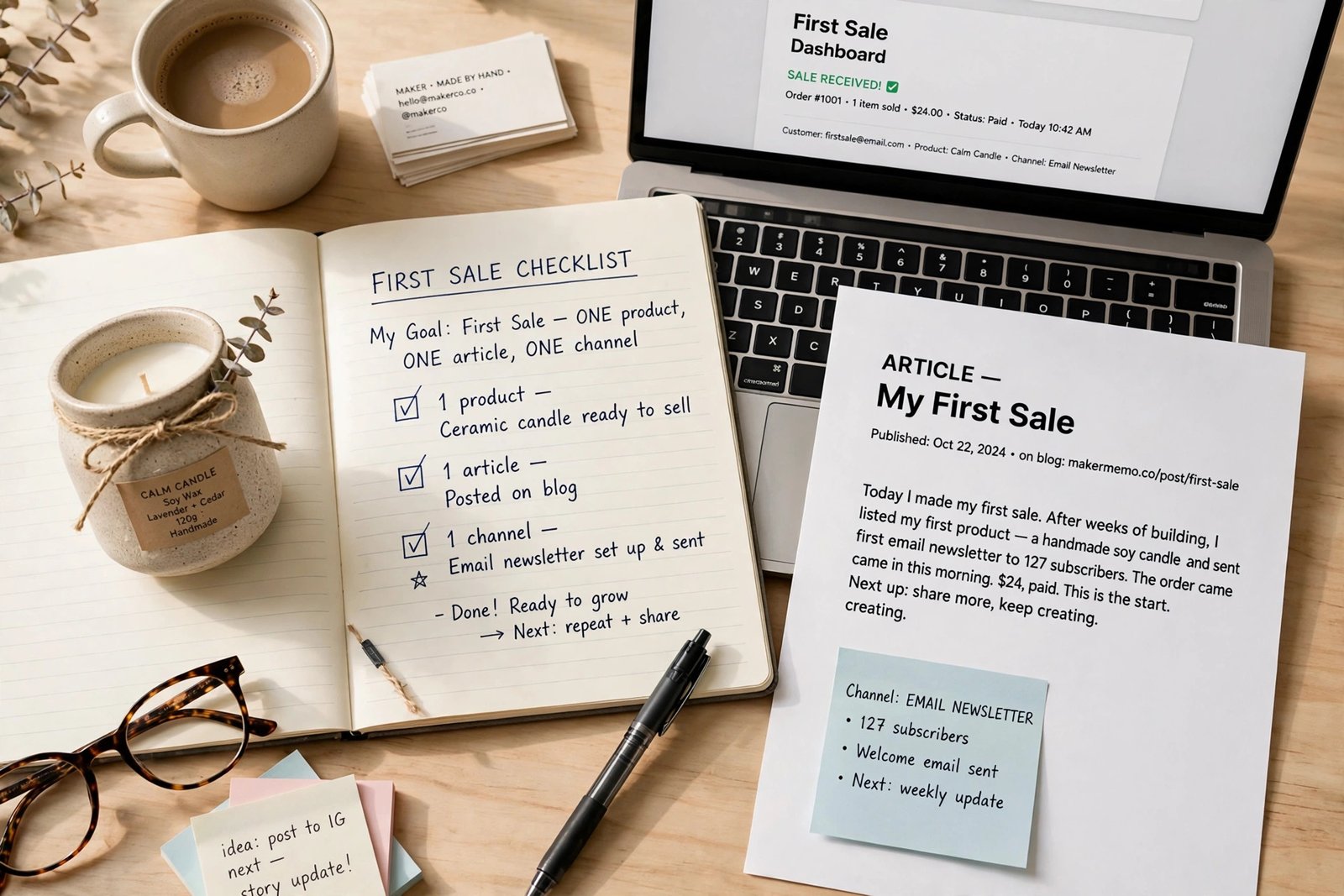
A first affiliate sale feels out of reach when you have published content, shared links, and seen nothing happen. That frustration is common, and it usually has a fixable cause. A first sale does not need a large audience, ten programmes, or a complicated funnel. It needs one clear path: one niche, one programme, one product, one helpful content piece, and one traffic source, all working together. This guide shows how to make your first affiliate sale in 2026 with that narrow plan, plus tracking and a fix guide for when no sale comes. It covers the first sale only. It does not re-teach the full beginner journey or all promotion channels. For those, read How to Start Affiliate Marketing in 2026 and How to Promote Affiliate Products in 2026.
In this guide
- The minimum viable first sale
- Step 1: Lock one niche and one product
- Step 2: Confirm the programme and test the link
- Step 3: Build one content piece that answers a buying question
- Step 4: Bring traffic from one channel
- Step 5: Disclose clearly and earn trust
- Step 6: Track clicks, sales, and refunds
- Step 7: Fix, then repeat after the first sale
- Zero sale diagnostic, common mistakes, frequently asked questions
The minimum viable first sale
A minimum viable first sale is the smallest complete system that can produce one qualifying sale. A qualifying sale is a sale that meets programme rules, passes validation, and is not refunded within the merchant rules. The system has five parts, and each part must work. If one part is missing, the whole system fails, even if the other parts are strong. The five parts are: a niche with buyers, a programme you are accepted into, a product you can explain, a content piece that answers a buying question, and a traffic source that brings interested readers to that piece. Most beginners fail because they build only two or three parts, then add more programmes or channels instead of fixing the missing part.
| Checklist item | Done? | What counts as done | | One niche chosen | Yes or no | You can name the audience and their problem in one sentence | | One programme accepted | Yes or no | You have an approved account and a working tracking link | | One product chosen | Yes or no | You can explain who it is for, who it is not for, and its limits | | One content piece published | Yes or no | It answers a buying question and has disclosure before the first link | | One traffic source active | Yes or no | It brings interested readers to that piece every week | | Tracking checked | Yes or no | You have clicked your own test link and seen it record correctly |
Step 1: Lock one niche and one product
Choose one niche you have already tested, or test one quickly with the scorecard method, and then choose one product inside it. Do not choose five products for your first sale. One product keeps your content focused, your recommendation clear, and your tracking simple. The product should solve a clear problem for a clear reader, have a price that reader can understand, and have terms you have read. Avoid products with exaggerated claims, hidden costs, or refund problems, because a first sale that refunds teaches you little and harms trust. Ask three questions about the product. First, what problem does it solve, in the reader words, not in marketing words? Second, who should not buy it, and why? Third, what would a careful buyer check before buying, such as price, renewal cost, limits, support, or cancellation terms? If you cannot answer all three, research more before you publish. For niche testing in detail, read How to Choose a Profitable Affiliate Niche in 2026. For programme choice, read Best Affiliate Programs for Beginners in 2026. Keep this article focused on the first sale sequence, and use those guides only for the decision behind step one.
Step 2: Confirm the programme and test the link
Before you publish, confirm that your programme account is active, that the product is still available, and that your tracking link works. Open the programme dashboard, find the product, and generate the link for that exact product, not for a general homepage, unless the programme requires a homepage link. Copy the link carefully, without extra spaces or broken characters. Then test it in a private browser window. Click it, check that it lands on the correct product page, and check that your dashboard records the click, allowing for any reporting delay the programme states. If the dashboard shows no click after the stated delay, check the link format, check whether you used a link shortener that strips tracking, and check programme rules for that channel.
Step 3: Build one content piece that answers a buying question
Your one content piece should answer a buying question, not just describe a product. Good buying questions include: which tool should a beginner choose for a first newsletter, which hosting plan fits a first blog, or which email tool suits a small list. Structure the piece in this order. Start with disclosure before the first link. State the reader problem and who the guide is for. Give a short answer up front, so a busy reader can see your recommendation and its main limit. Then explain the product in plain language: what it does, what it costs, what its limits are, and who it is not for. Add a comparison with one alternative, or a clear reason why this product fits this reader better than a general alternative. End with a clear next step, such as a checklist of what to check before buying, and a call to action such as "Check current price" or "See full details".
Step 4: Bring traffic from one channel
Traffic means interested readers arriving at your content piece. For a first sale, use one traffic source you can sustain, not five sources you cannot maintain. If your piece is a blog article, your source might be search traffic, Pinterest, or one social channel. If your piece is a video, your source might be YouTube search or one social channel. Choose the source where your target readers already look for answers, and where you already have some presence, even if it is small. A small, interested audience will outperform a large, uninterested audience for a first sale.
Step 5: Disclose clearly and earn trust
Place a clear disclosure before the first affiliate link, stating you may earn a commission at no extra cost to the reader. For guidance, see the Federal Trade Commission endorsement guides. Say who the product is not for and admit its limits, because honest limits build trust and reduce refunds.
Step 6: Track clicks, sales, and refunds
Tracking is how you know whether your first sale system works, and where it breaks. Check your programme dashboard weekly for clicks, sales, and refunds. Record the numbers for your one piece in a simple table, with the date, visitors, clicks, sales, and refunds. Calculate two rates. Click rate is clicks divided by visitors. Conversion rate is sales divided by clicks. Those rates tell you where to fix, as the diagnostic table below shows. Also check that your link still works, that the product page still exists, and that programme terms have not changed. A broken link or a discontinued product can silently stop sales, even when traffic stays steady.
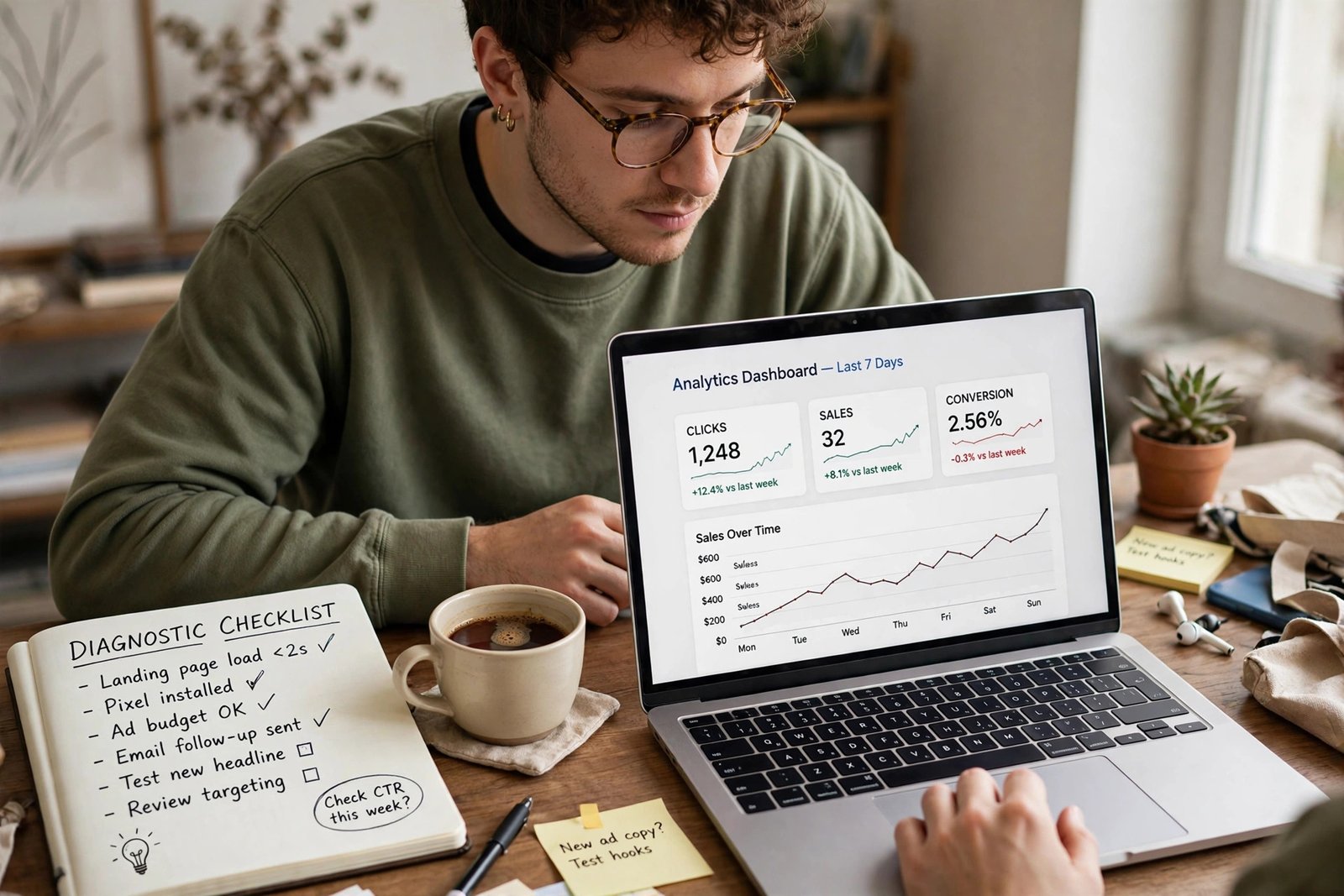
| Weekly record | What to write | What it tells you | | Visitors to the piece | Number from your site or channel analytics | Whether traffic is reaching the piece | | Clicks on the affiliate link | Number from the programme dashboard | Whether readers want more details | | Sales and refunds | Number from the programme dashboard | Whether clicks turn into kept sales | | Fix tested this week | One change only, with date | Whether that change helped or not |
Step 7: Fix, then repeat after the first sale
When the first sale arrives, confirm it is validated and not refunded, note what worked, and keep that piece updated. Then repeat the same system with a second product for the same audience, using the same channel and template, before adding another channel.
Zero sale diagnostic: what to fix first
Use this diagnostic when no sale has come yet. Find your symptom, then test only the fix in that row before moving to another row. Do not change everything at once.
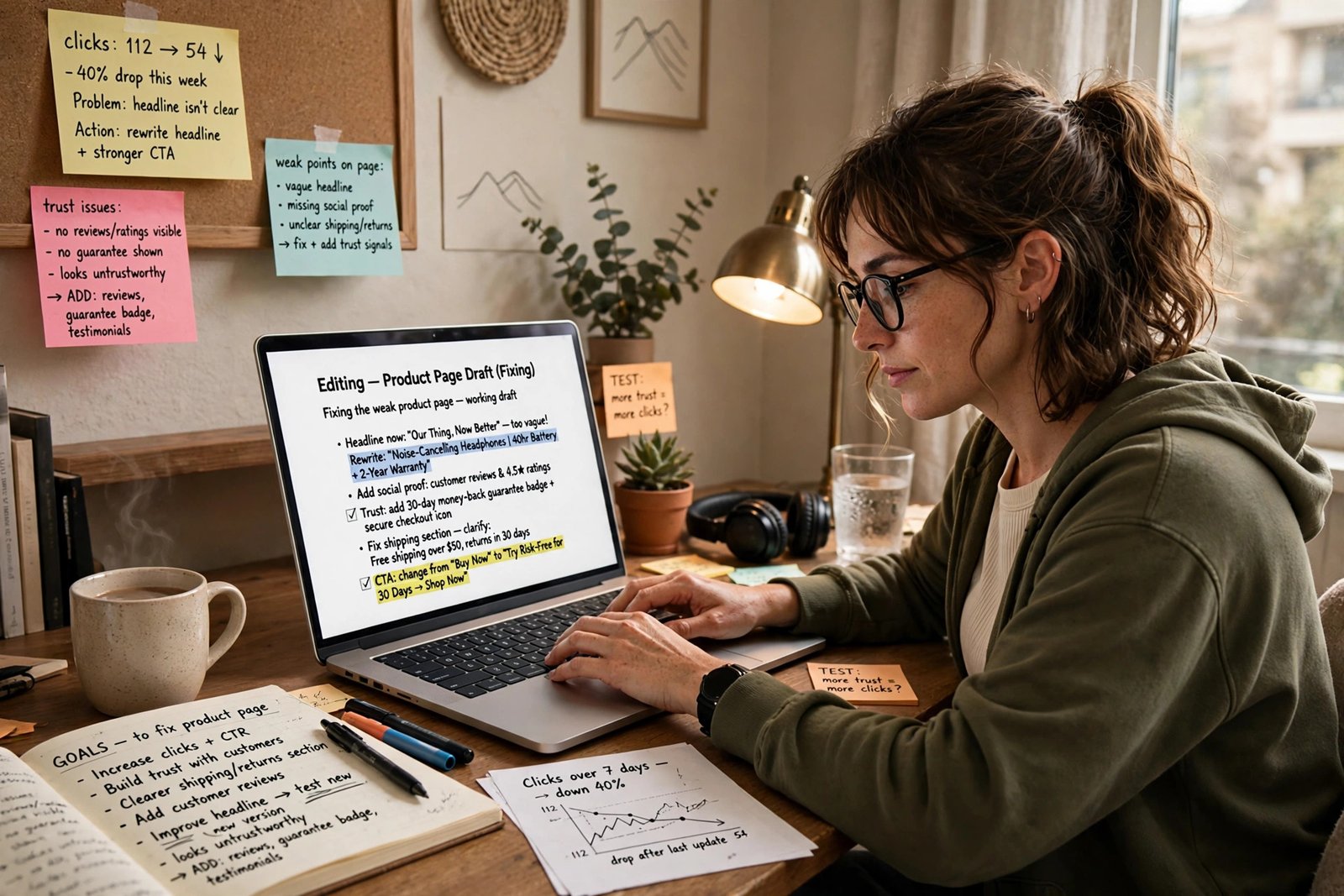
| Symptom | Likely cause | First fix to test | | No visitors to the piece | Traffic source too weak or topic too broad | Narrow the topic, improve the title for a real question, share in one place where readers already gather | | Visitors but no clicks | Link placement weak, call to action vague, or recommendation unclear | Add a clear call to action after a key feature, add a comparison table, state who the product is for | | Clicks but no sales | Product fit wrong, price surprise, trust low, or page mismatch | Explain price and limits before the click, add who it is not for, check the landing page matches your promise | | Link or account problem | Broken link, programme rejection, or banned placement | Test the link in a private window, check dashboard, check programme terms for that channel |
Common mistakes
- Trying to sell five products at once, instead of proving one narrow system first.
- Hiding disclosure, or placing it only at the bottom, which breaks trust and programme rules.
- Changing title, product, channel, and call to action in the same week, so no test result can be trusted.
- Copying a competitor claim or a dramatic result, without evidence or context for your own readers.
Risks and scams to watch for
First sale advice attracts scams. Beware of anyone who sells a first sale system that requires buying their course, joining a pay-to-join programme, or recruiting others to earn. Beware of screenshots that show a first sale with no costs, refunds, or time spent. A screenshot does not prove a system works for you. Beware of programmes that promise a first sale in 24 hours, or that guarantee income if you follow their steps. Those promises ignore niche, traffic, product fit, and programme terms, all of which vary. Check programme terms on official pages, such as Amazon Associates programme help, before you invest effort. Keep tax duties in general terms: rules differ by country, so check your local tax authority or a qualified accountant for personal advice. This guide gives general information only, not financial advice.
Frequently asked questions
How long does it take to make a first affiliate sale?
There is no fixed timeline. It depends on niche, content quality, traffic, product fit, and time available each week. Some beginners see a first sale in weeks, while others need months of steady publishing and improvement. Judge progress by visitors, clicks, and fixes tested, not only by sales, and review after 60 to 90 days.
Do I need a website to make my first affiliate sale?
No, but you need a clear home for your content piece, such as a blog, video channel, email newsletter, or social channel that the programme accepts. Some programmes require an approved website or channel, so check terms before you build your first sale plan around one programme alone.
What if nobody buys through my affiliate link?
Use the zero sale diagnostic in this guide. Check visitors first, then clicks, then sales, then refunds, in that order. Fix one weakness at a time, wait long enough to judge the fix, and record the result. If visitors are zero, fix traffic. If clicks are zero, fix placement and recommendation clarity. If clicks are healthy but sales are zero, fix product fit and trust.
How do I know if my affiliate link works?
Test it in a private browser window and check that it lands on the correct product page. Then check your programme dashboard after the reporting delay stated by the programme. If no click is recorded, check the link format, check whether a shortener stripped tracking, and check programme rules for your channel.
What should I do after my first affiliate sale?
Confirm the sale is validated and not refunded, note what worked, and keep the winning piece updated. Then repeat the same system with a second product for the same audience, using the same channel and template. Do not scale to ten products and five channels at once, because that breaks the focus that produced the first sale.
Conclusion
A first sale comes from one niche, one programme, one product, one content piece, and one traffic source, with clear disclosure and weekly tracking. When no sale comes, use the diagnostic in order and fix one thing at a time. Complete the checklist today, test your link, and improve your one piece, then use the Affiliate Marketing category page for the other guides. Results vary, and nothing on this site is financial advice.