
You are ready to apply, but every list gives you a different top ten, different commission figures, and different advice. That confusion is understandable, because programme terms change, guides disagree, and some lists promote their own product first. This guide compares beginner affiliate programmes in a way you can actually use: how they pay, what they require, and which ones to apply to first. It covers programme comparison only. It does not repeat the full start-up journey or niche selection, and it does not teach promotion in detail. For those steps, read How to Start Affiliate Marketing in 2026 and How to Choose a Profitable Affiliate Niche in 2026. A warning comes first, because it affects every figure in this guide. Commission rates, cookie windows, payout thresholds, and eligibility rules change, and different guides quote different figures for the same programme. This guide therefore describes commission types in general terms and does not quote specific rates as current facts. Before you apply, open the official programme terms page, note the commission type, cookie window, threshold, payment method, and eligibility, and note the date you checked it. If a list article and the official page disagree, the official page wins.
In this guide
- How affiliate programmes pay you
- Programmes at a glance
- Apply now programmes and networks
- Apply later programmes that need an audience
- Creator tools, marketplaces, and brief examples
- Red flags in programme terms
- Which programme to choose first
- Common mistakes, risks, frequently asked questions
How affiliate programmes pay you
A programme pays you when a reader completes a qualifying action through your tracked link. The details decide whether you ever get paid, so learn them before you apply. A commission type tells you how payment is calculated. A percentage commission pays a share of the sale price. A flat fee pays a fixed amount per sale, whatever the price. A recurring commission pays while a customer keeps a subscription, subject to renewal and cancellation rules. A payment per lead or trial pays for a sign-up or trial, not for a purchase, and usually has stricter validation rules.

| Field to record | What to write down | Question to ask yourself | | Commission type | Percentage, flat fee, recurring, or per lead | Does this match my content and audience? | | Cookie window | Number of days after a click | Do my readers buy quickly or decide slowly? | | Payout threshold and method | Minimum balance and how payment arrives | Can I actually receive this payment in my country? | | Eligibility | Website, channel, audience, or location required | Do I meet this now, or should I apply later? | | Promotion rules | Bans on brand bidding, direct linking, or certain channels | Can I promote this in my planned channel? |
Programmes at a glance
The table below groups programmes by type, not by a single ranking, because the best programme depends on your niche and channel. Retail programmes suit product reviews and buying guides. Software and creator tool programmes suit tutorials and comparisons. Networks give you access to many merchants through one login, but each merchant still sets its own terms. Read the table as a shortlist to investigate, not as a promise. Check official terms for every programme before you apply.
| Programme type | Examples in this guide | Commission type in general | Best for a beginner who | | Retail programmes | Amazon Associates, large retail partner programmes | Percentage by product category, varies widely | Writes product guides and has buying intent traffic | | Affiliate networks | Impact, ShareASale, Awin, CJ Affiliate, Rakuten | Set by each merchant, varies by brand | Wants many brands in one dashboard | | Software and creator tools | Email tools, website tools, creator platforms | Often recurring or flat fee, varies by plan | Writes tutorials and comparisons | | Marketplaces and services | Brief examples only, see below | Varies by first order, service, or sale | Serves freelancers or service buyers |
Apply now: programmes and networks for a first application
Some programmes accept beginners with a small site, a social channel, or an email list, provided the channel is real and the content is helpful. Amazon Associates is the most widely known retail example. Readers trust the brand, and product range is huge, but you must follow strict operating rules, including disclosure and link rules, and you must have an approved property, such as a website, social channel, or app, that meets their requirements. Read the official help pages before you apply, starting with Amazon Associates programme help. Do not assume that a large product range means easy sales. A short cookie window and category-based percentages mean product choice and buyer intent matter more than volume alone. For networks, see ShareASale and Awin.
Apply later: programmes that need an audience or a site first
Some well known programmes look beginner friendly in a list, but their terms require more. Examples from competitor research include programmes that require an active website, established audience, original content, and relevant experience, or a minimum number of monthly visitors or followers. Those requirements are not a rejection of you personally. They are a signal to build first and apply later. Applying too early, with an empty site and no content, wastes an application and can lead to a rejection that is harder to overturn.
Creator tools, marketplaces, and brief examples
This section keeps two marketplace examples brief on purpose, because this guide is about choosing programmes, not about freelancing or creating digital products. Fiverr Affiliates is one marketplace example that appears in beginner lists. In general terms, it pays on first-time buyer orders, with different structures for different services, and commissions only on qualifying first orders, not on clicks or registrations. Check its current terms for the exact structure, cookie window, and eligibility, because those details change. It suits creators who already help freelancers or service buyers, but it is not a freelancing guide. For freelancing itself, read How to Start Freelancing.
Red flags in programme terms
Learn to spot red flags before you invest weeks of content. A programme with no published terms page, or with terms that are vague about payment, is a warning sign. A programme that charges a fee just to join, requires you to buy a course first, or promises guaranteed income, is also a warning sign. A programme that approves everyone instantly, with no review at all, may have weak quality control, which can lead to payment problems later. A programme that changes terms retroactively, or that has many public complaints about unpaid commissions, deserves a search before you join. Search the programme name plus terms like "payment problems" or "affiliate complaints" and read recent, credible reports, not just one angry post.
Which programme to choose first
Choose by content type, not by a universal ranking. Use this decision guide as a starting point, then check official terms for your shortlist.
| If your content is | Consider first | Why it fits | | Product reviews and buying guides | A retail programme with trusted brands | Readers already want to buy, and brand trust helps | | Tutorials and tool comparisons | A software or creator tool programme | Readers need help choosing, and detail builds trust | | Service buyer guides | A marketplace programme, as a brief option | Readers want a service, not just a product | | Many small brands in one niche | A network with several merchants | One dashboard, many options, still check each merchant |
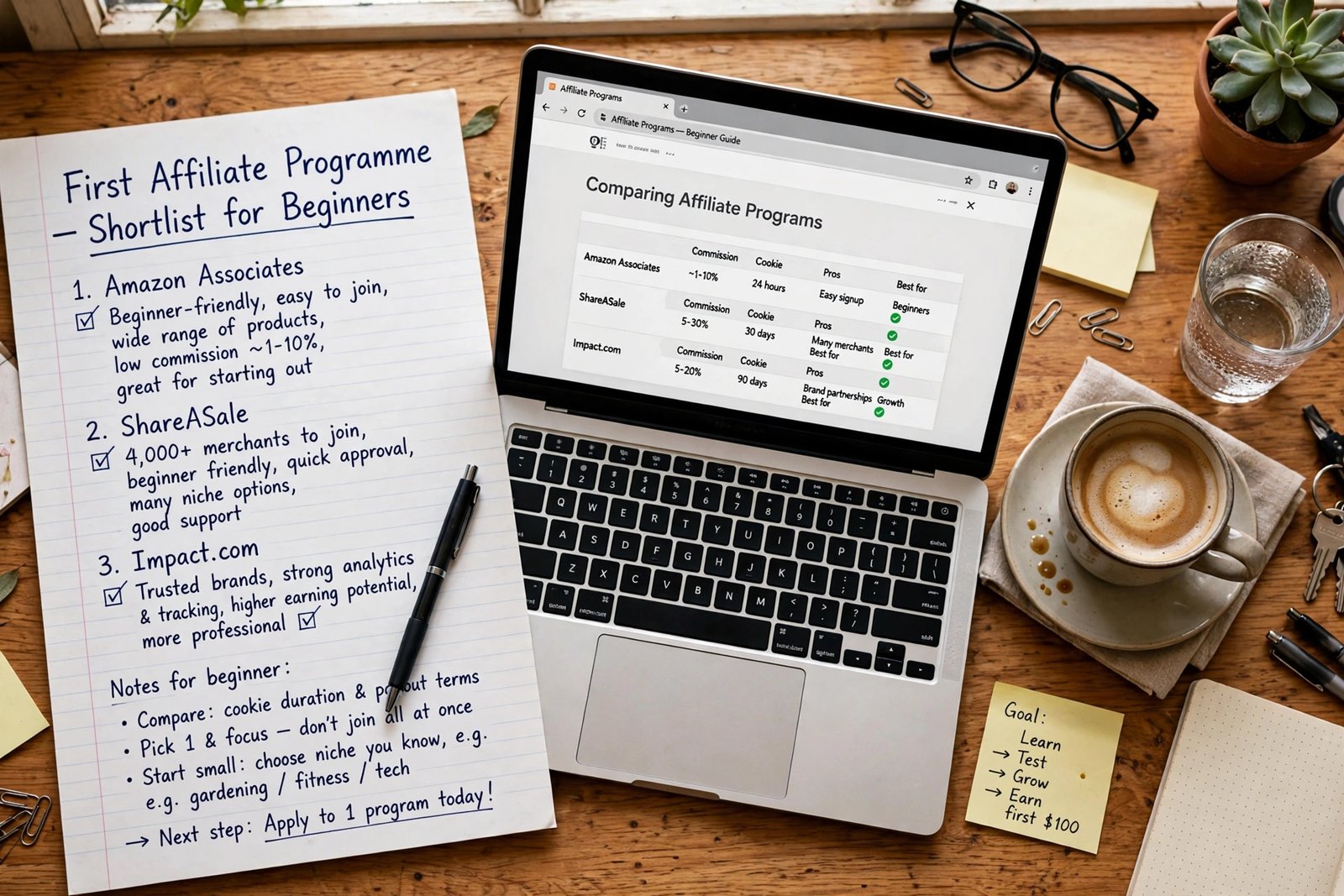
Worked example: a shortlist in one hour
Example only: this is a method example, not a recommendation of any programme. Set a timer for one hour. In the first 20 minutes, list five programmes that fit your niche, using official programme pages and network directories. In the next 20 minutes, fill in the terms table from the earlier section for each programme: commission type, cookie window, payout threshold and method, eligibility, and promotion rules. In the final 20 minutes, split the list into apply now and apply later, using the eligibility column. Your apply now list should have one or two programmes. Your apply later list should have a clear task for each programme, such as "publish ten tutorials" or "grow email list to a steady size". If you cannot fill in a field from an official page, mark it as not verified and do not guess. A shortlist with two verified programmes is better than a list of ten programmes with invented figures. Keep the date you checked each terms page, because terms change and your future self will need to know when the information was current.
Common mistakes
- Ignoring cookie windows, then wondering why clicks from last month did not convert.
- Ignoring payout thresholds and payment methods, then discovering you cannot receive payment in your country.
- Applying to audience-gated programmes with an empty site, then treating rejection as a final verdict.
- Choosing a programme only for a high headline commission, without checking refunds, validation, or product quality.
- Promoting a product in a banned channel, such as paid brand bidding, and losing commissions or an account.
- Hiding disclosure or using vague wording, which breaks trust and programme rules.
Risks and scams to watch for
Programme choice carries real risks. Pay-to-join programmes, programmes that require a starter kit purchase, and programmes that pay mainly for recruiting others are warning signs, not legitimate affiliate opportunities. Programmes with no published terms, no contact method, and no payment schedule should be avoided. Even legitimate programmes carry risk: terms can change, cookie windows can shorten, and a merchant can close a programme. That is why you should not build your whole income on one programme. Diversify slowly, across two or three programmes that serve the same audience, once the first one is working.
Frequently asked questions
Do I need a website to join an affiliate program?
It depends on the programme. Some programmes accept a social channel, video channel, or email list, if that channel is real and follows programme rules. Others require an approved website. Check the eligibility section on the official terms page for each programme, and do not assume that "without a website" in a list title means every programme in the list accepts social-only affiliates.
Why was my affiliate application rejected?
Common reasons include an empty or very new channel, content that does not match the programme niche, a channel type the programme does not accept, or missing disclosure and contact information. Build helpful content in the niche, add clear disclosure, and reapply with examples of your work. If a programme needs an audience first, add it to your apply later list with a clear growth task.
When do I get paid as an affiliate?
Payment timing depends on validation, payout threshold, payment method, and payment schedule. Most programmes validate sales first, to allow for refunds, then pay on a monthly or set schedule once you reach the threshold. Check the terms page for the exact cycle, and do not spend expected income before it is confirmed.
Which affiliate program pays beginners fastest?
There is no reliable fastest programme for all beginners, because payment depends on traffic, conversion, threshold, and validation. A programme with a low threshold and a payment method you can receive may pay sooner than a programme with a high threshold, even if its headline commission looks smaller. Compare threshold and method, not just commission type.
Can I join more than one affiliate program?
Yes, and most affiliates do, but start with one or two. Adding programmes slowly keeps your content focused and your tracking clear. Add a new programme only when it serves the same audience, fills a real gap, and you can explain its products honestly.
Conclusion
The best affiliate programme for a beginner is not the one with the highest headline commission. It is the one you can explain honestly, that accepts your channel now or with a clear build task, that pays by a method you can receive, and whose terms you have actually read. Check official terms, split your shortlist into apply now and apply later, apply to one or two programmes first, and publish helpful content for them before you add more. Your next step is to spend one hour on the shortlist method above, then move to promotion: read How to Promote Affiliate Products in 2026, and use the Affiliate Marketing category page to find the start, niche, and first sale guides. Results vary, and nothing on this site is financial advice.