How to Find Online Transcription Jobs in 2026
Learning how to find online transcription jobs starts with a hard truth: this work is real, but it pays less than most beginners expect, and it attracts more scams than most online jobs. A transcriptionist listens to audio and types out exactly what is said, and the genuine companies pay per audio minute, which means your real hourly pay depends on how fast and how accurately you type. This guide shows you which companies are genuine, how to pass their tests, and how to avoid the fake listings that ask you to pay first.
This guide is for beginners who type well, listen carefully, and want flexible work from home. You will learn what transcription work really is, how AI changed it, which companies to apply to, how to pass the style guide test, what equipment you need, and how to track your real hourly pay.
In this guide
- What online transcription work really is, and what AI changed
- The genuine companies, and how they compare
- Step 1: Check your typing and listening skills
- Step 2: Apply to two or three platforms at once
- Step 3: Pass the style guide test
- Step 4: Your first two weeks, and your real hourly rate
- Equipment and setup
- What it costs and what to expect
- Common mistakes
- Risks and scams to watch for
- Frequently asked questions
What online transcription work really is, and what AI changed
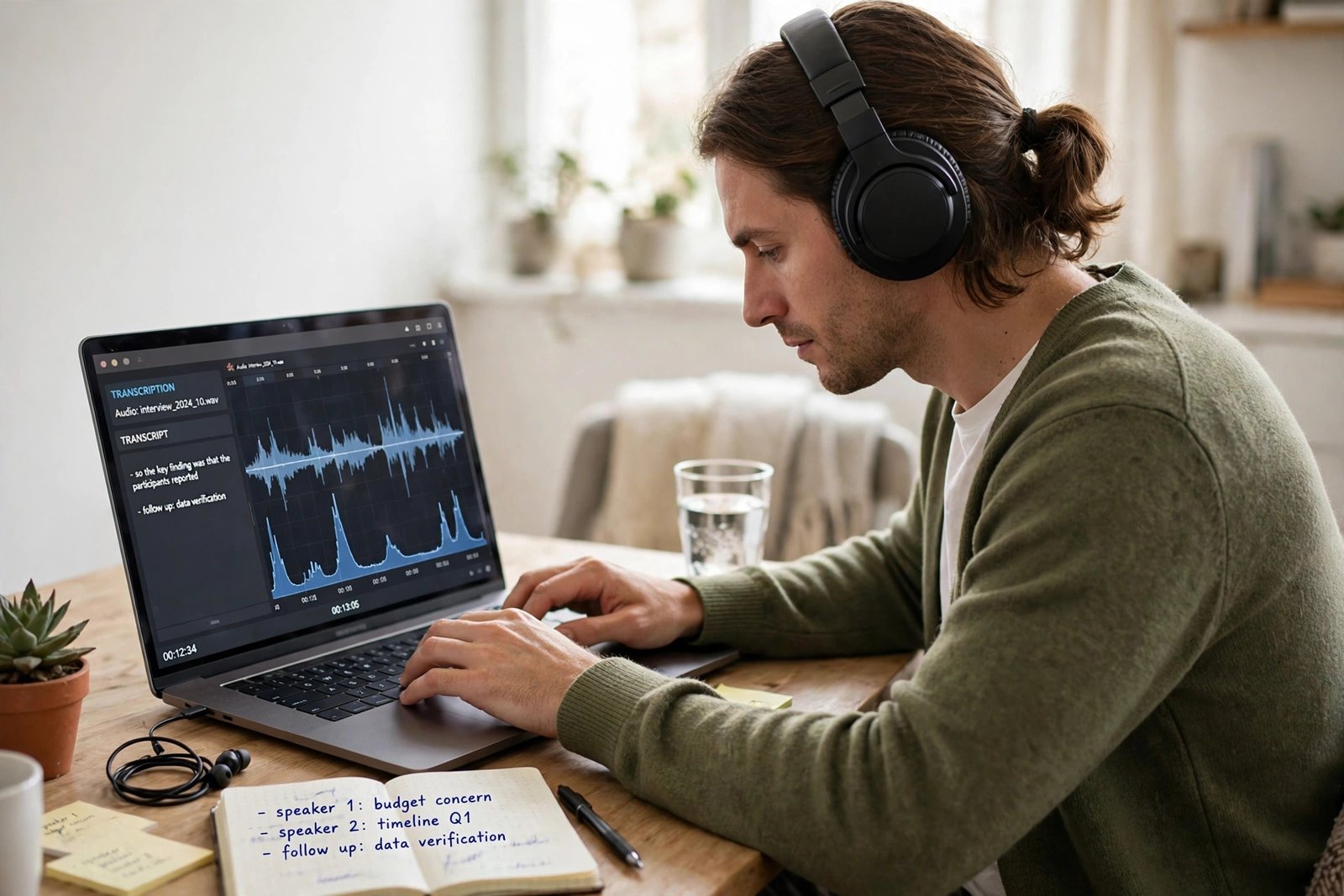
Transcription means turning spoken audio into written text. The audio can be an interview, a lecture, a podcast, a meeting, or a legal hearing. You listen, you type what you hear, and you follow a style guide, which is a set of rules about spelling, punctuation, and how to mark unclear speech, laughter, and pauses.
There are four types of transcription, and a beginner should start with general transcription, which covers interviews, podcasts, and meetings. Legal transcription needs knowledge of court language. Medical transcription needs knowledge of medical terms, and it is shrinking as a separate job. Captioning means writing timed subtitles for video, and it is a useful second skill once you are comfortable with general work.
AI changed this work in a real way. AI tools can now draft a transcript in seconds, so pure typing work is worth less than it was. The paid work that remains is editing AI drafts for accuracy, and transcribing hard audio that AI gets wrong, such as several speakers talking over each other, strong accents, or poor recordings. This means a beginner should learn to edit and check transcripts, not just type them. The work is still there, but the skill that pays is accuracy, not speed alone.
The genuine companies, and how they compare
The companies below are the ones that appear in all three competitor guides, and they all accept beginners in some form. Pay is per audio minute, which means you are paid for each minute of audio you transcribe, not for each hour you work. The exact rates change, and competitor guides disagree on them, so check the company's own jobs page on the day you apply, and do not trust a pay figure from a blog alone.
| Company | Who it suits | How to apply | What to know first |
|---|---|---|---|
| Rev | Beginners in approved countries, including the UK, US, Canada, Australia, and Ireland | Grammar quiz, then a transcription or caption sample | Rev accepts freelancers only from listed countries, and you must be at least 18 |
| GoTranscript | Beginners worldwide, with a short test | Online test and a sample file | Known for a clear test process and PayPal payouts |
| TranscribeMe | Beginners who want short files | Short test files, then a style guide exam | Files are short, which suits new transcribers |
| Scribie | Beginners who want very short files | Test file, then short audio clips | Short clips, but check the jobs page is live before you apply |
| Way With Words | Patient beginners who want steady work | Application, then a test and training | Slower to start, but the work is steady once you pass |
| Verbit | Experienced transcribers, or beginners who can edit AI drafts | Application and test | More editing work than pure typing, which suits the AI shift |
Apply to two or three of these at once, because not every application is accepted, and some companies keep applications for months before they reply. Rev's own help page says applications are kept for six months, and that not everyone who applies is selected, because demand for places is high. Read the Rev freelancer help page before you apply, and start your application at Rev freelancers.
Step 1: Check your typing and listening skills
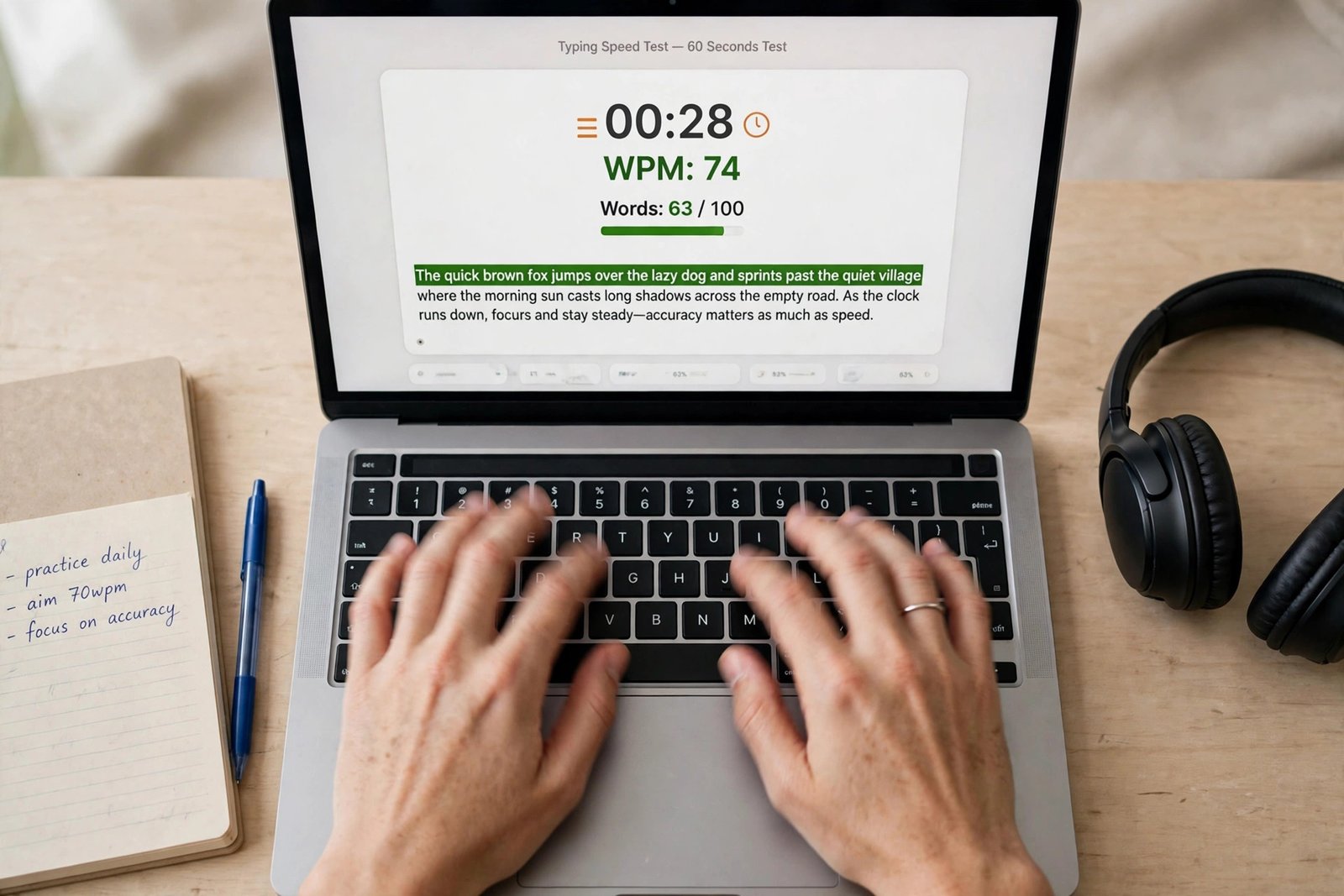
You need to type at least 40 words per minute to make this work pay, and 60 words per minute is a better target. Test yourself free on a typing test site, and write down your speed and your accuracy. If you are below 40 words per minute, practise for 20 minutes a day for two weeks before you apply. Use free typing practice sites, and focus on accuracy first, because a fast transcript full of errors fails the test.
Listening matters as much as typing. Practise with a podcast or an interview, and type what you hear without pausing every few seconds. If you cannot follow two speakers at normal speed, you are not ready yet, and that is fine. Practise with clear audio first, then move to harder audio with background noise and accents.
You also need strong English grammar and spelling, because the test checks both. If English is not your first language, read your transcript out loud before you submit it, and check every name, number, and date twice. A single wrong number can fail a test file.
Step 2: Apply to two or three platforms at once
Here is a full walkthrough of one application, using Rev, because its process is published on its own help page. The other companies follow a similar shape, with a test and a sample file.
First, check that you are eligible. Rev accepts transcription and caption freelancers only from Australia, Canada, Ireland, Mexico, Netherlands, New Zealand, South Africa, the United Kingdom, and the United States, except California, and you must be at least 18 and physically located in an approved country, with official ID from an approved location. If you are outside those countries, apply to GoTranscript or TranscribeMe instead.
Second, go to the company's freelancers page and choose transcription. Read the style guide and the example files before you start the test. Most beginners skip this step, and most of them fail.
Third, take the grammar quiz. It is short, and it checks basic English, punctuation, and spelling. Take your time, and do not rush it.
Fourth, submit a transcription sample. You will listen to a short audio file and type what you hear, following the style guide exactly. Use headphones, work in a quiet room, and listen to each section twice before you type it.
Fifth, wait. Rev says the review can take time, and that applications are kept for six months, so you may be approved at any point in that period. While you wait, apply to a second platform, and keep practising your typing.
Step 3: Pass the style guide test
The style guide test is where most beginners fail, and it is almost always because they did not read the guide. A style guide is a rule book, and the test checks whether you follow it, not whether you are a good typist. Common rules include how to write numbers, how to mark a speaker change, how to mark unclear words, and how to handle laughter, coughs, and pauses.
Read the whole guide once, then read it again with a pen in your hand, and write down the ten rules you are most likely to forget. Then do a practice file, and check every line against the guide before you submit it. The most common fail reasons are guessing at unclear words instead of marking them unclear, writing numbers in the wrong form, and missing speaker changes.
If you fail, read the feedback, wait for the reapply period the company states, and try again. Most companies let you reapply after a set time, and a failed first test does not end your chances.
Step 4: Your first two weeks, and your real hourly rate
Your first two weeks are for learning, not for earning. Take short files first, even if they pay less, and check every transcript against the audio before you submit it. Keep a note of how long each file takes you, because that is how you learn your real hourly rate.
Per audio minute pay misleads beginners, because one minute of audio takes far longer than one minute to transcribe. A widely used estimate, from a guide that cites Middlebury guidance, is that one hour of audio takes four to eight hours of work for a beginner. That means a rate that sounds fair per audio minute can work out to a low hourly rate until you get faster. Track your own numbers, and do not judge a platform by its per-minute rate alone.
After two weeks, look at your notes. If your real hourly rate is very low, you have three options: get faster with practice, take easier audio, or move to editing AI drafts, which is often quicker than typing from scratch. Do not keep taking hard files at a low rate and hoping it improves on its own.
Equipment and setup
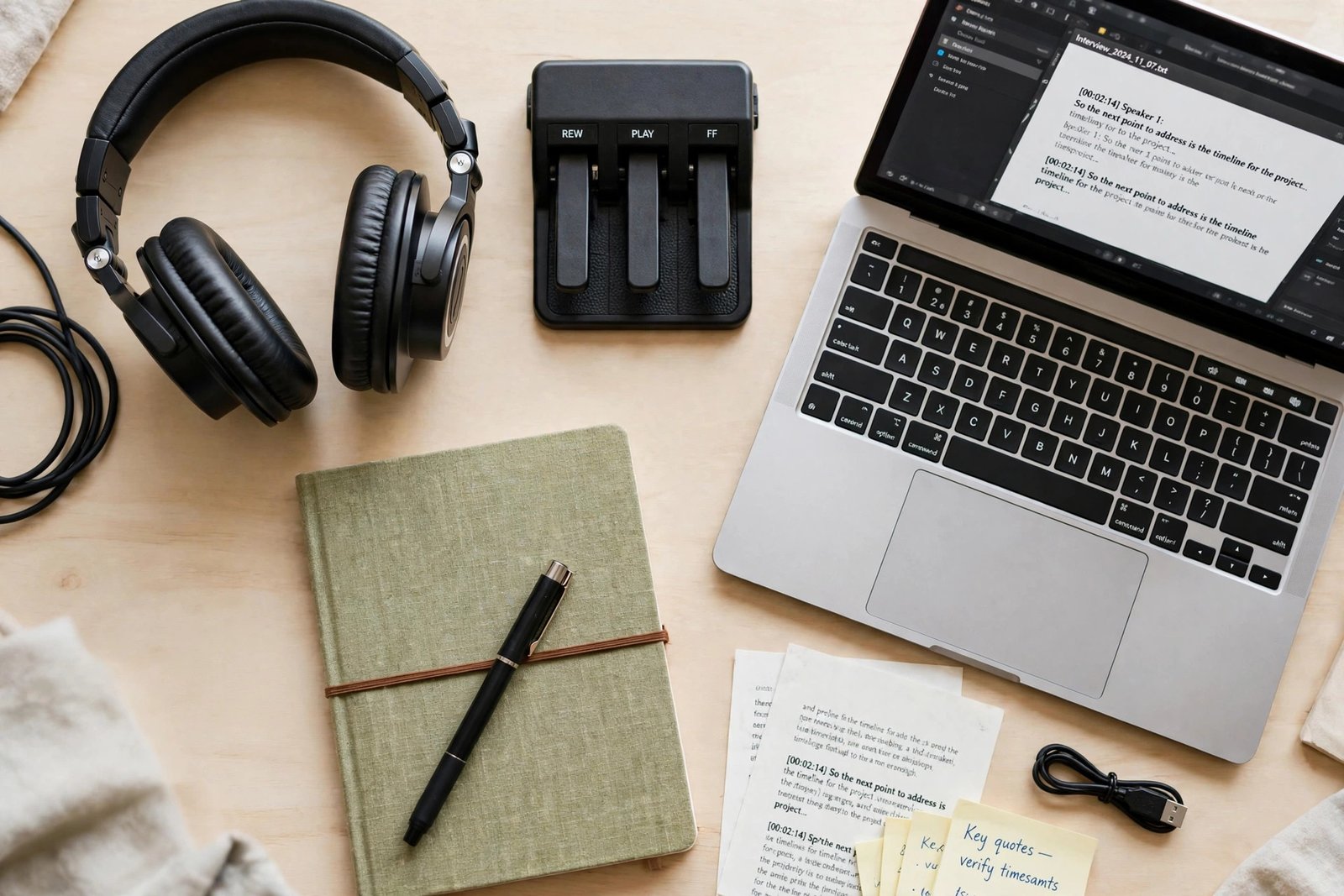
You need less equipment than most guides suggest, but the two items that matter are headphones and a quiet room. Good over-ear headphones make unclear audio easier to hear, and they are the one item worth paying for. A foot pedal, which lets you pause and rewind the audio with your foot, helps once you are working regularly, but you do not need one to start.
A text expander, which is a tool that turns a short code into a full phrase, saves time on repeated words such as speaker names. Two monitors help, because you can keep the audio controls on one screen and the transcript on the other, but one screen is enough to start. Free tools such as Express Scribe, which is a free audio player made for transcription, help you slow down audio and jump back a few seconds without using your mouse.
What it costs and what to expect
Starting costs are low. Headphones cost around 20 to 50 dollars, and the software you need to start is free. Do not pay for a transcription course before you have tried the free test on a real platform, because the test itself tells you whether you are ready.
Pay varies, and competitor guides disagree on the exact rates, so this guide gives no pay figure as fact. What is certain is the maths: you are paid per audio minute, and your hourly pay depends on your speed. Check the rate on the company's own jobs page on the day you apply, and date any figure you rely on.
Example only: these numbers are not typical results. Imagine a platform pays 0.50 dollars per audio minute, and you transcribe 10 audio minutes in a day. That is 5 dollars for the audio. If those 10 audio minutes take you 60 minutes of work, your real rate is 5 dollars per hour. If you get faster and the same 10 audio minutes take 30 minutes, your real rate is 10 dollars per hour. This is why speed and easy audio matter more than the per-minute rate.
Expect slow progress at first. Most beginners earn little in the first month, and the work can dry up for days at a time on some platforms, which is why applying to two or three platforms at once matters. If work dries up on one platform, check the others, and keep a weekly routine of checking job boards on set days, rather than waiting for work to arrive.
Common mistakes
- Applying to one platform only, then waiting months for a reply.
- Skipping the style guide, then failing the test on rules you never read.
- Guessing at unclear words, instead of marking them unclear as the guide says.
- Judging a platform by its per-minute rate, without working out your real hourly rate.
- Paying for a course or a certificate before trying the free platform test.
- Taking very hard audio as a beginner, then failing the quality check and losing access to work.
Risks and scams to watch for
Transcription attracts scams, because it looks like easy work from home. The Federal Trade Commission says honest employers will never ask you to pay to get a job, and will never ask you to deposit a cheque and send part of the money back. Read the FTC guidance on job scams before you apply anywhere.
Watch for these warning signs. A listing asks you to pay for training, a certificate, or a job directory. A "company" offers you a job without a test, then asks for your bank details. A listing promises hundreds of dollars a day for simple typing. A recruiter contacts you on a messaging app and asks you to buy equipment from a specific seller. A real platform tests you first, pays through its own system, and never asks you to pay to start.
Verify every company before you apply. Search the company name plus the words "scam", "review", or "complaint", and check that the jobs page sits on the real company website. If a site that used to list jobs now returns a dead page, treat that as a warning sign, and check the company's own site instead. For the full checklist, read how to spot online job scams.
Frequently asked questions
Are online transcription jobs legit?
Yes, the genuine companies are real, and they pay through their own systems. But the field also has many fake listings, so apply only on the company's own website, never pay to start, and check the company name with a search before you apply.
How much do transcription jobs pay?
Pay is per audio minute, and it varies by company, language, and difficulty. Your real hourly pay depends on how fast you type and how hard the audio is. Check the rate on the company's own jobs page on the day you apply, and track your own hourly rate for two weeks before you judge it.
Do I need experience for transcription jobs?
No, most of the companies in this guide accept beginners, and they test you with a sample file instead of asking for a CV. You need good typing, strong English, and the patience to follow a style guide exactly.
Do I need a certificate for transcription work?
No, you do not need a certificate to start. The companies test you themselves. Do not pay for a transcription certificate before you have tried the free test on a real platform.
Will AI replace transcription jobs?
AI already does the first draft of many transcripts, so pure typing work is shrinking. The paid work that remains is editing AI drafts, checking hard audio, and captioning video. Learning to edit and check transcripts matters more now than typing speed alone.
Conclusion: apply to three platforms, read the style guide, track your rate
Finding online transcription jobs in 2026 is a realistic route into flexible work from home, if you go in with clear eyes. Apply to two or three genuine platforms at once, read the style guide before you test, and track your real hourly rate for two weeks before you decide whether the work pays enough for you. Never pay to start, and check every listing against the scam warning signs.
Your next step is to test your typing speed today, then apply to one platform this week. Then read how to get a data entry job online, how to find part-time online jobs, and how to spot online job scams before you apply anywhere. You can also browse all our guides in the online jobs category.
Note for the reader: pay, eligibility, and tax rules differ by country, so check the platform's own pages and your local rules. Earning results vary; nothing on this site is financial advice.