How to Learn Bookkeeping Online in 2026
To learn bookkeeping online, start with the core concepts, then pick one course, practise in one software package, and follow a short study plan. Bookkeeping is the daily record of what a business earns and spends, and you can learn it from home with no degree and no prior experience.
This guide gives you a step by step path. It covers what bookkeeping is, the skills you need, the free and paid learning routes, the software to practise in, a 4 to 8 week study plan, and the main certification paths. It also shows the costs, the common mistakes, and the course scams to avoid.
In this guide
- What bookkeeping is, and what it is not
- Skills you need before you start
- Step 1: Learn the core concepts
- Step 2: Pick your learning route
- Step 3: Choose your software and practise in it
- Step 4: Follow a 4 to 8 week study plan
- Step 5: Build practice records and a small portfolio
- Certification paths compared
- Example only: a week of bookkeeping, with the maths shown
- What it costs to learn bookkeeping online and what to expect
- Common mistakes
- Risks and scams to watch for
- Frequently asked questions
What bookkeeping is, and what it is not
Bookkeeping is the job of recording money in and money out, in an organised way, so a business always knows where it stands. A bookkeeper records sales, pays bills, matches bank statements, and prepares simple reports on profit, cash, and debts.
Bookkeeping is not the same as accounting. An accountant uses the bookkeeper records to give advice, plan tax, and sign off accounts. The table below shows the difference in plain words.
| Task | Bookkeeping | Accounting |
|---|---|---|
| Record daily sales and spending | Yes, this is the core job | No, it uses the records |
| Match bank statements to the books | Yes, every week or month | No, it checks the results |
| Prepare profit and loss reports | Yes, simple reports | Yes, detailed analysis |
| Give tax advice | No | Yes, with qualifications |
| Plan business strategy | No | Yes, from the numbers |
Skills you need before you start
Start with honest basics. You need to add, subtract, multiply, and divide without fear. You do not need advanced maths, because spreadsheets do the heavy sums, but you must spot when a number looks wrong. You also need patience with detail, because a single wrong digit can throw a whole month out. Basic computer skills are enough.
Step 1: Learn the core concepts
Every bookkeeping course starts with the same core ideas. Learn them in this order.
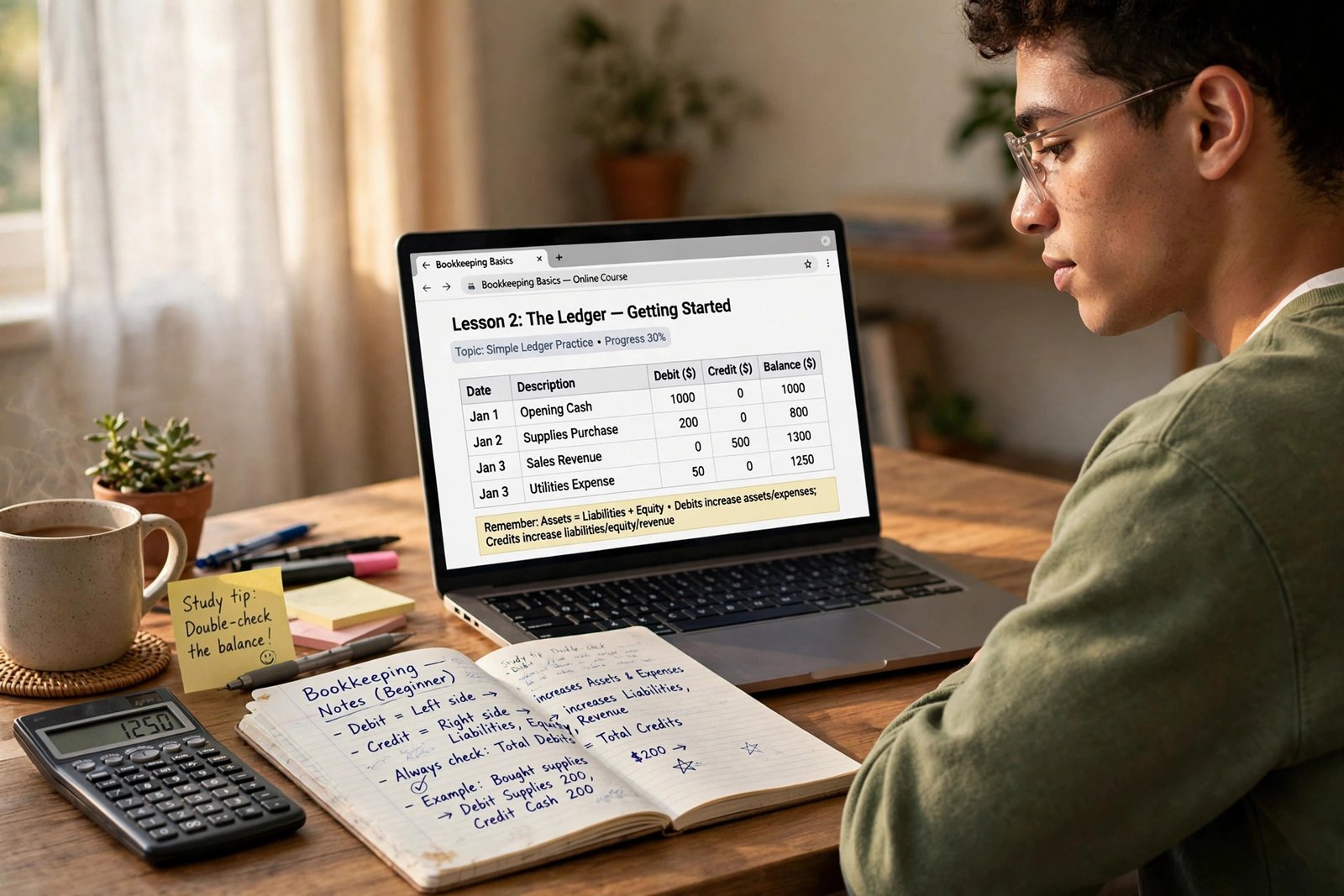
First, learn double entry bookkeeping. Double entry is the rule that every transaction has two sides. When a business sells a product for 100 dollars, the sales figure and the bank balance both go up by 100 dollars. When it pays 100 dollars in rent, the bank balance falls by 100 dollars and the rent cost rises by 100 dollars. This two sided record keeps the books balanced.
Second, learn the chart of accounts, which is simply the list of categories a business uses, such as sales, rent, stock, wages, and bank fees. Every transaction goes into one category.
Third, learn debits and credits. A debit is an entry on the left side of an account, and a credit is an entry on the right side. In plain words, a debit usually increases an asset or an expense, and a credit usually increases income or a liability. Learn it by recording ten real transactions and watching the two sides balance.
Fourth, learn the three main reports: profit and loss, which shows income minus costs; the balance sheet, which shows what the business owns and owes on one date; and cash flow, which shows money in and out over a period.
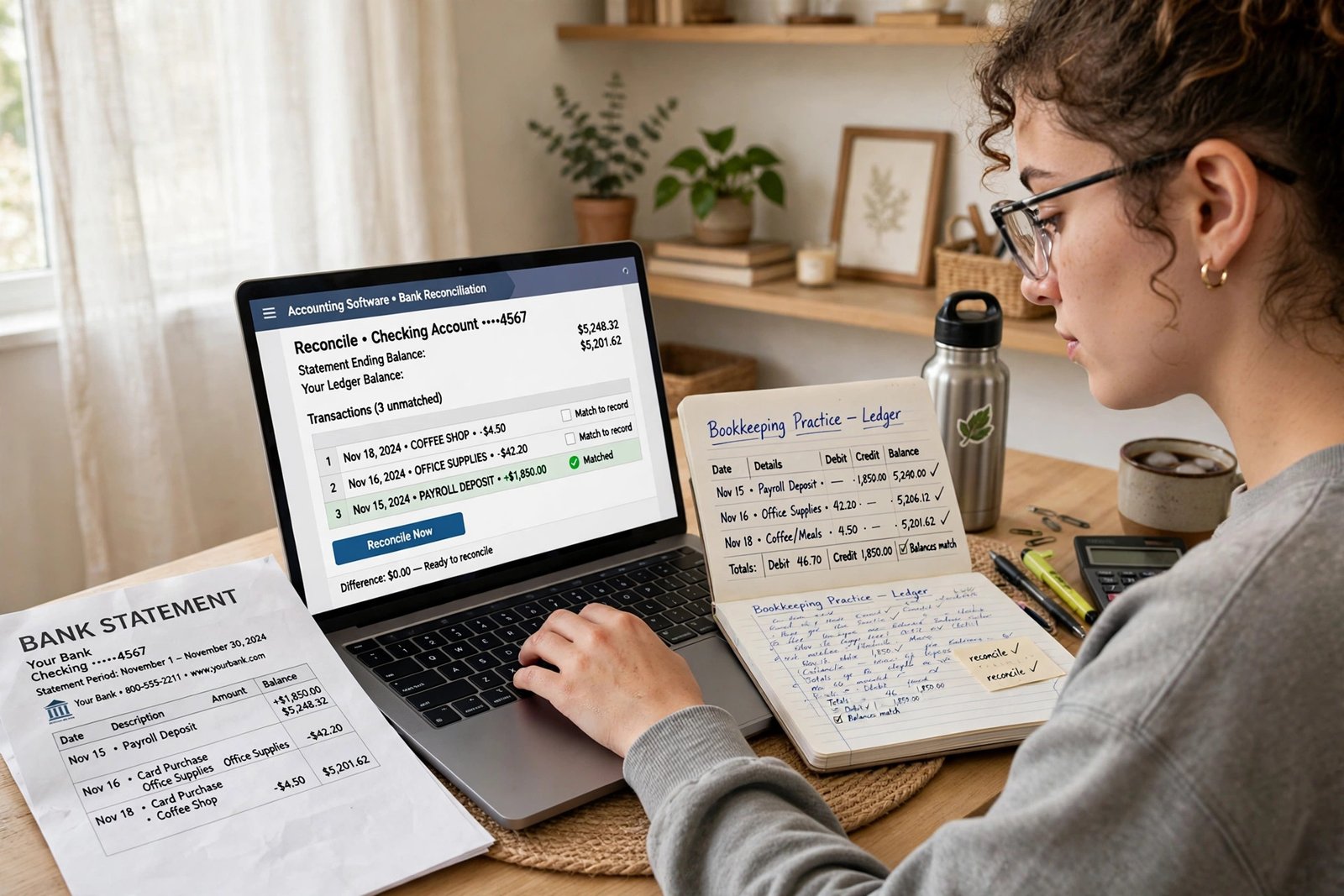
Fifth, learn bank reconciliation, which is the job of matching the bank statement to the books, line by line, until the two agree. It is the most common weekly task in bookkeeping, and it is where most errors are found.
Free courses cover all five ideas well. The Khan Academy accounting and finance lessons explain the basics in short videos with no cost. AccountingCoach also offers free lessons on the same ideas, with a paid option for practice questions.
Step 2: Pick your learning route
There are three sensible routes to learn bookkeeping online. Pick the one that fits your budget and your goal.
| Route | Cost | Best for | Time needed |
|---|---|---|---|
| Free route | 0 dollars | Testing the subject before you spend money | 4 to 8 weeks, part time |
| Certificate route | About 160 US dollars total | A named certificate for your CV | About 4 months, part time |
| Paid course route | Varies, often 100 to 500 US dollars | Structured teaching with a tutor | 4 to 12 weeks |
The free route starts with Khan Academy and AccountingCoach for concepts, then a free trial of QuickBooks or Xero to practise. It costs nothing, and it is enough to learn the basics.
The certificate route suits people who want proof of study. The best known option is the Intuit Academy Bookkeeping Professional Certificate on Coursera. It is a four course series from Intuit, with about 54 hours of study. As of November 2026, Coursera lists it at about 39 US dollars a month in the US and Canada after a 7 day free trial, or about 160 US dollars in total. Check the Coursera page before you enrol, because the price can change.
The paid course route suits people who want a tutor and a fixed timetable. Udemy and LinkedIn Learning both sell bookkeeping courses, often at sale prices that change weekly. Check the reviews and the last update date before you pay.
Step 3: Choose your software and practise in it
Bookkeeping is learned by doing, not by reading. Pick one software package and practise in it from week two onwards.
| Software | Cost for learners | Best for | Notes |
|---|---|---|---|
| QuickBooks Online | Paid subscription, free trial available | Most small business jobs | The most widely used package in the US |
| Xero | Paid subscription, free trial available | Small businesses and UK learners | Strong bank feeds and clean design |
| Wave | Free for basic bookkeeping | Learners on a tight budget | Good for practice, fewer features |
| Excel or Google Sheets | Free or already owned | Learning the concepts by hand | Slow for real work, great for learning |
QuickBooks is the safest first choice if you plan to look for bookkeeping work later, because most small business adverts name it. Xero is a strong second choice, and it is common in the UK, Australia, and New Zealand. Wave is free and fine for practice, but few employers ask for it.
Whichever you pick, open a practice company file and enter 20 transactions of your own: sales, purchases, rent, wages, and bank fees. Then run a profit and loss report and a balance sheet. If the numbers balance, you are learning. If they do not, find the error.
Step 4: Follow a 4 to 8 week study plan
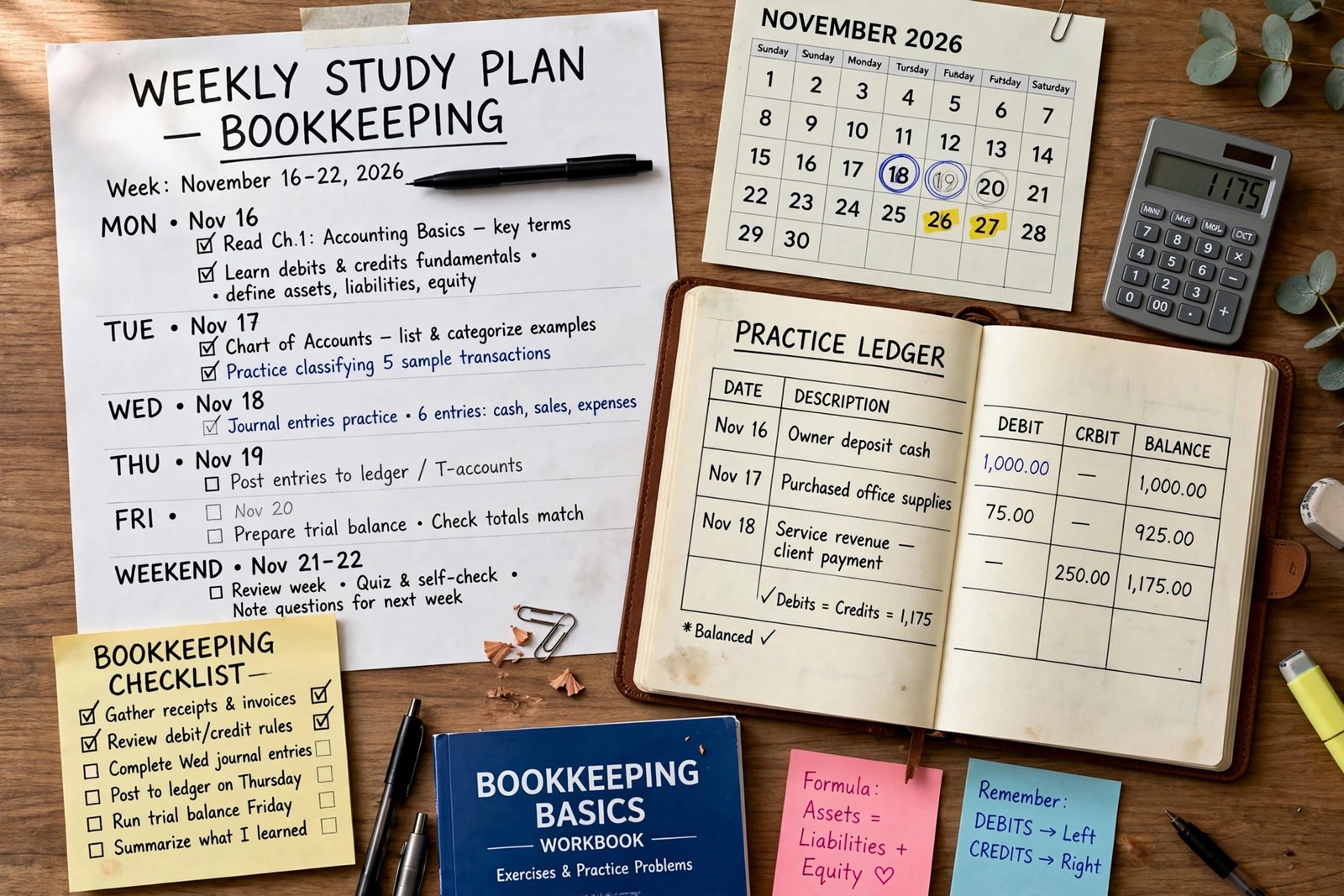
Study for 45 to 60 minutes a day, five days a week. Short, regular study is the fastest way to learn bookkeeping online. The table below is a 6 week plan.
| Week | What to study | What to practise |
|---|---|---|
| 1 | Double entry, debits and credits, chart of accounts | Record 10 transactions on paper |
| 2 | Sales, purchases, and expenses | Enter 20 transactions in your software |
| 3 | Bank reconciliation and the trial balance | Reconcile a practice bank statement |
| 4 | Profit and loss and balance sheet reports | Run both reports and explain them in plain words |
| 5 | Payroll basics and tax basics for your country | Record a practice payroll run |
| 6 | Review, practise exam questions, and tidy your portfolio | Reconcile a full practice month from scratch |
Step 5: Build practice records and a small portfolio
A portfolio for a beginner bookkeeper is a set of practice books, not a list of clients.
Start with a made up small shop. Give it a name, a bank balance, and a list of products. Then record a full month of activity: 30 sales, 20 purchases, rent, wages, bank fees, and one refund. Reconcile the bank statement, run the profit and loss report and the balance sheet, and write one page that explains, in plain words, whether the shop made a profit and why.
Add a second practice file for a service business, such as a freelance designer. Service businesses have no stock, so the books are simpler. Two tidy practice files show more skill than ten half finished courses.
If you want paid work later, read our guide on how to work as a remote bookkeeper next. It explains the jobs angle in full, and this guide stays on the learning side. If you want to run your own practice one day, our guide on how to start a bookkeeping business online covers that path separately.
Certification paths compared
A certificate is not required to learn bookkeeping, and it does not guarantee work. It can help your CV and give your study a clear target. Compare the main options before you pay.
| Certificate | What it covers | Time | Cost, November 2026 | Who it suits |
|---|---|---|---|---|
| Intuit Academy Bookkeeping Professional Certificate | Bookkeeping basics and QuickBooks Online | About 4 months, part time | About 39 US dollars a month on Coursera, about 160 US dollars total | Beginners who want a structured course and a certificate |
| NACPB Certified Public Bookkeeper (CPB) | Bookkeeping, QuickBooks, payroll, and business communication, plus experience | 4 to 6 months, self paced, plus experience | Check nacpb.org for current fees; the licence application fee is 100 US dollars | US learners who want a recognised licence |
| ACCA-X Introduction to Bookkeeping | Bookkeeping fundamentals, free to study | Self paced | Free to study, fee to upgrade to a certificate | UK and international learners who want a respected name |
| LinkedIn Learning Accounting Foundations | Bookkeeping basics in short video lessons | A few days | Included in a LinkedIn Learning subscription | People who already pay for LinkedIn Learning |
The NACPB CPB is the most demanding option on this list. It is a licence, not just a course. To earn it you must pass three certification exams, complete training, and show either three months in the NACPB experience programme or one year, or 2,000 hours, of supervised work, plus 24 hours of continuing education each year. Full details and fees are on the NACPB Certified Public Bookkeeper licence page.
ACCA-X is the cheapest respected route for learners outside the US. The course is free to study on edX, and you only pay if you want a verified certificate. Check your own country tax basics separately, because UK rules differ from US rules.
Example only: a week of bookkeeping, with the maths shown
This example uses made up numbers. It is an example only.
A small online shop starts Monday with 12,400 dollars in the bank. During the week it records 3,200 dollars in sales. It pays 900 dollars in rent, 1,100 dollars for stock, 180 dollars for delivery, and 45 dollars for software.
First, add the expenses: 900 plus 1,100 is 2,000, plus 180 is 2,180, plus 45 is 2,225 dollars.
Next, work out the closing bank balance. Start with 12,400 dollars. Add sales of 3,200 dollars, which gives 15,600 dollars. Subtract expenses of 2,225 dollars, which gives 13,375 dollars.
The closing bank balance should be 13,375 dollars. The bookkeeper then checks the bank statement. If it also shows 13,375 dollars, the books agree. If it shows a different number, the bookkeeper looks for the missing or wrong entry.
What it costs to learn bookkeeping online and what to expect
| Item | Typical cost | Notes |
|---|---|---|
| Free courses and videos | 0 dollars | Khan Academy, AccountingCoach free lessons |
| Intuit Academy certificate on Coursera | About 160 US dollars total | About 39 US dollars a month, 4 months, November 2026 |
| Udemy or LinkedIn Learning course | 15 to 200 US dollars | Sale prices change often, check before you pay |
| QuickBooks or Xero practice | Free trial, then a monthly subscription | Cancel the trial if you do not want to pay |
| NACPB CPB licence | Fees listed on nacpb.org | Application fee 100 US dollars, plus exam and course costs |
| Total to learn the basics | 0 to 200 US dollars | Most learners spend under 200 US dollars |
Expect a slow start. Most beginners need 4 to 8 weeks to learn the basics and feel confident with simple books. A certificate takes about 4 months. Real confidence comes from practice, not from certificates, so keep recording practice transactions after the course ends. Do not rush to paid work before you can reconcile a full month without help.
Common mistakes
- Do not skip the core concepts and jump straight to software, because the software will hide your mistakes.
- Do not learn three software packages at once, because you will mix up their menus and shortcuts.
- Do not pay for an expensive course before you try a free one, because you may not enjoy the work.
- Do not ignore bank reconciliation, because it is the check that finds your errors.
- Do not record transactions from memory at the end of the month, because you will forget half of them.
- Do not mix personal spending with business spending in your practice books, because it makes the reports meaningless.
- Do not trust a certificate to get you work on its own, because practice and a tidy portfolio matter more.
- Do not study tax rules for the wrong country, because tax basics differ by country.
Risks and scams to watch for
Paid bookkeeping courses attract scams, so check before you pay. A real course names its teacher, shows a full syllabus, and lets you see sample lessons. A fake course hides the teacher and pressures you to pay today.
Watch for these warning signs. The course promises a guaranteed job or a set income. The price is only shown after a sales call. The certificate is called accredited but no accrediting body is named. The reviews all use the same words and appear on the same day. The seller asks for payment by bank transfer or gift card.
Check a course before you pay. Search the course name with the word review, read the refund policy, and check whether the provider is a known platform such as Coursera, edX, or LinkedIn Learning. Never pay for a course that asks for your bank login details.
Tax rules differ by country. This guide does not give tax advice, so check your local tax authority or a qualified accountant.
Frequently asked questions
Can I learn bookkeeping online with no experience?
Yes. Bookkeeping starts with simple ideas and builds slowly. You need basic maths and care with detail, not a degree. Start with a free course, practise in one software package, and follow the 6 week plan in this guide.
How long does it take to learn bookkeeping?
The basics take 4 to 8 weeks of part time study, at about an hour a day. A certificate such as the Intuit Academy programme takes about 4 months part time.
Is bookkeeping certification worth it?
It can help, but it is not required. A certificate gives your study a clear target and your CV a named credential. The NACPB CPB licence carries more weight in the US, but it needs exams, training, and supervised experience. Start with the free route, then decide if a certificate is worth the cost.
Do I need a degree to become a bookkeeper?
No. Most bookkeeping work needs a certificate or proven practice, not a degree. Employers and clients care more about accurate books and a tidy portfolio than about a university qualification.
Which software should I learn first?
Learn QuickBooks Online first if you want the widest choice of work, because most small business adverts name it. Learn Xero first if you are in the UK, Australia, or New Zealand, where it is common. Use Wave or a spreadsheet for free practice.
What is the difference between bookkeeping and accounting?
Bookkeeping records daily money in and money out. Accounting uses those records to give advice, plan tax, and prepare formal accounts. A bookkeeper keeps the records tidy and correct, and an accountant interprets them.
Conclusion
To learn bookkeeping online, start with the core concepts, pick one learning route, practise in one software package, and follow a short study plan. Free courses cover the basics well, a certificate adds structure, and the NACPB CPB licence is the deeper US path. Practise every week, reconcile a full practice month, and keep a small portfolio of tidy books.
To go further, read how to work as a remote bookkeeper if you want paid work next, how to start a bookkeeping business online if you want your own practice one day, and how to learn data analysis online to build a related skill, then browse the full Digital Skills category for more guides. The facts in this guide were checked against Coursera, NACPB, and Khan Academy in November 2026, and prices are stated as of November 2026.
Note for the reader: prices are in US dollars unless stated otherwise, and tax rules differ by country, so check your local tax authority before you act. Earning results vary; nothing on this site is financial advice.