How to Learn QA Testing Online in 2026
To learn QA testing online, start with manual testing, learn to write test cases and bug reports, practise on free practice sites, then move to API testing and automation. QA testing, which stands for quality assurance testing, is the job of checking software for bugs before users find them. It suits people who like detail, logic, and clear communication, and you can learn it from home with no degree.
This guide gives you a clear path. It explains what QA testing is, six practical steps, an 8 week study plan, the free and paid routes, and the costs. It also covers the ISTQB certificate, which is the best known QA credential.
In this guide
- What QA testing is
- Step 1: Learn manual testing basics
- Step 2: Learn test design techniques
- Step 3: Practise on real practice sites
- Step 4: Learn API testing
- Step 5: Learn automation, one tool at a time
- Step 6: Prepare for ISTQB Foundation, optional
- 8-week study plan
- Free vs paid routes
- Example only: a bug report and a test case, with the details shown
- What it costs to learn QA testing online and what to expect
- Common mistakes
- Risks and scams to watch for
- Frequently asked questions
What QA testing is
QA testing is the work of finding problems in software before it reaches users. A QA tester, also called a software tester, tries an app in many ways, records what breaks, and reports each problem clearly so a developer can fix it.
There are two main kinds of testing. Manual testing means a person clicks through the app and checks it by hand. Automation testing means writing small programs, called test scripts, that run the checks automatically.
QA testing is not the same as software testing, although the two terms overlap. Software testing is the act of running tests. QA is the wider job of making sure quality is built into the whole process, from planning to release. In job adverts the two terms are often used for the same role.
A tester works in an Agile team, which builds software in short cycles called sprints. The tester checks each new feature during the sprint, reports bugs in a tool such as Jira, and checks the fixes before release. Clear writing matters as much as technical skill.
Step 1: Learn manual testing basics
Start with the software development life cycle: planning, building, testing, and release. Learn what happens at each stage and where testing fits.
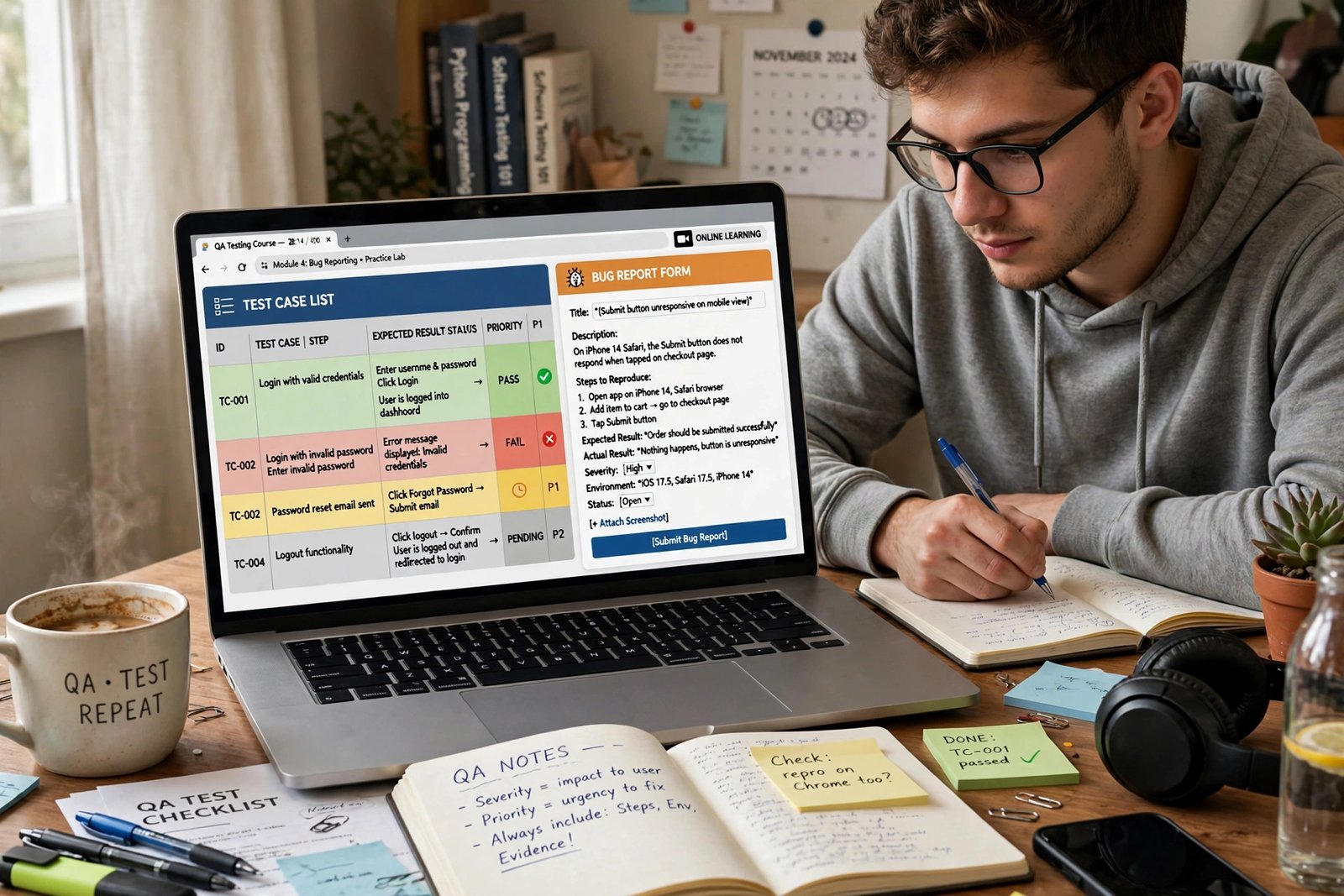
Next, learn to write a test case. A test case is a written check with four parts: what you will do, what you expect to happen, what actually happened, and whether it passed or failed. For example, a test case for a log in form might say: enter a correct email and password, expect the user to reach the home screen, and record the result.
Then learn to write a bug report. A bug report has five parts: a clear title, the steps to reproduce the bug, what you expected, what actually happened, and the environment, which means the device, browser, and app version. A good bug report lets a developer reproduce the bug in minutes.
Learn the common types of testing too. Functional testing checks that a feature does what it should. Usability testing checks that it is easy to use. Regression testing checks that a new change did not break old features.
Step 2: Learn test design techniques
Test design techniques are methods for choosing which tests to write. They help you find bugs with fewer tests.
Equivalence partitioning means grouping inputs that should behave the same way, then testing one from each group. For example, an age field that accepts ages 18 to 65 has three groups: under 18, 18 to 65, and over 65. Test one value from each group.
Boundary value analysis means testing the edges of each group. For the same age field, test 17, 18, 65, and 66. Bugs love edges, because that is where developers make off by one errors, which is a mistake where the code allows one value too many or too few.
Decision tables help when a feature has several conditions. A discount that depends on membership and order value has four combinations: member or non member, with a big or small order. A decision table lists all four and the expected result for each.
State transition testing checks how an app moves between states. A shopping cart moves from empty to full to checked out. Test each move, and test the wrong moves too, such as checking out with an empty cart.
Step 3: Practise on real practice sites
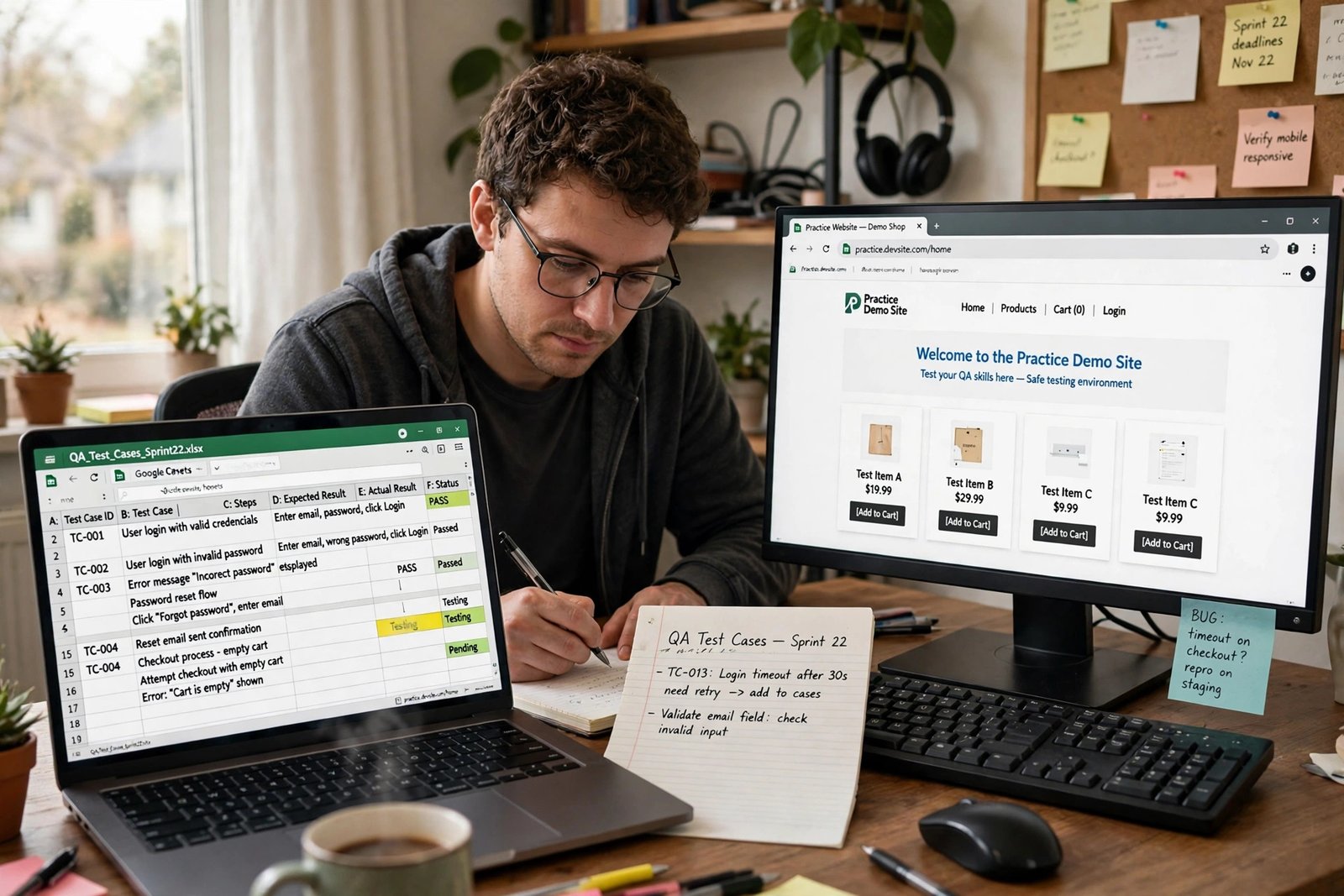
Practise on sites built for testers if you want to learn QA testing online. Never test a live site or app without permission, because that can break real data and real users.
| Practice site | What it teaches | Cost |
|---|---|---|
| Sauce Demo | Log in, shopping cart, and checkout flows | Free |
| Test Pages | Forms, tables, and common web elements | Free |
| API Challenges | API testing with real endpoints | Free |
Start with Sauce Demo. Write 10 test cases for its log in page and checkout flow, run them, and write a bug report for anything odd you find.
Aim to write 5 real bug reports on practice sites before you move to automation. Keep your best bug reports and test cases in a folder, and show them when you apply for work.
Learn the tools testers use every day. Jira is the main tool for tracking bugs and tasks: learn to create a bug ticket, set its priority, and move it through the workflow from open to fixed to verified. Postman is the main tool for API testing, and it appears in Step 4. Learn basic SQL too, because testers often check data in a database. You only need the basics: select, filter, and count.
Step 4: Learn API testing
An API, which stands for application programming interface, is the way two pieces of software talk to each other. When an app shows your bank balance, it asks the bank API for the number.
Learn Postman, which is the standard free tool for API testing. In Postman, you send a request to an API and you check the response. The response has a status code, which is a number that says what happened: 200 means success, 404 means not found, and 500 means a server error. Learn these three codes first.
Practise on the API Challenges site, which gives you a free API to test. Write test cases for each endpoint, which is one address in the API. Check that a correct request returns the right data, that a wrong request returns a clear error, and that a request with no login is refused.
API testing is a skill that employers value, because many modern apps are built on APIs. A tester who can test both the screen and the API is more useful.
Step 5: Learn automation, one tool at a time
Automation testing means writing scripts that run checks for you. It saves time on checks that run often, such as log in and checkout. It does not replace manual testing, because a script can only check what you told it to check.
Pick one automation tool and learn it well, because depth beats breadth when you learn QA testing online. The choice depends on the programming language you want to use.
| Tool | Language | Best for | Learning curve |
|---|---|---|---|
| Selenium | Java, Python, C#, and more | Older web apps, large test suites | Steep |
| Playwright | JavaScript, TypeScript, Python, and more | Modern web apps, fast and reliable | Medium |
| Cypress | JavaScript and TypeScript | Modern web apps, easy setup | Medium |
If you know no coding yet, start with Playwright and JavaScript, because JavaScript is the most common language in web testing. If you already know Python, Selenium with Python is a solid choice. Learn the basics of the language first, then learn the tool.
Learn in this order: write one script that opens a page and checks the title, then one that logs in, then one that adds a product to a cart and checks the total. Keep each script short and focused.
Also learn the basics of a CI pipeline, which is a system that runs your tests automatically when code changes. GitHub Actions is the simplest place to start, because it is free for small projects and it is built into GitHub.

Step 6: Prepare for ISTQB Foundation, optional
ISTQB, which stands for the International Software Testing Qualifications Board, offers the best known QA certificate. The Foundation Level, called CTFL, is the entry level exam, and it covers testing principles, the test process, static testing, test design techniques, test management, and tool support. The syllabus is version 4.0, and it is free to download.
The exam has 40 multiple choice questions, lasts 60 minutes, or 75 minutes if English is not your first language, and needs a 65 percent pass mark. There are no prerequisites, so anyone can sit the exam.
The fee depends on your country and the board you book through. In the US, the exam costs 229 US dollars through AT*SQA, the official exam provider for the American board, ASTQB. The ASTQB 2026 price list also lists 249 US dollars for advanced exams and 199 US dollars for specialist exams. In other countries the fee differs: for example, the UK fee is listed at 200 pounds plus VAT. Check the ASTQB exam prices page and your own national board before you book. The ISTQB exam cost page also lists fees by country.
Is the certificate worth it? It helps for junior roles, because it shows you know the standard terms and methods. It does not prove you can test well, and it does not replace practice. A good plan is to study the syllabus for free, practise on real sites, and take the exam only when you are ready to apply for jobs.
8-week study plan
Study for 1 to 2 hours a day, five days a week.
| Week | What to study | What to practise |
|---|---|---|
| 1 | Testing basics, life cycle, test cases | Write 10 test cases for Sauce Demo |
| 2 | Test design techniques | Apply equivalence partitioning and boundary values |
| 3 | Bug reports and Jira | Write 5 bug reports, file them in Jira |
| 4 | Practice sites, forms and tables | Test the Test Pages site, 10 new test cases |
| 5 | SQL basics and data checks | Write 10 SQL queries against a practice database |
| 6 | API testing with Postman | Test the API Challenges endpoints |
| 7 | First automated test | Write one Playwright or Selenium script |
| 8 | Portfolio and interview practice | Tidy your test cases, bug reports, and scripts |
By the end of week 8 you should have a small portfolio: 20 or more test cases, 5 bug reports, a few API tests, and one automated script.
Free vs paid routes
| Route | Cost | Best for | Notes |
|---|---|---|---|
| Free route | 0 dollars | Most beginners | freeCodeCamp, Test Automation University, Guru99, practice sites |
| Paid course route | 15 to 300 US dollars | Structured learning | Udemy bootcamps, Coursera specialisations |
| ISTQB exam | 229 US dollars in the US | A recognised certificate | Fee differs by country, check your national board |
The free route is strong for QA testing. The freeCodeCamp Quality Assurance Certification takes about 300 hours, is free, and covers testing with Chai and Node, with five projects. Test Automation University offers free courses, and Guru99 offers free tutorials on manual testing.
Paid courses help when you want a set order and feedback. Udemy offers a complete software testing bootcamp with high ratings and many students, and Coursera offers a software testing specialisation. Check the ratings and the last update date before you pay.
Example only: a bug report and a test case, with the details shown
This example uses made up details. It is an example only.
A test case for a log in form might read: Test case 1, log in with a correct email and password. Steps: open the log in page, enter test@example.com, enter the password Test1234, click Log in. Expected result: the user reaches the home screen and sees a welcome message. Status: pass.
A bug report for the same form might read: Title: Log in button does nothing when the password field is empty. Steps to reproduce: open the log in page, enter test@example.com, leave the password blank, click Log in. Expected result: a clear error message that says the password is required. Actual result: nothing happens, and no error appears. Environment: Chrome on Windows 11, app version 2.4.1.
Notice how both documents are short, specific, and easy to follow. A developer reading the bug report can reproduce the bug in under a minute.
What it costs to learn QA testing online and what to expect
| Item | Typical cost | Notes |
|---|---|---|
| Free courses and practice sites | 0 dollars | freeCodeCamp, Test Automation University, Guru99 |
| A paid Udemy or Coursera course | 15 to 300 US dollars | Sale prices change often, check before you pay |
| ISTQB Foundation exam | 229 US dollars in the US | Fee differs by country, check your national board |
| Test tools | 0 dollars | Postman, Playwright, Selenium, and Jira all have free plans |
| Total to learn the basics | 0 to 300 US dollars | Most learners spend under 100 US dollars |
Expect a slow start. Most beginners need 2 to 3 months to learn manual testing well enough for a junior role. Automation takes longer, because it needs basic coding too. Plan for 3 to 6 months from first lesson to job ready.
AI tools are changing QA work. AI can now draft test cases and run simple checks, which puts pressure on purely manual roles.
Common mistakes
- Do not jump to automation before you learn manual testing, because you cannot automate what you do not understand.
- Do not write vague bug reports, because a developer cannot fix a bug they cannot reproduce.
- Do not test only the happy path, because bugs hide in error cases and edge cases.
- Do not test a live site without permission, because you can break real data and real users.
- Do not learn three automation tools at once, because you will mix up their commands.
- Do not skip SQL, because many testing jobs need basic data checks.
- Do not pay for an expensive bootcamp before you try the free route, because you may not enjoy the work.
- Do not ignore the ISTQB syllabus, because it teaches the standard terms employers use.
Risks and scams to watch for
Paid QA courses attract the same scams as other online courses. Check before you pay. A real course names its teacher, shows a full syllabus, and lets you see sample lessons. A fake course hides the teacher and pressures you to pay today.
Watch for these warning signs. The course promises a guaranteed job or a set income. The price is only shown after a sales call. The certificate is called accredited but no accrediting body is named. The seller asks for payment by bank transfer or gift card.
Job scams also target QA beginners. A real employer never asks you to pay for a job, a training course, or equipment before you start. A real employer never asks for your bank details, your password, or a copy of your ID in the first message.
Frequently asked questions
Can I learn QA testing without coding?
Yes, for manual testing. Manual testing needs logic, detail, and clear writing, not code. Automation testing needs basic coding.
How long does it take to become a software tester?
Manual testing takes 2 to 3 months of steady study. Automation adds another 2 to 3 months, because it needs basic coding.
Is ISTQB certification worth it?
It can help for junior roles, because it shows you know the standard terms and methods. It does not prove you can test well, and it does not replace practice. Study the free syllabus first, and take the exam when you are ready to apply for jobs.
Do I need a degree for QA testing?
No. Most QA roles ask for a certificate or proven practice, not a degree. Employers care more about your test cases, bug reports, and portfolio than about a university qualification.
Should I learn manual or automation testing first?
Learn manual testing first. It teaches you how to think like a tester and how to write clear bug reports. Automation builds on those skills.
Which automation tool should I learn first?
Pick by language. Learn Playwright with JavaScript if you are new to coding, because it is modern and fast growing. Learn Selenium with Python if you already know Python.
Conclusion
To learn QA testing online, start with manual testing, learn test design techniques, practise on free practice sites, then add API testing and automation one tool at a time. Follow the 8 week plan, build a small portfolio, and consider the ISTQB Foundation exam when you are ready to apply for jobs.
To go further, read how to learn coding for beginners to add the coding you need for automation, how to learn web development online for the web basics testers need, and how to find remote software developer jobs to see the wider tech jobs market, then browse the full Digital Skills category for more guides. The facts in this guide were checked against ASTQB, ISTQB, and freeCodeCamp in November 2026, and exam fees are stated as of November 2026.
Note for the reader: exam fees are in US dollars for the US route unless stated otherwise, and fees differ by country, so check your national board before you book. Earning results vary; nothing on this site is financial advice.