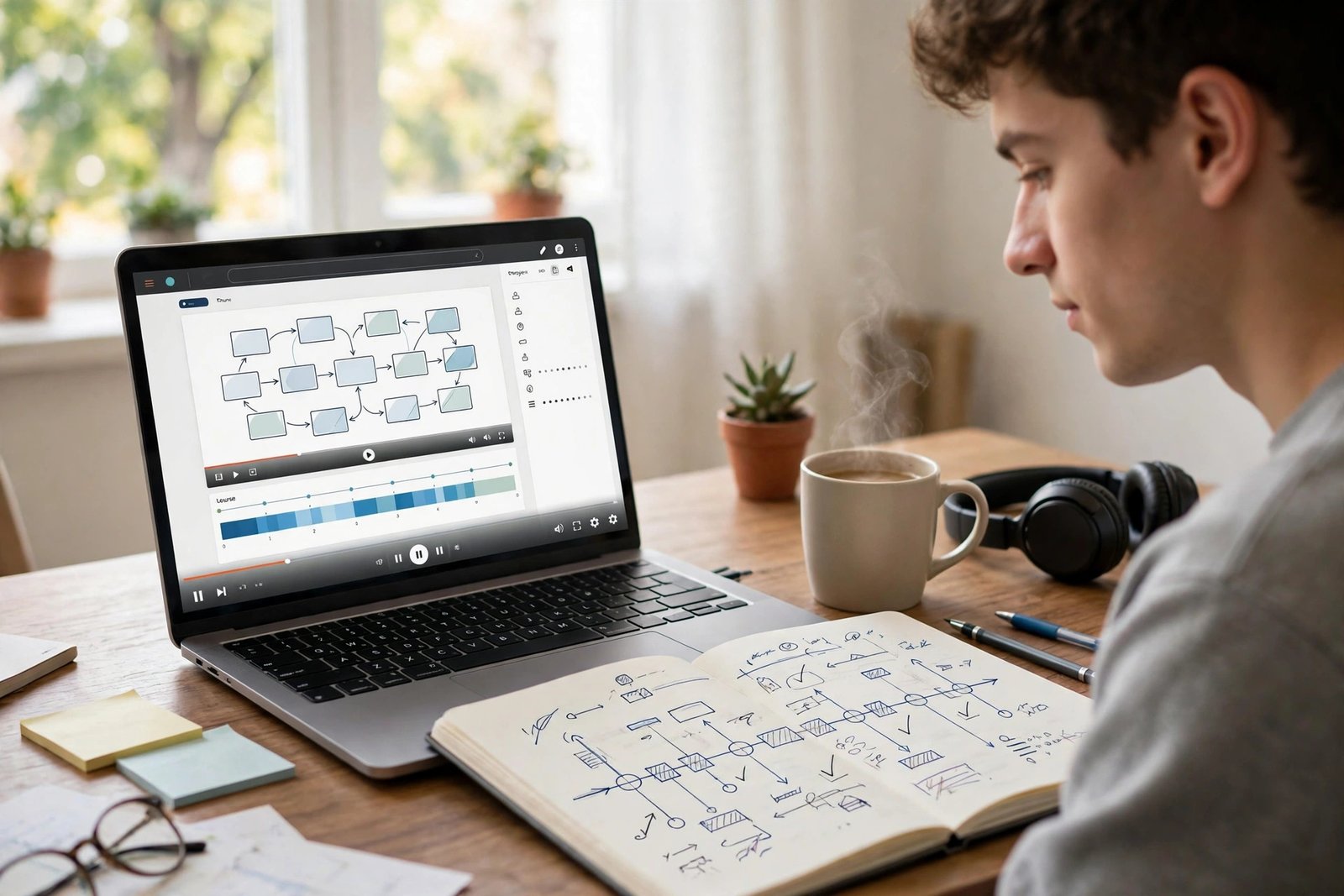
Learning how to learn project management online is a practical goal, because the best starting material is free and you do not need a degree to begin. Project management is the skill of planning work, guiding a team, and finishing a project on time and within budget. This guide gives you a free-first learning path, a course comparison, and a 90-day plan.
In this guide
- What project management is, in plain words
- Step 1: Learn the project lifecycle
- Step 2: Learn Agile and Waterfall
- Step 3: Take one structured free course
- Step 4: Learn one project tool properly
- Step 5: Run a practice project
- Step 6: Prepare for the CAPM certification
- Which course should you choose?
- Your 90-day plan
- Worked example: a realistic first 90 days
- What it costs and what to expect
- Common mistakes
- Risks and scams to watch for
- Frequently asked questions
What is project management, in plain words?
Project management is the work of taking a goal and turning it into a finished result. A project is a piece of work with a clear start, a clear end, and a clear result, such as launching a website, organising an event, or building an app. A project manager plans the work, assigns tasks, tracks progress, handles risks, and talks to everyone involved.
The field is defined by the Project Management Body of Knowledge, known as the PMBOK, which is written by the Project Management Institute, known as PMI. You do not need to read the whole PMBOK to start. You need its core ideas: scope, which is what the project includes; schedule, which is when each part happens; cost, which is what it costs; quality, which is how good the result must be; and risk, which is what could go wrong.
Project management is a versatile skill. Project managers work in almost every industry, from software to construction to healthcare. It is also a skill you can use as a freelancer or a consultant. If you want the job side, read how to work as a remote project manager. This guide is about learning the skill itself.
Step 1: Learn the project lifecycle
Every project follows the same five stages, known as the project lifecycle. Learn them in order.
- Initiation. Define the goal, the result, and who is involved. Write one short paragraph that says what success looks like.
- Planning. Break the work into tasks, put them in order, set dates, and list the risks.
- Execution. Do the work, assign tasks, and keep the team moving. This is the longest stage.
- Monitoring. Check progress against the plan every week, and fix the gap early.
- Closure. Finish the work, check the result against the goal, and write down what you learned.
PMI publishes a free introductory guide to these ideas, and it is a good first read. Learn the vocabulary as you go: a stakeholder is anyone affected by the project; a milestone is a key date; a deliverable is a finished piece of work; scope creep is when extra work sneaks in without a decision.
Step 2: Learn Agile and Waterfall
Agile and Waterfall are the two main ways to run a project. Most real projects use a mix of both.
| Method | How it works | Best for | Watch out for |
|---|---|---|---|
| Waterfall | Plan everything first, then build it step by step in order | Projects with a fixed result, such as construction or a legal process | Changes late in the project are slow and costly |
| Agile | Work in short cycles called sprints, and adjust after each one | Software and creative work where needs change often | Needs a team that talks often and honestly |
| Scrum | An Agile framework with fixed roles, events and lists | Teams that want a clear weekly rhythm | Only works if the team follows the events properly |
| Kanban | A board that shows work moving from to do, to doing, to done | Support teams and work that arrives in a steady flow | Easy to start, easy to let slip without limits |
| Hybrid | Waterfall planning with Agile delivery, or the reverse | Most real projects | Needs judgement about which part uses which method |
Learn Scrum properly, because most job listings mention it. The official Scrum Guide is free, short, and written by the people who created Scrum. It defines three roles: the product owner, the Scrum master, and the developers. It also defines the events: the sprint, the daily stand-up, the sprint review, and the retrospective.
For Waterfall, learn the Gantt chart, a bar chart that shows tasks on a timeline. It is the simplest way to see what depends on what.
Step 3: Take one structured free course
One good course beats ten half-finished ones. Pick a single course and finish it.
- Google Project Management Professional Certificate on Coursera. This is a seven-course programme built by Google. It covers traditional and Agile methods, project documentation, and stakeholder management. It takes under six months at under ten hours a week, and most learners finish for under 300 US dollars, because Coursera charges about 49 US dollars a month after a seven-day free trial in the US and Canada. It also gives you over 100 hours of project management education, which helps prepare you for the CAPM exam. Check the Coursera certificate page for the current price in your country.
- Introduction to Project Management on edX. A free course from the University of Adelaide, about six weeks at two to three hours a week. Audit it for free, and pay only for a verified certificate.
- Agile Project Management on Coursera. A focused course on Agile methods, useful after you have the basics. It can be audited for free.
- PMI's free introductory guides. Short, plain-language guides that explain scope, schedule, cost, quality and risk. Read these first if a full course feels too big.
While you take the course, do every exercise. Project management is a doing skill, and watching videos without practising is the fastest way to forget it.
Step 4: Learn one project tool properly
Learn one tool deeply rather than five tools badly. The free tiers of the main tools are enough for learning.
| Tool | Free tier | Best for | Notes |
|---|---|---|---|
| Trello | Free for basic boards | Simple Kanban boards and small projects | Easy to learn, limited reporting |
| Asana | Free for small teams | Task lists, timelines, and team work | Good free plan for practice projects |
| ClickUp | Free for basic use | All-in-one boards, docs and goals | Powerful, but the settings can confuse beginners |
| Jira | Free for small teams | Software teams using Scrum or Kanban | The industry standard for Agile software work |
Pick the tool that matches the work you want to do. Trello or Asana is the best first choice for most beginners. Learn to build a board, add tasks with dates and owners, set dependencies, and run a weekly review. If you want a role that uses Jira, learn that one instead.

Step 5: Run a practice project
Theory evaporates without practice. Run a small project from start to finish, using the lifecycle from Step 1 and the tool from Step 4.
Run it like this:
- Write the goal in one paragraph. Say what success looks like and when it is due.
- Break it into tasks. Aim for 20 to 40 tasks, each small enough to finish in a day or less.
- Put the tasks in order. Mark which tasks depend on others, and find the critical path, the longest chain that sets the finish date.
- Assign owners and dates. Even if the team is imaginary, assign each task to a person and a date. This is the habit that matters.
- Hold a weekly review. Every week, check what is done, what is late, and what changed. Write the update as if you were sending it to a real manager.
- Close it properly. When the project ends, write a one-page review: what worked, what did not, and what you would do differently.
Then volunteer for a tiny real project. A local charity, a student society, or an open-source project will often let a beginner coordinate a small piece of work. One real project teaches more than ten practice ones, and it gives you a story to tell in interviews.
Step 6: Prepare for the CAPM certification
The Certified Associate in Project Management, known as the CAPM, is PMI's entry-level certification and the right first credential for a beginner.
The facts, from the official PMI CAPM page: the exam has 150 questions and lasts 180 minutes, and it is available in English and several other languages. To sit the exam you need formal project management education, and training providers state the requirement as 23 hours. The Google certificate gives you over 100 hours, which covers that requirement. Check the current exam fee and eligibility rules on the PMI page before you book, because both change.
Prepare like this:
- Finish one structured course first. The Google certificate or the edX course both cover the material.
- Read the free Scrum Guide. Scrum questions appear on the exam, and the guide is short.
- Use practice questions. Free sample tests train your decision-making and show which topics are weak.
- Book the exam only when you are ready. A failed attempt costs money and confidence.
The CAPM is a starting point, not a finish line. The next step is the PMP, which needs real project experience as well as study. Do not rush to it.

Which course should you choose?
Start free, then pay only for a credential you actually need.
| Route | Cost | Best for | Watch out for |
|---|---|---|---|
| PMI free introductory guides | Free | A fast start in plain language | Thin, so pair it with a course |
| edX Introduction to Project Management | Free to audit | University teaching at no cost | Pay only if you want a verified certificate |
| Google Project Management certificate on Coursera | About 49 US dollars a month | A career credential and CAPM preparation | Takes under six months, so it is a real commitment |
| Udemy project management courses | Usually a low price on sale | Short, practical courses on single topics | Check the teacher and the update date |
| LinkedIn Learning project management courses | Included with a subscription | Short courses that show on your LinkedIn profile | Less useful if you only want this one topic |
The most common path that works is the free PMI guides first, then the Google certificate on Coursera, then CAPM preparation. That combination gives you the knowledge, the credential, and the exam preparation in one line.
Your 90-day plan
This plan assumes five to seven hours a week. Keep the order, and adjust the hours to your life.
| Weeks | Focus | What you will have |
|---|---|---|
| 1 to 2 | Project lifecycle, PMI free guides, key vocabulary | A one-page summary of the five stages |
| 3 to 4 | Agile and Waterfall, Scrum Guide, Gantt chart basics | A comparison table in your own words |
| 5 to 8 | One structured course, one tool learned properly | A course in progress and a working board |
| 9 to 10 | Run a practice project with 20 to 40 tasks | A finished practice project and a weekly review habit |
| 11 to 12 | CAPM preparation, practice questions, volunteer project search | A study plan and one volunteer application sent |
Worked example: a realistic first 90 days
Example only: these numbers are not typical results. They show the time and the maths, not what you will earn.
Ayesha is a complete beginner with six hours a week. She follows the plan above.
- Weeks 1 to 4: 24 hours. She reads the PMI free guides, reads the Scrum Guide, and learns the lifecycle and the key terms.
- Weeks 5 to 8: 24 hours. She starts the Google certificate on Coursera, learns Trello, and builds a board for a practice project.
- Weeks 9 to 10: 12 hours. She runs a practice project: organising a small online workshop for a student society, with 28 tasks, a Gantt chart, and two weekly reviews.
- Weeks 11 to 12: 12 hours. She starts CAPM practice questions and applies to coordinate a small volunteer project for a local charity.
- Total learning time: 72 hours over 90 days. Total money spent: about 49 US dollars for one month of Coursera, and 0 on anything else.
At the end she has a course in progress, one finished practice project, one volunteer application, and a clear path to the CAPM exam. She has not earned anything yet. That is normal. The next step is the volunteer project and the CAPM exam. For the job side, read how to work as a remote project manager.
What it costs and what to expect
| Item | Typical cost | Notes |
|---|---|---|
| PMI free guides and Scrum Guide | Free | The best starting material costs nothing |
| edX course (audit mode) | Free | Pay only for a verified certificate |
| Google certificate on Coursera | About 49 US dollars a month | Under six months, so most learners pay under 300 US dollars |
| Udemy short course | Usually a low price on sale | Optional, and only for a single topic |
| CAPM exam fee | Check the PMI page | Fees change, so confirm before you book |
| Total to get started | 0 | Everything in the first month can be free |
Expect a solid foundation in eight to twelve weeks of consistent part-time study, at five to seven hours a week. After three months you can comfortably manage small projects. Deep expertise takes years, but the free path gets you to entry-level readiness fast. Do not expect income in the first month. Project management pays when you can show finished projects and a credential. Results vary with experience, the industry, and the country you work in.
Common mistakes
- Hoarding certificates over real practice. Recruiters care about how you apply knowledge. After every course module, recreate the concept in your practice project.
- Ignoring the soft skills. Project management is mostly communication. Practise writing clear status updates and explaining a delay honestly. These skills matter more than any tool.
- Sticking to one method too early. Many new project managers fall in love with Scrum and skip everything else. Plan one small project in Waterfall, one in Kanban, and one in a blended model.
- Failing to simulate constraints. Free learning removes pressure, but real projects have budgets, fixed dates, and difficult stakeholders. Impose limits on your practice project, such as finishing 30 tasks in ten days with only three imaginary team members.
- Not seeking feedback. Upload a short video of your project plan to a project management community and ask for a two-minute review. One piece of real critique is worth hours of solitary study.
- Learning tools instead of thinking. A tool organises the work, but it does not decide what the work is. Learn the lifecycle first, then the tool.
Risks and scams to watch for
- Paid certificates with no recognised value. Some sellers charge for a certificate that no employer asks for. Check whether real job listings mention it before you pay. The CAPM and PMP are the recognised ones.
- Courses that promise a job. No course can promise you a job. A certificate plus a practice project is a strong start, but hiring depends on the employer and the market, not on the course alone.
- Fake PMI exam dumps. Some sellers offer "real exam questions" for the CAPM or PMP. These are against PMI's rules, and using them can get your result cancelled. Use official practice material instead.
- Bootcamps with inflated prices. Some bootcamps charge thousands for material that is free on Coursera and edX. Compare the syllabus with the free options before you pay.
- Unpaid work that never ends. Volunteering for one small project is good experience. Working for free for months with no learning and no reference is not. Set a clear end date before you start.
Frequently asked questions
Can I learn project management online for free?
Yes. PMI's free guides, the Scrum Guide, and the audit mode of the edX and Coursera courses all cost nothing. The only costs come later.
How long does it take to learn project management?
For a solid foundation, plan eight to twelve weeks of consistent part-time study, at five to seven hours a week. After three months you can comfortably manage small projects. Deep expertise takes years.
Do I need a degree to become a project manager?
No. Employers care about demonstrated skill: finished projects, a credential such as the CAPM, and the ability to communicate clearly. A degree can help for some roles, but it is not required.
Which project management certification should I get first?
The CAPM is the right first certification for a beginner. It is PMI's entry-level credential, the exam has 150 questions over 180 minutes, and it needs formal project management education, which the Google certificate covers.
Is project management hard to learn?
The ideas are simple, and the practice is where the difficulty lies. Planning is easy on paper and hard with real people, real deadlines, and real changes.
Conclusion
Learning project management online comes down to a clear order: learn the five stages of the project lifecycle, understand Agile and Waterfall, take one structured free course, learn one tool properly, run a practice project, then prepare for the CAPM exam. Start free and practise on real work.
Next, read how to work as a remote project manager, how to learn digital marketing online, and how to learn data analysis online. Then browse all digital skills guides to plan your next step.
Reader note: course, exam and price details were checked on 14 November 2026 against the official PMI CAPM page, the official Scrum Guide, and the Coursera certificate page. Exam fees and eligibility rules change, so confirm them on the PMI page before you book. Tax and work rules differ by country, so check your local rules and a qualified accountant. Earning results vary; nothing on this site is financial advice.