How to Get Backlinks for a Blog in 2026
A backlink is a link from another website to your blog. Search engines treat backlinks as votes of trust, but not all votes count equally. One link from a real, relevant site that readers trust can help more than dozens of links from low quality sites. Learning how to get backlinks for a blog, honestly and without paying for risky links, is therefore a long term skill, not a quick trick.
This guide gives you a blogger specific playbook. You will learn the three routes to links, how to claim links you are already owed, five free methods that still work, how to find prospects without paid tools, short outreach templates, how to judge a prospect site, what to avoid under Google's spam policy, and a realistic 90 day plan.
In this guide
- What a backlink is, and why quality beats quantity
- The three routes: earn, ask, and pay
- First, claim the links you are already owed
- Build one linkable asset before you pitch anything
- Five free methods that still work
- How to find prospects with free search operators
- Three short outreach templates, and follow-up rules
- How to qualify a prospect site in two minutes
- What to avoid: paid followed links, PBNs, and bulk packages
- A 90 day starter plan, and realistic expectations
- Frequently asked questions
What a backlink is, and why quality beats quantity
When another site links to your post, readers can click through to you, and search engines see a signal that your post may be worth showing. That signal is stronger when the linking site is real, topically relevant, and itself trusted. A link from a respected food blog to your food post counts more than a link from an unrelated directory that links to everyone.
A linkable page is a page worth linking to, such as an original guide, a useful template, or a clear checklist. A thin post that repeats what ten other posts say gives other sites no reason to link, so link building starts with content, not outreach.
The three routes: earn, ask, and pay
There are three routes to backlinks. Earning means creating something so useful that other sites link to it without being asked. Asking means contacting a site owner with a helpful suggestion, such as adding your guide to a resource page, or offering a guest post. Paying means giving money, a free product, or another favour in exchange for a link.
For a new blogger, earn and ask are the right routes. Earning is free, but slow. Asking is faster, but needs good content and polite emails. Paying needs care, because Google's spam policy treats paid links that pass ranking credit as link spam, unless they use sponsored or nofollow attributes. A sponsored link is a link marked as paid. A nofollow link is a link marked so search engines do not follow it for ranking. If a site offers you a paid followed link, which is a link that passes ranking credit without a sponsored or nofollow mark, that is risky, and this guide recommends against it. Paid links are covered honestly later, but they are not the starting plan for a new blog.
First, claim the links you are already owed
Before you pitch strangers, claim easy links you may already deserve. Search for your blog name, your post titles, and your unique phrases, with and without quotes. You may find sites that mention your blog without linking, or sites that link to an old URL that no longer works.
For an unlinked mention, send a short, friendly email. Thank the writer for the mention, and ask if they would add a link so their readers can find the post. Many writers say yes, because the link helps their readers too. For a broken link, check whether the linked URL moved. If it did, ask the site owner to update the link to the current address, and offer the correct URL in your email so the fix takes seconds.
Build one linkable asset before you pitch anything
A linkable asset is a page designed to earn links. For a blogger, good assets include an original checklist, a template, a step by step guide that is clearly better than the current top results, or a small original study, such as a survey of your readers or a summary of data you collected yourself. Do not invent data. If you run a survey, say how many people replied, and show the method plainly.
Pick one asset and make it excellent before you start outreach. It should answer one question fully, be easy to scan, and include something other pages lack, such as a printable checklist, a worked example, or a clear comparison table. That asset becomes the page you pitch in most emails, because it gives the other site a clear reason to link. For help choosing a topic readers actually search for, read how to do keyword research for a blog.
Five free methods that still work
Resource page outreach. A resource page is a page that lists useful links on one topic. Find resource pages in your niche, check that your asset genuinely fits, and email the owner with a short suggestion. Mention the exact page, explain in one sentence why your asset helps their readers, and give the exact URL.
Broken link building. Find a page in your niche with a link that no longer works, and offer your post as a replacement, but only if your post truly replaces what the broken link pointed to. Check the old page topic through an archive or a search, so you do not pitch an unrelated post. This method works because you help the site owner fix a problem, not just because you want a link.
Guest posting done well. A guest post is an article you write for another blog, with a link back to your site in the author bio or body. Pitch only blogs you actually read, with a topic that fits their readers. Write it to the same standard as your own posts.
Journalist and expert requests. Journalists and writers sometimes ask for expert quotes or examples. Free request services and social media hashtags for press requests can connect you with writers who need a quote. Reply only when you truly know the topic, give a short, quotable answer, and include your blog link in your signature or bio, not forced into the quote. A single quote in a respected article can bring a strong link, but it needs real expertise, not a generic reply.
| Method | Effort | Speed | Best for a new blog |
|---|---|---|---|
| Unlinked mention reclamation | Low | Fast | Blogs that already get mentioned |
| Resource page outreach | Medium | Weeks | A strong guide or checklist |
| Broken link building | Medium | Weeks | A post that replaces a dead resource |
| Guest posting | High | Weeks to months | Bloggers who enjoy writing for others |
| Journalist requests | Low per reply, but needs expertise | Days to weeks | Bloggers with real experience on a topic |
How to find prospects with free search operators
You do not need a paid backlink tool to find prospects. Use search operators, which are special search commands. For resource pages, search for your topic plus "resources", "useful links", or "helpful guides". For broken links, search for your topic plus "resources" and check each page for dead links by clicking through. For guest post chances, search for your topic plus "write for us" or "guest post", but read each blog first, because many such pages accept low quality posts and link to everyone, which is a warning sign.

Three short outreach templates, and follow-up rules
Keep every outreach email under 120 words, and personalise the first line. A generic email that could go to anyone will be ignored. State the exact page, the exact benefit to their readers, and the exact URL. Do not praise the site in vague terms. Show that you read it, by naming one specific post or section.
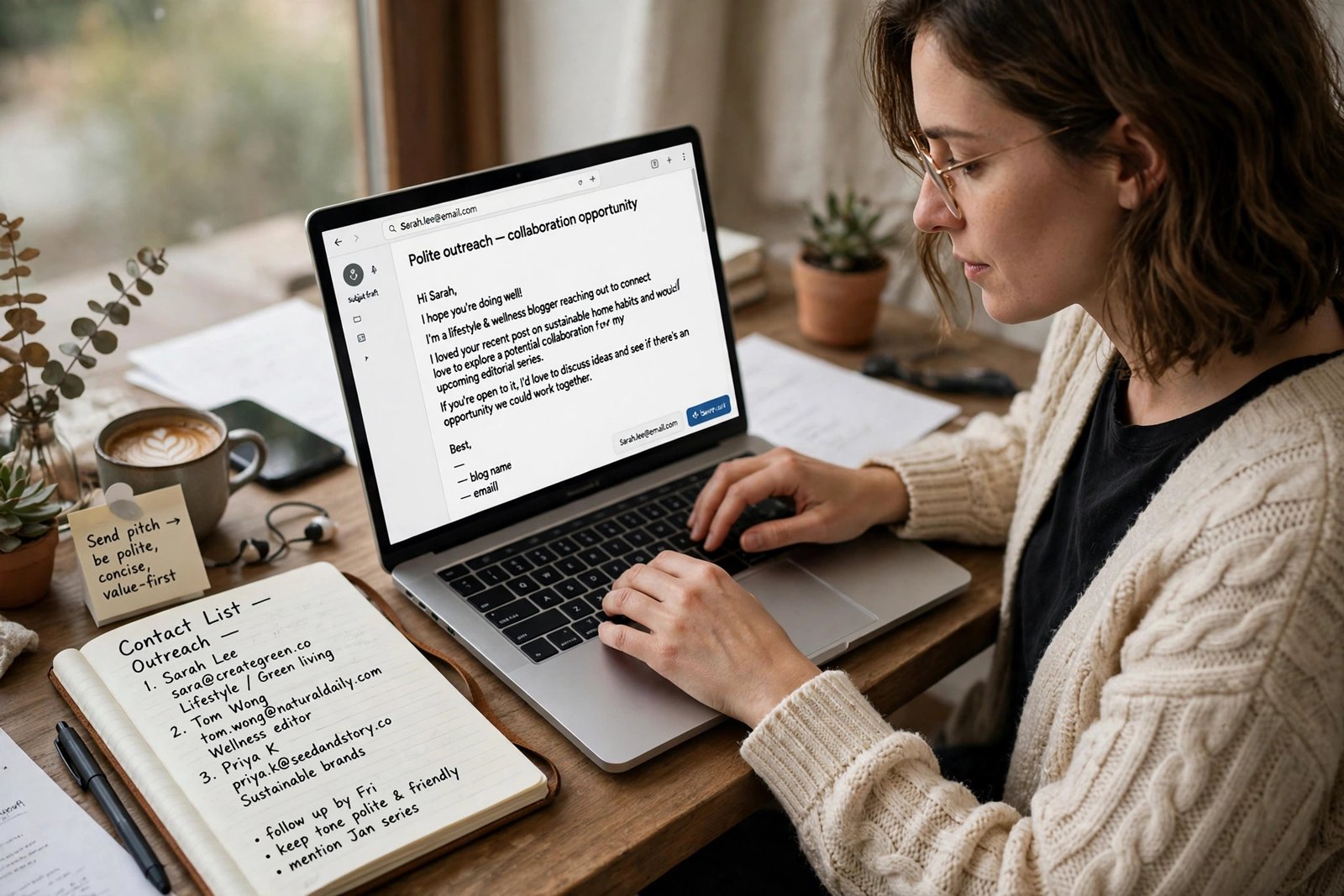
Resource page pitch. Subject: A resource suggestion for your [topic] page. Body: Hello [name], I read your [page title] page, and your section on [specific section] helped me. I recently published [asset title], which covers [one sentence on what it adds]. Would you consider adding it here: [URL]? Thank you for considering it. [Your name], [blog name].
Broken link pitch. Subject: A broken link on your [topic] page. Body: Hello [name], I was reading your [page title] page and noticed the link to [old resource] no longer works. I recently published [asset title], which covers [one sentence on the same topic]. It may work as a replacement: [URL]. Thank you for your time. [Your name], [blog name].
Guest post pitch. Subject: A guest post idea for [blog name]. Body: Hello [name], I enjoy your posts on [specific topic], especially [specific post]. I would like to offer a guest post titled [working title], which would cover [two short bullet points in sentence form]. I write at [blog name], where I cover [topic]. Would that fit your readers? Thank you. [Your name].
Follow up once, after seven to ten days, with a short reminder that adds nothing new except politeness. If there is no reply after that, move on. Do not send a third email, do not follow up on social media with pressure, and do not pitch the same site again for at least three months, with a different, better idea.
How to qualify a prospect site in two minutes
Before you pitch, check four things: is the site real, with recent posts and a sensible about page; is it topically relevant; does it link out normally to useful sources, rather than to hundreds of unrelated sites; and does it show real engagement, such as comments and shares. If a site fails two of these checks, skip it.
What to avoid: paid followed links, PBNs, and bulk packages
A PBN, or private blog network, is a group of sites built mainly to sell links, not to serve readers. Links from a PBN may help briefly, but they can harm your blog if search engines detect the network. Bulk link packages, which promise dozens or hundreds of links for a fixed price, almost always use low quality sites, automated tools, or PBNs. Avoid them, even when the sales page shows impressive numbers.
Automated outreach tools that send thousands of identical emails also harm your reputation. A site owner who receives a generic pitch will remember your blog name, and not in a good way. Excessive link swaps, where two sites agree to link to each other repeatedly, also look unnatural. A pattern of swaps for ranking is not.
If you ever pay for exposure, such as a sponsored post, the link must carry the sponsored or nofollow attribute, so it does not pass ranking credit. Never pay for a followed link meant to pass ranking credit, because a penalty can remove your blog from search results until bad links are cleaned up. Check Google's official spam policy guidance before you agree to any paid placement.

A 90 day starter plan, and realistic expectations
| Phase | Days | Main tasks |
|---|---|---|
| Claim and build | 1 to 14 | Claim unlinked mentions, fix broken links, build one linkable asset |
| Pitch | 15 to 45 | Build a prospect list of 20 to 30 sites, send five to ten pitches per week |
| Write and follow up | 46 to 90 | Write accepted guest posts, follow up once, start a second asset |
Expect slow, uneven results. Many pitches get no reply, and that is normal. A realistic goal for a new blog is a handful of relevant links in 90 days, not dozens. Links help rankings over months, not days. For more on the content side, read how to grow blog traffic and how to write blog posts that rank on Google.
Common mistakes
- Pitching before you have a page worth linking to, so every reply is a polite no.
- Sending generic outreach emails that show you never read the target site.
- Chasing link counts instead of relevance, trust, and real reader value.
- Buying bulk link packages or PBN links that risk a search penalty.
- Paying for followed links, instead of using sponsored or nofollow marks for paid placements.
- Following up repeatedly after a no reply, which harms your reputation.
- Ignoring internal links, which you control fully, while chasing external links you do not control.
Frequently asked questions
How do I get backlinks for my blog?
Create a page worth linking to, claim unlinked mentions, then pitch resource pages, broken link replacements, and guest posts with short, personalised emails. Focus on relevance and trust, not on link counts, and expect slow, steady progress over months.
What is the easiest way to get backlinks?
The easiest honest method is unlinked mention reclamation, because the site already mentioned you and only needs to add a link. After that, resource page outreach for a strong guide is the next easiest, because you help the site owner improve a page they already maintain.
Are paid backlinks safe?
Paid links are safe only when they are marked with the sponsored or nofollow attribute, so they do not pass ranking credit. Paid followed links, bulk packages, and PBN links are risky under Google's spam policy, and they can lead to a penalty that removes your blog from search results. When in doubt, do not pay for a followed link.
How long does it take to get backlinks?
A first link can arrive in days, from an unlinked mention, or in weeks, from a resource page or guest post. A meaningful set of relevant links usually takes three to six months of steady outreach. Links help rankings over time, and no method can guarantee a ranking or a timeline.
What is broken link building?
Broken link building is finding a link on another site that no longer works, and offering your own post as a replacement, but only when your post truly covers the same topic. It works because you help the site owner fix a problem for their readers, while also earning a relevant link for your blog.
Conclusion: build the asset, pitch a few good sites, repeat
Backlinks reward patience and relevance. Build one page worth linking to, claim the links you are already owed, pitch a small list of well matched sites with short, honest emails, and repeat the cycle each quarter. That steady habit beats any bulk package, and it builds relationships as well as links.
Your next step is to pick your linkable asset and search for ten resource pages in your niche today. Then read how to do keyword research for a blog to make sure your asset targets a phrase readers search for, and browse all our guides in the blogging category.