
Learning how to offer AI consulting services starts with one clear idea: a consultant sells advice, not software and not hours of building. Small businesses know AI could help them, but they do not know where to start, which tool to trust, or what a change would cost. Your job is to look at their work, find the best first step, and explain it in plain words. This guide shows you how to pick a niche, package that advice, price it, and find your first clients.
AI consulting is advisory work. You study a business, find where AI can save time or cut costs, and give a written plan. You may also guide the business while it puts the plan into action, but you do not have to build the tools yourself. That is the key difference from selling AI automations, where you build the system, and from selling AI agents, where you set up software that works for the client. If you would rather build than advise, read our guides on how to offer AI automation services to small businesses and how to build AI agents for small businesses.
What AI consulting is, and what it is not
An AI consultant does four things. First, they learn how a business works today. Second, they find tasks where AI can help, such as answering repeat questions, drafting documents, or sorting data. Third, they check the risks, such as wrong answers, private data, and staff training. Fourth, they give a clear plan with costs, steps, and a way to measure the result.
Consulting is not a magic fix, and it is not a sales pitch for one tool. A good consultant sometimes tells a client not to buy anything yet, because the business is not ready. That honesty builds trust, and trust brings repeat work. That is the heart of how to offer AI consulting services: clear advice, honestly given, that a client can act on. A consultant also does not promise income, rankings, or savings. You can estimate a saving, but you must say it is an estimate and show how you worked it out.
You do not need a computer science degree to start. You need to understand one type of business well, know the common AI tools, and explain your findings in plain language. If you know how a dental clinic, a small law firm, a shop, or a school office works, that knowledge is your edge. The AI tools are the easy part to learn. The business knowledge is the hard part, and it is what clients pay for.
Step 1: Pick one niche you understand
A niche is a small, clear group of customers you serve. Beginners who try to serve everyone end up with no message and no clients. Pick one niche where you already know the work, the words, and the daily problems.
Score each niche idea against four checks. First, do you understand the daily work? Second, do businesses in that niche have money to spend? Third, can you name 30 businesses in that niche you could contact? Fourth, is the work repeated, so one good plan can serve many clients? Pick the niche with the best total score, not the one that sounds most exciting.
Good first niches include small clinics, estate agents, accountants, online shops, hotels and guest houses, schools, and trades businesses such as plumbers and electricians. Each has repeat admin work, customer questions, and records to keep. Avoid niches you know nothing about, and avoid highly regulated work such as medical diagnosis or financial advice unless you hold the right qualifications.
Spend a week learning the niche before you sell. Read three trade blogs, join one online group, and list the ten most common admin tasks. Write down the software the niche already uses. That list becomes the base of your assessment.
Step 2: Define three packages
Clients buy clear packages, not open-ended hours. Offer three packages so the client can choose a level. Each package needs a name, a list of what it includes, a time frame, and a price range. Prices below are typical ranges reported in the market, not promises of what you will earn.
| Package | What it includes | Typical price range |
|---|---|---|
| AI readiness assessment | Interviews, a review of current tools, a written report with three to five ranked recommendations, and a one-hour call | 1,000 to 5,000 US dollars |
| Implementation guidance | The assessment plus a step-by-step plan, tool setup help, staff training, and two weeks of follow-up | 5,000 to 15,000 US dollars |
| Monthly retainer | A monthly check-in, help with new AI tasks, staff questions, and a short progress report | 1,000 to 3,000 US dollars a month |
The assessment is your best first product. It is small enough to sell, it proves your skill, and it often leads to the larger packages. A readiness assessment, also called an AI readiness audit, is a structured review of a business and its readiness to use AI. It looks at the tasks, the data, the tools, the staff skills, and the risks. The client gets a written report they can act on, even if they never hire you again.
Here is a worked example that shows the method, not a promise of income.
Example only: these numbers are not typical results. They show the method, not a promise.
- Assessment price: 2,000 US dollars.
- Time to deliver: 12 hours of interviews, review, and writing.
- If you sell two assessments a month, gross income is 4,000 US dollars a month, for 24 hours of delivery work.
- Monthly costs: AI tools about 50 US dollars, video call and scheduling tools about 30 US dollars, website and email about 20 US dollars. Total: about 100 US dollars a month.
- That leaves 3,900 US dollars before tax, before unpaid time spent finding clients, and before any refunds or late payments. Finding the two clients may take far longer than delivering the work. Recheck: 2 times 2,000 is 4,000, and 4,000 minus 100 is 3,900.
Some guides claim new consultants reach a high fixed monthly income within 6 to 12 months. Treat that as a sales claim, not a typical result. Most beginners take months to win a first client, and many never reach that level. Your income depends on your niche, your network, your prices, and how much time you spend selling. Say that plainly to yourself before you start, and never repeat an income claim to a client.
Step 3: Build proof without clients
Clients will ask, "What have you done before?" You need an honest answer before you have paying clients. Build proof from work you can show, not from invented results.
Start with a sample audit. Pick a fictional small business in your niche, or ask a friend's business if you may review it for free. Write a short report: what you found, what you recommend, and what it would cost. Remove any private details. That report is your sample.
Next, write a one-page case study of the sample audit. State the problem, what you checked, what you recommended, and what changed. Only state results you can prove. If nothing has changed yet, say so. A short honest case study beats a long invented one.
Also write three short posts that teach one useful thing each. For example, how a clinic can cut email time, how a shop can answer repeat questions faster, or how a small firm can check AI output before sending it. Post them where your niche gathers. These posts show your thinking and bring inbound enquiries over time.
Never invent a client, a result, or a testimonial. In the United States, the Federal Trade Commission says endorsements must be truthful and not misleading, and unrepresentative testimonials can mislead buyers. Read the FTC's own page on advertisement endorsements. The FTC also has a rule on consumer reviews and testimonials, in effect since 21 October 2024, that covers fake reviews. You can read the questions and answers on the FTC reviews rule. The same honesty rule applies everywhere: if you have no clients yet, say so, and show your sample work instead.
Step 4: Find the first three clients
Your first three clients usually come from people you already know, not from cold adverts. Make a list of 40 people: past colleagues, business owners you know, members of groups you belong to, and local businesses in your niche. Contact them one by one with a short, personal message.
Here is a message template you can adapt. Keep it short, name the niche, and offer one clear next step.
"Hi [name], I help [niche, for example small dental clinics] use AI to cut admin time. I am offering a short AI readiness assessment that shows the three best first steps and what they would cost. Would a 20 minute call next week be useful, so I can explain what it covers?"
Do not send the same message to 40 people at once. Personalise each one with a detail about their business. Send five a day, and follow up once after a week if there is no reply. Track who replied, who booked a call, and who said no. After 40 contacts, you will know if your niche and message work.
LinkedIn helps if your niche uses it. Post your short teaching posts there, comment on posts by business owners in your niche, and send a short message after someone engages with your post. Freelance platforms can also bring first clients, but they take a fee and the work is often price-led. Our guide on how to find freelance clients covers the same outreach steps in more detail, and our guide on how to set freelance rates helps you check your prices.
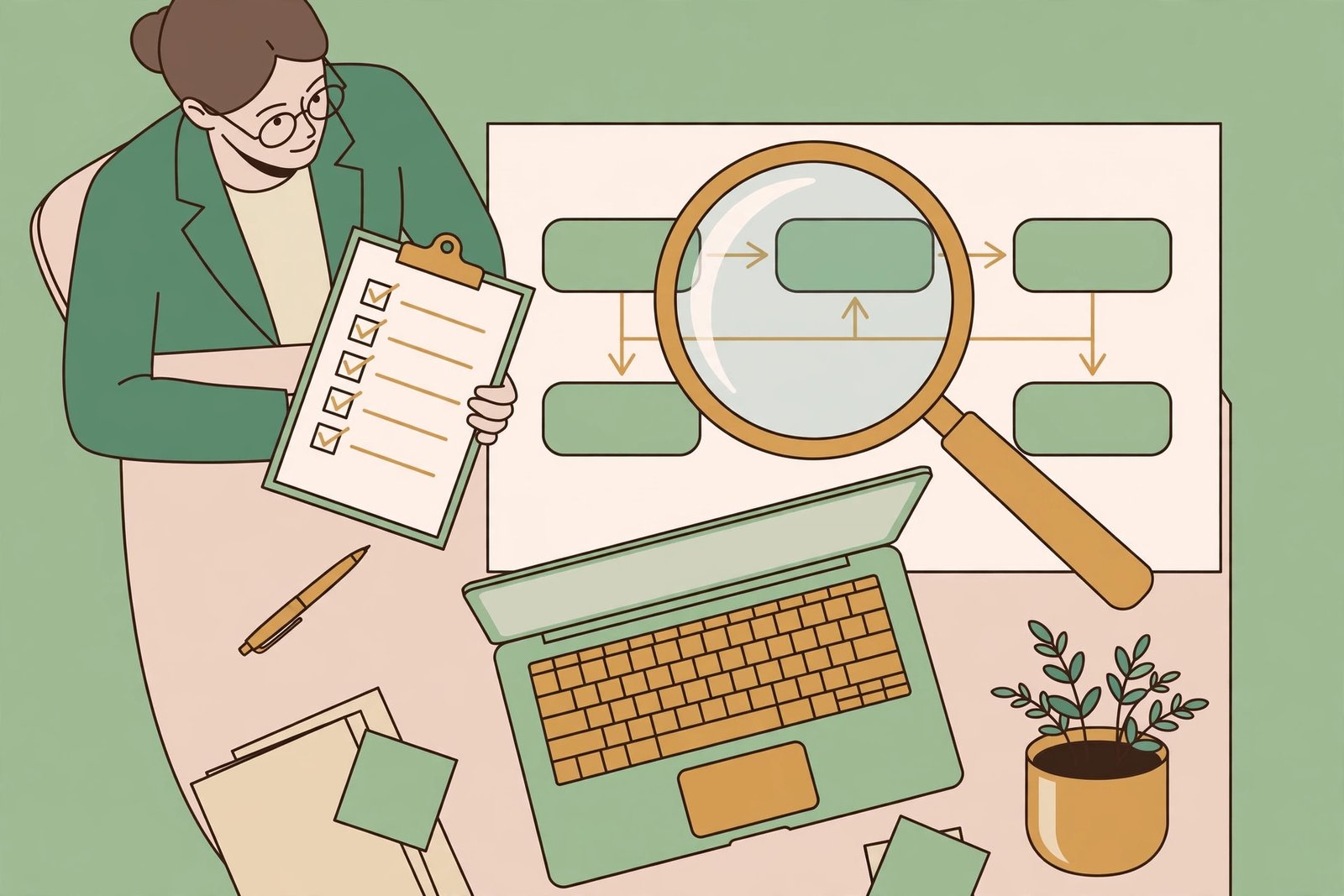
Step 5: Deliver, measure, and document results
Good delivery is simple: do what you promised, on time, in writing. Start every project with a short kick-off call. Agree on the goal, the deliverables, the dates, and who in the business will give you access and answers. Write it down and send it to the client the same day.
For an assessment, follow the same order each time. First, interview two or three staff members for 30 minutes each. Second, look at the tools and documents they already use. Third, list the tasks that take the most time. Fourth, rank three to five AI uses by time saved and risk. Fifth, write the report in plain language, with costs and next steps. Sixth, present it in a one-hour call and answer questions.
Measure the result in a way the client can check. If you claim a task takes two hours a week now, count it before and after. If staff save time, ask them to log it for two weeks. Do not claim savings you did not measure. At the end of the project, ask the client for a short written review and for permission to use it. One real review is worth more than ten promises on your website.
Keep a simple file for each client: the agreement, the report, the emails, and the review. That file protects you if a client later disagrees about what was promised.
What it costs and what to expect
Starting costs are low, because you sell knowledge, not stock or equipment. That low start is one reason how to offer AI consulting services appeals to beginners, but the selling still takes time.
| Cost | What to expect |
|---|---|
| AI tools and subscriptions | 30 to 100 US dollars a month |
| Website, email, and scheduling | 10 to 30 US dollars a month |
| Video calls and documents | Free plans are usually enough at first |
| Business registration and tax | Varies by country; check your local rules |
| Your time | 10 to 20 hours a week for outreach, delivery, and learning |
A realistic timeline looks like this. Weeks 1 to 2: pick a niche and build a sample audit. Weeks 3 to 6: contact 40 people and book calls. Weeks 7 to 12: deliver the first assessment or two. A first paying client can take one to three months, and a steady flow of clients can take six months or more. Some consultants never get past a few clients, because selling is harder than advising. Budget for that slow start.
Rates vary by experience and by country. New consultants often charge 50 to 150 US dollars an hour, or a fixed project price. Experienced consultants charge more. Fixed prices suit beginners better than hourly rates, because the client knows the total cost up front and you are paid for the result, not the clock.
Contracts, boundaries, and risks
Put every project in writing before you start. A simple engagement letter should cover the deliverables, the price, the payment dates, who gives you data access, how you handle private data, who checks AI output, what happens if the client wants extra work, and how either side can end the project. Our guide to freelance contracts explained covers the same points for service work.
Set clear boundaries. Say what you do not do. You do not give legal advice, medical advice, or financial advice unless you are qualified. You do not guarantee savings, rankings, or income. You do not handle data you are not allowed to see. If a client asks for work outside your skill, say so and suggest a specialist. Saying no to the wrong job protects your reputation.
Watch for three risks. First, a client may act on your advice and blame you if it fails, so keep your report honest about limits and risks. Second, a client may share private customer data with you, so agree in writing how you store it and delete it when the project ends. Third, AI tools can produce wrong or biased output, so always tell the client that a human must check important output before it is sent or published.
Also watch for scams aimed at new consultants. Real clients do not ask you to pay a fee to start, do not ask for your bank login, and do not pressure you to sign in a day. If an offer feels rushed or secretive, walk away.

Common mistakes
- Trying to serve every industry at once, so no message lands.
- Selling hours instead of a clear package with a fixed price.
- Starting work with no written agreement about scope and payment.
- Quoting income claims from other guides as if they were typical.
- Recommending one tool for every client, instead of checking what fits.
- Skipping the human check on AI output, then blaming the tool.
- Spending on a logo and a website before talking to a single client.
- Taking work in regulated areas without the right qualifications.
Frequently asked questions
Do I need to code to be an AI consultant?
No. You need to understand what AI tools can and cannot do, and how a business in your niche works. You will use AI tools, not build them. If a client needs custom software, you can recommend a developer or a no-code builder instead of building it yourself.
How much should an AI consultant charge?
New consultants often charge 50 to 150 US dollars an hour, or a fixed price per project. A small assessment often costs 1,000 to 5,000 US dollars. Price from your costs, your time, and the value to the client, and check the going rates in your niche and country before you quote.
What services does an AI consultant offer?
The core services are a readiness assessment, a written AI plan, tool selection, staff training, and a monthly retainer for ongoing help. Some consultants also guide the setup of simple tools. The work is advice and guidance, not building custom software.
How do I find my first AI consulting client?
Start with people you already know and businesses in a niche you understand. Contact 40 people one by one with a short personal message, offer a free 20 minute call, and show a sample audit. Your first clients usually come from your own network, not from adverts.
Is AI consulting profitable?
It can be, because the startup costs are low and the work is paid by the project. But profit depends on finding clients, and finding clients takes time. Most beginners take months to win a first paying client. Treat income claims from other guides as sales talk, not typical results.
What is an AI readiness assessment?
It is a structured review of a business that shows whether it is ready to use AI. It looks at the daily tasks, the data, the tools, the staff skills, and the risks. The client gets a written report with three to five ranked recommendations, costs, and next steps.
Conclusion
To learn how to offer AI consulting services in 2026, pick one niche you understand, package a small assessment first, build proof with a sample audit, contact 40 people one by one, and deliver every project in writing with measured results. Keep your claims honest, your scope clear, and your prices tied to real costs and value.
Next, read how to offer AI services as a freelancer for the freelance side of selling AI work, how to make money with AI for the wider picture, and how to find freelance clients for more outreach detail. Browse all our guides in AI earning.
Reader note: Prices and rates in this article are typical ranges, not promises, and they differ by country. The FTC guidance cited here was checked on the FTC website on 2026-11-12. Tax and business registration rules differ by country, so check your local tax authority or a qualified accountant. Earning results vary; nothing on this site is financial advice.