
Learning how to make money with AI SEO services starts with a simple fact: small businesses need help ranking on Google, but most cannot afford a big agency. AI tools can speed up the research and drafting, so one person can serve a few small clients at a fair price. The work still needs a human who checks facts, writes for real readers, and reports honestly. This guide shows you the full delivery workflow, how to package and price it, and how to find your first clients.
SEO means search engine optimisation: the work of helping a website show up in search results. AI SEO services use AI tools to speed up parts of that work, such as keyword research, content briefs, and first drafts. The AI does not replace the human. It drafts, and the human checks, edits, and publishes. If you sell AI content with no human review, you sell low-quality work, and the client will find out.
What AI SEO services include, and what they do not
An AI SEO service usually covers five things: keyword research, content planning, AI-assisted writing with human editing, on-page optimisation, and monthly reporting. On-page optimisation means improving the page itself: the title, headings, internal links, images, and meta description. Some providers also add link building, which means earning links from other websites, and local SEO, which means helping a business show up in local map and search results.
Your service does not include guaranteed rankings. No one can guarantee a top spot on Google, because Google controls the results. Do not promise a first-page rank, a set number of visitors, or a set number of sales. Promise the work, the schedule, and the reporting, not the outcome.
Here is a service menu you can adapt. Each line is one service you can sell on its own or as part of a package.
| Service | What the client gets | What it does not include |
|---|---|---|
| Keyword research | A list of keywords the business can rank for, with search intent for each | No content writing |
| Content plan | A monthly plan of article topics, titles, and briefs | No publishing |
| AI-assisted articles | Drafted, fact-checked, edited, and published articles | No link building |
| On-page optimisation | Fixed titles, headings, links, and images on existing pages | No site redesign |
| Local SEO | Google Business Profile setup, local keywords, and review guidance | No paid adverts |
| Monthly reporting | Rankings, traffic, and leads in plain language | No guaranteed results |
Start with one or two services you can deliver well. A beginner who sells everything usually delivers nothing well. Most beginners start with keyword research and AI-assisted articles, because those are the easiest to learn and the easiest to show.
Step 1: Learn the SEO basics AI cannot replace
AI can draft fast, but it cannot judge. You need to understand search intent, which means what the searcher really wants. A person who searches "plumber near me" wants a phone number, not a 2,000 word essay. A person who searches "how to fix a leaking tap" wants steps, not a sales page. If you target the wrong intent, the page will not rank and will not help the reader.
You also need to understand quality. Google rewards original, helpful, people-first content that shows expertise, experience, authoritativeness, and trustworthiness. Those four qualities are called E-E-A-T. A page that copies others, states wrong facts, or hides who wrote it will struggle. Learn these basics before you take a client. Our guide on how to learn SEO for beginners covers the same ground.
Learn to use Google Search Console, the free tool that shows how Google sees a website. It shows which queries bring clicks, which pages are indexed, and which pages have problems. You can submit sitemaps and single URLs for crawling, and the URL Inspection tool shows crawl and index detail for a page. Read the official overview on Google Search Console and set it up for your own site first, so you learn it before a client pays you.
Step 2: Build your AI-assisted delivery workflow
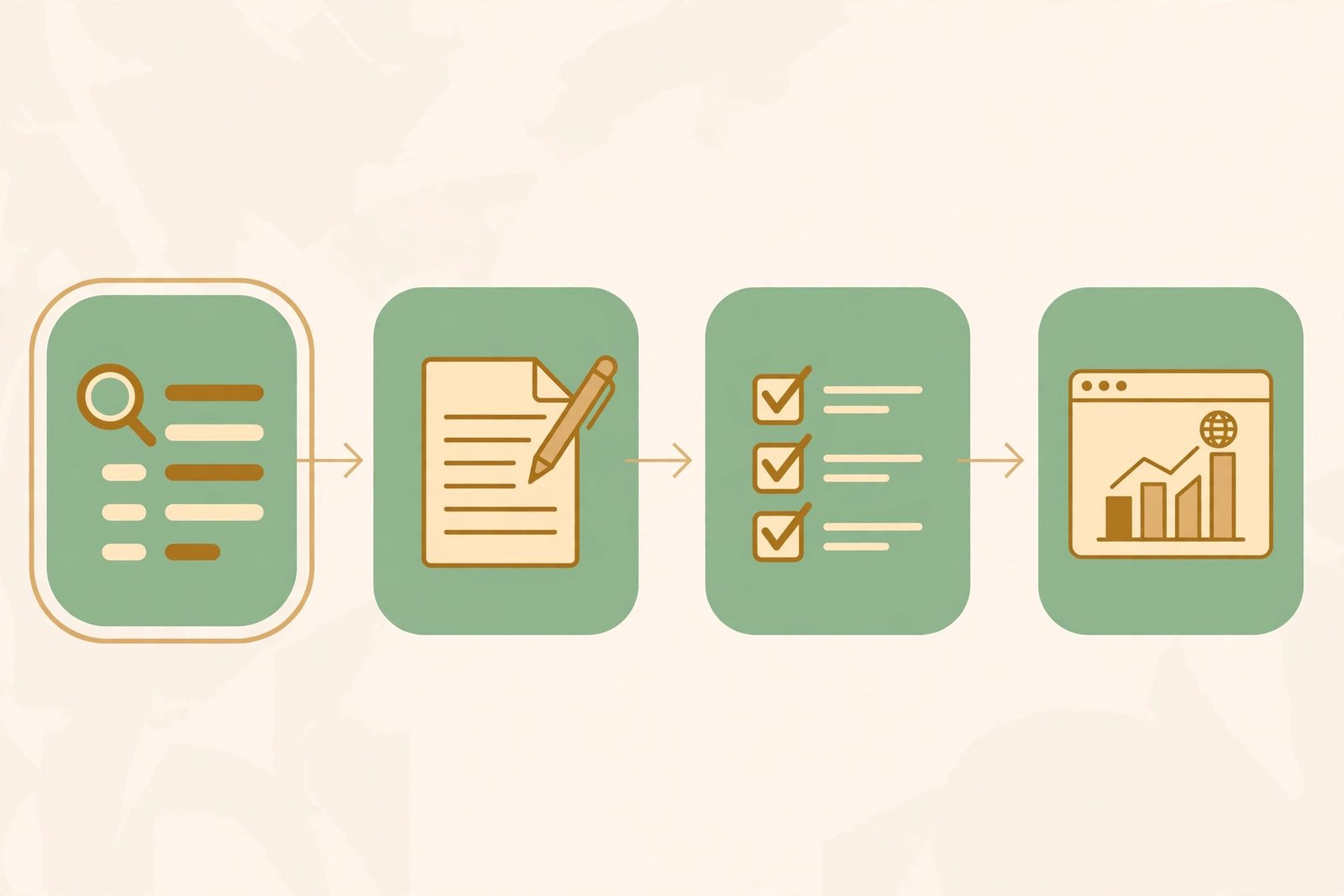
A workflow is a fixed order of steps you follow for every client. It keeps quality steady and stops you from skipping the human check. Here is a workflow that works for a small client with four to eight articles a month.
First, research keywords. Find what the client's customers search for, and group the keywords by intent. Pick topics the client can rank for: specific, local, or niche phrases, not broad terms owned by big sites. Check the top results for each keyword, and note what they cover and what they miss.
Second, write a content brief for each article. A brief is a short plan: the keyword, the intent, the headings, the questions to answer, the facts to check, and the internal links to add. The brief is the most important step, because a good brief stops the AI from writing vague filler.
Third, draft with AI. Use the brief to guide the draft, then treat the draft as a rough first version, not a finished article. Keep the useful parts and cut the rest.
Fourth, fact-check and edit by hand. Check every fee, date, rule, and claim against a trusted source. Fix awkward sentences, cut repetition, and add real examples from the client's business. Add the internal links and the images. This step is the service. If you skip it, the client is paying for raw AI output they could make themselves.
Fifth, optimise the page. Write a clear title, a meta description of 140 to 160 characters, and descriptive headings. Add internal links to the client's other pages and to related guides. Check that images have alt text and that the page loads well on a phone.
Sixth, publish and report. Publish on a set schedule, then send the client a short monthly report. That report is covered in Step 5. Follow the same order every time, because a steady workflow is how to make money with AI SEO services without cutting corners.
Step 3: Package and price it
Clients buy outcomes and clear schedules, not hours. Package your work by the month, with a set number of articles and a set list of tasks. Here are three package shapes that fit beginners. Prices are typical ranges reported by other providers, not promises of what you will earn.
| Package | What it includes | Typical price range |
|---|---|---|
| Starter | Keyword research and 4 AI-assisted articles a month, with on-page optimisation | 300 to 500 US dollars a month |
| Growth | Keyword research, 8 articles a month, on-page optimisation, and a monthly report | 700 to 1,200 US dollars a month |
| Authority | 12 articles a month, on-page optimisation, basic link building, and local SEO | 1,500 US dollars a month or more |
Project pricing also works for one-off jobs, such as a keyword research report or fixing ten existing pages. Charge a fixed fee for the project, and state what is included.
What affects the price? The number of articles, the depth of research, whether you write for a hard niche, whether link building is included, and the client's location. A local plumber pays less than a national finance firm, because the competition is lower. Start at the low end while you build proof, and raise prices when you have results to show.
Be honest about timelines. SEO takes months. A new page can take three to six months to rank, and a new site can take longer. Tell the client that in the first call. If a client wants results in two weeks, they need paid adverts, not SEO. Saying that honestly will win you more trust than promising fast rankings.
Step 4: Find the first clients
Local businesses are the best first clients. They need SEO, they are easy to find, and they often have no one helping them. Make a list of 30 local businesses in one niche, such as dentists, estate agents, or home service firms. Check their websites. If a site has thin pages, no blog, or no Google Business Profile, that business needs help.
Offer a free mini audit, not free work. A mini audit is a one-page note: three things that are wrong and three quick fixes. Send it with a short message that offers a call. Do not write their articles for free. A free audit shows skill. Free articles teach the client that your work costs nothing.
Freelance platforms can also bring first clients. Set up a clear gig: what you deliver, how many articles, and what the price includes. Our guide on how to find freelance clients covers outreach in detail, and how to set freelance rates helps you check your prices. If you already sell other AI services, your existing clients are the easiest first SEO clients. Our guides on how to offer AI services as a freelancer and how to make money with AI writing tools explain how those services fit together.
Step 5: Report results honestly
A monthly report keeps the client. Send it on the same day each month, and keep it short: one page, plain language, and four numbers. Show keyword rankings for the target pages, organic traffic from Google, enquiries or calls from the site, and what you published that month. Do not hide bad months. If rankings fell, say why and what you will change.
Avoid vanity metrics. A vanity metric is a number that looks good but means little, such as total impressions or social media likes. A client who runs a plumbing firm cares about calls and bookings, not impressions. If you cannot show leads, show the steps that lead to them: pages indexed, keywords in the top ten, and clicks from search.
When rankings do not move, check five things before you blame Google. First, is the page indexed? Second, does the page match the search intent? Third, is the content thin or copied? Fourth, are there technical problems, such as slow loading or broken links? Fifth, is the competition simply stronger, so the page needs more depth or better links? Fix the problem you find, and tell the client what you changed.
Turn down clients you cannot help. If a business wants guaranteed rankings, a banned niche, or a site full of copied content, say no. A bad client costs more in refunds and stress than the fee is worth.
AI content and Google: what is safe, and what to avoid
Google's own guidance is clear, and it is good news for honest providers. Google does not ban AI content. Its ranking systems reward original, high-quality content that shows E-E-A-T, however it is produced. Using automation, including AI, to generate content mainly to manipulate rankings is a violation of its spam policies. Read the full guidance on Google's AI-generated content page.
What does that mean in practice? Safe work is AI-assisted and human-checked: real research, real facts, real examples, and a human editor who fixes errors. Risky work is mass-produced AI text with no review, no facts, and no original value. That kind of content can be treated as spam, and it will not rank for long even if it ranks at first.
Tell your clients how you work. Say that AI drafts and a human edits, checks facts, and publishes. Clients who understand the process trust the price. Clients who think you press a button will expect a very low price.
AI search is the second change to watch. People now ask questions in Perplexity and ChatGPT, not only in Google. To show up there, a page needs clear, direct answers, correct facts, and a trusted source. Write short answer paragraphs under question headings, keep facts current, and make sure the page states who wrote it and when. That is the same quality work that ranks on Google, so you do not need a separate service for it yet. Just tell clients that visibility now covers AI answers as well as Google results.
What it costs and what to expect
| Cost | What to expect |
|---|---|
| AI writing and research tools | 20 to 60 US dollars a month |
| Keyword research tool | Free tools at first; paid tools cost more later |
| Rank tracking tool | Free or low-cost plans cover a few clients |
| Website and email | 10 to 30 US dollars a month |
| Your time | 3 to 6 hours per article, including research, editing, and reporting |
A realistic timeline looks like this. Month 1: learn the basics, build your workflow, and offer free mini audits. Months 2 to 3: win one or two small clients. Months 4 to 6: publish regularly and send monthly reports. Rankings often start to move in months 3 to 6, but some pages take longer. Income in the first months is often low or zero, because you are building proof. That is normal for a service business, and it is the honest picture of how to make money with AI SEO services.

Common mistakes
- Publishing raw AI drafts with no fact-check and no edit.
- Targeting broad keywords a small site cannot rank for.
- Promising a first-page rank or a set number of visitors.
- Writing for search engines instead of for the reader.
- Ignoring local SEO for a business that serves one town.
- Reporting vanity metrics instead of leads and calls.
- Taking on too many clients before the workflow is steady.
- Copying a competitor's content and changing a few words.
- Forgetting to check that new pages are indexed in Search Console.
Frequently asked questions
How much can I charge for AI SEO services?
Beginners often charge 300 to 500 US dollars a month for four articles, and 700 to 1,200 US dollars a month for eight articles with reporting. Prices rise with depth, link building, and local SEO. Price from your costs and your time, and raise prices when you have results to show.
Do I need SEO experience to offer AI SEO?
You need the basics: search intent, keyword research, on-page optimisation, and how to read Search Console. You do not need years of agency work. Learn on your own site first, then take one small client and deliver carefully.
Can AI content rank on Google?
Yes, if it is original, helpful, and people-first. Google says it rewards quality content however it is produced. AI content that is mass-produced to manipulate rankings can be treated as spam. The human edit and fact-check are what make the difference.
How long does AI SEO take to work?
Most pages take three to six months to rank, and a new site can take longer. Tell the client this in the first call. If a client needs visitors in two weeks, they need paid adverts, not SEO.
What tools do I need for AI SEO services?
You need an AI writing tool, a keyword research tool, a rank tracker, and Google Search Console, which is free. Start with free or low-cost plans. Buy a paid keyword tool only when you have paying clients.
How do I find SEO clients?
Start with local businesses in one niche. Check their sites, send a short free mini audit, and offer a call. Freelance platforms and your existing clients are the next best sources. One niche and one clear package beat a wide net.
Conclusion
To learn how to make money with AI SEO services in 2026, learn the basics AI cannot replace, build a fixed workflow of research, brief, draft, edit, optimise, and publish, package the work by the month, start with local businesses, and report rankings, traffic, and leads honestly every month. Keep the human check in every article, and never promise a ranking no one can guarantee.
Next, read how to learn SEO for beginners to build the basics, how to offer AI social media content services for a service that pairs well with SEO, and how to make money with AI writing tools for the writing side. Browse all our guides in AI earning.
Reader note: Google's rules and tool prices change often. The Google guidance and Search Console pages cited here were checked on 2026-11-12. Prices in this article are typical ranges, not promises. Tax rules differ by country, so check your local tax authority or a qualified accountant. Earning results vary; nothing on this site is financial advice.