
How to Start an Online Real Estate Business in 2026
Learning how to start an online real estate business is a practical way to build income around property without renting an office. Most buyers now start their search online, and many sellers expect video tours, fast replies and clear listings before they ever meet an agent. An online real estate business lets you serve those people from home, with a website, a phone and a local network. This guide shows you how to choose a model, get licensed, build listings, win clients and earn commission, with honest costs and a realistic timeline.
In this guide
- Which online real estate business model fits you?
- Step 1: Get licensed
- Step 2: Choose your niche and your market
- Step 3: Register the business and set up your finances
- Step 4: Build a website that wins listings
- Step 5: Get listings and build a pipeline
- Step 6: Market each property properly
- How agents earn commission
- Worked example: what one sale could earn
- How to start an online real estate business: what it costs and what to expect
- Common mistakes
- Risks and scams to watch for
- Frequently asked questions
Which online real estate business model fits you?
Real estate is not one business. It is several models that share a market but need different skills, licences and capital. Pick one before you spend money, because each model changes what you do each day.
| Model | What you do | What it needs |
|---|---|---|
| Sales agent or broker | Help buyers and sellers complete a sale, and earn commission | A licence, a sponsoring broker, local knowledge |
| Property management | Manage rentals: tenants, leases, repairs and rent collection | Systems for tenants and maintenance, trust accounting |
| Real estate investing | Buy, hold or sell property for your own profit | Capital, market knowledge, tolerance for risk |
| Wholesaling | Find underpriced property, contract it, and assign the contract to a buyer | Negotiation skill, a buyer list, careful contracts |
| Virtual consulting or coaching | Advise buyers, sellers or investors online, without handling sales | Experience, a clear service, a way to find clients |
| Listing website | Run a property portal that earns from listings, ads or leads | A website, traffic, and a way to get listings |
Most beginners start as a sales agent, because it needs the least capital and teaches you the market. Property management suits organised people who like systems. Investing and wholesaling need money or strong deal flow, so they suit later stages. This guide focuses on the sales agent route, with notes on the other models where they differ. It is about running a real estate business, not about promoting property for a commission through links. If you want the affiliate side instead, read our guide to how to earn with real estate affiliate programs.
Step 1: Get licensed
In most countries, you need a licence to help people buy or sell property for a fee. In the United States, every state requires real estate brokers and sales agents to be licensed, according to the US Bureau of Labor Statistics, which also reports median pay of 57,400 dollars a year for brokers and sales agents in 2025, with about 530,600 jobs and growth of 2 per cent from 2025 to 2035. You can read the full figures on the BLS page for real estate brokers and sales agents, checked on 2026-11-24.
The US licensing path has the same steps in most states. First, meet the minimum age, usually 18, and hold a high school diploma or equivalent. Second, complete a state approved pre-licensing course. The hours vary a lot by state, from 40 hours in Michigan to 180 hours in Texas, according to a 2026 guide that checked state agency pages, which you can read on the Jamil Academy guide to becoming a Realtor, checked on 2026-11-24. Third, pass the state licensing exam, which usually has a national portion and a state portion. Fourth, pass a background check, which may need fingerprints. Fifth, join a sponsoring broker, because new agents cannot practise alone and must work under a licensed broker.
Outside the United States, the rules are different but the pattern is similar: a course, an exam, and a registration with a regulator. In the United Kingdom, for example, estate agents are not licensed in the same way, but they must follow consumer protection and money laundering rules. Check your state real estate commission or your national regulator before you spend money on a course, and confirm the current hours and fees, because they change.
Joining a Realtor association is a separate choice in the United States. A Realtor is a licensed agent who has also joined the National Association of Realtors, known as NAR, and agreed to its Code of Ethics. Membership is not required to practise, but it usually brings access to the local Multiple Listing Service, known as the MLS, which is the database of listed properties in your area. NAR national dues for 2026 are 156 dollars plus a 45 dollar advertising assessment, with local and state dues on top, according to the guide linked above.
Step 2: Choose your niche and your market
A niche is the kind of property and client you focus on, and it decides your marketing, your knowledge and your income. Common niches include first-time buyers, luxury homes, rental properties, new developments, commercial property, land, and vacation homes. Pick a niche you understand and enjoy, in a market you know well.
Then narrow it by place. A small, well-known area beats a large, vague one. An agent who knows one neighbourhood deeply wins more listings than an agent who covers a whole city thinly. That local knowledge is your edge over big portals.
Check the market before you commit. Look at how many homes sold in your area in the last year and the average time on the market. A good market has steady sales and room for one more agent who works hard.
Step 3: Register the business and set up your finances
Register your business and keep its money separate from your own. In the United States, a limited liability company, known as an LLC, is the common choice for a small real estate business, because it separates your personal assets from the business. Open a business bank account, and set up simple accounting from day one, because commission income is irregular and tax time is painful without records.
Get liability insurance and errors and omissions cover. Real estate deals involve large sums, and a missed disclosure can lead to a claim. Check whether your state needs a separate business registration or a home business permit, because some states require a licensed brokerage to have a physical office.
Set aside money for tax from every commission cheque. A simple rule is to move 25 to 30 per cent of each commission into a separate savings account for tax, and adjust the figure with your accountant once you know your real rate. Tax rules differ by country, so check your local tax authority or a qualified accountant before you rely on a single figure.
Step 4: Build a website that wins listings
Your website is your shopfront, and it is where sellers judge you before they call. It needs five pages to start: a home page that says who you help and where, a listings page with photos and key details, an about page with your photo and your local knowledge, a contact page with a simple form, and a page that explains how you work with sellers. Add a Google Business Profile so local searches can find you, and make sure your phone number and email are easy to find on every page.
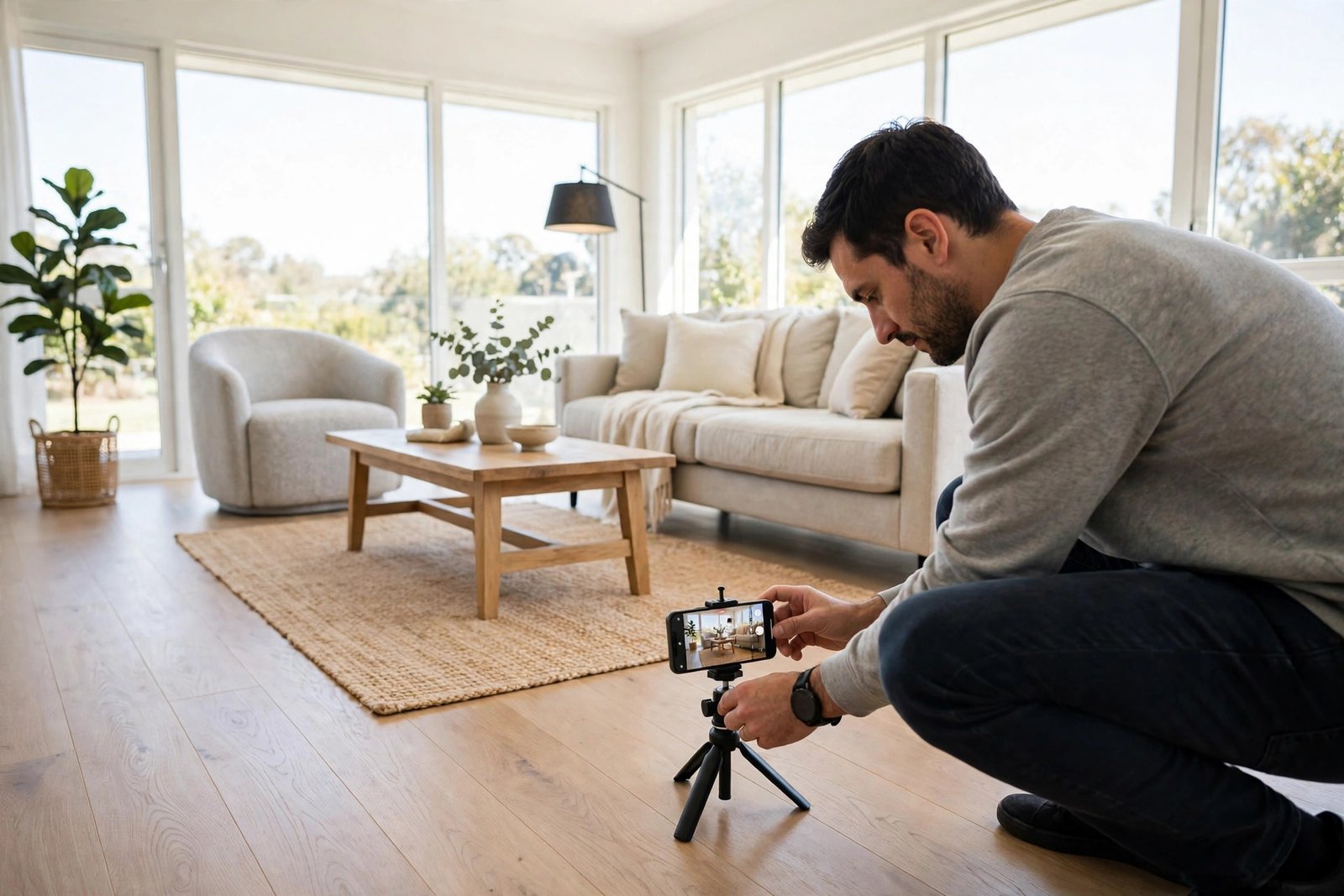
Listings need good photos more than anything else. A recent phone, a small tripod and daylight are enough to start. Photograph each room from the doorway, include the outside and the street, and add a short video walkthrough. Write honest descriptions, and never use a photo of a different property.
Use a customer relationship system, known as a CRM, to track every buyer and seller you speak to. HubSpot, Zoho and Follow Up Boss are common choices for agents. Log each conversation, each viewing and each follow-up, so no lead goes cold because you forgot to call back. Add e-signature software such as DocuSign for contracts, and a scheduler such as Calendly for viewings.
Step 5: Get listings and build a pipeline
Listings are the business. Without them, you have no properties to show buyers and no commission to earn. Your first listings usually come from people you know: friends, family, neighbours and former colleagues who are thinking of selling. Tell them you are an agent, explain how you work, and ask them to keep you in mind.
Then work your local area systematically. Attend open houses, join local business groups, and build relationships with mortgage brokers, solicitors, builders and home inspectors, because they all meet sellers before you do. Offer a free valuation to homeowners in your area, and follow up with useful local market updates, not with sales pressure. A seller who has read your market notes for six months is far more likely to call you than a stranger who knocked once.
Step 6: Market each property properly
A good listing needs more than a portal upload. Start with the photos and the video, then write a description that helps a buyer picture living there: the light, the layout, the garden, the commute, and the schools nearby. Price it honestly, using recent sales of similar homes in the area, and explain your reasoning to the seller. An overpriced listing sits, gets reduced, and sells for less than a well-priced one.
Promote each listing on the main property portals, your website, social media and email to your buyer list. Answer enquiries fast, because buyers contact several agents at once. After each viewing, share the buyer's feedback with the seller the same day.

How agents earn commission
A sales agent earns commission, which is a percentage of the sale price, agreed in advance and usually shared with the brokerage under a split. The percentage varies by country and by market, and in some places it is negotiable, so agree the figure in writing before you market a property. The brokerage takes its share under your split, and you keep the rest, before tax and your own costs.
Commission income is irregular, which is the hardest part of the business. A sale can take weeks or months to complete, and a deal can fall through at the last step. Some agents add steadier income from property management or lettings, but do not take on that work until you understand the legal duties it brings.
Worked example: what one sale could earn
Example only: these numbers are not typical results, and they are shown only to explain how the maths works.
Imagine an agent who sells a home for 300,000 dollars, with a total commission of 5 per cent of the sale price, which is 15,000 dollars. The commission is split between the seller's agent and the buyer's agent, so the seller's agent side is 7,500 dollars. The agent's brokerage takes 30 per cent of that side under their split, which is 2,250 dollars, leaving the agent with 5,250 dollars. The costs for that sale are about 200 dollars for photography, 100 dollars for portal and advertising fees, and 50 dollars for travel, which adds up to 350 dollars. The income before tax from that one sale is 5,250 minus 350, which is 4,900 dollars. Results vary with the sale price, the commission rate, the brokerage split, and how long the sale takes to complete.
How to start an online real estate business: what it costs and what to expect
You can start as a sales agent for 2,000 to 5,000 dollars, covering the pre-licensing course, the exam and licence fees, a basic website, and your first marketing. The course is the biggest cost, and its price depends on your state. A brokerage may also charge a monthly desk fee or a joining fee, so ask for the full fee schedule before you sign with one.
| Step | What it involves | Time it can take |
|---|---|---|
| Pre-licensing course | 40 to 180 hours, depending on your state | Two to eight weeks |
| State exam | A multiple-choice test on law and practice | A few hours, plus study time |
| Licence application | Background check and fee to your state board | Two to six weeks |
| Join a brokerage | A broker sponsors your licence | A few days to two weeks |
A realistic timeline is two to four months to get licensed, depending on your state's course hours and exam dates, then three to six months to win your first listings and close your first sale. Many new agents earn little or nothing in the first six months, and income becomes steadier in the second year, when past clients refer friends and your pipeline is full. Keep a second income source or savings to cover the first year, and do not depend on one sale to pay your bills.
Common mistakes
- Covering a whole city instead of learning one area deeply, which leaves you with no local edge.
- Using poor photos, which is the fastest way to lose buyers online.
- Overpricing a listing to win the instruction, which leads to a stale listing and a price cut later.
- Forgetting to follow up with buyers and sellers, so warm leads go cold.
- Skipping the licence step, or working without a sponsoring broker where one is required.
- Promising a sale price you cannot support with recent sales evidence.
- Spending on ads before you have listings worth advertising.
- Mixing business and personal money, which makes tax time painful.
Risks and scams to watch for
The biggest risk is a deal that falls through. A buyer can pull out, a survey can reveal a problem, or a mortgage can be refused, and you earn nothing for weeks of work. Keep a full pipeline so one lost deal does not empty your month, and never count a commission until the sale completes.
The second risk is a disclosure mistake. If a listing hides a known defect, or a contract misses a required disclosure, you can face a claim. Be honest in every listing, write down what the seller tells you, and follow your broker's disclosure rules. Check the fair housing and advertising rules in your country, because discriminatory wording in a listing is illegal in many places.
Watch out for scams aimed at agents and buyers. A common one is a fake buyer who asks you to pay an upfront fee to view a property, or a "seller" who lists a property they do not own. Never pay to access a listing, and verify ownership before you market a property. Another is a lead generation service that charges a large monthly fee for leads that never answer the phone. Test any service for one month before you commit to a contract. Property rules differ by country, so check your local regulator or a qualified adviser before you act.
Frequently asked questions
Do I need a licence to start a real estate business?
In the United States, yes, if you help people buy or sell property for a fee. You need a state licence, which means a pre-licensing course, an exam, a background check and a sponsoring broker. Rules differ by country, so check your state real estate commission or your national regulator before you start.
How much does it cost to start an online real estate business?
A realistic starting budget as a sales agent is 2,000 to 5,000 dollars, covering the course, exam and licence fees, a basic website and first marketing. Investing in property needs far more capital, and property management needs systems for tenants and deposits. Costs vary by state and country.
How long does it take to get a real estate licence?
It depends on your state. Pre-licensing education ranges from 40 hours in Michigan to 180 hours in Texas, so a full-time student can finish in a few weeks while a part-time student may need a few months. Add time for the exam, the background check and the licence application.
How do real estate agents get paid?
A sales agent earns commission, which is a percentage of the sale price, agreed in writing before the property is marketed. The commission is usually shared between the seller's agent and the buyer's agent, and each agent shares their side with their brokerage under an agreed split. You are paid when the sale completes.
Conclusion
Learning how to start an online real estate business in 2026 comes down to getting licensed, choosing one niche and one local market, building a website with strong listings, and following up with every buyer and seller you meet. Start as a sales agent, learn the market deeply, and add steadier services such as management only when you understand the duties they bring. The business rewards patience and local knowledge more than a big budget.
To keep building, read our guide to how to earn with real estate affiliate programs for a related income stream, our guide to how to start a real estate YouTube channel and earn money for video marketing that fits property well, and our guide to how to start a bookkeeping business online for the money skills that keep a property business healthy. You can browse the rest of the Online Business category for more business guides.
Earning results vary; nothing on this site is financial advice. Property and licensing rules differ by country, so check your local regulator or a qualified adviser before you act, and check the BLS and licensing pages linked above for the latest figures.