
A podcaster records an hour-long episode, publishes it, and then has no time to turn it into anything else. The episode sits on one platform while the audience on every other platform never sees it. That waste is your business. Learning how to make money with AI content repurposing services means taking one piece of long content a client already owns and turning it into many finished pieces, short clips, social posts, blog summaries, and emails, and charging for the finished package.
Repurposing is not copying. It is taking the best ideas from a long recording and reshaping them for a new place and a new reader. AI helps by transcribing the recording, finding the strong moments, and drafting the new versions. You add the judgement: which moments matter, what the client's voice sounds like, and what is actually true. Clients pay for that judgement, and for content that goes out every week without them having to make it.
What AI content repurposing services are
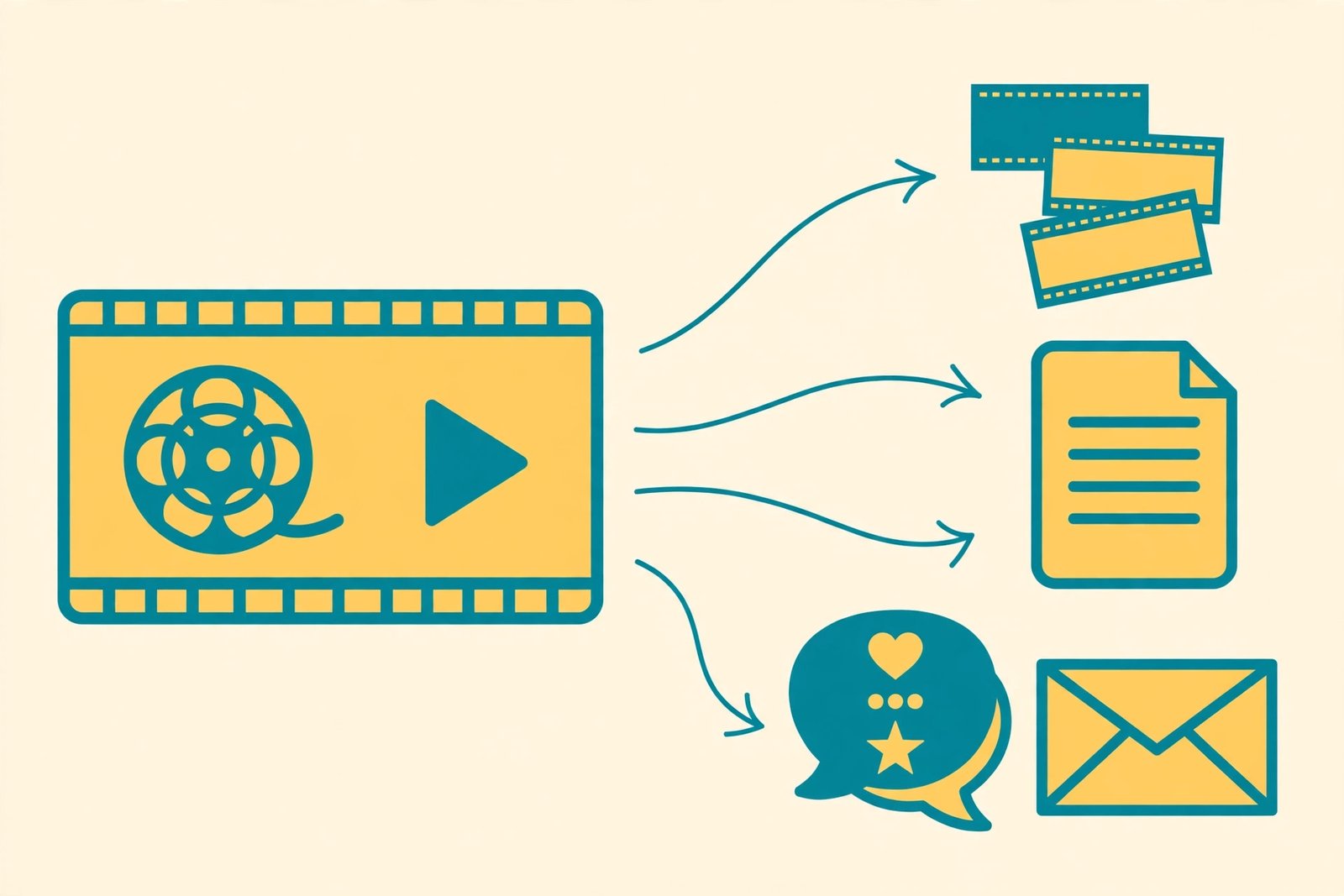
Content repurposing means taking one source, such as a podcast episode, a webinar, a long video, or a talk, and turning it into many smaller pieces for other channels. One 60 minute episode can become eight short video clips, four social posts, one blog summary, and one email newsletter. The client already did the hard work of thinking and speaking. Your job is to extract the value and reshape it.
AI does the heavy lifting in three places. First, transcription turns audio and video into text with timestamps. Second, extraction finds the strongest quotes, stories, and frameworks in that text. Third, drafting turns each strong moment into a first version in the right format. You then edit every piece: check the facts against the original, fix the tone, and cut anything generic. That editing step is the service. Raw AI output is not a product. Checked, polished, client-ready content is.
A good repurposing package is predictable. The client knows what arrives each week, in what format, and when. That predictability is what turns a one-off job into a monthly retainer, which is where the steady income comes from.
Who pays for repurposing, and why
The best clients are people and businesses that already publish long content regularly. Podcast hosts with 20 or more episodes, coaches who run weekly webinars, consultants who record training videos, and small software companies with a video library all fit. They have a backlog of valuable material and no time to reuse it. When you show them that their last ten episodes could become eighty social posts, the value is obvious.
The clients to avoid are those with no long content at all. If a business has never recorded anything, there is nothing to repurpose, and you would have to create content from scratch, which is a different service with a different price. Also avoid clients who want you to make their content "go viral". You can make good clips and posts, but you cannot control what an algorithm shows. Promise a finished package and a regular schedule, not a result you cannot control.
| Client type | Source material | What they buy each month |
|---|---|---|
| Podcaster | Weekly episodes, 30 to 60 minutes | Short clips, social posts, show notes, newsletter |
| Coach or consultant | Webinars and training calls | LinkedIn posts, email summaries, short videos |
| Small software company | Product demos and webinars | Blog summaries, help articles, social clips |
| YouTuber | Long videos | Shorts, community posts, and a blog version |
| Business executive | Talks and interviews | Thought leadership posts and a monthly newsletter |
The tools you need, and what they cost
You need four tools: a transcription tool, a writing assistant, a video clipping tool, and a way to deliver files. Descript transcribes audio and video and lets you edit by editing the text, which makes it a good first tool. ChatGPT or Claude handles extraction and drafting. Opus Clip or a similar tool finds strong moments in long videos and cuts them into vertical clips with captions. Google Drive or Dropbox handles delivery, and both have free plans that are enough to start.
Your monthly costs can stay low at the start if you use free plans and pay per use. A transcription tool and a clipping tool are the two subscriptions worth paying for first, once you have a client, because they save the most time. Keep a simple list of what each tool costs and what it does, and cancel any tool you have not used in a month. Your costs are part of your price, so you need to know them before you quote anyone.
You also need a way to keep client material safe. Store client recordings in a folder only you can access, delete them when the client asks, and never upload a client's unpublished material to a public AI tool without checking its privacy terms. If a tool keeps your uploads to train its models, use a different tool for client work.
Step 1: Pick one type of client and one source format
Pick one client type and one source format and learn it deeply. A niche is a specific type of client plus a specific problem you solve. "Repurposing for podcasters" is a niche. "Repurposing for everyone" is not, because a webinar needs different handling from a podcast, and a product demo needs different handling again.
Learn how your chosen format works. If you pick podcasts, listen to ten episodes in your niche and note how hosts structure them and where the strong moments sit. If you pick webinars, watch three and note the slides and the parts that repeat. This research becomes your workflow.
Choose a niche where the client already publishes every week. A weekly podcaster needs your service every week. A business that records one video a year needs you once. Weekly work is what builds a retainer, so look for a regular publisher with a backlog.
Step 2: Build a sample package from a public episode
Before you contact anyone, build one complete sample package from a public episode you have permission to use. Pick a podcast episode that is freely available, listen to it once, and turn it into a full package: four short clips with captions, four social posts, one blog summary of about 800 words, and one short email newsletter. Label it clearly as a sample made from a public episode, and do not claim the podcaster hired you.
Your sample should show the whole range of the service, not just one format. The clips should each stand on their own, with a clear opening and ending. The social posts should sound like the host, not like a robot. The blog summary should be accurate to the episode, with no invented quotes. Check every quote against the transcript, because a wrong quote tells a buyer you do not check your work.
Put the sample in a simple folder with a short note explaining what you made and how long it took. When a prospect asks what you do, you send the folder. A finished package that a buyer can watch, read, and judge is worth more than any sales pitch. For ideas on the video side, read our guide to repurposing long videos into YouTube Shorts and our guide to making money with AI videos.
Step 3: Package your service and set prices
Package your service as a monthly retainer with a fixed deliverable list. A good first package is a weekly episode turned into eight short clips, eight social posts, one blog summary, and one email newsletter, delivered every week. The client knows what arrives, and you know how much work it is. A second, larger package can add more clips, a second platform, or a monthly report.
Example only: these numbers are not typical results. Suppose you charge 1,000 dollars a month for a weekly package, and you spend about eight hours a month on that client. That is 125 dollars per hour before costs and tax. With three clients, that is 3,000 dollars a month. Real prices vary by niche and country, and many beginners charge less for the first client to build proof. Price from the finished package, not from the time the AI tool took, because the client buys the result.
Write down what is included and what is not. Include one revision round per piece, a fixed delivery day, and the source material the client must send you on time. State clearly that you do not guarantee views, sales, or viral results. Clients respect that honesty, and it protects you when a good clip gets few views.
Step 4: Find clients who already publish long content
Make a list of 30 podcasters, coaches, or businesses in your niche who publish long content every week. Check their social pages: if they publish great episodes but their social accounts are quiet, they have the exact problem you solve. Note the gap in one sentence for each prospect, such as "20 episodes, no clips on LinkedIn in the last month".
Contact them with a free sample, not a sales pitch. Listen to 15 minutes of their latest episode, use your workflow to make two social posts and one short clip from their own words, and send them with a short message explaining what you did. This works because the client can see the quality before spending anything. A generic message gets ignored. A message that shows their own words turned into a finished post gets a reply.
Aim for ten real conversations, not a hundred cold emails. A free sample takes you about an hour to make, so ten samples is ten hours of work that can produce your first two or three clients. If a prospect does not reply, follow up once after a week, then move on. Never send a sample to a client's list or publish it publicly without their permission.

Step 5: Run the weekly workflow, from transcript to delivery
A reliable weekly workflow is what makes this service profitable. Use the same steps for every client, every week, so the work gets faster without getting sloppy.
First, get the source file and the brief. Ask the client to send the recording and one line about what matters most this week, such as a product launch or an event. Note the deadline and the formats they need.
Second, transcribe it. Use Descript or a similar tool to get a timestamped transcript. Read the transcript once through, marking the strongest moments: a surprising claim, a clear story, a useful framework, or a quotable line. Do not trust the AI to pick the moments alone, because it often picks the loudest part, not the most useful one.
Third, extract and draft. Ask your writing assistant to pull the three strongest insights, the five best quotes, and the key stories from the transcript, then draft each piece in the right format. Keep the client's words where possible, and mark anything you rephrased so you can check it later.
Fourth, edit and check. Read every piece against the transcript. Fix any quote that is not exact, remove any claim the client never made, and cut phrases the client would never say. Check the video clips for bad cuts and wrong captions. This step is the service, and it is where most beginners cut corners.
Fifth, deliver and report. Send the finished package in one organised folder, with file names the client can understand, and a short note listing what is inside. Once a month, send a short report: how many pieces you delivered, which ones the client used, and what you will improve next month.
What it costs, and what to expect in the first months
Your main costs are a transcription tool and a clipping tool, which together usually cost less than a single client's monthly fee once you have one. Your time is the bigger cost. Expect to spend two to three weeks learning the tools and building your sample package, then four to eight hours per client per month once the workflow is smooth. The first month usually brings no income. A realistic path is one client in month two or three, three clients by month six, and steadier income only after those clients renew.
Results vary with your niche, your outreach, and how good your samples are. A repurposing service lives or dies on quality: if your clips are dull or your posts sound generic, clients leave after one month. If your pieces sound like the client and arrive on time every week, clients stay for a year. Set aside money for tax, because client payments are income in your country.
Common mistakes that lose clients
- Sending raw AI drafts without checking quotes and facts against the original.
- Promising viral results or a fixed number of views.
- Missing the weekly delivery day, so the client's social accounts go quiet.
- Ignoring the client's voice and writing everything in the same style.
- Taking on too many clients before the workflow is ready, then delivering late.
- Never reporting what you delivered, so the client cannot see the value.
Risks, rules, and scams to watch for
Copyright is the biggest risk in repurposing. You are working with the client's own material, so you need their written permission to use it, and you must only use material they own or have the right to use. If a podcast episode includes music, a guest's words, or a clip from someone else, check who owns those parts before you reuse them. The U.S. Copyright Office has explained that purely AI-generated material, with no human authorship, is not protected by copyright, while human selection, arrangement, and editing of AI material can be protected to the extent of the human contribution. Read the Copyright Office AI guidance summary before you sell work that mixes AI output with client material, and get proper legal advice if a client asks you to reuse material you are unsure about.
Platform rules matter too. YouTube requires original and authentic content for monetisation and warns against repetitive or mass-produced material, so do not sell a client near-identical clips and promise YouTube income from them. Check the current rules for each platform your client uses.
Watch for scams aimed at new freelancers. A "client" who asks you to pay for software before you start, who sends a cheque for more than your fee and asks for the difference back, or who asks for your bank login details is not a client. Real clients pay you. Also beware of courses that promise a fixed monthly income from repurposing with no work. The work is real, the outreach is hard, and the editing takes time.
Frequently asked questions
How do I make money with AI content repurposing services?
You charge clients a monthly fee to turn their long content into finished short pieces every week. AI helps you transcribe, extract, and draft faster, and you earn by editing, checking, and delivering a reliable weekly package.
Do I need video editing skills to offer repurposing services?
Basic skills help, but modern clipping tools do most of the cutting automatically. You need to judge which moments are strong, check captions, and fix bad cuts. You can learn the tools in a few days of practice.
How much should I charge for content repurposing?
It depends on how much you deliver each week and the value of the client's audience. Beginners often start with a small weekly package for one client, then raise prices as they build proof. Price from the finished package, not from the time the AI tool took.
What is the best content to repurpose for clients?
Long content the client already owns and publishes regularly: podcasts, webinars, long videos, and talks. One hour of good material can become a week of posts, clips, and emails, which is why clients pay for it.
Can AI do all the repurposing work on its own?
No. AI can transcribe, draft, and cut, but it cannot judge which moments matter, check facts against the original, or match a client's voice. The human editing step is the service, and skipping it is the fastest way to lose a client.
How do I find clients for content repurposing?
Find people who publish long content every week but post rarely on social media. Make a free sample from one of their public episodes and send it to them. A finished sample from their own words gets replies far better than a generic sales message.
Conclusion
Making money with AI content repurposing services comes down to a simple trade: clients have valuable long content and no time to reuse it, and you turn it into a finished weekly package with AI help and careful editing. Pick one client type, build a complete sample, package the service as a monthly retainer, and reach out with real samples, not sales pitches. Start today by choosing your niche and making one sample package from a public episode.
To go further, read our guide to making money with AI videos, our guide to using AI to write blog posts, and our guide to offering AI social media content services. You can also browse all our AI earning guides. Earning results vary; nothing on this site is financial advice.