
How to Learn Machine Learning Online in 2026
Learning how to learn machine learning online is easier than it looks, and harder than the adverts suggest. The ideas are simple at heart: a machine learning model finds a pattern in data and uses it to make a prediction. The hard part is the groundwork, because you need Python, data handling and a little maths before the models make sense. This guide gives you the order that works, the free courses that teach it well, three projects to prove your skill, a 20 week plan, honest costs and the mistakes that waste most learners' time.
In this guide
- What is machine learning, and how is it different from AI?
- What do you need before you start?
- Step 1: Learn Python and data handling first
- Step 2: Learn the statistics that models rely on
- Step 3: Learn the four core model types
- Step 4: Learn how to test a model honestly
- Step 5: Go deeper with deep learning
- Step 6: Build three portfolio projects
- Step 7: Choose a course or certificate
- A 20 week study plan
- How to learn machine learning online: what it costs
- Common mistakes to avoid
- Risks and scams to watch for
- Frequently asked questions
What is machine learning, and how is it different from AI?
Machine learning is a part of artificial intelligence, and it is the part that does most of the practical work. Artificial intelligence is the broad idea of making computers do tasks that need human intelligence, such as understanding language or recognising images. Machine learning is one way to get there: instead of writing rules by hand, you show a computer many examples and let it find the pattern itself.
A simple example makes the idea clear. If you want a programme to spot spam email, you could write rules such as "block every email with the word prize in it". That breaks quickly, because spammers change their words. A machine learning model works differently. You show it thousands of emails that are labelled spam or not spam, and it learns which patterns predict spam. Then it scores each new email and makes a judgement. The same idea powers product recommendations, fraud detection, image search and voice assistants.
There are three main types of machine learning. Supervised learning uses labelled examples, such as emails marked spam or not spam, to predict an answer for new data. Unsupervised learning finds groups in data with no labels, such as grouping customers by buying habits. Reinforcement learning learns by trial and error, such as a programme that learns to play a game by trying moves and keeping the ones that win. Beginners should start with supervised learning, because it is the most used and the easiest to test.
Machine learning is a natural next step after data science, and the two skills overlap a great deal. If you have not studied data science yet, our guide on how to learn data science online covers the foundations. If you want to use AI tools without building models, our guide on how to learn AI prompt engineering online covers that side of the field.
What do you need before you start?
You need three things before your first model, and none of them is a degree. First, basic Python. You need to write loops, functions and simple scripts, and you need to load a dataset with pandas. If you cannot do that yet, spend three to four weeks on Python first. Our guide on how to learn coding for beginners is a good place to start.
Second, comfort with data. You need to clean a messy table, handle missing values and make a simple chart. Machine learning models learn from data, so if your data is dirty, your model will be wrong. A short course in data cleaning pays for itself many times over.
Third, school level maths, refreshed as you go. You need averages, probability and a basic idea of what a line of best fit does. You do not need calculus on day one. Learn the maths when a project needs it, and use free visual explanations when a formula confuses you.
You also need a computer with a browser. Google Colab gives you free access to a notebook environment with computing power included, so you do not need an expensive machine or a graphics card. Most beginner models run in seconds on a normal laptop.
Step 1: Learn Python and data handling first
Do not open a machine learning course until you can write basic Python. The Noble Desktop guide to learning machine learning puts it plainly: Python plus NumPy plus pandas is non-negotiable, and it comes before any model. Learners who skip this step spend their time fighting code errors instead of learning machine learning, and many quit in frustration.
Spend three to four weeks on Python and pandas. Learn variables, lists, dictionaries, loops and functions. Then learn pandas: how to read a file into a table, filter rows, group data and calculate averages. Kaggle Learn offers free micro-courses in Python and pandas that run in your browser, with exercises and a free certificate for each. You can find them on Kaggle Learn.
Then learn SQL basics, because most real data lives in a database. You only need the essentials: select, filter, join and group. A week is enough for the basics.
Practise daily in short sessions with a public dataset, such as a list of houses with prices.
Step 2: Learn the statistics that models rely on
Machine learning models are statistics with a new name. If you understand a few statistical ideas, the models stop feeling like magic and start feeling like tools.
Learn these five ideas. First, mean, median and spread, so you can describe any dataset in a sentence. Second, probability, so you understand what a model means when it says there is a 70 percent chance of rain. Third, correlation, so you can see which factors move together, and remember that correlation does not prove that one thing causes another. Fourth, regression, which is the simplest prediction method and the ancestor of many fancier models. Fifth, the difference between training data and test data, which is the single most important idea in this guide and gets its own step below.
Step 3: Learn the four core model types
Start with four model types. They cover most beginner work, and they teach you the ideas that every other model builds on.
| Model type | What it does | A simple use |
|---|---|---|
| Linear regression | Predicts a number from other numbers | Predicting a house price from its size and location |
| Logistic regression | Predicts a yes or no answer | Predicting whether a customer will cancel a subscription |
| Decision trees and random forests | Predicts by asking a series of yes or no questions | Predicting whether a loan applicant will repay |
| Clustering | Groups similar rows together with no labels | Grouping shoppers by buying habits |
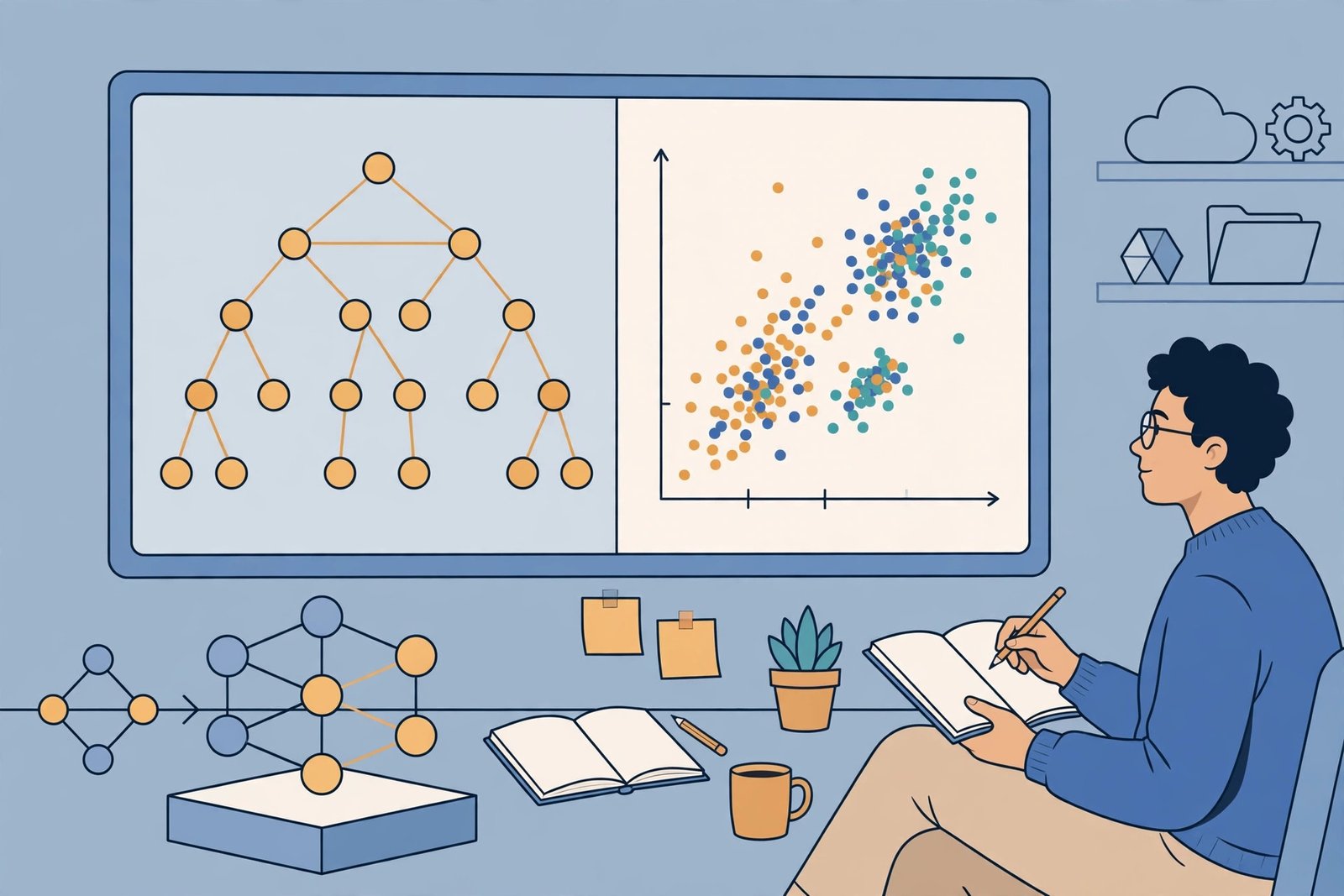
Linear regression is the best place to start. It is simple, it is easy to explain, and it teaches you the workflow that every model follows: prepare the data, train the model, test it, and check the errors. Logistic regression uses the same workflow for yes or no questions. Decision trees are easy to draw and explain, which makes them useful when you need to show a manager how a prediction was made. Random forests combine many trees to get a steadier result. Clustering is different because it needs no labels, and it is useful when you want to explore data rather than predict a specific answer.
Learn them with scikit-learn, the Python library that most beginners use. Its models share the same simple pattern, so once you learn one, the next takes half the time. Google's Machine Learning Crash Course is a free introduction that covers linear and logistic regression, classification, overfitting and neural networks, with exercises that run in your browser. You can start it on the Google Machine Learning Crash Course page.
Step 4: Learn how to test a model honestly
A model that is never tested properly is worse than no model at all, because it gives you false confidence. This step is short, and it is the most valuable one in the guide.
Always split your data. Keep most of it for training and hold back a smaller part for testing. Train the model on the training part only, then check it on the test part it has never seen. If the model scores well on training data but badly on test data, it has memorised the examples instead of learning the pattern. This is called overfitting, and it is the most common beginner error. The Medium essay by Harsh Arora on learning machine learning free makes the same point from experience: his first model looked great on paper and fell apart on new data, and that failure taught him more about evaluation than any lecture.
Learn three simple measures. Accuracy tells you how often the model is right, and it works well when the answers are balanced. Precision and recall tell you more when the answers are uneven, such as fraud detection where most transactions are honest. You do not need to master every measure now, but you do need to report test results honestly, including the cases where your model fails.
Step 5: Go deeper with deep learning
Deep learning uses neural networks, which are layers of simple calculations stacked together. They are powerful for images, sound and language, and they sit behind tools such as image search and chatbots. They are also the part of machine learning that beginners rush into too early.
Wait until you can build and test the four core models first. Then learn neural networks with a practical course. The free fast.ai course, Practical Deep Learning for Coders, takes a top-down approach: you train a working model in the first lesson and learn the theory as you go. Kaggle Learn also has a free introductory deep learning course that takes about four hours and uses TensorFlow and Keras.
Deep learning needs more computing power and more data than the core models, but Google Colab gives you free access to a graphics processor in your browser, which is enough for beginner projects. Start with one image project, such as sorting pictures of cats and dogs, because it teaches you the full workflow in a few hours.
Step 6: Build three portfolio projects
Projects are the proof of your skill. A certificate shows you finished a course. A project shows you can do the work. Build three, publish them on GitHub, and write a short README for each that explains the question, the data, the method, the result and what you would improve.
Project one: a regression project. Predict house prices, or taxi fares, from a public dataset. Show the data cleaning, the model, the test result and a chart of predicted prices against real prices. This shows the full basic workflow.
Project two: a classification project. Predict whether a customer will leave a service, or whether an email is spam. Show how you handled uneven data, which measures you used, and where the model makes mistakes. This shows honest evaluation.
Project three: a small deep learning or language project. Sort images into categories, or build a simple sentiment classifier for short reviews. This shows you can go beyond the basics.

Write up each project in plain language. Say what you tried, what failed and what you learned. One honest paragraph about a limitation is worth more than a page of claims. If you want to see how these skills fit into paid work, our guide on how to offer AI data analysis services shows the client side, and our guide on how to learn data analysis online covers the analysis skills that support every model.
Step 7: Choose a course or certificate
Free courses cover the whole beginner path, and many learners never pay for one. A paid certificate makes sense when you need structure, deadlines and a credential that a hiring manager recognises. Compare the main options before you pay.
| Course or programme | Cost | Time | Best for |
|---|---|---|---|
| Google Machine Learning Crash Course | Free | Self-paced, about 15 hours of material | A free, practical first course from Google |
| Kaggle Learn Intro to Machine Learning | Free | About 3 hours | Building your first models in an afternoon |
| Andrew Ng Machine Learning Specialization on Coursera | Free to audit, fee for a certificate | About 3 months at a steady pace | The most widely recommended introduction |
| fast.ai Practical Deep Learning for Coders | Free | Self-paced, about 9 lessons of 90 minutes each | Learning deep learning by building first |
| DeepLearning.AI short courses | Videos free, labs and certificates need a paid plan | Short, a few hours each | Going deeper on one topic at a time |
Andrew Ng's Machine Learning Specialization remains the most recommended starting point, and you can audit it free on Coursera and pay only if you want the certificate. Google's crash course is the best free alternative if you prefer short modules with exercises. Pick one main course and finish it before you start another. Collecting courses feels like progress, but only building is progress.
A 20 week study plan
This plan assumes 8 to 10 hours a week. If you have less time, stretch each stage rather than skipping it.
| Weeks | Focus | What you finish |
|---|---|---|
| 1 to 3 | Python and pandas | Python and pandas micro-courses, 10 small exercises |
| 4 | SQL basics | Introductory SQL course, 10 practice queries |
| 5 to 7 | Statistics alongside data | Averages, probability, correlation, first regression |
| 8 to 11 | Core models | Linear and logistic regression, trees, clustering |
| 12 to 13 | Testing and evaluation | Test splits, accuracy, precision and recall, one honest report |
| 14 to 16 | Deep learning basics | Introductory deep learning course, one image project |
| 17 to 20 | Three portfolio projects | Regression, classification and deep learning projects on GitHub |
Worked example, example only: these numbers are not typical results. Suppose you study 10 hours a week for 20 weeks. That is 200 hours in total. If you spend 40 hours on Python and data handling, 30 hours on statistics, 60 hours on models and testing, 30 hours on deep learning and 40 hours on projects, you will have three finished projects and a clear record of your skill. If you can only study 5 hours a week, the same plan takes about 40 weeks. The hours matter more than the calendar.
How to learn machine learning online: what it costs
You can learn machine learning for nothing. Google's crash course, Kaggle Learn, fast.ai and Google Colab are all free, and public datasets cost nothing. The only costs are your time and an internet connection. If you choose a paid certificate, expect to pay a monthly subscription on Coursera of about $49 a month, and check the course page for the current price before you enrol.
Expect a slow start. The first month is mostly Python and data cleaning, and it can feel as if you are not learning machine learning at all. That is normal. The models come in month two, and they make sense much faster once the foundations are in place. Most learners feel stuck around week eight, when the first model fails on test data. That failure is the lesson, not a sign to quit.
Expect no income at first. A certificate does not guarantee a job, and the market for junior machine learning roles is competitive. What turns study into work is a portfolio of three honest projects and the ability to explain them in plain language. Results vary with your background, your location, the time you put in and local demand. If you need paid work sooner, data analysis roles are more common at entry level, and machine learning skills make you stronger for them later.
Common mistakes to avoid
- Jumping to models before you can write Python, which leaves you copying code you do not understand.
- Watching course after course without building anything, which feels like progress but builds no skill.
- Front-loading months of maths before touching a dataset, which kills motivation.
- Testing a model on the data it trained on, which gives a flattering score that means nothing.
- Using only clean tutorial datasets, which teaches you nothing about messy real data.
- Chasing every new model and framework, when the fundamentals outlast every hype cycle.
- Learning in isolation, when a community or study partner would keep you going.
- Never publishing your work, which means nobody can see what you can do.
Risks and scams to watch for
Be careful with expensive bootcamps that promise a machine learning job. No course can guarantee employment, and some charge thousands of dollars for material that is free from Google, Kaggle and fast.ai. Check the refund policy, read independent reviews, and try the free material first. If a provider pressures you to sign up today, walk away.
Watch for courses that promise you will build advanced AI systems in a weekend. Real learning takes months, and anyone who says otherwise is selling a dream. Watch for fake job offers that ask you to pay for training or software before you start work. Real employers do not ask applicants for payment.
Protect your accounts. Use a strong password on learning platforms, and never share login details. When you publish projects, use public datasets only, and never upload personal data or data that belongs to an employer.
Frequently asked questions
Can I learn machine learning online?
Yes. Every core skill in machine learning can be learned online, from Python and statistics to model building and testing. Google's free crash course, Kaggle Learn and fast.ai cover the full beginner path, and paid certificates add structure. What matters is steady practice and finished projects.
Do I need maths to learn machine learning?
You need school level maths, including averages, probability and basic algebra, and you will learn more as you go. You do not need advanced maths on day one. Learn each idea when a project needs it, and use free visual explanations when a formula confuses you.
How long does it take to learn machine learning?
For a beginner studying 8 to 10 hours a week, expect about 3 to 6 months to build and test your first models with confidence, and 6 to 12 months to reach a level where you can apply for junior roles. The exact time depends on your starting point and your weekly hours.
Is machine learning hard to learn?
It is demanding because it combines programming, statistics and careful testing, but it is learnable in small steps. Most learners find the first month the hardest, because the foundations feel slow. Once the models start working, progress speeds up.
Should I learn data science or machine learning first?
Learn data science foundations first, because machine learning builds on them. Python, SQL, data cleaning and statistics come before models. If you already know those skills, you can start with machine learning directly.
Are machine learning certificates worth it?
Certificates help when they come from a recognised provider and sit next to real projects. They show that you finished a structured programme. On their own they rarely land a job, so pair any certificate with three portfolio projects that prove you can build and test models.
Conclusion
Learning how to learn machine learning online comes down to a simple order: Python and data handling first, statistics alongside real data, then the four core models, then honest testing, then three projects that prove you can do the work. Pick one course, follow the 20 week plan, and build something every week. Start today with a free Kaggle Learn course, and train your first model this week.
To keep building, read our guides on how to learn data science online, how to learn coding for beginners and how to learn AI prompt engineering online, and browse all our skill guides on the Digital Skills category page. Earning results vary; nothing on this site is financial advice.